


Buying guide
Best LED Face Masks 2026: An Honest Comparison of 8 Major Brands
How eight popular LED face masks compare on wavelengths, stated dose, schedule, FDA clearance and price, with the evidence graded and a cost-per-session calculator.
캐나다에서 디자인
VIP early accessBlack FridayThe weekend is hereBlack FridayLast callCyber Monday40% off sitewide, applied for you at checkout.Shop the sale미국과 캐나다 무료 배송60일 환불 보장가이드와 고객 지원은 영어로 제공
장바구니

1-Month Supply — 8 pairs (16 patches)
Explainer
Red light improved wrinkles, elasticity and collagen in small trials. What four trials actually measured, why sagging is a different problem, and what to try if sagging is your main concern.
Published by EVENSKYN, which makes and sells at-home beauty devices.

An evidence guide, 15 sources checked, updated 15 November 2026
Does red light therapy tighten loose skin? Partly, and less than the marketing says. Here is what four trials actually measured, why sagging is a different problem, and what to try if sagging is your main concern.

Six questions, six short answers
Does red light therapy tighten skin? Partly. In small trials it reduced wrinkles and raised elasticity and collagen; no controlled trial we found shows it lifting sagging skin.1,2
Does it help loose skin on the jaw or neck? The only one of the four trials that scored facial sagging had no control group and gives no figures in its abstract.3
How big were the changes? In a sham-controlled trial, wrinkles fell by up to 36 percent and elasticity rose by up to 19 percent from baseline.1
How long does it take? The trials ran 8 to 30 sessions, over one to about three and a half months; judge it at about three months.1,2
Which light? Red at about 630 to 660 nm, in some trials with near-infrared at 830 nm.1,3,4
What does more for sagging? Heat-based treatments. Clinic focused ultrasound has the most data for a lift; home radiofrequency has a randomised trial for wrinkles and skin thickness.5,6
Key takeaways
01Red and near-infrared light improved wrinkles, elasticity and collagen in small controlled trials, measured over one to about three and a half months.1,2,4
02Elasticity is not sagging. Of the four trials we read, only one scored sagging of the face, and it had no control group.3
03Changes were modest: the best result in the sham-controlled trial was 36 percent fewer wrinkles, not a lift.1
04Treatments with lifting data use heat: clinic focused ultrasound lifted the brow by 0.47 to 1.7 mm across 16 studies.5,7
05For fine lines, red light is a reasonable home option used for about three months; for sagging, look at heat-based treatments.1,6
Partly. Red light gave modest, measurable gains in wrinkles, elasticity and collagen in small trials. None of the controlled trials studied sagging of the jaw, jowls or neck. Here is what each one measured.
| Trial | Design | Light and course | What changed | Read with |
|---|---|---|---|---|
| Lee and colleagues, 2007 | Randomised, double-blinded, split-face, with a sham light; 76 people | 633 nm, 830 nm or both, twice a week for four weeks, then three months of follow-up | Wrinkles down by up to 36 percent and elasticity up by up to 19 percent from baseline; more collagen and elastic fibres on biopsy1 | Professional LED devices, not a home mask |
| Wunsch and Matuschka, 2014 | Randomised and controlled; 113 treated, 23 controls | 611 to 650 nm, or 570 to 850 nm, twice a week; 30 sessions | Better complexion and skin feel, less roughness and higher collagen density on ultrasound; blinded photo ratings better than controls2 | Full-body light units, not face masks; broadband was no better than red alone |
| Barolet and colleagues, 2009 | Single-blinded split-face study, plus a laboratory skin model | Pulsed 660 nm; 12 sessions | More than 90 percent had shallower wrinkles and smoother skin on profilometry; 87 percent improved on a blinded wrinkle score4 | The abstract does not give the number of people |
| Couturaud and colleagues, 2023 | One group of 20 women, no control | 630 nm home mask, 15.6 J/cm² per 12-minute session, twice a week for three months | Scored wrinkles, sagging of the facial oval, firmness, elasticity and dermal density; reports progressive improvement but gives no figures in the abstract3 | An author leads the lighting company named with the mask |

Red light therapy shines red light, often with invisible near-infrared, onto the skin from a mask, a panel or a handheld device. The trials above used 630 to 660 nm red light, and 830 nm for near-infrared.1,3,4
The working idea is photobiomodulation: light absorbed by skin cells is said to raise their energy production, cell signalling and growth-factor output and to lower oxidative stress.3 The trials measured its effects on the surface and in the dermis: wrinkles, roughness, elasticity and collagen.1,2 Most used professional light systems, and the studies of home LED devices are small.8
Trials reported better elasticity and more collagen, and marketing often turns that into tightening. Elasticity is how readily skin springs back after it is pulled. Sagging along the jaw or neck is a different measure, and only one of the four trials scored it.1,3
The one trial that scored sagging of the facial oval used a home mask in 20 women for three months, with no control group. Its abstract reports progressive improvement and changes lasting up to a month after stopping, but gives no figures.3
We also searched PubMed on 15 November 2026 for LED or red-light studies of facial laxity or sagging and found 87 records. One was a clinical study of a new micro-LED mask that reported less sagging than with a conventional mask; its abstract gives no group sizes, trial length or measurement method.9,10
The treatments with lifting data use heat. Clinic focused ultrasound heats tiny points above 60°C up to about 5 mm below the surface, and a review of 16 studies found brow lifts of 0.47 to 1.7 mm after a single treatment.5,7 Home radiofrequency warms the skin more gently, to 40 to 42°C in our Lumo+.11 In a randomised split-face trial, a home radiofrequency device improved wrinkles and skin thickness more than an anti-aging cosmetic, though it did not measure sagging.6
Wavelength. The trials used red at 630 to 660 nm, and near-infrared at 830 nm.1,3,4
Dose. Dose is light power multiplied by time, in J/cm². The 136-person trial normalised its red-range dose to about 9 J/cm², and the home mask study used 15.6 J/cm² in a 12-minute session, about 22 mW/cm² by our arithmetic.2,3 No trial we read compared doses head to head.
How often. The trials used two sessions a week.1,2,3 Masks on sale often ask for three to five; follow the maker. Our guide to LED masks for wrinkles and sagging compares them.
Three questions, answered from the trials on this page.
Will red light help your skin?
The answer draws only on the studies cited on this page.
Answer the questions to see what to expect.
Fine lines or rough texture. Red light is a reasonable home option, at least twice a week for about three months.1,2
Jowls, a softer jawline or neck laxity. Look at heat-based treatments, and see a clinic for a lift.5
Melasma or dark marks. Use red only and skip blue modes.12
Twice a week, or the maker's schedule. That is what the trials used.1,2
Clean, dry skin and covered eyes. Use the eye protection supplied.
Weeks 1 to 4. The shortest trial treated for four weeks and kept measuring for three months.1
Weeks 4 to 15. The longest trial ran 30 sessions, about 15 weeks at twice a week.2 Take photos in the same light every four weeks.
After you stop. In the home mask study, changes lasted up to a month after stopping.3
What the trials found. No adverse effects were reported in the 76-person trial, and no adverse events or downtime in the 660 nm study.1,4
Pigmentation. In an exposure study in volunteers with medium skin, 415 nm blue-violet light caused darkening that lasted up to three months, while 630 nm red light caused none. Darker skin was not tested.12
Eyes. Use the eye protection supplied. Near-infrared is invisible, so the absence of glare does not mean the absence of light.
Medicines and conditions. Our Mirage page asks anyone taking light-sensitising medicine, or with a light-sensitive condition such as lupus or porphyria, to speak to a doctor first, and to stop if redness or irritation persists.13
Pregnancy. We found no safety data for pregnancy in the sources we read; ask your doctor.
Our inference, not a tested method
Inference: red light is a reasonable choice for fine lines and texture; it is not the tool for sagging.
Untested hypothesis: twelve weeks of a red light mask does not change measured jawline sagging more than a sham mask.
What would prove it wrong: a randomised, sham-controlled trial of a red light mask reporting a measured change in sagging.
What we would do
Fine lines or texture? Use red light at least twice a week for about three months, then judge from photos.
Jowls, jawline or neck? Look past red light. For a visible lift, book a clinic consultation; for gradual firming at home, consider radiofrequency, with modest expectations.
Melasma or dark marks? Red only, no blue.
Our own LED masks are not on sale, so we do not recommend one. This is our choice for gradual firming at home. It is a seller's choice, not an independent test.

Our pick for firming at home, and yes, we make it
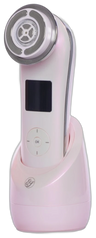
For the look of firmer skin along the jaw and neck and softer fine lines, in five-minute sessions. It warms the skin with radiofrequency and adds red and blue light, but it is not a face mask.
$179.98
What it will not do: light the whole face at once like a mask, lift like a clinic treatment, treat the eye area, or show results without a routine kept for months. With a pacemaker or a heart condition, ask your doctor first.11,14,15
Partly. In small trials it reduced wrinkles and raised elasticity and collagen. No controlled trial we found shows it lifting sagging skin, and the one study that scored facial sagging had no control group.
The trials measured modest gains in elasticity and collagen, not changes in looseness itself. For jowls, a softer jawline or neck laxity, we found no controlled evidence; heat-based treatments have more.
One study of a home mask in 20 women scored sagging of the facial oval and reported improvement, but it had no control group and its abstract gives no figures. We would not count on it for sagging.
The trials ran 8 to 30 sessions, mostly twice a week, over one to about three and a half months. Judge it at about three months, using photos taken in the same light.
The trials used red at 630 to 660 nm, and some added near-infrared at 830 nm. In one trial, broadband light did no better than red light alone.
Radiofrequency is a heat treatment and has a randomised home trial for wrinkles and skin thickness; red light has trials for wrinkles and elasticity. We found no trial comparing them directly.
The trials reported no adverse effects. Protect your eyes, skip blue modes if you have melasma, and ask a doctor first if you take a light-sensitising medicine or are pregnant.
No. The changes measured in the trials were in wrinkles, elasticity and collagen, not a lift.
How we built this page. On 15 November 2026 we read the PubMed records and abstracts of the studies cited, searched PubMed for LED studies of sagging, and read our own Lumo+, Mirage, duo and safety pages. This version replaces an earlier one at the same address. It removes a reviewer persona and a Medically Reviewed label, and corrects the earlier description of the 2023 mask study, which it had given as a randomised trial of 137 women with a 30 percent wrinkle figure; the published abstract describes one group of 20 women and gives no figures. It also drops funding claims we could not confirm from the abstracts, and adds a figure, a three-question check and a sagging evidence section.
Conflicts: we make LED masks (the Mirage, now sold out, and the Mirage Pro, not yet on sale) and the Lumo+ named here. EvenSkyn is a Canadian company that makes at-home beauty devices. No clinician reviewed this version. General information, not medical advice: talk to a dermatologist about your own skin.
Red light and LED
Buying guide
How eight popular LED face masks compare on wavelengths, stated dose, schedule, FDA clearance and price, with the evidence graded and a cost-per-session calculator.
Buying guide
Red and near-infrared light has trial evidence for fine wrinkles; sagging is harder. What the studies show, which masks match the trial light, and what to choose if sagging is your main...
Safety
The wavelength-by-wavelength, mode-by-mode, trimester-by-trimester answer to whether red light therapy is safe during pregnancy. Reviewed by Dr. Ismail Kimji, MD, FRCPC. Eighteen peer-reviewed sources. The Mirage Pro mode breakdown for pregnant readers,...


댓글 남기기
모든 댓글은 게시 전 검토됩니다.
이 사이트는 hCaptcha에 의해 보호되며, hCaptcha의 개인 정보 보호 정책 과 서비스 약관 이 적용됩니다.