Ultrasound Skin Tightening at Home: A 2026 Expert Guide
What clinic focused ultrasound actually does, what the studies of home ultrasound devices show, how to judge one before you buy, and why we would pick radiofrequency for firming at home.
Published
18 min read
Published by EVENSKYN, which makes and sells at-home beauty devices.
An evidence guide, 24 sources checked, updated 15 November 2026
Can a home device tighten skin with ultrasound? Here is what clinic focused ultrasound actually does, what the studies of home devices show, how to judge one before you buy, and what we would choose instead.
EvenSkyn Skin Science Desk. We make the Lumo+ radiofrequency device named near the end; the clinic devices discussed are made by other companies. No clinician reviewed this version.
Illustrative still life.
Six questions, six short answers
Does home ultrasound tighten skin? We found no trial of a home device that uses ultrasound on its own.1
Is it the same as Ultherapy or HIFU? No. Clinic focused ultrasound heats tiny points above 60°C at set depths. The one home trial we found used low-intensity ultrasound mixed with three other energies.2,3
Does the clinic version work? Yes, modestly. Across studies, one treatment lifted the brow by 0.47 to 1.7 mm.4
Is it safe? In clinics it mostly causes redness, swelling and pain. Burns and altered sensation are rare, and reports to the FDA most often describe fat loss, nerve problems and scarring.4,5
What has better evidence at home? Radiofrequency. In a randomised split-face trial over 12 weeks it improved wrinkles and skin thickness more than an anti-aging cosmetic.6
How do I judge a device? With the six-question check further down.
Key takeaways
01Ultrasound skin tightening, in the medical sense, is a clinic procedure: focused heat above 60°C in points smaller than a cubic millimetre, placed at set depths below the surface.2,7
02Clinic results are real but measured in millimetres, and patients report improvement far less often than investigators do.4
03We found no published trial of a home device using ultrasound on its own, and none of a home focused-ultrasound device.1
04The one home trial that included ultrasound combined it with light, radiofrequency and microcurrent, so the share owed to ultrasound is unknown.3
05For a visible lift, clinic focused ultrasound has the evidence. At home, radiofrequency has the better published record, with a randomised trial that improved wrinkles and skin thickness.4,6
What at-home ultrasound skin tightening actually is
Ultrasound is sound above the range of human hearing. It travels poorly through air, which is why every ultrasound device needs a gel or another coupling medium between the head and the skin. Medical ultrasound typically runs at 1 to 20 MHz.8
When doctors talk about ultrasound skin tightening, they mean focused ultrasound: energy brought to a point below the surface to heat it, so the tissue there contracts and rebuilds.2 Home devices that use the word ultrasound are a different category. The only trial of one we found described its ultrasound as low-intensity, and its abstract gives no focal depth.3
Why home ultrasound is everywhere now
The clinic procedure has a long record. The FDA's record for the Ulthera System includes a 510(k) clearance dated June 2014, and its maker describes its cleared uses as lifting the brow, the skin on the neck and under the chin, and improving lines and wrinkles on the décolletage.9,10 Home devices borrow that vocabulary. The words are the same; the physics, as the next section shows, is not.
What ultrasound does to skin: heat, focus and depth
Clinic focused ultrasound converges its energy on a point, the way a lens gathers light. There, tissue briefly passes 60°C and forms thermal coagulation points smaller than a cubic millimetre, up to about 5 mm deep, while the surface layers above are spared. The collagen in those points denatures, contracts and is then rebuilt.2
Lab work shows how precise this is. In skin samples from deceased donors, a prototype running at 7.5 MHz made confined lesions as deep as 4 mm, with their depth and size set by power, exposure time and focal depth.11 In faces from deceased donors, the same approach made heat zones in the SMAS, a layer of connective tissue under the skin of the face, as deep as 7.8 mm, without harming the surface.12
The deciding factor: focus and depth
Depth is what separates a lift from a warm massage. Clinic transducers are built for set depths: 3.0 and 4.5 mm in a 2010 brow-lift study, and 1.5, 3.0 and 4.5 mm in a 2026 case series.7,13 The abstract of the one trial of a home device with ultrasound gives no focal depth at all.3
Fig. 1 | Clinic focused ultrasound places its heat at set depths; the home trial's abstract gives none. Depth below the skin surface in millimetres. Dots mark the depths where heat was placed or the transducers were set; dashed lines run to the deepest point reported. Transducer depths from a 2026 case series7 and a 2010 brow-lift study;13 heated points in skin from deceased donors11 and as described in a 2015 review;2 heat zones in the SMAS of faces from deceased donors.12 The home device combined low-intensity ultrasound with three other energies; its abstract gives no focal depth.3 Drawn by us.
An earlier version of this page gave home devices working depths of 1 to 3 mm. We could not find a source for those figures and have removed them.
HIFU, MFU-V, sonic, sonophoresis: the terms decoded
Much of the confusion around home ultrasound is vocabulary. Here is what each term means.
Term
What it means
HIFU
High-intensity focused ultrasound. Energy converges on points below the surface to heat them; used in clinics for skin tightening and for body contouring.14,15
MFU and MFU-V
Microfocused ultrasound. The V adds real-time imaging, so the operator can see tissue layers to a depth of 8 mm before placing the heat. Ultherapy is the best-known device.2
Low-intensity ultrasound
Lower-power ultrasound without a stated focal point, the kind described in the home device trial we found.3
Sonic
Vibration at audible frequencies, as in sonic massage or cleansing. It is not ultrasound, which sits above the range of hearing.8
Sonophoresis
Using ultrasound to try to help a product into the skin, rather than to heat tissue.
What clinic ultrasound does, and when to choose it
The real evidence for ultrasound tightening comes from clinics. In a rater-blinded study of 35 people, three experts who were not authors judged 30 of them, 86 percent, to have a clinically significant brow lift 90 days after one treatment of the face and neck. The eyebrow rose by 1.7 mm on average.13
Systematic reviews agree on the direction and the size. One review of 16 studies, all in women, found brow lifts of 0.47 to 1.7 mm and a smaller area under the chin on side photographs. Investigators rated 92 percent of patients improved at day 90. In patients' own ratings the improvement was mild, and the share reporting it rose from 42 percent at 90 days to 53 percent at a year.4 A meta-analysis of 13 studies with 477 participants put the response rate at 77 percent at 90 days and 69 percent at 180, and another of 17 studies of focused ultrasound judged the improvement moderate.14,16
Fig. 2 | After one clinic treatment, investigators saw improvement far more often than patients did. Share of patients, in percent. Investigator ratings and patients' own ratings are pooled figures from a 2023 systematic review of 16 studies;4 responder and satisfaction rates, with their 95 percent intervals, come from a 2023 meta-analysis of 13 studies with 477 participants.16 All studies are of clinic microfocused ultrasound, not home devices. Drawn by us.
Who it suits. Mild to moderate laxity. The 2023 review lists marked laxity and a body mass index over 30 as relative reasons not to treat, because results fell as both rose.4
How it feels. Moderately painful. Pain averaged about 3 to 4 out of 10 in two meta-analyses, and studies have used numbing cream or nitrous oxide to manage it.13,14,16,17
How long it lasts. In the 2023 review, investigator-rated improvement held to one year after a single treatment; longer-term data were not available.4
What home ultrasound devices combine, and what the evidence says
The home device in the one trial we found combined four energies in one handset: low-level light, low-dose radiofrequency, low-energy microcurrent and low-intensity ultrasound.3 That design makes any result hard to credit to a single part.
In that trial, 36 Korean women used the device on one side of the face for 8 weeks, in a randomised split-face design. Hydration, elasticity, roughness, pore size and eye wrinkle volume improved against baseline and the control side; skin tissue studies, including biopsies after use, showed more type I collagen and less MMP-1, an enzyme that breaks collagen down; and no adverse effects were seen.3 It is encouraging for that device. It cannot tell you what the ultrasound did on its own.
We searched PubMed on 15 November 2026 for studies of home-use ultrasound on skin and found 15 records, with this as the only trial of a home device that included ultrasound. A second search for home-use focused ultrasound or HIFU found no trial of a home device at all.1
Some vibrating devices are sonic rather than ultrasonic. A 2010 study of a sonic infusion system used with an anti-aging serum reported better-looking lines around the eyes straight after one 30-second treatment per eye.18 That was an immediate effect; the abstract reports no later follow-up.
Clinic focused ultrasound, home ultrasound and home radiofrequency compared
The same word covers very different tools. This table lines them up on what is actually known.
Option
How it works
Depth
Best evidence we found
Where it fits
Clinic MFU-V, such as Ultherapy
Focused heat points above 60°C, placed with imaging2
Reviews and meta-analyses; brow lifts of 0.47 to 1.7 mm4,16
Mild to moderate laxity; a clinic procedure
Other clinic HIFU
Focused heat points
Set by the transducer
A meta-analysis of 17 studies found moderate improvement14
As above
Home device with low-intensity ultrasound
Ultrasound without a stated focus, in the one trial combined with three other energies3
None given in its abstract
One 8-week randomised split-face trial of a four-energy device3
Hydration and texture, not a lift
Home radiofrequency
Heat from radiofrequency current; our Lumo+ holds the skin at 40 to 42°C19
No focal depth
A randomised split-face trial over 12 weeks and an open-label 8-week trial6,20
Fine lines and the look of firmness at home, as upkeep
How to judge an at-home ultrasound device
Six questions for any home ultrasound device. Answer them from the maker's own page and manual; “not stated” is a question to put to the maker before you buy.
Six questions for any home ultrasound device
Answer for the device you are weighing. The result counts what it meets and lists the gaps.
Answer the six questions to see how a device measures up.
Which route fits you
A visible lift of the brow, jawline or neck. A consultation for clinic focused ultrasound, which has the trials; with marked laxity, a surgeon.4
Firmness and fine lines, kept up at home. A radiofrequency device used to its schedule.6
Hydration and texture. Skincare first. A multi-energy home device is a reasonable extra, with modest expectations.3
Safety: what is normal, what is not, and who should skip it
After clinic focused ultrasound. Temporary redness and swelling, and pain during treatment, are common. Numbness or altered sensation, bruising, stinging, burns and striations are rare.4 Serious events, including blistering, ulceration, thinning of the skin or the tissue beneath it, and skin necrosis, have been reported after single sessions, and a review of reports to the FDA's device database found fat loss, nerve problems and scarring most often.5,21 One case report describes an acute cataract three days after a focused ultrasound facial procedure, which the authors suspect was linked to inappropriate use.22
Using a home device safely
Follow the maker's schedule and list of who should not use it. If a device has neither, do not use it.
Use a gel or another coupling medium; ultrasound travels poorly through air.8
Keep it away from the eyes, and follow the maker's limits for the area around them.
Stop and see a doctor for blistering, numbness that lasts, a burn or any change in vision.
With a pacemaker or a heart condition, check with your physician before using an electrical or radiofrequency device.23
Our recommendation
Our inference, not a tested method
Clinic tightening depends on focused heat above 60°C at set depths.2
The only home trial with ultrasound used a low-intensity, four-energy device, and its abstract gives no focal depth.3
We found no trial of home ultrasound alone, and none of a home focused-ultrasound device.1
Home radiofrequency improved wrinkles and skin thickness more than an anti-aging cosmetic in a randomised split-face trial.6
Inference: for home use, radiofrequency has better published support than ultrasound; for a visible lift, clinic focused ultrasound is the option with evidence.
Untested hypothesis: a home device using low-intensity ultrasound on its own does not change measured laxity at 12 weeks more than a sham device.
What would prove it wrong: a randomised, sham-controlled trial of a home ultrasound device used on its own, showing measurable tightening.
What we would do
Want a visible lift? Book a consultation for clinic focused ultrasound, and ask about pain control.
Want firming at home? Use radiofrequency, kept to its schedule. That is why our pick below is a radiofrequency device, not an ultrasound one.
Weighing a home ultrasound device? Run it through the six questions, expect hydration and texture at most, and skip anything sold as home HIFU.
Marked laxity on the jaw or neck? See a dermatologist or surgeon. No home device is a facelift.
Our pick for home firming, and what it will not do
This is our choice for firming at home. It is a seller's choice, not an independent test.
Our pick for home firming, and yes, we make it
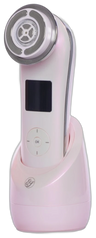
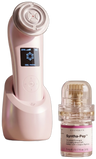
EvenSkyn Lumo+ radiofrequency, EMS and light in one handset
For the look of firmer skin along the jaw and neck and softer fine lines, in five-minute sessions. It uses radiofrequency, not ultrasound.
The heatBipolar radiofrequency at 1 MHz: a brief warm-up, then a steady 40 to 42°C.
The currentEMS at 3 to 15 mA, strong enough to make facial muscles contract.
The lightRed at 623 nm and blue at 465 nm, plus ion cleansing and iontophoresis modes for water-based products.
The routineFive-minute sessions, two to three times a week, with a water-based conduction gel; under 25 minutes of radiofrequency a week.
StatusA cosmetic device, not a medical device, and not FDA-cleared.
$179.98
2-year warranty and a 60-day money-back guarantee.
What it will not do: match a clinic focused-ultrasound treatment, lift the brow like one, treat the eye area, or show results without a routine kept for months. With a pacemaker or a heart condition, ask your doctor first.19,23,24
Frequently asked questions
Does at-home ultrasound skin tightening work?
We found no trial of a home device that uses ultrasound on its own. The one trial of a home device that includes ultrasound combined it with light, radiofrequency and microcurrent, and improved hydration, elasticity and texture over 8 weeks. Tightening in the medical sense comes from focused ultrasound in a clinic.
Is at-home ultrasound the same as Ultherapy or HIFU?
No. Clinic focused ultrasound heats tiny points above 60°C at set depths, with imaging in the case of Ultherapy. The home device trial we found used low-intensity ultrasound, and its abstract gives no focal depth.
What is the best at-home ultrasound device for the face?
We cannot name one with published evidence for ultrasound on its own. Judge any device on six points: a stated frequency and power, no clinic promises, not sold as home HIFU, a published trial, a coupling gel, and a list of who should not use it. If firming is the goal, radiofrequency has randomised home trials.
Is at-home HIFU safe?
We found no published trial of a home focused-ultrasound device. Even in clinics, focused ultrasound has occasionally caused burns, nerve problems and fat loss, and one cataract was reported after a facial procedure, so we would not use a home device sold as HIFU.
Does clinic ultrasound skin tightening need numbing?
Usually some pain control is used. In two meta-analyses pain averaged about 3 to 4 out of 10, and studies have used numbing cream or nitrous oxide.
How long do clinic ultrasound results last?
In a 2023 review, investigator-rated improvement after one treatment held to one year. Longer-term data were not available.
Do I need gel with an ultrasound device?
Yes. Ultrasound travels poorly through air, so a gel or another coupling medium has to sit between the device and the skin.
How much does clinic ultrasound lift the brow?
In a 2023 review of 16 studies, single treatments lifted the brow by 0.47 to 1.7 mm. In one rater-blinded study the average was 1.7 mm at 90 days.
How we built this page. On 15 November 2026 we read the PubMed records and abstracts of every study cited, the FDA's 510(k) record for the Ulthera System, its maker's description of the cleared uses, the StatPearls chapter on ultrasound physics, and our own Lumo+, duo and safety pages. We searched PubMed for trials of home ultrasound devices and report what we found. This version replaces an earlier one at the same address. It no longer builds the guide around one of our own devices, because we found no published trial of home ultrasound on its own. It removes a reviewer persona, working depths for home devices that we could not source, clinic prices, a market-size figure, a microcurrent energy claim and an overstatement about an FDA safety communication, and adds two figures, a comparison table and a six-question check.
Conflicts: we make the Lumo+ named here, along with other at-home beauty devices. EvenSkyn is a Canadian company that makes at-home beauty devices. No clinician reviewed this version. General information, not medical advice: talk to a dermatologist about your own skin.
References
PubMed. Two searches run 15 November 2026: ultrasound or ultrasonic with home-use terms and skin or wrinkle terms (15 records; one trial of a home device that included ultrasound, combined with three other energies); and focused ultrasound or HIFU with home-use terms and skin or face (one record, a clinic study). pubmed.ncbi.nlm.nih.gov
Fabi SG. Noninvasive skin tightening: focus on new ultrasound techniques. Clinical, Cosmetic and Investigational Dermatology. 2015;8:47-52. doi:10.2147/CCID.S69118. PubMed 25709486. Abstract read.
Choi S, Kim J, Lee YI, Lee SG, Jung I, Suk J, et al. Efficacy and safety of a home-use handheld multi-energy-based device for skin rejuvenation: clinical, ex vivo, and histological studies. Lasers in Medical Science. 2024;39(1):38. doi:10.1007/s10103-024-03982-8. PubMed 38236440. Abstract read.
Contini M, Hollander MHJ, Vissink A, Schepers RH, Jansma J, et al. A systematic review of the efficacy of microfocused ultrasound for facial skin tightening. International Journal of Environmental Research and Public Health. 2023;20(2):1522. doi:10.3390/ijerph20021522. PubMed 36674277. Abstract read; the authors declare no conflict of interest.
Humphrey VS, Rambhia PH, Gmyrek R, Chapas A. Microfocused ultrasound with visualization: a systematic review of adverse events and risk of subsequent facelift compromise. Dermatologic Surgery. 2025;51(4):424-429. doi:10.1097/DSS.0000000000004510. PubMed 39625163. Abstract read.
Shu X, Wan R, Huo W, Li Z, Zou L, Tang Y, Li L, Wang X. Effectiveness of a radiofrequency device for rejuvenation of aged skin at home: a randomized split-face clinical trial. Dermatology and Therapy. 2022;12(4):871-883. doi:10.1007/s13555-022-00697-y. PubMed 35249173. Abstract read.
Heitzmann W, Schiefer JL, Lanckohr L, Visnovska D, Schulz A, et al. First clinical experiences with microfocused ultrasound in infraorbital rejuvenation: a clinically and scientifically grounded perspective. Facial Plastic Surgery. 2026;42(3):367-376. doi:10.1055/a-2666-5719. PubMed 40763772. Abstract read.
Ultrasound physics and instrumentation. StatPearls. Treasure Island (FL): StatPearls Publishing; updated 27 March 2023; read 15 November 2026. NCBI Bookshelf NBK570593
US Food and Drug Administration. 510(k) premarket notification K134032, Ulthera System (Ulthera, Inc.): decision 20 June 2014, regulation 878.4590, product code OHV. Read 15 November 2026. accessdata.fda.gov
Merz Aesthetics. Ultherapy for physicians: FDA-cleared indications (brow, neck, under the chin, décolletage). Read 15 November 2026. ultherapy.com
Laubach HJ, Makin IRS, Barthe PG, Slayton MH, Manstein D. Intense focused ultrasound: evaluation of a new treatment modality for precise microcoagulation within the skin. Dermatologic Surgery. 2008;34(5):727-734. doi:10.1111/j.1524-4725.2008.34196.x. PubMed 18429926. Abstract read.
White WM, Makin IRS, Barthe PG, Slayton MH, Gliklich RE. Selective creation of thermal injury zones in the superficial musculoaponeurotic system using intense ultrasound therapy: a new target for noninvasive facial rejuvenation. Archives of Facial Plastic Surgery. 2007;9(1):22-29. doi:10.1001/archfaci.9.1.22. PubMed 17224484. Abstract read.
Alam M, White LE, Martin N, Witherspoon J, Yoo S, West DP. Ultrasound tightening of facial and neck skin: a rater-blinded prospective cohort study. Journal of the American Academy of Dermatology. 2010;62(2):262-269. doi:10.1016/j.jaad.2009.06.039. PubMed 20115948. Abstract read.
Ayatollahi A, Gholami J, Saberi M, Hosseini H, Firooz A. Systematic review and meta-analysis of safety and efficacy of high-intensity focused ultrasound (HIFU) for face and neck rejuvenation. Lasers in Medical Science. 2020;35(5):1007-1024. doi:10.1007/s10103-020-02957-9. PubMed 32026164. Abstract read.
Haykal D, Sattler S, Verner I, Madhumita M, Cartier H. A systematic review of high-intensity focused ultrasound in skin tightening and body contouring. Aesthetic Surgery Journal. 2025;45(7):690-698. doi:10.1093/asj/sjaf053. PubMed 40184185. Abstract read.
Ling J, Zhao H. A systematic review and meta-analysis of the clinical efficacy and patients’ satisfaction of micro-focused ultrasound (MFU) treatment for facial rejuvenation and tightening. Aesthetic Plastic Surgery. 2023;47(5):1806-1823. doi:10.1007/s00266-023-03384-1. PubMed 37198297. Abstract read.
Tran J, Lultschik S, Sapra S, Dong K. Prospective, single-arm, split-face pain management evaluation of nitrous oxide system during micro-focused ultrasound with visualization. Journal of Drugs in Dermatology. 2022;21(11):1228-1234. doi:10.36849/JDD.7030. PubMed 36342737. Abstract read.
Shah S, Alster TS. Clinical efficacy of a novel sonic infusion system for periorbital rhytides. Journal of Drugs in Dermatology. 2010;9(9):1121-1124. PubMed 20865845. Abstract read.
EvenSkyn. Lumo+ product page: radiofrequency, EMS and LED specifications, sessions, suitability, warranty and guarantee. evenskyn.com. Read 15 November 2026.
Ai X, Chen L, Lan Y, Liu B, Song P, Wang J, Zhang Z, et al. Efficacy and safety of a noninvasive, home-based radiofrequency device for facial rejuvenation: an open-label, intraindividual controlled trial. Journal of Cosmetic Dermatology. 2024;23(3):862-868. doi:10.1111/jocd.16076. PubMed 37942722. Abstract read.
Friedmann DP, Bourgeois GP, Chan HHL, Zedlitz AC, Butterwick KJ. Complications from microfocused transcutaneous ultrasound: case series and review of the literature. Lasers in Surgery and Medicine. 2018;50(1):13-19. doi:10.1002/lsm.22768. PubMed 29154457. Abstract read.
Makibara RN, de Oliveira LP, Rocha MDA, et al. Unilateral acute cataract after facial aesthetic procedure: a case report. Arquivos Brasileiros de Oftalmologia. 2024;88(2):e20230248. doi:10.5935/0004-2749.2023-0248. PubMed 39319911. Abstract read.
EvenSkyn. Micro-infusion contraindications and safety. evenskyn.com. Updated 15 November 2026.
EvenSkyn. Lumo+ and MicroInfuser duo product page: box contents, sequence, regulatory status, guarantee and warranty. evenskyn.com. Read 15 November 2026.
Can you do Ultherapy at home? No home device performs it. What clinic focused ultrasound does, what the trials show for home radiofrequency, how the costs compare over time, and how to...





Deixar comentário
Os comentários precisam ser aprovados antes da publicação.
Este site é protegido por hCaptcha e a Política de privacidade e os Termos de serviço do hCaptcha se aplicam.