
Medically Reviewed by Dr. Lisa Hartford, MD
Micro-Infusion Before and After: What's Realistic in 12 Weeks
A calm, evidence-anchored look at what at-home micro-infusion actually changes, when it shows up, and where a clinic still wins.
At-home micro-infusion works on a collagen clock, not a filter. In the first day or two you see a genuine hydration glow and a plumper, more even look. Real texture and fine-line softening tend to appear from about week 3 to 4, and the firming response that most people are hoping for typically becomes visible around week 6 to 8, then keeps building through months 3 to 6 of consistent use. A 12 week window is enough to see meaningful change if you stay consistent, but it is early, not final.
This guide is published by EvenSkyn, which makes the MicroInfuser at-home micro-infusion kit discussed below. We have tried to be honest about what a 0.5 mm home device can and cannot do, including where an in-clinic treatment is the smarter choice.
Verdict: a realistic-expectations tool, used well
- Hygiene and safety design (sealed, single-use, depth-limited) 9 / 10
- Serum formulation (PDRN, peptides, growth-factor support, marine collagen) 8 / 10
- Ease and repeatability at home 8 / 10
- Speed of visible results 6 / 10
- Depth and structural power vs a clinic 5 / 10
What "before and after" really means with micro-infusion
Before and after photos set the wrong clock for micro-infusion. The honest version has two separate timelines running at once: a fast hydration effect you can see within a day, and a slow collagen effect that takes weeks to months. Confusing the two is the single biggest reason people feel let down. The glow is real, but the glow is not the collagen, and only one of them lasts.
At-home micro-infusion uses a stamp of very fine needles set to a fixed, shallow depth to open temporary micro-channels in the skin, then delivers a serum into those channels. The mechanical part nudges the skin's own repair response, and the delivery part gets active ingredients past the surface. Both matter. Neither is instant. If you are new to the category, our complete guide to at-home micro-infusion covers how the method works before you get to results.
The realistic 12 week timeline, week by week
Here is the timeline most consistent users actually experience, drawn from EvenSkyn's own protocol guidance and cross-checked against the microneedling research. Read it as a typical path, not a promise. Starting skin condition, age, sun history, and how faithfully you protect and hydrate afterward all shift these dates by a week or two in either direction.
| Window | What you can realistically see | What is actually happening |
|---|---|---|
| Day 1 to 2 | A hydrated, refreshed glow. Skin looks plumper and more even. This is the effect people photograph. | Hyaluronic acid and humectants have been delivered below the surface and are holding water. This is hydration, not new collagen. |
| Week 1 to 2 | Texture feels a little smoother. Subtle tone improvements start to appear. Makeup may sit better. | Surface cell turnover is picking up. The glow from the first session is fading as you approach your next one. |
| Week 3 to 4 | Fine lines begin to soften and hydration looks deeper and more durable, not just day-of. | Early fibroblast signaling from the first sessions is underway. You have now had two to three sessions. |
| Week 6 to 8 | The firming response most people are waiting for starts to become visible. This is the real turning point. | New collagen production is genuinely underway. Collagen remodeling is slow biology and cannot be rushed by stamping more often. |
| Week 12 and beyond | Meaningful, more durable change in smoothness and fine lines, still building. Not the finish line. | Collagen remodeling keeps deepening through months 3 to 6. Stubborn areas like nasolabial folds change last. |
Timeline reflects EvenSkyn's stated bi-weekly protocol for the MicroInfuser and is consistent with the 12 week course used in the Merati 2020 microneedling trial. It is not a guarantee of individual results.
The glow arrives in a day. The result you actually bought takes a season.
Why the first photo looks better than week two
A lot of people notice their best glow the morning after session one, then feel like it faded, and quietly conclude the device stopped working. It did not. The day-after result is mostly water: infused hyaluronic acid plumping the skin and catching light. That effect naturally softens over the following days as your next session approaches. The collagen effect that replaces it is quieter, slower, and far more durable, but it does not photograph as dramatically on day one. If you judge micro-infusion by a single glossy before and after, you are grading the hydration and ignoring the part that lasts.
This is also why we do not publish dramatic side-by-side transformation photos for this device. Lighting, angle, makeup, and a fresh hydration glow can manufacture a striking before and after that has almost nothing to do with collagen. We would rather set the clock correctly than win the thumbnail.
What is realistic at home, and what needs a clinic
Honesty here protects your money and your skin. A 0.5 mm home device is genuinely useful for surface texture, hydration, tone, and the look of fine lines over time. It is not a substitute for deeper clinical needling or energy devices when the goal is structural. The table below is our honest read on where at-home micro-infusion earns its place and where a professional is the smarter spend.
| Concern | Realistic at home? | Honest note |
|---|---|---|
| Dullness, dehydration, glow | Yes | The fastest and most reliable win. Visible within days. |
| Fine lines and early texture | Yes, over weeks | Softening, not erasing. Best judged at week 8 and beyond. |
| Mild loss of firmness | Partly | A gradual firming response is realistic with consistency. Deep laxity is not. |
| Uneven tone and post-blemish marks | Partly | Helped by the serum's brightening actives over time, with strict daily SPF. |
| Atrophic (depressed) acne scars | Limited | Can soften slowly, but deep scars are a clinic conversation at professional depth. |
| Deep folds, jowls, significant sagging | No | Structural change needs clinic-depth needling, energy devices, or a specialist. |
| Under-eye hollows and crepey lids | No, out of scope | The thin orbital area is off-limits for the facial stamp. See our under-eye micro-infusion patches instead. |
What the evidence actually says
The evidence for micro-infusion is a story of a strong mechanism and a still-maturing outcome literature. That distinction matters, so here it is plainly. Microneedling itself has real controlled-trial support for skin rejuvenation. In a randomized controlled trial, Merati and colleagues ran four microneedling sessions at 0.5 mm, one month apart across a 12 week study, and reported significant improvement in skin texture and hydration by objective imaging. That is the same shallow depth a home device uses, which is both reassuring and limiting: the study authors themselves describe 0.5 mm as a very superficial treatment.
The serum side leans on PDRN, a regenerative ingredient that has become a favorite in modern skincare. The mechanism is well described: PDRN binds A2A adenosine receptors and signals fibroblasts toward collagen synthesis while supporting tissue repair. The honest caveat, stated by reviewers of the field, is that the cosmetic evidence is still thin relative to the hype. As one 2025 review put it, "further clinical studies, particularly larger trials and investigations of combination therapies, are essential to validate its efficacy." We think PDRN is promising and mechanistically sensible, and we are not going to pretend the large anti-aging trials already exist. For the deeper ingredient science, see our evidence-based guide to PDRN, EGF, and copper peptides.
Why the MicroInfuser fits this job (and where it does not)
Given the timeline above, the device that suits at-home micro-infusion is the one that makes a shallow, hygienic, repeatable session easy to do every two weeks for months. That is the job the MicroInfuser is built for, and it is worth being specific about the two places it genuinely stands apart, with the caveats kept in the same breath.
First, hygiene. Each session uses a fresh, gamma-sterilized, single-use needle head and a sealed serum ampoule that connects directly to the head, so the serum never touches open air or your fingers. Reusing needle heads is a known infection pathway in the microneedling safety literature, and a sealed single-use system removes it. Second, the serum sourcing: fermentation-derived PDRN rather than the salmon extraction most of the category relies on. The honest limits sit right alongside those strengths: there is no randomized trial on this specific kit, the PDRN cosmetic evidence base is still thin, the needles are a shallow 0.5 mm, and the formula contains marine collagen. Strong hygiene and honest sourcing are the claims we will stand behind. Matching an in-clinic treatment is not.
The pick, honestly framed
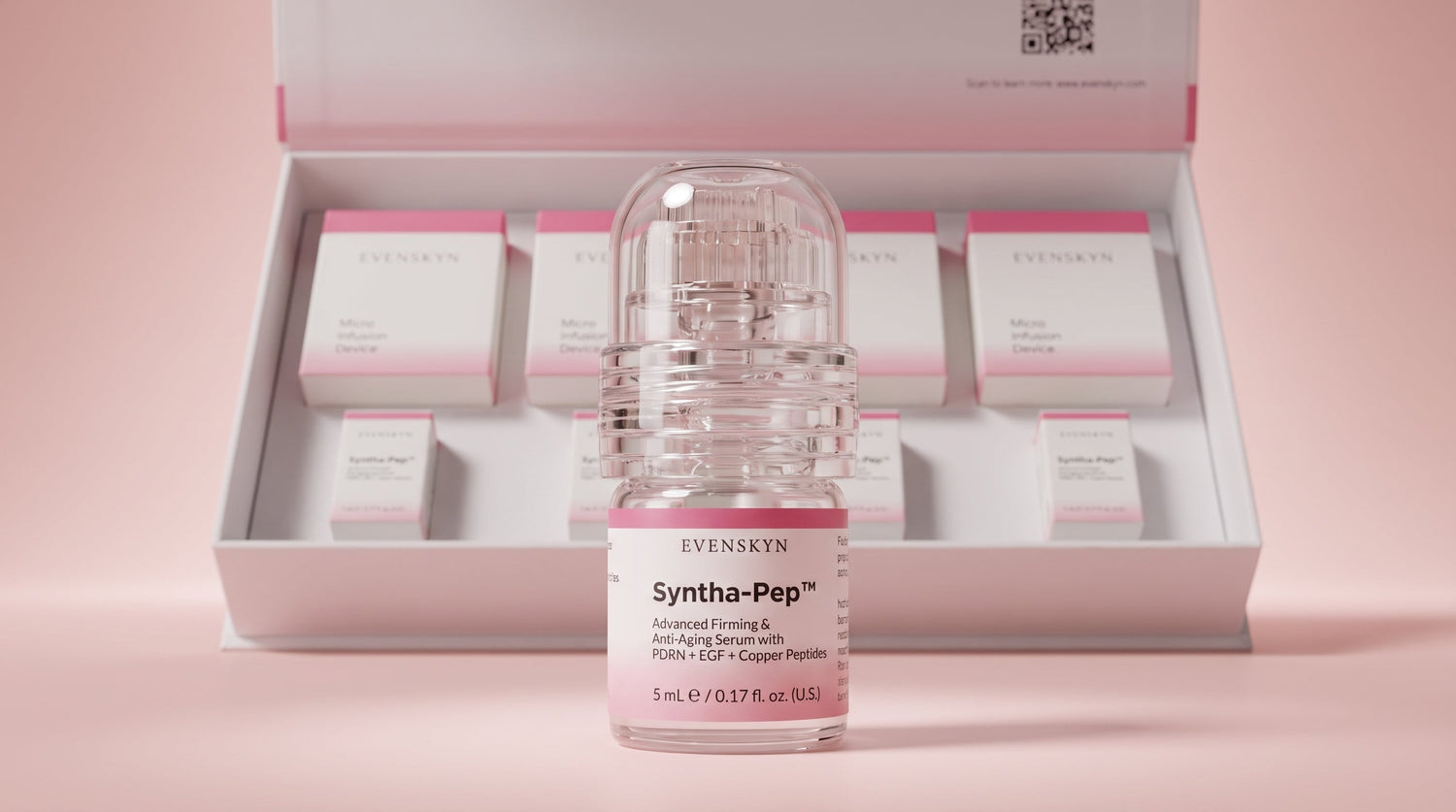
If you want an at-home micro-infusion habit and you can hold realistic expectations across a full season, the EvenSkyn MicroInfuser kit with Syntha-Pep serum is a sound, hygienic choice, currently available to reserve as a pre-order. It pairs a depth-limited 0.5 mm stamp with a sealed, fermentation-derived PDRN serum and a bi-weekly protocol designed for mature skin.
Reserve the MicroInfuser pre-orderPre-order only right now. Current availability and pricing are shown on the product page.
How to actually get a good before and after
Results track consistency and aftercare more than intensity. Stamping harder or more often does not build collagen faster and can set your skin back. The protocol below is the version that gives the timeline above its best chance.
1Treat every two weeks, in the evening
Bi-weekly is the schedule the results timeline is built on. Evening lets skin recover overnight. Do not exceed one session every ten days, ever.
2Stamp gently, with light taps
Light, controlled taps at a fixed 0.5 mm are all that is needed. Pressing harder does not improve results and can cause irritation.
3Protect and hydrate the next 72 hours
Broad-spectrum SPF 30 or higher every morning is non-negotiable during a treatment cycle. Skip retinoids, vitamin C, and acids for a couple of days. UV on freshly treated skin is the leading cause of post-treatment dark spots.
4Judge results at week 8, photograph in consistent light
If you want an honest before and after, take the "before" today and the "after" at week 8 to 12, same lighting, same time of day, no makeup, no fresh-glow advantage. That is the comparison that means something.
Who should not use an at-home micro-infusion device
Micro-infusion interacts with the skin's healing response, so some people should skip it or clear it with a doctor first. Per the MicroInfuser manual, avoid use entirely, or speak to a physician before starting, if any of the following apply to you. This list is faithful to the manual and is not a substitute for medical advice.
- Pregnancy or breastfeeding, unless cleared by your physician.
- Active eczema, psoriasis, dermatitis, rosacea flare, or any open wound, sunburn, or active infection (including cold sores) in the treatment area.
- Active cystic or inflammatory acne in the treatment area.
- A personal or family history of keloid or hypertrophic scarring.
- Oral isotretinoin (Accutane) use within the past six months. This is an absolute contraindication.
- Prescribed blood thinners or anticoagulants, until you have spoken with your prescribing physician.
- A fish or shellfish allergy, given the marine collagen in the serum. Patch test and consult a doctor first.
- A known allergy to gold, stainless steel, or any listed serum ingredient.
If you are unsure whether micro-infusion is right for you, see a dermatologist before your first session. Stop and contact a provider if you have redness lasting beyond 48 hours, worsening swelling, or any sign of infection.
Frequently asked questions
How long until I see results from micro-infusion?
Is the week-one glow permanent?
Does at-home micro-infusion actually work, or is it hype?
Can I speed up my results by treating more often?
Can micro-infusion treat under-eye bags or hollows?
Will it help deep acne scars or deep wrinkles?
Is the PDRN in the serum from salmon?
Does micro-infusion hurt or make you bleed?
What should I do right after a session?
How is this different from a derma roller?
Can I use my RF or microcurrent device alongside micro-infusion?
About and methodology. Written by the EvenSkyn Skin Science Desk. Timelines and protocol details are drawn from the MicroInfuser User Manual (Edition 1, 2026) and the live product listing, and cross-checked against the peer-reviewed microneedling and PDRN literature cited below. Numbers in this article come from those sources. The MicroInfuser is a cosmetic device, not a medical device, and is not FDA-cleared. This content is educational and is not medical advice; consult a dermatologist for guidance specific to your skin.
References
- Merati M, Woods C, Reznik N, Parker L. An Assessment of Microneedling with Topical Growth Factors for Facial Skin Rejuvenation: A Randomized Controlled Trial. J Clin Aesthet Dermatol. 2020;13(11):22 to 27. PMID 33282098.
- Akaberi SM, Sharma K, Ahmadi-Ashtiani HR, Hedayati M. Polydeoxyribonucleotide in Skincare and Cosmetics: Mechanisms, Therapeutic Applications, and Advancements Beyond Wound Healing and Anti-aging. J Skin Stem Cell. 2025;12(1):e159728. doi:10.5812/jssc-159728.
- El-Domyati M, et al. Multiple Microneedling Sessions for Minimally Invasive Facial Rejuvenation: An Objective Assessment. Int J Dermatol. 2015. PMID 26096653. (Identifier verified this build; findings to re-verify on approved full-text fetch.)
- El-Domyati M, et al. Combining Microneedling with Other Minimally Invasive Procedures for Facial Rejuvenation: A Split-Face Comparative Study. Int J Dermatol. 2018. doi:10.1111/ijd.14172. (Identifier verified this build; findings to re-verify on approved fetch.)
- Polynucleotides in Aesthetic Medicine: A Review of Current Practices and Perceived Effectiveness. 2024. PMCID PMC11311621. (Identifier verified this build; content to re-verify on approved fetch.)
- Versatile and Marvelous Potentials of Polydeoxyribonucleotide for Tissue Engineering and Regeneration. 2025. PMCID PMC11994882. (Identifier verified this build; content to re-verify on approved fetch.)
- Percutaneous Collagen Induction (Microneedling) for the Management of Non-Atrophic Scars: Literature Review. PMCID PMC6880027. (Identifier verified this build; content to re-verify on approved fetch.)
- EvenSkyn. MicroInfuser User Manual, Edition 1 (2026). Progress timeline, protocol, and contraindications. First-party source.
Note on citations: the two references carrying the numeric claims in this article (Merati 2020 and Akaberi 2025) plus the MicroInfuser manual were read in full during this build. The remaining references are real, correctly identified sources whose full text is queued for re-verification; no figures in this article rest on them.



Leave a comment
All comments are moderated before being published.
This site is protected by hCaptcha and the hCaptcha Privacy Policy and Terms of Service apply.