



Medically Reviewed by Dr. Lisa Hartford, MD
Salmon PDRN vs Bioengineered PDRN: What the Evidence Actually Shows in 2026
PDRN is the most discussed regenerative skincare term of the year, and almost all of its search interest is built on the word "salmon." This guide separates what the primary literature supports from what marketing implies, compares salmon-derived and bioengineered (fermentation) PDRN at their true evidence class, and explains why, for at-home use, the source of the molecule matters less than how it reaches the skin.
Key takeaways
- PDRN is a DNA-fragment compound that acts mainly by engaging the adenosine A2A receptor. This is a mechanism-level finding repeated across independent groups. (Evidence: Mechanism)
- The strongest human PDRN data come from injected, clinic-administered use in wound, ulcer, scar, and tendon contexts, not from topical cosmetic anti-aging. (Evidence: Human outcome)
- Bioengineered PDRN, made by plant tissue culture or microbial fermentation rather than salmon, activates the same receptor in cell and reconstructed-skin models, but its evidence base is preclinical and several reports are authored by ingredient manufacturers. (Evidence: Lab/animal)
- For at-home use, the limiting step is delivery across the skin barrier, not the species the DNA came from.
- If structural change is the goal, a clinician-delivered option can be the better route, and that is stated plainly below before any product appears.
At a glance, with evidence grades
Is bioengineered PDRN as good as salmon PDRN? At a mechanism level the two appear to act through the same receptor pathway. (Evidence: Mechanism) On documented human results, salmon-sourced PDRN carries the larger record, although that record is built on injection in medical contexts rather than topical cosmetic use. (Evidence: Human outcome) For bioengineered PDRN the supportive data are currently in vitro and in reconstructed-skin models. (Evidence: Lab/animal) The practical reading is that for a topical or at-home routine the decisive variable is whether the molecule is delivered past the stratum corneum at all, which is a delivery question rather than a sourcing question.
How EvenSkyn assessed this
EvenSkyn opened three primary scholarly sources in full at their journal or PMC records and read the EvenSkyn internal product manual for product-specific facts. Each scientific sentence in this guide carries an explicit evidence class: Mechanism, Human outcome, or Lab/animal. Where a source has a manufacturer or single-discoverer affiliation, that is flagged on its reference line, because such affiliations can shape interpretation. Where the literature contains a genuine counterpoint, it is shown rather than smoothed.
What PDRN actually is
PDRN stands for polydeoxyribonucleotide. It is a mixture of DNA fragments with molecular weights reported between 50 and 1500 kilodaltons, conventionally purified from the sperm cells of salmon trout or chum salmon, and purified to remove active proteins and peptides that could provoke an immune reaction. (Evidence: Mechanism) It is a registered DNA-derived drug used in tissue repair and wound treatment in some markets. (Evidence: Human outcome) PDRN is distinct from generic DNA in that it does not carry usable genetic information; it behaves pharmacologically rather than genetically. (Evidence: Mechanism)
Figure 1 summarises the mechanism described above and sets up why delivery, discussed later, governs whether any of this reaches living skin.
Why the term spread
Public interest accelerated through clinic injectables and celebrity coverage often labelled the "salmon DNA facial." That framing is why the high-demand search terms contain the word salmon, even though the molecule itself can be produced without salmon. The cultural shorthand and the ingredient science are not the same thing, and the gap between them is where most consumer confusion sits.
The mechanism
Across an academic marine-PDRN review and an independent plant-PDRN study, PDRN is described as an agonist of the adenosine A2A receptor, with downstream signalling associated with cell proliferation, angiogenesis, and modulation of inflammation. (Evidence: Mechanism) In the plant-PDRN study, blocking the A2A receptor with a known inhibitor reduced the proliferative effect, which supports the receptor as the route of action in that model. (Evidence: Lab/animal) The mechanism is reproducible. The size of any cosmetic benefit in intact human skin is a separate question that the mechanism alone does not answer.
Terminology clarifier
PDRN refers to shorter DNA fragments. Polynucleotide, often abbreviated PN, generally refers to longer chains and is the form used in several injectable clinic products. Salmon-derived PDRN, vegan or plant-derived PDRN (sometimes called phyto-PDRN), and microbial or recombinant PDRN describe the source, not a different receptor target. Treat "salmon," "vegan," and "bioengineered" as sourcing labels, and treat PDRN versus PN as a molecular-size distinction.
Disclosure and scope
EvenSkyn manufactures at-home skincare devices and a microinfusion system that uses a bioengineered PDRN serum. That is a direct commercial interest and it is disclosed here, before any product is described. This article is educational. It is not medical advice, and it does not diagnose, treat, or claim to cure any condition. Ingredient and device statements are written for the appearance of healthy skin, not as therapeutic claims.
What the clinic procedure does
In clinical use, PDRN has been studied mainly as an injected or clinician-administered treatment, including a large trial in diabetic foot ulcer healing and a comparison in which a topical PDRN plus hyaluronic acid gel reached complete healing in 67 percent of venous-ulcer patients versus 22 percent for the hyaluronic acid only group at 45 days. (Evidence: Human outcome) These are medical wound contexts, not cosmetic anti-aging endpoints, and several supportive studies combine PDRN with another modality such as laser or radiofrequency, which makes the isolated contribution of PDRN harder to read. (Evidence: Human outcome)
The single deciding factor
For at-home or topical use the deciding factor is delivery. PDRN is a large, water-loving molecule, and intact skin is built to keep large molecules out. Most clinical PDRN evidence used injection, which bypasses the barrier entirely. (Evidence: Human outcome) A topical product that cannot cross the stratum corneum cannot reproduce an injected result regardless of whether its PDRN came from salmon, plants, or fermentation. The sourcing debate is therefore secondary to the delivery question for any consumer not in a clinic.
Figure 2 makes the asymmetry visible: mechanism is well supported for both sources, human cosmetic at-home outcomes are thin for either source, and delivery is where the practical difference is won or lost.
Source and component breakdown
The comparison below grades each element at its true evidence class.
- Mechanism Salmon-derived PDRN: largest historical literature, established A2A engagement, purification step designed to remove immunogenic proteins. (Evidence: Mechanism) Human results are mostly from injection in medical contexts. (Evidence: Human outcome)
- Lab/animal Bioengineered PDRN (plant tissue culture or microbial fermentation): same A2A pathway shown in keratinocyte and fibroblast cultures and in a reconstructed-skin model, with a receptor-blocker reducing the effect. (Evidence: Lab/animal) No published human topical cosmetic trial was found for this source class.
- Mechanism Sourcing advantages for bioengineered PDRN that do not depend on outcome data: no fish-derived material in the PDRN itself, batch-to-batch consistency from a controlled process, and reduced ecological and animal-welfare impact. These are process facts, not efficacy claims.
One paired serum, described later, also contains peptides, a recombinant growth-factor analog, multi-weight hyaluronic acid, and barrier-support ingredients. Those are formulation components sourced to the product manual and are described qualitatively, not as proven clinical anti-aging outcomes. (Evidence: Mechanism)
Figure 3 restates the central claim visually: changing the source moves the curve little at equal delivery, while moving along the delivery axis is what changes the expected at-home effect.
Which reader are you
- You want the trend explained. The mechanism is real and reproducible; the consumer hype borrows injectable and medical results that topical products do not automatically inherit.
- You already use a PDRN serum and feel underwhelmed. The likely issue is delivery, not the brand or the source.
- You want structural change. Read the clinic note above first; an in-person clinician route may suit you better.
- You want an at-home routine that respects the evidence. The protocol section sets realistic expectations.
Comparison matrix
| Dimension | Salmon-derived PDRN | Bioengineered PDRN |
|---|---|---|
| Receptor pathway | A2A adenosine receptor (Evidence: Mechanism) | A2A adenosine receptor (Evidence: Lab/animal) |
| Human evidence depth | Larger, but injection and medical contexts (Evidence: Human outcome) | Preclinical, cell and reconstructed-skin models (Evidence: Lab/animal) |
| Fish-derived material in PDRN | Yes, purified | None |
| Batch consistency | Variable by marine source | Controlled process |
| Topical at-home cosmetic proof | Thin (Evidence: Human outcome) | Thin (Evidence: Lab/animal) |
| Decisive at-home variable | Delivery | Delivery |
By the numbers, with reading rules
Read each figure with its rule attached.
- 50 to 1500 kilodaltons: reported molecular-weight range for PDRN. Rule: this is a size descriptor, not an efficacy figure. (Evidence: Mechanism)
- 67 percent versus 22 percent complete healing at 45 days: a topical PDRN plus hyaluronic acid gel against hyaluronic acid alone in venous leg ulcers. Rule: a medical wound endpoint under clinical supervision, not a cosmetic anti-aging outcome, and not an at-home result. (Evidence: Human outcome)
- About 20 percent increase in cultured cell proliferation with plant PDRN, reduced when the A2A receptor was blocked. Rule: cell-culture and reconstructed-skin data only, manufacturer-authored, not human skin. (Evidence: Lab/animal)
An evidence-aligned routine
The honest position is conservative. A topical PDRN serum can reasonably be expected to support surface hydration and comfort. Asking it to reproduce injected clinical outcomes is not supported for any source. (Evidence: Human outcome) If a routine is built, pair a PDRN serum with a delivery method that creates transient channels through the barrier, keep sessions infrequent, protect the barrier afterward, and judge results over months rather than days. The device that pairs with this approach is described in the recommendation, after the evaluation criteria.
The decision
For at-home use, choose PDRN by delivery method first and source second: a bioengineered PDRN serum delivered through transient skin micro-channels is the most evidence-consistent at-home approach, while structural goals should be discussed with a clinician.
Figure 4 traces the same logic as a path: structural goals route to a clinician, and at-home goals split on whether a delivery method is present at all.
A realistic timeline
Surface hydration and a smoother look can appear within days from any well-formulated serum, largely a humectant effect. (Evidence: Mechanism) Changes that would depend on sustained signalling are slower and less certain at home and should be judged over a multi-month period, if at all. (Evidence: Lab/animal) Anyone promising rapid structural change from a topical is overstating the evidence.
Cost framing
No price table is given here because pricing varies and a fabricated table would mislead. The useful framing is this: a clinic course of injected PDRN is a recurring professional cost, while an at-home routine trades lower per-session cost for a smaller and less certain effect. Decide based on goal and evidence tolerance, not on a single headline number.
Safety
Usually normal. Mild transient redness or a light tingling after a barrier-channel session. Not normal, stop and seek advice. Redness lasting beyond 48 hours, spreading swelling, signs of infection, or an allergic reaction. Do not use barrier-disruption methods. Over active acne, eczema or psoriasis flares, open or sunburned skin, keloid-prone skin, during pregnancy unless cleared by your physician, or within the wait windows after clinic procedures. A serum containing marine-derived hydrolyzed collagen is not suitable for a fish or shellfish allergy even when its PDRN is fish-free; patch test and consult a physician. (Evidence: Mechanism)
How EvenSkyn evaluates a device
EvenSkyn evaluates an at-home delivery device on fixed and limited needle depth, a sealed single-use serum-to-head path, sterilisation standard, suitability for untrained users, and whether the paired serum is formulated for channel delivery rather than borrowed from a topical line. These criteria apply to any device in the category, including EvenSkyn's own.
The recommendation
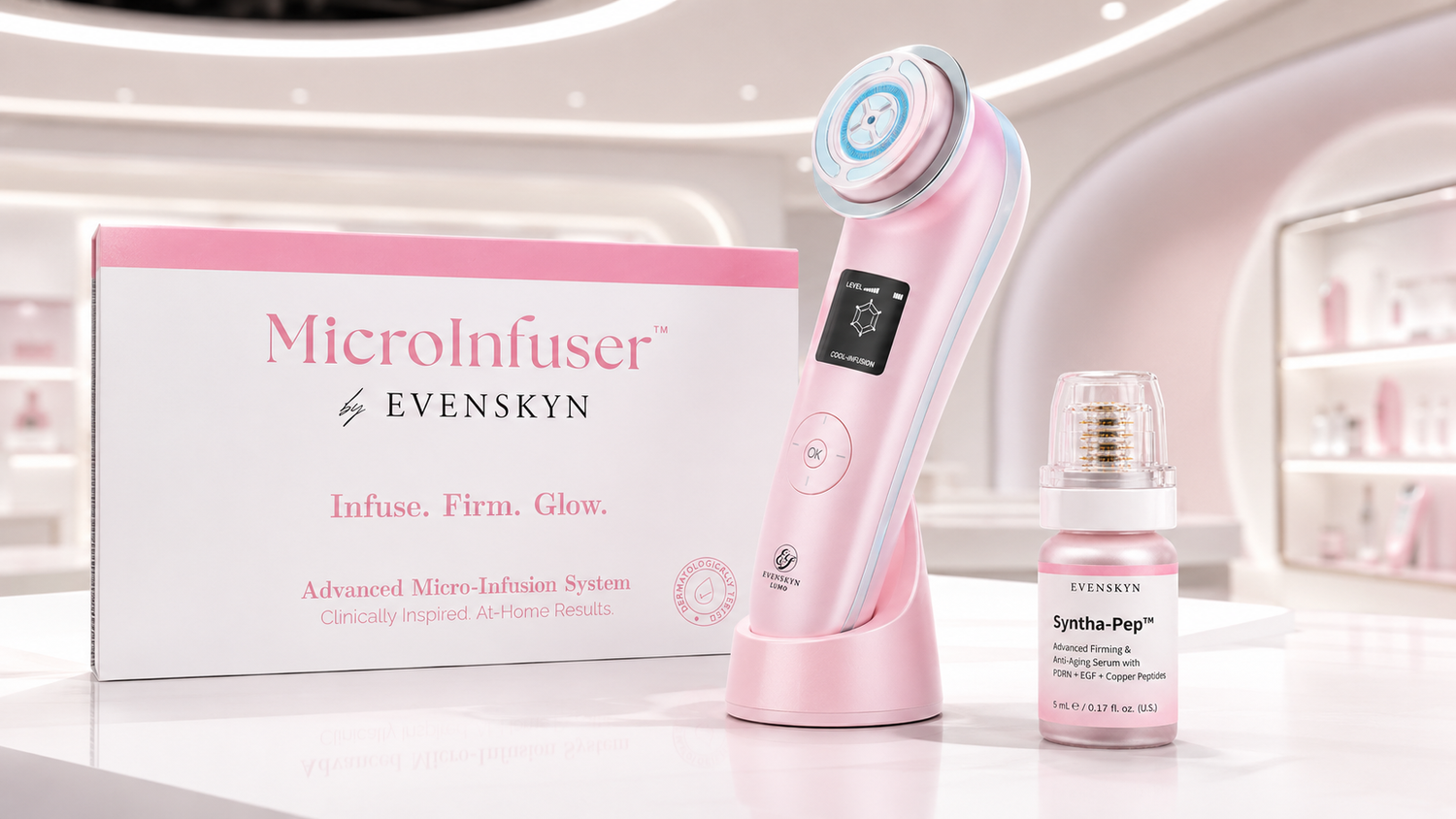
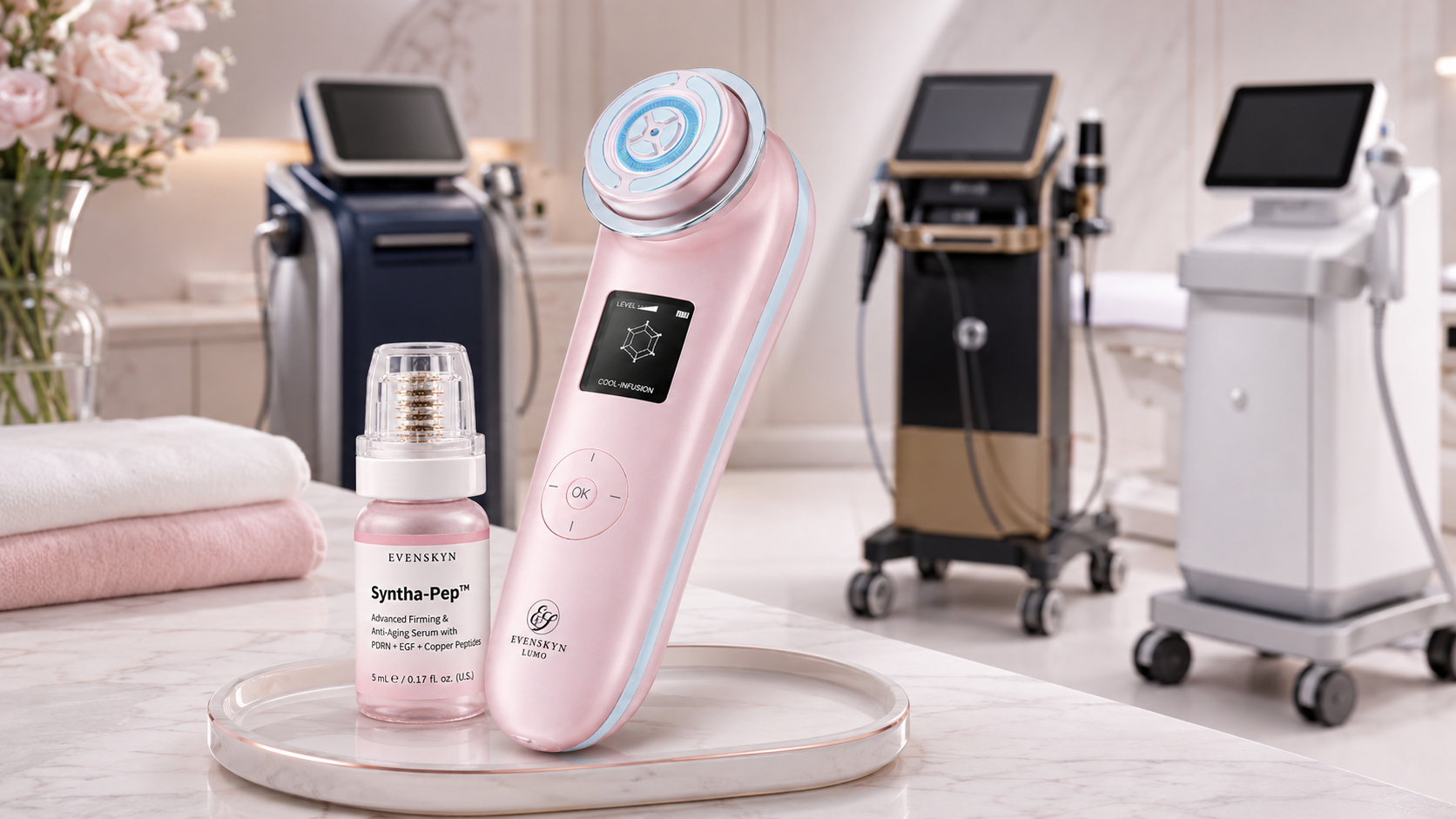
Measured against those criteria, the EvenSkyn MicroInfuser is a fixed 0.5 millimetre, gold-plated micro-needle stamping system with a sealed single-use serum-to-head path and a gamma-sterilised head, paired with a bioengineered PDRN serum formulated for micro-channel delivery rather than adapted from a topical product. (Evidence: Mechanism) It is described here on its design merits and its documented specifications, sourced to its internal manual; this guide makes no purchase or availability claim and links to no store. The reason it fits the evidence is structural, not promotional: it pairs a fish-free, batch-consistent PDRN with the delivery step that the literature shows is the actual limiter at home.
Mistakes and myths
- "Salmon PDRN is proven for anti-aging." The strong human data are injected and medical, not topical cosmetic. (Evidence: Human outcome)
- "Vegan PDRN is just marketing." It activates the same receptor in models; the limitation is preclinical evidence, not a fake mechanism. (Evidence: Lab/animal)
- "A better serum beats delivery." Barrier penetration is the binding constraint for any topical PDRN. (Evidence: Mechanism)
- "Results in a week." Surface hydration yes, structural change no.
The case against the recommendation
The honest counter-argument: bioengineered PDRN has no published human topical cosmetic trial, and several of its supportive studies are authored by ingredient manufacturers, which can shape interpretation. (Evidence: Lab/animal) The marine-PDRN literature also includes a model in which PDRN around an ablative-laser wound was associated with prolonged redness, crusting, and hyperpigmentation, a reminder that more stimulation is not automatically better. (Evidence: Lab/animal) A reader who weights only large human datasets could reasonably prefer a clinician-delivered option and treat all at-home topical PDRN as adjunctive comfort care.
What would change this view
A well-controlled human trial of topical or micro-channel-delivered bioengineered PDRN with cosmetic endpoints, independently funded, would materially update the recommendation. So would head-to-head human data comparing salmon and bioengineered PDRN at equal delivery. Until then the delivery-first position stands.
FAQ
Is bioengineered PDRN as effective as salmon PDRN?
At a mechanism level they appear to use the same receptor pathway. (Evidence: Mechanism) Salmon PDRN has more human data, although mostly from injection in medical contexts, and bioengineered PDRN evidence is preclinical. (Evidence: Lab/animal) For at-home use, delivery matters more than source.
Is PDRN actually salmon sperm?
Salmon-derived PDRN is purified DNA fragments from salmon reproductive cells, processed to remove proteins and peptides. Bioengineered PDRN contains no fish-derived material. (Evidence: Mechanism)
Can topical PDRN match an injectable result?
Not on current evidence. The clinical results used injection, which bypasses the skin barrier. (Evidence: Human outcome)
Is bioengineered PDRN safe for a fish allergy?
The PDRN itself is fish-free, but a serum may contain other marine-derived ingredients such as hydrolyzed collagen, so a fish or shellfish allergy still requires a physician check and a patch test. (Evidence: Mechanism)
Methodology, author, standards, corrections
Three primary scholarly sources were opened in full at their journal or PMC records and graded by evidence class. Affiliation flags are recorded on the reference lines. The standing pattern in this niche is that the most-cited support is injection-based and frequently combined-modality, so the isolated effect of PDRN is often not cleanly separable; this is stated rather than smoothed. Editorial review by Dr. Ismail Kimji, dermatology advisor and Doctor-in-Residence at EvenSkyn, covering safety, contraindication, and claim language. No license number, institution, or publication record is asserted here. Corrections to this article will be logged below with date and change.
Related reading
- At-Home Micro-Infusion: how it works, what to buy, and whether it replaces a clinic facial (EvenSkyn).
- How to use PDRN at home: topical serums versus micro-channel delivery (EvenSkyn).
- What to layer with a microinfusion treatment: device and skincare compatibility (EvenSkyn).
References
- Kim TH, Heo SY, Oh GW, Heo SJ, Jung WK. Applications of Marine Organism-Derived Polydeoxyribonucleotide: Its Potential in Biomedical Engineering. Mar Drugs. 2021;19(6):296. doi:10.3390/md19060296. PMID 34067499; PMCID PMC8224764. Opened in full at PMC. Affiliation flag: academic authors; review names Mastelli Srl and other firms as PDRN suppliers; predominantly in vitro, in vivo, and injection-based clinical evidence.
- Squadrito F, Bitto A, Irrera N, Pizzino G, Pallio G, Minutoli L, Altavilla D. Pharmacological Activity and Clinical Use of PDRN. Front Pharmacol. 2017;8:224. doi:10.3389/fphar.2017.00224. PMID 28491036; PMCID PMC5405115. Corrigendum: Front Pharmacol. 2022;13:1073510. Opened in full at the journal and PMC records. Affiliation flag: a PDRN-specialist pharmacology group with a long PDRN research lineage; a formal corrigendum corrected citation attributions, noted here for reliability transparency.
- Lee KS, Lee S, Wang H, Lee G, Kim S, Ryu YH, Chang NH, Kang YW. Analysis of Skin Regeneration and Barrier-Improvement Efficacy of Polydeoxyribonucleotide Isolated from Panax Ginseng (C.A. Mey.) Adventitious Root. Molecules. 2023;28(21):7240. doi:10.3390/molecules28217240. PMID 37959659; PMCID PMC10649580. Opened in full at PMC. Affiliation flag: most authors are employees of Biosolution Co., Ltd., a manufacturer of plant-derived PDRN and the reconstructed-skin model used; in vitro and 3D-model evidence only.
Internal source, counted separately from the scholarly list: EvenSkyn MicroInfuser User Manual, Edition 1, 2026, used only for product specification facts.
Update log
- May 2026: First publication. Three scholarly sources opened in full and graded by evidence class; one manufacturer-affiliation flag and one corrigendum flag recorded. The MicroInfuser is described as a pre-launch product per integrity policy: no purchase or availability claim and no store link. Action recorded: the product link is to be added at launch via this update log, with no other body change.
This guide is educational and does not provide medical advice or diagnosis. Speak with a qualified clinician about treatments appropriate to your skin. EvenSkyn has a commercial interest in at-home skincare devices, disclosed above before any product description.



Leave a comment
All comments are moderated before being published.
This site is protected by hCaptcha and the hCaptcha Privacy Policy and Terms of Service apply.