
Medically Reviewed by Dr. Lisa Hartford, MD
Skin Science Desk · At-home beautytech
Microchanneling, Honestly
It is the facial your esthetician keeps recommending and the word ProCell put on the map. What it actually is, where it sits next to microneedling, what it costs, who can perform it, and the honest answer on doing a version at home.
Microchanneling is a stamp-based form of microneedling paired with a serum. A grid of fine needles is pressed straight into the skin to open temporary micro-channels, a serum is delivered into them, and the controlled micro-injury triggers a collagen-building repair response over the following weeks. It is a technique and marketing term, not a separate biology. ProCell Therapies popularized it in the United States. It is well suited to maintenance, glow, and fine lines, less suited to deep scars, and the clinic version cannot be fully replicated at home.
The five things that actually matter
It is microneedling with a stamp and a serum. The biology is the microneedling literature, which is solid for collagen induction and for delivering actives past the skin barrier (Jaiswal & Jawade, 2024).
The stamp design is a genuine upgrade over a roller, vertical entry, fixed depth, integrated serum, but it is not categorically better than all microneedling for every goal.
The serum window is short. Channels begin resealing within about thirty minutes, which is why the serum goes in during the stamp, not after (Gupta et al., 2011).
Depth and the operator's license are linked. Shallow cosmetic work is often within esthetician scope; medical-depth work is not. That distinction is the whole safety story.
The honest at-home version is micro-infusion, a shallow single-use stamp with a sealed serum, not the clinic procedure itself.
What microchanneling actually is
Strip away the branding and microchanneling names one design decision inside microneedling: how the needles enter the skin. A derma roller drags a wheel of needles across the surface, so each needle enters and exits at a shifting angle. A motorized pen oscillates needles up and down at high speed, powerful but operator-dependent. A stamp presses a flat grid of needles straight down and lifts it straight back up. Vertical in, vertical out, then move to the next patch of skin.
That geometry is the pitch. Vertical entry makes cleaner channels with less surface tearing than a dragging roller, a real mechanical advantage rather than a marketing one. The tips are fixed-depth, so the needles cannot wander deeper than intended. The trade-off: a fixed shallow stamp is built for maintenance and delivery, not for the deep remodeling that treats significant scarring.
The second half is the serum, and it is where ProCell built its identity. Rather than the hyaluronic acid layered with basic microneedling, ProCell delivers a serum of growth factors and signaling proteins called cytokines, cultured from human bone-marrow stem cells, suspended in hyaluronic acid. The premise is that controlled micro-injury plus concentrated repair signals amplifies the collagen response. The mechanism is plausible and rests on real wound-healing biology. Whether any specific serum delivers a clinically meaningful version of it is a separate question, and one the published evidence answers more quietly than the brochures do.
For skin to largely reseal its barrier after a shallow stamp, left unoccluded. The reason serum goes on during the session.
Gupta et al., 2011, J Control ReleaseThe practical ceiling for self-safe stamping: deep enough to deliver and start collagen, shallow enough to skip anesthesia.
Microneedling depth literatureThe standard spacing between clinic sessions, matched to the skin's renewal cycle. Results build over months, not days.
Common clinical practiceHow it works, underneath
Two well-studied mechanisms run at once. The first is collagen induction. When fine needles enter the skin, the body reads the controlled micro-injuries as wounds and starts the wound-healing cascade: fibroblasts migrate, growth factors and cytokines release, and over the following weeks new collagen and elastin remodel the dermal matrix. That sequence is laid out in the 2024 Cureus review by Jaiswal and Jawade, which draws together the evidence on microneedling across rejuvenation, scarring, and pigmentation (Jaiswal & Jawade, 2024). Earlier comprehensive reviews reached the same conclusions across human trials (Hou et al., 2017; Iriarte et al., 2017).
The second mechanism is delivery, the more interesting half for serum-driven systems. Most useful skincare actives, peptides, growth factors, larger hyaluronic acid, cannot cross the stratum corneum in meaningful amounts on their own. The instant the needles open micro-channels, that barrier is briefly bypassed and the serum reaches the upper skin directly. The home-use signal here is real if modest: a 2022 study in the Journal of Cosmetic Dermatology tracked eleven women using home microneedling with topical growth factors over three months and measured improvements in texture, fine lines, and pigmentation on imaging analysis (Quinlan, Ghanem and Hassan, 2022).
This is also where the most common consumer question gets a real answer. The channels do not stay open. Working in human subjects with electrical impedance measurement, Gupta and colleagues showed that, left uncovered, microneedle-treated skin recovers its barrier within roughly two hours, with surface channels beginning to reseal inside the first half hour (Gupta et al., 2011). That short window is exactly why microchanneling delivers serum during and immediately after the stamp, and why the aftercare rules exist.
Left uncovered, microneedle-treated skin recovers its barrier within roughly two hours. The absorption window is real, and it is brief.Gupta, Gill, Andrews and Prausnitz, Journal of Controlled Release, 2011
The real benefits of a microchanneling facial
Within its shallow, cosmetic range, a microchanneling facial (sometimes written micro-channeling, sometimes micro channeling as two words, occasionally listed as a microchannel facial) is suited to a specific band of concerns. It is a skin-quality and maintenance treatment, not a scar-correction tool. Realistically, that means:
- Fine lines and early wrinkles, softened gradually as collagen rebuilds over a series
- Dull, rough, or uneven texture, smoothed session over session
- Mild, diffuse pigmentation and overall evenness of tone
- Enlarged-looking pores and general skin quality
- Better serum delivery, so the actives you apply reach past the barrier and do more than they would on intact skin
What it will not do, no matter how good the serum, is erase deep acne scars, fill deep static wrinkles, or tighten significant laxity. Those need depth or energy a shallow stamp cannot reach. That honest line between maintenance and correction is the difference between a treatment people are glad they booked and one they feel sold on.
Microchanneling at a glance, scored honestly
A sound maintenance treatment, oversold as a miracle
Strong on comfort and delivery, weaker on independent proof of the brand-specific serum claims and on value versus cheaper microneedling. Scored as a treatment choice for the average reader, not as a single product.
Best for
- Maintenance, glow, fine lines, dull texture
- People who want serums delivered deeper than a topical can reach
- Anyone who found roller microneedling harsh or messy
Not the best fit for
- Significant acne scarring or deep wrinkles (needs deeper work)
- Anyone expecting a one-session visible lift
- Bargain hunters who would get similar results from basic microneedling
Microchanneling versus microneedling
This is the comparison everyone searches, so here it is precisely rather than tribally. Microchanneling is a kind of microneedling. The meaningful differences sit in the device and the serum, not in some separate underlying science.
| Feature | Microchanneling (stamp) | Roller microneedling | Pen microneedling (clinic) |
|---|---|---|---|
| Needle entry | Vertical, stamped in and out | Angled, dragged across skin | Vertical, oscillating fast |
| Depth control | Fixed tips, consistent | Varies with pressure | Adjustable, operator-set |
| Typical depth | Shallow, cosmetic | Variable, often shallow | 0.5 to 2.5 mm |
| Serum | Integrated, often growth-factor | Applied before or after | Applied before or after |
| Surface trauma | Lower, cleaner channels | Higher, tearing risk | Moderate, controlled |
| Comfort | Mild, numbing often optional | Drag sensation | Numbing usually needed |
| Best at | Maintenance, glow, delivery | Surface texture, budget | Acne scars, deep wrinkles |
Brand names such as ProCell, AquaGold, Glov, Qure and Seranova belong to their respective owners and appear here for identification and comparison only. Device specifications and prices change; verify against each brand's current listing.
Read down the stamp column and the reputation makes sense: vertical fixed-depth entry with integrated serum is a better-engineered version of what a roller does badly. That is the legitimate core of the "microneedling evolved" framing. What does not follow is that microchanneling beats all microneedling for every goal. A clinical pen at 2 mm out-remodels a shallow stamp on deep acne scars, because depth is doing the work, and a 2024 split-face study found measurably greater scar improvement at deeper needling settings (Zaki et al., 2024). Read the table by goal, not by brand.
How to vet any microchanneling treatment
Whether you are booking a facial or comparing at-home kits, the same five questions separate the real thing from something that resembles it. They apply to every provider and device, EvenSkyn included.
Depth and operator
What depth do they treat at, and does their license cover it? Shallow cosmetic depth is one thing; medical-depth needling is another and belongs with a medical provider.
Single-use sterility
Is the needle head single-use and sterile, discarded after each session? "Cleaned" or "disinfected" is not the same as sterile and single-use.
The serum
What is actually being delivered, and is the claim about it the brand's own or independently supported? A great stamp with a thin serum is doing half the job.
Contraindications up front
Do they list who should not have it, isotretinoin, active infection, keloid history, pregnancy? Silence on this signals a casual relationship with safety.
Honest cost and cadence
Is the price transparent, and is the recommended course realistic (a few sessions, then maintenance) rather than an open-ended package?
What results look like, and how to read a before-and-after
Search "microchanneling before and after" and you will find dramatic split images. Treat them with care, because several things move those photos as much as the treatment does: lighting, angle, makeup, and timing. Collagen remodeling is slow, so the honest results curve looks like this.
- After one session: a short-term glow and slight plumping from the serum and mild swelling, fading within days. That is not the finished result.
- Over a series (commonly two to six sessions, four to six weeks apart): gradual, cumulative improvement in texture, tone, and fine lines as new collagen lays down.
- With maintenance: results hold for as long as you keep up periodic sessions, because the skin keeps aging underneath.
When you look at a before-and-after, check whether the lighting and angle match, whether the after shot is wearing makeup or a filter, and how long after the final session it was taken. A fair comparison is the same light, the same angle, bare skin, weeks after the last session. Anything else is closer to marketing than evidence. It is also the reason consistent at-home maintenance, done every couple of weeks, can keep results steady between or instead of clinic visits, as long as expectations stay realistic about what a shallow at-home depth can do.
What it costs
Microchanneling sits above basic microneedling on price, and the gap mostly reflects the device and the proprietary serum rather than the labor. Figures below are commonly reported US ranges; verify against the specific provider, since pricing varies widely by city and add-ons.
| Option | Typical per session | Cadence | Notes |
|---|---|---|---|
| Clinic microchanneling (face) | $300 to $500 | Every 4 to 6 weeks | Packages lower the per-session cost |
| Clinic microchanneling (range) | $250 to $1,200 | Course of 2 to 6, then maintenance | Varies by area, serum tier, city |
| Basic microneedling (face) | ~$100 to $700 | Every 4 to 6 weeks | Wide range by device and add-ons |
| At-home micro-infusion | Consumables per session, no clinic fee | Every 2 weeks | Maintenance category, shallower depth |
The honest way to read this: if your goal is periodic maintenance and serum delivery, the at-home category covers most of it at a fraction of the per-session cost. If your goal is correcting significant scarring, neither shallow microchanneling nor an at-home stamp is the tool, and the clinic spend belongs on deeper modalities.
The ProCell machine, "near me," and what at-home really means
A lot of people searching "microchanneling machine," "microchanneling device," or "microchanneling pen" are really asking whether they can just buy the tool. Worth being clear about what is and is not available.
The professional systems, ProCell's stamp and its medical-grade serums, are sold to licensed practitioners, not as consumer DIY kits, and the growth-factor serums are professional-only. That is deliberate: depth and sterile technique matter, and those serums belong in trained hands. So a search for "microchanneling near me" is really a search for a provider, and the right questions to ask one are the five in the checklist above.
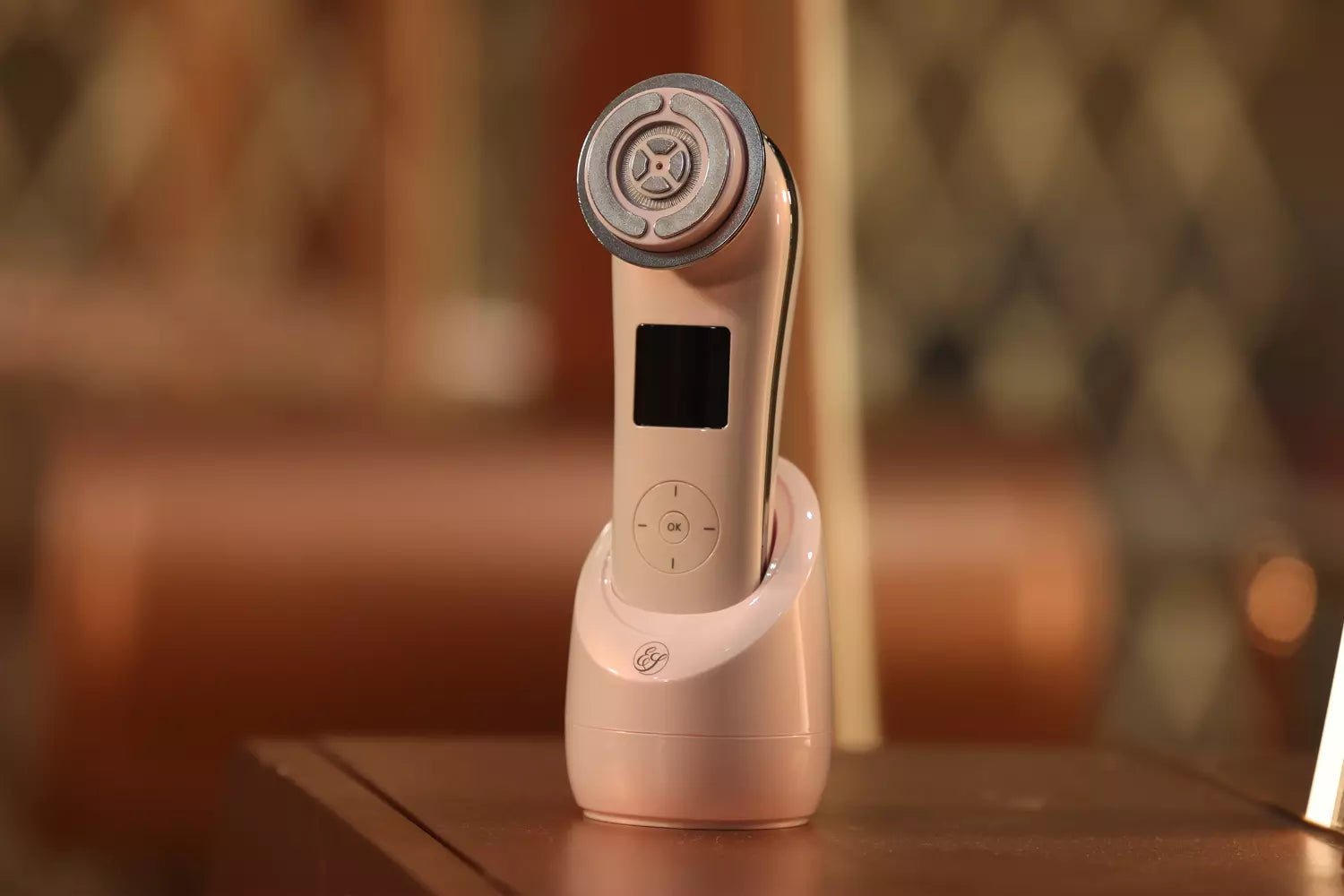
What you can buy and use yourself is the at-home cousin, and it is a different category from the professional machine, not a home edition of it. An at-home micro-infusion device is built for unsupervised use at a fixed, shallow, self-safe depth with a sealed cosmetic serum. It will not match a clinic session, and it is not designed to. It is a maintenance tool, used about every two weeks, for the same reason anyone keeps up a good routine between professional visits.
Where the at-home version actually fits
Put the pieces together and an honest inference falls out. The technique that drives results is shallow, stamp-based, serum-integrated delivery. The clinic adds two things a home user cannot safely have: professional-only growth-factor serums and deeper, provider-judged protocols. The barrier window is short, so timing the serum to the stamp matters more than raw needle count. And the safety record depends almost entirely on single-use sterility and respecting contraindications, both of which a well-designed home device can build in.
What follows is not that at-home equals clinic. It does not, and any brand implying so is overreaching. What follows is that the maintenance layer of this category, the bi-weekly delivery of cosmetic actives through clean, fixed-depth channels, translates to home use when the device copies the parts that matter: a fixed self-safe depth, a sealed serum path, and a single-use sterile head. That is the narrow, defensible claim, and it is the one worth making.
If you want the at-home version
Disclosed: this is our category
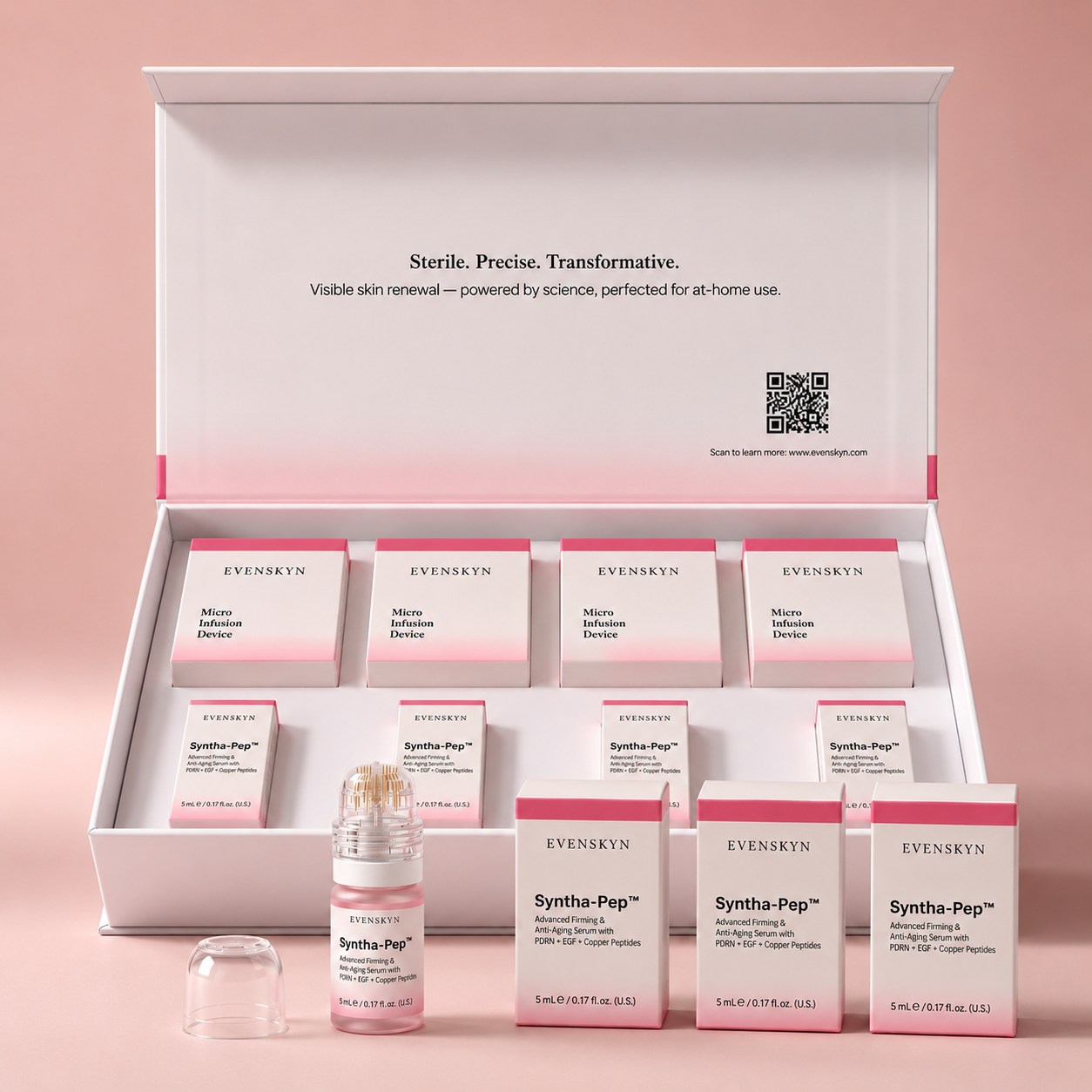
The EvenSkyn micro-infusion approach uses the same fixed-depth, sealed-serum, single-use-head architecture this article describes, at a depth designed for unsupervised use about every two weeks. For the under-eye area specifically, where stamping is not appropriate, dissolving microneedle patches deliver actives through self-dissolving tips instead. Run the five questions above on it the same way you would on any clinic or competitor.
What it does
- Bi-weekly maintenance delivery at home
- Fixed, self-safe depth with a sealed serum path
- Single-use sterile heads, no reuse
What it will not do
- Replace a clinic AquaGold or ProCell session
- Treat significant acne scars or deep wrinkles
- Deliver professional-only growth-factor serums
Does it hurt, and who should not have it
For cosmetic-depth microchanneling, most people report a light prickling or tapping sensation with mild warmth and a flush that fades within an hour to a day. Because the stamp enters vertically and shallowly, numbing is often skipped, a genuine comfort advantage over both rollers and deeper pen work.
Comfort is not the same as suitability. Providers generally treat the following as reasons to defer or avoid microchanneling, and a clinic or kit that does not surface them is signaling a casual relationship with safety.
- Active skin infection in the area, including cold sores, or inflammatory flares of eczema, psoriasis, or dermatitis
- Oral isotretinoin within the past six months, because it changes how skin heals
- A personal or family history of keloid or hypertrophic scarring
- Pregnancy or breastfeeding, until cleared by a physician
- Bleeding disorders or blood thinners, and uncontrolled diabetes or active immunosuppression, which all warrant a doctor's sign-off first
Our safety and contraindications guide covers this eligibility list in full, tier by tier.
Can estheticians do it? The scope question
This explains why microchanneling spread through spas rather than dermatology offices. In much of the United States, shallow cosmetic microchanneling that stays in the upper layers of the skin falls within a licensed esthetician's scope, while deeper, medical-depth microneedling is more often restricted to medical providers such as nurses, nurse practitioners, and physicians. The depth and the license are linked. Rules vary by state, so the responsible questions to ask are what depth they treat at, what their license permits, and how the device is kept sterile. On that last point, the rule a careful clinic follows is the one the CDC sets for any needle: once used, it is contaminated and gets discarded, never reused (CDC, 2024).
The takeaway is not that esthetician-performed microchanneling is unsafe. Done shallow, on suitable skin, by a trained and licensed professional with single-use heads, it has a strong record. The takeaway is that the label "microchanneling" can describe anything from a gentle cosmetic facial to a near-medical treatment depending on depth, and the word alone does not tell you which one you are getting.
Aftercare that actually matters
The aftercare rules are not arbitrary caution. They follow from the closure window: for the first day or so the skin is an unusually open surface, so what goes on it carries more weight than usual.
- Leave the skin mostly alone for the first 60 to 90 minutes. Many clinic protocols ask you to apply nothing topical in this window beyond what was used in treatment, and to let the flush settle.
- Hold off on actives for 24 to 72 hours. No retinoids, vitamin C in its acidic form, exfoliating acids, or benzoyl peroxide. Each is fine on a normal day and an irritant on a freshly channeled one.
- Wait on makeup. Most providers advise against makeup for the first 24 hours while channels reseal, then favor clean mineral formulas over heavy liquid foundation.
- Hydrate and protect the barrier. Hyaluronic acid, panthenol, Centella, and ceramide-based moisturizers are the right post-treatment company.
- Wear broad-spectrum SPF every morning for several days. Sun on freshly treated skin is the single most preventable cause of post-treatment pigmentation, and it matters more, not less, for deeper skin tones.
Pairing microchanneling, or its at-home micro-infusion cousin, with other devices follows the same logic set out in what to use after microneedling at home: thermal and electrical devices like radiofrequency and microcurrent go on non-treatment days or before the stamp, never on top of freshly channeled skin. For the broader at-home category and how the specific kits compare, see our at-home micro-infusion and AquaGold guide and the at-home device comparison.
Frequently asked questions
Is microchanneling the same as microneedling?
It is a subtype, not a separate procedure. Microneedling is the umbrella technique of creating controlled micro-injuries with fine needles. Microchanneling is the stamp-based version, where needles enter vertically rather than rolling, usually paired with a serum delivered into the channels. ProCell is the best-known brand of it.
Is microchanneling better than microneedling?
For comfort, surface trauma, and depth consistency, the stamp design has real advantages over a roller. For deep remodeling of scars and wrinkles, a deeper clinical pen does more. Better depends on the goal, not the label.
What does microchanneling help with?
Within its shallow cosmetic range it is used for fine lines, texture, dullness, mild pigmentation, and overall maintenance, and to drive serums deeper than they could reach on their own. Deeper concerns such as significant acne scarring need deeper treatment.
Does microchanneling hurt?
Most people describe a light tapping or prickling sensation with mild warmth afterward. Because the stamp is shallow and vertical, numbing is often optional, unlike deeper pen microneedling.
How much does microchanneling cost?
Commonly reported around $300 to $500 for a single facial session, with packages lowering the per-session price. The wider US range runs about $250 to $1,200 depending on area, provider, and serum. Verify current pricing with the provider.
How long do the microchannels stay open?
Not long. Human studies show surface channels beginning to reseal within about thirty minutes and the barrier largely recovering within roughly two hours when skin is left uncovered, which is why serum is delivered during the session, not after.
How often should you do microchanneling?
Clinic sessions are usually spaced every four to six weeks. A typical starting course is two to six sessions, then maintenance every few months. The at-home micro-infusion version is generally used every two weeks.
Can estheticians do microchanneling?
In many US states, shallow cosmetic microchanneling is within a licensed esthetician's scope, while deeper medical-depth microneedling is restricted to medical providers. Rules vary by state, so depth and license both matter.
Can I do microchanneling at home?
Not the clinic version. The growth-factor serums and deeper protocols belong in professional hands. The architecture that translates safely to home is micro-infusion: a single-use stamp at a fixed shallow depth with a sealed cosmetic serum, used every two weeks.
Is microchanneling safe?
Done shallow, on suitable skin, by a trained and licensed professional using single-use sterile heads, it has a strong safety record. Risk rises with reused devices, ignored contraindications, and excessive depth. If you are pregnant, on isotretinoin within six months, have an active skin infection, or a keloid history, avoid it or clear it with a physician first.
How is microchanneling different from micro-infusion?
Both are stamp-based. Micro-infusion delivers the serum from a sealed vial through the channels in the same motion, with no open chamber, and exists in both clinic form (AquaGold) and a shallower at-home form. Microchanneling is the broader stamp technique, with ProCell the defining clinic brand.
Is microchanneling worth it?
For texture, fine lines, dullness, and better serum absorption, most people who complete a full course see worthwhile gradual improvement. It is less worth it if you expect deep scar or wrinkle removal, which needs deeper clinical treatment. At home, micro-infusion offers a lower-cost way to maintain results between or instead of clinic visits.
About this guide
Author: the EvenSkyn Skin Science Desk, the brand's in-house research and editorial team. EvenSkyn is an at-home anti-aging beauty device company, and that commercial interest is disclosed throughout.
Medical review: pending. Dr. Lisa Hartford, MD, a dermatologist who advises EvenSkyn on skin content, is scheduled to review this article; the reviewed-by line and review date will be added once that review is complete. Until then this carries the honest brand byline rather than a reviewer credit.
Methodology: Claims about the microchanneling technique, devices, pricing, cadence, and aftercare were checked against multiple independent provider sources and the published positioning of the ProCell system, and are presented as commonly reported practice rather than universal standards, since protocols vary. Scientific claims about collagen induction, transdermal delivery, channel-resealing kinetics, and needling depth were checked against their PubMed or PMC records for this article; where a specific detail such as a page range or secondary identifier could not be independently confirmed, it was omitted rather than guessed. Where evidence supports a mechanism but not a specific commercial claim, the article says so. Vendor figures, such as specific absorption multipliers, are labeled as vendor claims, not established facts.
Conflict of interest disclosure
EvenSkyn manufactures and sells at-home skincare devices, including a micro-infusion system and dissolving microneedle eye patches in the broader category this article describes. That is a clear commercial interest, disclosed transparently. Competitor and clinic brands are named for identification and comparison only, not endorsed or disparaged. This article is educational and is not personal medical advice. Consult a qualified dermatologist before beginning any new procedure if you have a relevant medical history or are unsure whether it suits you.
References
- Jaiswal S, Jawade S. Microneedling in Dermatology: A Comprehensive Review of Applications, Techniques, and Outcomes. Cureus. 2024;16(9):e70033. PMID 39449889 | PMC11499218
- Hou A, Cohen B, Haimovic A, Elbuluk N. Microneedling: A Comprehensive Review. Dermatologic Surgery. 2017;43(3):321-339. PMID 27755171
- Iriarte C, Awosika O, Rengifo-Pardo M, Ehrlich A. Review of applications of microneedling in dermatology. Clinical, Cosmetic and Investigational Dermatology. 2017;10:289-298. PMID 28848356
- Gupta J, Gill HS, Andrews SN, Prausnitz MR. Kinetics of skin resealing after insertion of microneedles in human subjects. Journal of Controlled Release. 2011. PMC3164267
- Quinlan DJ, Ghanem AM, Hassan H. Topical growth factors and home-based microneedling for facial skin rejuvenation. Journal of Cosmetic Dermatology. 2022;21(8):3469-3478. PMID 34951101
- Zaki MS, et al. Evaluation of microneedling depth of penetration in management of atrophic acne scars: a split-face comparative study. International Journal of Dermatology. 2024. PMID 38159109
- Centers for Disease Control and Prevention. Preventing Unsafe Injection Practices. Reviewed March 26, 2024. CDC Injection Safety
Update log
- June 24, 2026 (Edition 1.0): Original publication. Medical review by Dr. Hartford pending.
EvenSkyn · Skin & Beauty Articles · Skin Science Desk


Leave a comment
All comments are moderated before being published.
This site is protected by hCaptcha and the hCaptcha Privacy Policy and Terms of Service apply.