
Medically Reviewed by Dr. Lisa Hartford, MD
Adult Acne After 40: An Honest Guide to Blue + Red Light When You're Breaking Out and Aging at Once
Nobody warns you that the same decade that brings fine lines can also bring back the breakouts. Here is the evidence-based version: why a hormonal shift in your forties and fifties triggers jawline acne, what at-home blue and red light can genuinely do about it, and the honest line on what it can't.
Medical review: This article has been reviewed by Dr. Lisa Hartford, MD (EvenSkyn dermatology advisor) before its publication.
At-home blue (415 nm) and red (630–633 nm) light therapy can meaningfully reduce mild-to-moderate inflammatory acne, including the jawline breakouts common in perimenopause, because blue light inactivates acne bacteria on the surface while red light calms the inflammation underneath. In controlled trials the combination reduced inflammatory lesions by roughly three-quarters over 8 to 12 weeks, and one LED study reported reductions above 80 percent.23 It will not clear severe, cystic, or purely hormone-driven acne on its own. For that you need a dermatologist. Used realistically, light therapy is the gentlest way to treat adult acne without abandoning the anti-aging work your skin also needs.
The five things worth knowing
Adult acne is common and it is not a personal failing. Population data show more than a quarter of women in their forties still get acne, and the rate stays meaningful past fifty.1
The trigger in midlife is a shift in the balance of hormones. As estrogen falls during the menopausal transition, the relative influence of androgens rises, and that can push oil glands back into overdrive.78
Adult breakouts cluster on the lower face. Papules and pustules along the jawline, chin, and neck are the signature of adult female acne, which is why a treatment you can aim at that zone matters.910
Blue and red light have real, replicated evidence for mild-to-moderate inflammatory acne, and the effect is strongest when the two wavelengths are combined.234 Over-the-counter LED masks have been studied directly.5
Light is a maintenance tool, not a cure. It calms active breakouts and reduces how often they come, but cystic acne, scarring acne, or acne that won't budge needs a dermatologist and, often, prescription therapy.9
EvenSkyn Lumo⁺ for acne that arrives with aging
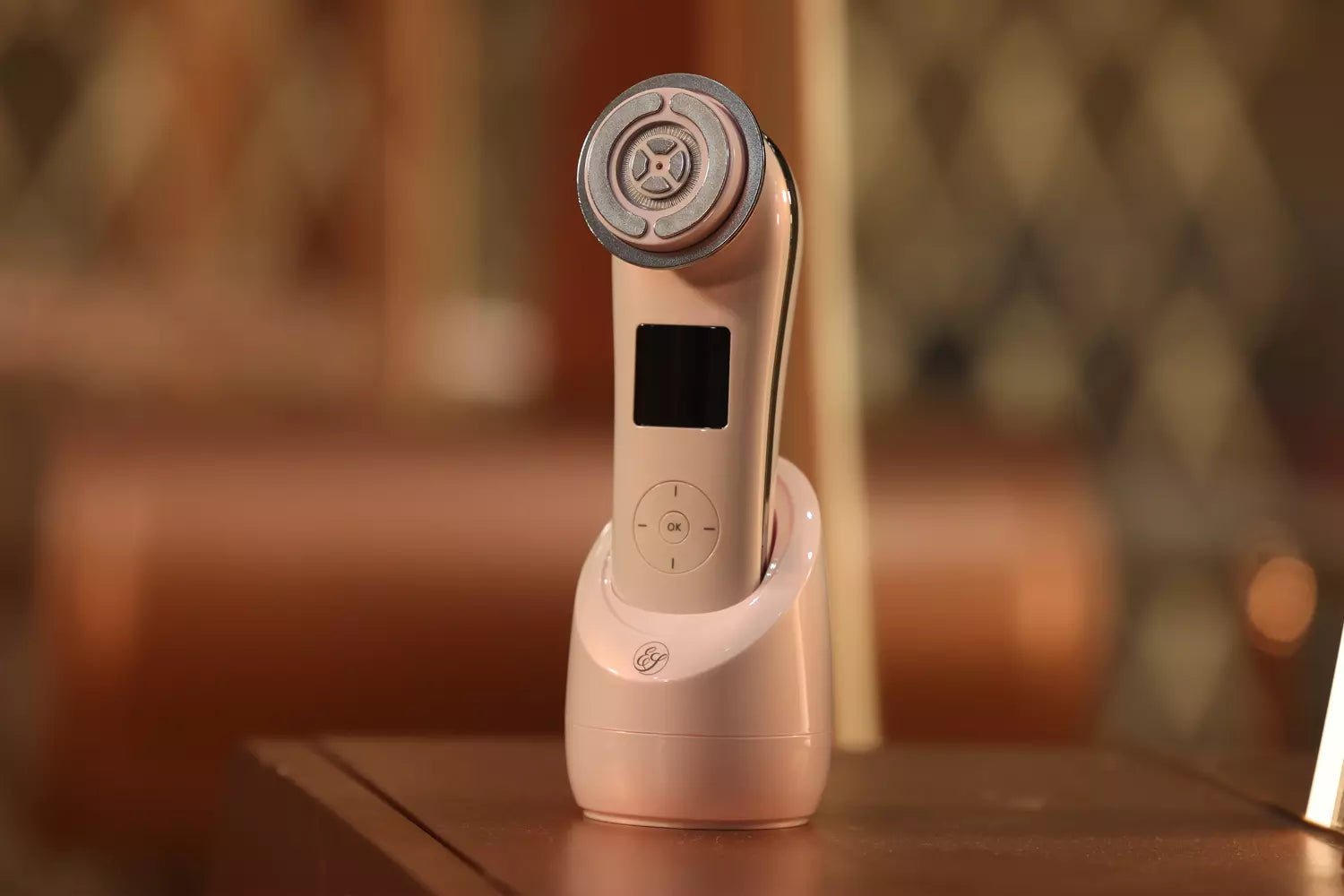
For the specific problem this guide is about — breakouts and fine lines at the same time — the Lumo⁺ is the standout, because it is the only one of our devices that carries the acne wavelengths and the firming technology in one handset.
Best for
- Women in their 40s and 50s with mild-to-moderate jawline or chin breakouts
- Anyone treating acne and early laxity or fine lines at the same time
- Skin that reacts badly to strong acids, benzoyl peroxide, or oral antibiotics
- People who want one device rather than a shelf of single-use gadgets
Not the best fit for
- Deep, painful cystic acne or acne that is leaving scars
- Anyone who wants overnight results on a single spot
- People on isotretinoin or strong photosensitizing medication
- Those who only want acne help and never plan to treat aging (a focused mask costs less)
of women in their forties report having acne, with the rate still meaningful past fifty.
Collier et al., J Am Acad Dermatol, 2008reduction in inflammatory acne lesions with combined blue and red LED light in controlled studies.
Papageorgiou 2000; Goldberg 2006is where adult female acne concentrates — jawline, chin, and neck, not the teenage T-zone.
Int J Womens Health, 2024Why your skin is breaking out again in your 40s and 50s
Adult acne (also called post-adolescent or hormonal acne) is acne that appears or persists after about age 25. In women it usually shows up as tender, inflammatory bumps along the lower face, the jawline, chin, and neck, rather than the forehead-and-nose pattern of teenage acne.910
Perimenopausal or menopausal acne is the version triggered by the hormonal shift around the end of the reproductive years, when estrogen falls and the relative influence of androgens on the oil glands rises.7
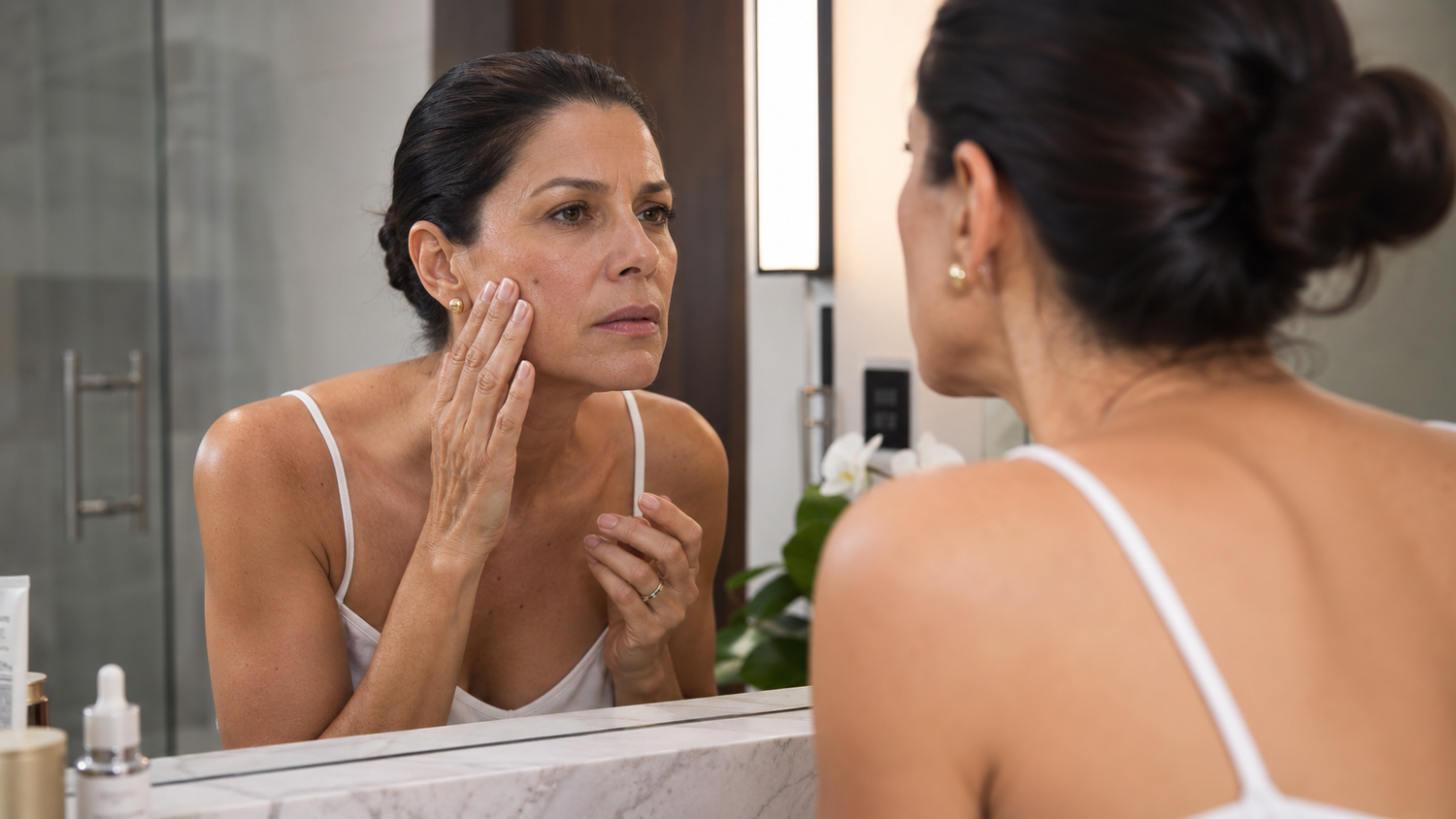
Here is the part that catches people off guard. You spend your thirties bracing for wrinkles. Then, somewhere in your mid-forties, the spots come back. Not the scattered breakouts of adolescence. Deep, tender bumps along the jaw and chin, the kind that take a week to surface and another two to leave.
You are not imagining it, and you are far from alone. When researchers surveyed women across age bands, acne did not politely disappear after the teenage years. It declined, but it lingered, with more than a quarter of women in their forties still affected.1 Dermatologists have a half-joking name for the version that shows up out of nowhere in this decade: the last hurrah. A woman who has had clear skin for thirty years suddenly faces a fresh crop of inflammatory lesions, right around the time her cycle starts to change.8
The mechanism is not a mystery. It is a shift in balance. Estrogen and androgens both circulate in a woman's body, and for most of adult life estrogen keeps the oil-stimulating effect of androgens in check. During the menopausal transition, estrogen production falls. The androgens do not necessarily rise in absolute terms, but their relative influence does, and androgens drive the sebaceous glands.78 More oil, plus the slower cell turnover of mature skin, plus the same acne bacteria everyone carries, and you have the conditions for breakouts in skin that is simultaneously getting drier and less firm.
That same drop in estrogen is also what accelerates collagen loss in midlife. Skin can shed as much as 30 percent of its collagen in the first five years after menopause, then keep declining at roughly 2 percent a year.11 So the firmness goes at the same time the breakouts arrive, which is a genuinely frustrating combination because the two problems usually pull treatment in opposite directions. We cover the laxity side of this story in our guide to perimenopausal skin changes.
Why adult acne looks different from teenage acne
The distribution is the giveaway. Teenage acne spreads across the forehead, nose, and cheeks. Adult female acne sits low: papules and pustules along the mandible, the chin, and sometimes down onto the neck.910 The inflammatory form, all redness and tenderness rather than blackheads, accounts for most adult cases.10 That lower-face pattern is exactly why a treatment you can direct at the jawline, rather than slather across your whole face, fits the problem so well.
A woman who hasn't had a pimple in thirty years can wake up at fifty to a jaw full of them. The hormones didn't surge. The balance simply changed.On perimenopausal acne, drawn from the dermatology literature8
How blue and red light therapy actually treats acne
Light therapy sounds like wishful thinking until you look at what each wavelength does, and it turns out the two colors do completely different jobs.
Blue light, around 415 nanometers, is the antibacterial half. The bacteria involved in acne, Cutibacterium acnes, produce compounds called porphyrins as part of their normal metabolism. Porphyrins are exquisitely sensitive to blue light. When they absorb it, they generate reactive oxygen species that rupture the bacterial cell from the inside, a process called photodynamic inactivation. No antibiotic, no resistance, no harsh chemistry. Fewer bacteria means less of the inflammation they trigger.3
Red light, around 630 to 633 nanometers, is the anti-inflammatory and repair half. It penetrates deeper than blue, reaching into the dermis, where it calms the inflammatory cascade and supports the skin's own repair processes. On its own it is a weaker acne treatment than blue light, but it tackles the redness and the post-breakout marks that blue light leaves untouched. This is the same family of red light therapy used for collagen support, which is part of why it suits skin that is aging as well as breaking out.4
Put them together and the trials line up. In one randomized study of acne patients, the blue-and-red combination outperformed either color alone, cutting inflammatory lesions by about three-quarters over twelve weeks.2 A separate LED study using the same 415 and 633 nanometer pairing reported lesion reductions north of 80 percent.3 A head-to-head trial later confirmed that red and blue produce comparable improvement in inflammatory lesions, with red light being slightly easier on the skin.4 And because people kept asking whether this works at home rather than in a clinic, researchers tested over-the-counter LED masks directly, and found they held up.5
A reasonable question: does this help the hormonal kind of adult acne? Light does not touch your hormones. What it does is intercept the part of the chain that hormones set in motion, the bacteria and the inflammation in the pore. So it manages the breakouts that hormonal shifts produce, without claiming to fix the shift itself. That distinction matters, and we come back to it in the limits below.
How to judge an at-home light device for adult acne
Most of the market is noise. These are the criteria that actually separate a device worth your money from an expensive nightlight.
The right wavelengths, stated in numbers
You want 415 nm blue for the bacteria and roughly 630 nm red for inflammation. If a device won't tell you its wavelengths, that is the answer. Vague "LED" claims are a red flag.
Both colors, ideally together
Blue alone helps. Blue plus red helps more and addresses the redness and marks adult skin cares about. A single-color device leaves results on the table.
Spot precision or full-face coverage
Adult acne clusters on the jaw. A targeted head lets you aim at it. A full mask treats everything at once. Match the format to whether your breakouts are localized or widespread.
Gentle enough for reactive, mature skin
Non-heating LED or carefully controlled warmth. Your barrier is already thinner than it was at twenty, so the treatment should not strip or sting.
A dual benefit, if you are also aging
If you are fighting fine lines as well as breakouts, a device that adds collagen-supporting technology earns its keep twice over instead of solving only half the problem.
Safety engineering and clearances
Built-in eye protection, automatic session timing, and regulatory clearance. These are not marketing extras. They are the difference between a medical-grade tool and a gadget.
Your real options for treating adult acne, compared
Light therapy is one lane among several. Here is the honest landscape, so you can see where an at-home device fits and where it doesn't.
| Approach | Best for | Speed | Commonly reported cost | The catch |
|---|---|---|---|---|
|
Dermatologist + prescription (retinoid, spironolactone) |
Persistent, hormonal, or scarring acne | Weeks to months | Visit fees plus ongoing medication | The most effective route for stubborn cases; requires a prescriber and monitoring |
|
In-office procedures (chemical peels, light-based treatments) |
Moderate acne and marks | Per session, cumulative | High per visit, often a series | Effective but recurring; downtime varies |
|
At-home blue + red light (LED mask or handset) |
Mild-to-moderate inflammatory breakouts | 4–12 weeks of consistent use | One-time device purchase | Needs consistency; not for cystic or severe acne |
|
OTC topicals (benzoyl peroxide, salicylic acid) |
Mild breakouts and prevention | Weeks | Low and recurring | Can irritate or dry mature, sensitive skin |
|
Spot light device (e.g., Solawave Bye Acne) |
Occasional single blemishes | Per spot, several days | Lower one-time cost | Designed for individual spots, not full-face or dual-concern use |
Brand names belong to their respective owners and appear here for comparison only. Specifications, prices, and clearances change; verify against each company's live listing before buying. This table is general information, not medical advice.
Why a dual-action device fits the 40-plus problem
Follow the chain, because the recommendation falls out of it rather than being asserted.
- In midlife, falling estrogen lets androgens drive oil production, so breakouts return on the lower face.7
- At the same time, the same hormonal shift accelerates collagen loss, so fine lines and laxity appear in the same window.11
- That leaves you with two problems at once, and most acne products make aging worse by drying and irritating mature skin.
- Blue plus red light treats the inflammatory acne without stripping the skin.2
- So the logical tool is one that delivers those acne wavelengths and adds collagen-supporting technology, rather than forcing you to choose which problem to treat.
This is a reasoned inference from the evidence, not a claim that any device has been trialed for this exact combined use. Where the inference points, in our line, is the Lumo⁺, because it carries blue and red LED alongside radiofrequency and microcurrent. For acne alone, a full-face LED mask such as our Mirage covers the same 415 nm blue and 630 nm red more gently and at lower cost.
EvenSkyn Lumo⁺
For the woman this guide is written for — clear for decades, now dealing with jawline breakouts and the first real signs of laxity — the Lumo⁺ is the device that addresses both in one routine. It pairs blue and red LED with radiofrequency and microcurrent for firming. The honest case for and against:
What it does well
- Carries the blue-and-red LED pairing the acne research relies on
- Treats fine lines and laxity in the same session, not a separate device
- No needles, no acids, gentle on a thinning barrier
- FDA-cleared and Health Canada approved, with eye protection and session timing built in
What it won't do
- Clear cystic, nodular, or scarring acne — that needs a dermatologist
- Fix a single spot overnight; it works over weeks of consistent use
- Replace prescription hormonal therapy if your acne is severe
- Make sense on price if you only ever want acne help (consider the Mirage instead)
What it costs, and how to think about value
Acne treatment is rarely a one-time purchase. That is the lens that makes an at-home device look different.
Prescription and in-office routes are effective, and for stubborn acne they are the right call, but they recur. A course of in-office treatments is billed per session, often as a series, and prescription paths carry a visit fee plus ongoing medication. A spot-treatment light device is inexpensive but, by design, treats one blemish at a time. An at-home full-face or dual-action device is a single larger purchase that you then use for years, which is where the math turns in its favor for someone managing a chronic, recurring problem rather than a one-off flare.
| Route | Cost shape | Commonly reported figures |
|---|---|---|
| In-office treatment series | Recurring, per session | High per visit; typically a multi-session course |
| Dermatologist + prescription | Recurring | Visit fees plus monthly medication |
| Spot light device | One-time, low | Around the price of a mid-range serum |
| EvenSkyn Lumo⁺ (acne + aging) | One-time | $499.99 |
| EvenSkyn Mirage LED mask (full-face light) | One-time | $399.99 |
Figures are commonly reported ranges for context, not quotes for your situation; clinic and prescription costs vary widely by location and provider. Device prices confirmed on the live EvenSkyn product pages at time of writing.
How to use light therapy for adult acne, and who shouldn't
- Start on clean, dry skin. Remove makeup and oil first so nothing blocks the light. No conductive gel is needed for the light-only modes; follow the device manual for any radiofrequency step.
- Target the breakout zone with blue light. Concentrate on the jawline, chin, and any active papules. This is the antibacterial step.
- Follow with red light for inflammation and marks. Red calms redness and supports the post-breakout repair that blue light does not address.
- Be consistent and patient. The trials ran sessions several times a week over 4 to 12 weeks before judging results. Acne responds slowly; do not expect overnight change.
- Layer sensibly with skincare. Light pairs well with gentle actives. If you use a retinoid, apply it at a different time and watch for irritation on mature skin.
Do not use, or check with a clinician first, if you: are taking isotretinoin or have within the past six months; take a medication that causes photosensitivity; have a history of light-triggered conditions or seizures; are pregnant or breastfeeding (use caution and ask your doctor); or have deep, painful, cystic, or scarring acne, which is a dermatologist's call and not something an at-home device should be your primary treatment for. Avoid the device over the eyes, and follow the contraindications in your product manual, including the guidance for radiofrequency devices around the thyroid and any implanted electronic devices.
Frequently asked questions
Does blue light therapy actually help hormonal or perimenopausal acne?
Yes, with an important caveat. Blue light does not change your hormones. It reduces the acne-causing bacteria and the inflammation that the hormonal shift sets in motion, so it manages the breakouts hormonal changes produce. Studies show meaningful reduction in inflammatory lesions, but if your acne is severe or relentless, hormonal therapy from a dermatologist treats the underlying driver more directly.
What wavelength of light kills acne-causing bacteria?
Blue light at around 415 nanometers. The bacteria involved in acne produce porphyrins that absorb 415 nm light and react by generating reactive oxygen species, which destroy the bacterial cells. Red light at roughly 630 nanometers works alongside it, not to kill bacteria but to calm inflammation and support repair. That is why many devices, including full-face LED masks, combine both.
Can an at-home light device replace seeing a dermatologist?
For mild-to-moderate inflammatory breakouts, many people manage well at home. For cystic acne, acne that is scarring, or acne that does not respond after a couple of months of consistent use, no. Those need a clinician and likely prescription treatment. Light therapy works best as part of the picture, not as a substitute for medical care when the acne is serious.
Blue light or red light for acne, which is better?
Blue light is the stronger antibacterial of the two and is the core acne wavelength. Red light is gentler and works on inflammation and post-breakout redness. In a direct comparison the two produced similar improvement in inflammatory lesions, but combining them gives the most complete result, which is why the better devices include both.
Can red light therapy make acne worse?
Red light is not known to worsen acne. It is anti-inflammatory and is commonly used to calm acne-related redness, and unlike heat-based or UV treatments it does not stimulate oil production or trigger breakouts. If your skin reacts during a routine, it is usually to a product applied alongside the light rather than the light itself.
How long before I see results?
Plan on weeks, not days. The clinical studies ran treatments several times a week and assessed results at 4, 8, and 12 weeks. Some people notice calmer skin sooner, but consistency over a couple of months is what the evidence is built on.
How often should I use an LED mask or light device for acne?
Most clinical protocols use sessions several times a week, often every other day, across a 4 to 12 week window. More is not better. Follow your device's recommended session length and frequency rather than overdoing it, and give it the full window before deciding whether it works for you.
Is light therapy safe to use alongside a retinoid or tretinoin?
Generally yes, but stagger them and watch your skin. Apply the retinoid at a separate time from your light session, and if you see irritation, scale back frequency. Mature skin tolerates less than younger skin, so build up slowly rather than doing everything at once.
I'm in menopause and breaking out for the first time in decades. Is that normal?
It is common enough that dermatologists have a name for it. As estrogen declines, the relative influence of androgens on the oil glands rises, and breakouts can appear on the lower face even in women who were clear for thirty years. It is a recognized pattern, not something you are doing wrong.
Will light therapy help the dark marks left after a breakout?
Red light supports the skin's repair processes and can help calm post-breakout redness over time. It is not a dedicated treatment for established pigmentation, and deeper marks may need targeted ingredients or professional treatment, but reducing new inflammation is the best way to stop fresh marks from forming.
Should I get a spot device or a full-face mask?
If you get the occasional single blemish, a spot device is enough. If your breakouts spread across the jawline and chin, or you are also treating fine lines, full-face coverage or a dual-action handset makes more sense and saves you treating one spot at a time.
Can I use a light device if I'm on spironolactone or other acne medication?
Light therapy is usually compatible with oral acne treatments and can complement them, but isotretinoin is a clear exception because it makes skin photosensitive and fragile. Always confirm with your prescriber, especially if you are on any medication that increases light sensitivity.
Is at-home light therapy safe for mature, sensitive, or darker skin?
It is one of the gentler options. LED light is non-ablative, generates little or no heat, and does not target melanin the way some lasers do, which is part of why it is generally well tolerated across skin tones and on reactive skin. Follow your device's timing guidance and stop if you see persistent irritation.
One routine for the breakouts and the fine lines
If your skin is doing two things at once, the Lumo⁺ meets it there, with blue and red LED for the breakouts and the firming technology mature skin wants. Prefer gentle full-face light only? The Mirage covers the same 415 nm blue and 630 nm red.
Explore the Lumo⁺How we put this together. EvenSkyn designs and sells at-home anti-aging and light-therapy devices, including the Lumo⁺ and Mirage mentioned by name. We separated verified science from our own product claims: every health statement here is tied to a numbered, web-verified source below, while statements about our devices reflect our published product specifications. Light therapy is genuinely useful for mild-to-moderate inflammatory acne and genuinely limited for severe acne, and we have tried to be straight about both. This article is educational and is not a substitute for personalized medical advice. If your acne is painful, scarring, or not improving, see a dermatologist.
References
- Collier CN, Harper JC, Cafardi JA, et al. The prevalence of acne in adults 20 years and older. J Am Acad Dermatol. 2008;58(1):56–59. doi:10.1016/j.jaad.2007.06.045
- Papageorgiou P, Katsambas A, Chu A. Phototherapy with blue (415 nm) and red (660 nm) light in the treatment of acne vulgaris. Br J Dermatol. 2000;142(5):973–978. PMID: 10809858
- Goldberg DJ, Russell BA. Combination blue (415 nm) and red (633 nm) light-emitting diode phototherapy in the treatment of mild to severe acne vulgaris. J Cosmet Laser Ther. 2006;8(2):71–75. PMID: 16766484
- Li J, et al. Comparison of red light and blue light therapies for mild-to-moderate acne vulgaris: a randomized controlled clinical study. Photodermatol Photoimmunol Photomed. 2022;38(5):459–464. PMID: 34981580
- Nestor MS, Swenson N, Macri A, et al. Efficacy and tolerability of a combined 445 nm and 630 nm over-the-counter light therapy mask with and without topical salicylic acid versus topical benzoyl peroxide for the treatment of mild-to-moderate acne vulgaris. J Clin Aesthet Dermatol. 2016;9(3):25–35. PMID: 27354885
- Lee SY, You CE, Park MY. Blue and near-infrared (415 nm and 830 nm) light-emitting diode therapy for moderate acne vulgaris. J Cosmet Laser Ther. 2007. PMID: 19391058
- Menopausal acne — challenges and solutions. Int J Womens Health. 2019. PMID: 31754313
- Unveiling the nuances of adult female acne: a comprehensive exploration of epidemiology, treatment modalities, dermocosmetics, and the menopausal influence. Int J Womens Health. 2024. doi:10.2147/IJWH.S431523
- Rocha MA, Bagatin E. Adult-onset acne: prevalence, impact, and management challenges. Clin Cosmet Investig Dermatol. 2018;11:59–69. doi:10.2147/CCID.S137794
- Adult female acne: recent advances in pathophysiology and therapeutic approaches. Cosmetics. 2024;11(3):74. doi:10.3390/cosmetics11030074
- Brincat MP, Baron YM, Galea R. Estrogens and the skin. Climacteric. 2005;8(2):110–123.


Leave a comment
All comments are moderated before being published.
This site is protected by hCaptcha and the hCaptcha Privacy Policy and Terms of Service apply.