






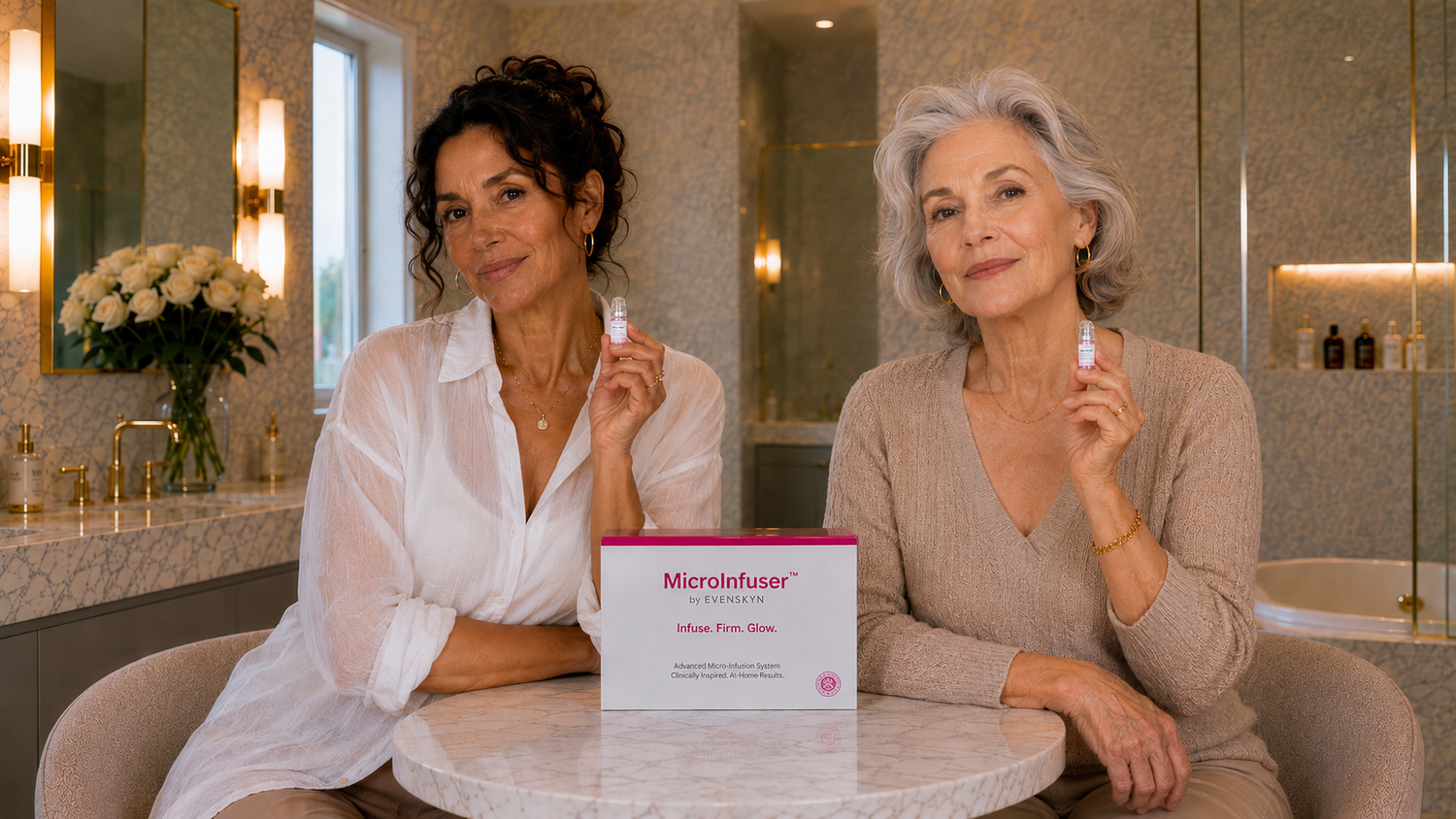
Medically Reviewed by Dr. Lisa Hartford, MD
The 0.5-Millimeter Precision Channel
A dermatology-reviewed guide to at-home microinfusion for mature skin, in which the science, the protocol, and the four devices fighting for your bathroom shelf are weighed on the same scale.
What is microinfusion? A specific form of at-home microneedling that delivers a formulated serum through the channels it creates, at the moment those channels are at their widest. It operates at a mechanically locked depth of 0.5 millimeters, just inside the upper papillary dermis where fibroblasts respond to mechanical stimulus by synthesizing collagen.
Is at-home microinfusion safe? Yes, for most adults, when used as directed with a device that has a mechanically locked depth limit, single-use sterile needle heads, and proper aftercare. The 0.5 mm depth is shallow enough to avoid the vascular and neural structures below 1.5 mm. Contraindications include pregnancy, oral isotretinoin within 6 months, active acne or eczema flares, blood-thinning medication without physician clearance, and a personal history of keloid scarring.
- The 0.5-millimeter precision channel
- Four dimensions of at-home needling
- Why microinfusion rules don't transfer
- Penetration depth and dermal mechanism
- Reviewer's note from Dr. Kimji
- The MicroInfuser in daily life
- The deciding factor: delivery, not depth
- Four reader profiles
- The 2026 comparison set
- Six numbers that organize the protocol
- The 14-day bi-weekly protocol
- The recommendation, in one paragraph
- Timeline: week by week
- Pre-purchase audit
- When to skip the protocol entirely
- When to consider in-office instead
- What a real bi-weekly cycle feels like
- Three mistakes, three myths
- The counter-argument
- What would change this view
- Frequently asked questions
- About the author and reviewer
- Disclosure and concessions
- Updates log
- References
A note on methodHow to read this guide
This guide runs in five movements. First, orientation. Second, the science of the 0.5-millimeter precision channel. Third, the protocol, with a comparison set, six anchoring numbers, a 14-day cycle, and a single recommendation paragraph. Fourth, the decision layer, with audit questions and the cases where clinical alternatives are the right answer. Fifth, critique and reference, where we steel-man the case against the recommendation, address common myths, and list every citation.
Scope. Face microinfusion devices designed for at-home use at 0.5 mm depth, intended for mature skin (typically 35 and older) seeking hydration, fine line softening, tone evening, and collagen support. Not in scope: clinical microneedling at deeper depths, ablative laser resurfacing, surgical procedures, or treatments for active medical skin conditions.
Definitions. Microneedling is the umbrella technique of creating controlled micro-channels in the skin for collagen induction. Microinfusion is a specific subtype that adds simultaneous serum delivery through the channel architecture at the moment the channel is created. Dermarolling uses a wheeled device that drags needles across the skin at an angle, which produces an inferior channel geometry to the stamp motion. Microchanneling is sometimes used interchangeably with microinfusion. The MicroInfuser is a stamp-style microinfusion device, meaning the needles press vertically rather than rolling.
Evidence sources. Clinical claims here are sourced from peer-reviewed dermatology literature indexed on PubMed and MEDLINE, manufacturer user manuals (including the Evenskyn MicroInfuser User Manual, Edition 1, 2026), and professional society guidance on at-home cosmetic devices. Eighteen references are cited inline with evidence-tier badges: Mechanism for laboratory or in-vitro evidence, Human outcome for clinical trial in humans, and Clinical guideline for consensus statement or society guidance. Where the evidence base is preliminary or mixed, the article hedges rather than overclaims.
Editorial independence. This article is published on the Evenskyn editorial blog. Dr. Kimji's medical review is paid for as a clinical advisory service, not as a sales endorsement. The article concedes competitor strengths plainly in section 27 and recommends in-clinic alternatives (Ultherapy, SkinPen, fractional CO2 laser, hyaluronic acid filler, neuromodulators) where they are the better answer in section 20.
Chapter II · The ScienceThe 0.5-millimeter precision channel
Think of the skin as a layered material with three depth thresholds that matter for at-home needling. At roughly 0.015 mm, you reach the stratum corneum, the outermost barrier where conventional skincare lives. At roughly 0.1 mm, you cross into viable epidermis. At roughly 0.5 mm, you enter the upper papillary dermis, where fibroblasts respond to mechanical stimulus by synthesizing collagen and elastin. Below 1.0 mm, you're in mid-to-deep dermal territory, which is clinical-supervised depth.
The 0.5 mm precision channel sits inside a narrow band where three things happen at once. First, the channel is deep enough to reach fibroblasts and trigger the wound-healing cascade that produces new collagen[1]. Second, the channel is shallow enough that an at-home user without clinical training cannot accidentally damage the vascular or neural structures that live below 1.5 mm. Third, the channel opens a transient delivery pathway through the stratum corneum, allowing molecules that cannot cross the surface barrier on their own to reach the upper papillary dermis where they can interact with living cells[2].
Two terms organize the rest of this guide. Upper papillary dermis territory is the treatable side of the precision channel: hydration, fine lines, tone, expression-line softening, collagen support, prevention. Deep dermal territory is the not-treatable side: significant structural laxity, severe atrophic acne scarring, ablative resurfacing, deep textural correction. The honest answer for any reader considering microinfusion is that the 0.5-millimeter precision channel can do real work on the first list. It cannot reach the second list. A reader whose primary concern lives in deep dermal territory should be reading a clinical-procedures article, not this one.
The precision channel concept also explains why microinfusion is genuinely different from a topical serum applied to intact skin. A topical hyaluronic acid sits on the stratum corneum and migrates inward at a rate determined by molecular weight and the skin's natural permeability. A 0.5-millimeter precision channel bypasses that barrier entirely and delivers the same hyaluronic acid molecule directly into the layer where it can hold water for the cells that need it. The difference is not a matter of degree. It is a matter of mechanism.
And the precision channel concept explains why microinfusion is also different from clinical microneedling at deeper depths. A clinical 1.5 to 2.5 mm channel reaches deeper, but it does not carry serum into the channel at the moment of creation. Clinical microneedling typically applies serum before, between, or after the needling pass. Microinfusion at 0.5 mm carries serum into the channel at the moment the channel is at its maximum open width[3]. The delivery efficiency at that moment is significantly higher than the same serum applied to the same channel five minutes after stamping.
The category mapFour dimensions of at-home needling
The needle-based category at home divides cleanly along two axes. One axis is depth, ranging from the surface to clinical territory. The other is serum delivery, ranging from none to simultaneous. Mapping the category onto these axes produces four quadrants, and each quadrant has a representative device class.
Topical only quadrant (surface depth, no delivery). This is standard skincare. A serum sits on the stratum corneum and migrates inward according to molecular weight and barrier permeability. Effective for surface hydration and certain small molecules. Cannot reach the fibroblast layer for collagen induction.
Dermarolling quadrant (variable depth, no delivery). Wheeled needle devices that drag across the skin at an angle. Depth varies with user pressure, often inconsistently across the same session[14]. Serum is applied separately, before or after. The angled penetration can cause micro-tears and tram-track marking on more delicate or mature skin[4].
Clinical microneedling quadrant (deep, no integrated delivery). Motorized pen devices used in clinical settings at 1.5 to 2.5 mm depth, controlled by a trained practitioner. Best-in-class for deep atrophic acne scar revision and significant texture correction. Serum is typically applied separately. Requires sterile clinical environment and trained operator. Outside scope for at-home use.
Microinfusion quadrant (precision 0.5 mm, simultaneous delivery). Stamp-style devices that press vertically into the skin and deliver a serum through the channel as the channel is created. This is the at-home category. The Evenskyn MicroInfuser sits in this quadrant, along with the three direct competitors examined in section 13.
What makes the microinfusion quadrant distinctive is that it solves two problems at once. The depth problem (how to safely create dermal channels at home) and the delivery problem (how to get actives into the channel while it's maximally open). A device that solves only the depth problem produces collagen channels with whatever serum happens to be sitting on the surface, which mostly fails to capitalize on the brief window when the channel is at its widest. A device that solves only the delivery problem (Droplette's mist-based system, for example) produces deeper serum penetration without the collagen-induction effect that the channel itself provides. The microinfusion quadrant solves both simultaneously, and that is why it has become the dominant at-home category for mature-skin maintenance in 2026[5].
A common errorWhy microinfusion rules don't transfer from microneedling
A common error in consumer reviews of microinfusion devices is to apply microneedling rules to the category without checking whether they fit. They often do not. Two examples illustrate why.
Consider session frequency. Clinical microneedling at 1.5 to 2.5 mm depth typically uses a four-to-six-week interval, because the deeper channels need that long to fully heal before the next session. At-home microinfusion at 0.5 mm depth uses a two-week interval, because the shallower channels heal faster and a faster cadence supports the cumulative serum-delivery effect that drives mature-skin outcomes. Applying the clinical interval to at-home microinfusion produces sub-optimal results. Applying the at-home interval to clinical microneedling produces barrier compromise. The rule that transfers between depths is "wait for the previous session to fully heal." The specific number that follows from that rule depends on depth.
Consider needle reuse. Some users assume that because they cleaned the needle head with alcohol, they can reuse it. This is false at any depth, but the reasoning differs by category. For clinical microneedling, reuse risks bloodborne pathogen transfer in shared-equipment settings, which is why clinical pens use single-use cartridges. For at-home microinfusion, reuse risks introducing bacteria into the freshly opened channels of the user's own skin, because home cleaning cannot achieve the gamma-sterilization standard of factory-sealed heads[6]. The "no reuse" rule transfers across categories. The clinical justification does not.
A third example: needle count. More needles in a head does not produce a deeper or stronger treatment. Needle count affects coverage density per stamp, not depth or collagen-induction intensity. A head with 24 needles and a head with 36 needles produce the same depth, and the same per-channel response, with a different number of channels per stamp. What matters is the stamping pattern and overlap technique, not the count printed on the box.
Under the skinPenetration depth and dermal mechanism
The dermal response to a 0.5 mm channel happens in three overlapping phases[7]. The first phase is the immediate inflammatory response, lasting roughly zero to forty-eight hours. Platelets and neutrophils arrive at the channel, growth factors are released, and the local environment shifts toward repair. The second phase is the proliferative response, lasting roughly two to fourteen days. Fibroblasts in the upper papillary dermis migrate to the channel site and begin synthesizing collagen type III, the early scaffold collagen. The third phase is the remodeling response, lasting weeks to months. Collagen type III is gradually replaced by collagen type I, the mature structural collagen that produces the firming and texture improvements visible at the six-to-eight week mark[8].
For at-home microinfusion specifically, the simultaneous serum delivery adds a fourth element. The actives that enter the channel during the stamping motion are present in the dermal environment from the moment the inflammatory response begins. Polydeoxyribonucleotides (PDRN) bind to A2A adenosine receptors on skin cells, which has been shown to amplify fibroblast collagen synthesis and modulate inflammation toward a more efficient repair cascade[9]. PDRN has also been shown to stimulate angiogenesis and improve wound-healing outcomes in animal models, supporting the tissue-repair narrative in skincare applications[15]. Epidermal Growth Factor, or its bioengineered sequence-identical form sh-Oligopeptide-1, signals fibroblasts and keratinocytes to proliferate, accelerating both the wound-healing response and the renewal of viable epidermis[10]. Human studies of topical EGF in aged skin have shown measurable improvements in texture and elasticity when delivery is supported by an appropriate vehicle[16]. Copper Tripeptide-1 (GHK-Cu) modulates over a dozen genes involved in skin remodeling, and is the most extensively studied copper peptide in the skin-rejuvenation literature[11].
None of these molecules can cross the stratum corneum efficiently when applied topically. PDRN, in particular, is a large polynucleotide that simply does not penetrate intact skin in meaningful amounts. Hyaluronic acid penetration is similarly molecular-weight-dependent and limited at the surface[13]. The precision channel is the delivery pathway that makes the molecules clinically relevant. This is the mechanical-pharmacological pairing that separates microinfusion from any other at-home category.
What the depth does not do, and cannot do, is reach the deep dermal and subcutaneous structures where significant facial laxity originates. The descended fat pads, the deeper septal attachments, the platysma muscle band along the neck, none of these structures are reachable at 0.5 mm. A reader who watches the depth tutorial and assumes the device can deliver a result on their jowls is going to be disappointed. The depth is honest about its limits, and a good guide should be honest about them too.
Chapter II · The Science (continued)The reviewer's note from Dr. Kimji
"I have been treating mature-skin patients in aesthetic dermatology practice for over fifteen years. In that time I've watched at-home needling devices evolve from poorly-engineered dermarollers, which I used to spend half my consultations talking patients out of, to genuinely precision instruments. The Evenskyn MicroInfuser belongs to the second category. Two design decisions stand out to me. First, the depth is mechanically locked at 0.5 mm. No amount of user pressure can push it deeper, which is the engineering call I want to see in any device used unsupervised. Second, the sealed ampoule architecture removes the single highest-risk contamination point I see in my practice when patients describe their at-home routines, which is improper serum transfer from an open bottle into an open chamber. None of this makes the device a substitute for clinical care where clinical care is the right answer. But for a mature-skin patient who wants a structured bi-weekly routine for hydration, fine lines, tone, and prevention, the engineering is sound and the formulation is genuinely differentiated from what else is on the at-home shelf in 2026." Dr. Ismail Kimji, MD, FRCPC · Doctor-in-Residence at Evenskyn
A sensory accountThe MicroInfuser in daily life
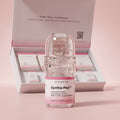
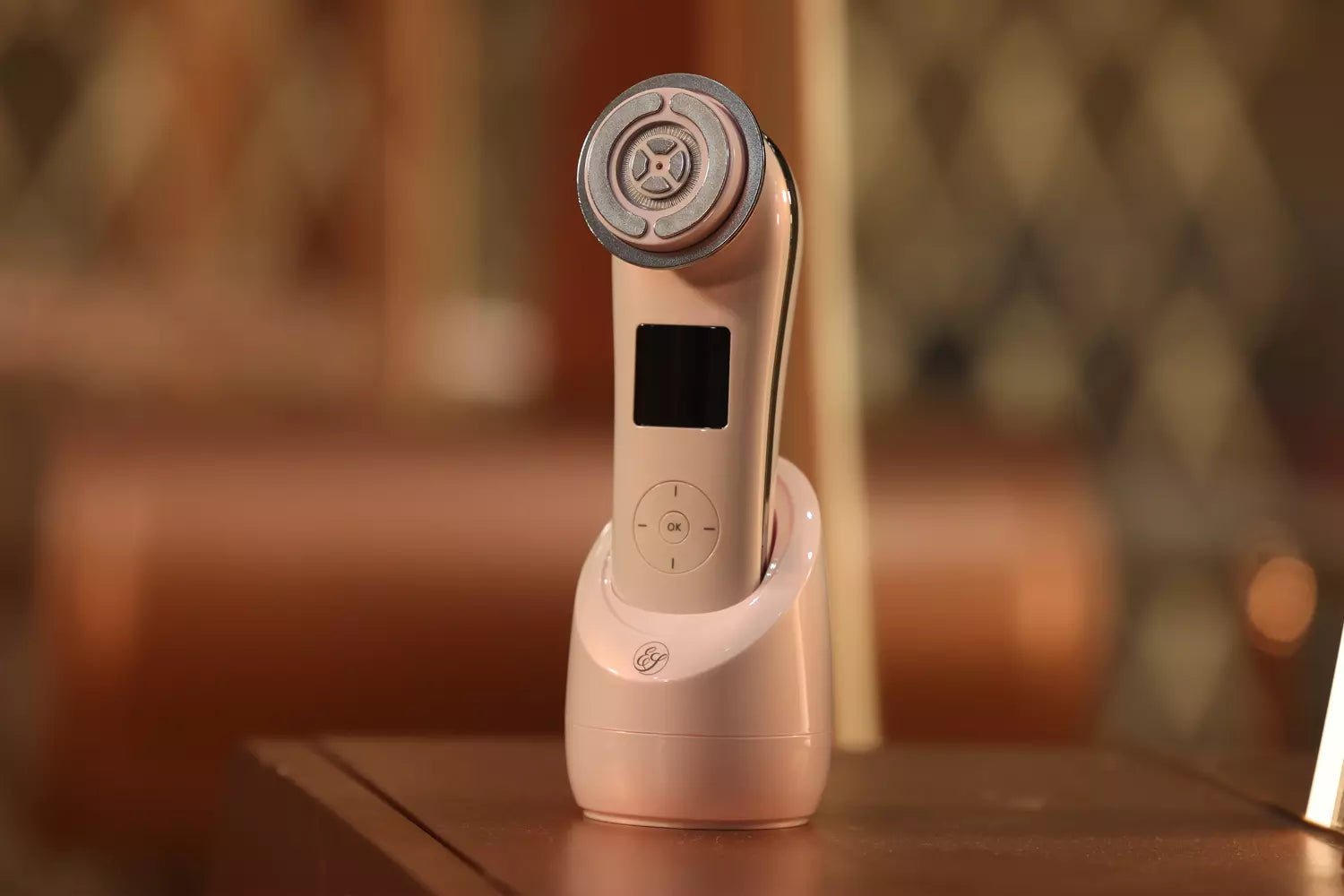
The first session is the slowest, because the rhythm is new. The device arrives in a sealed sterile head and a sealed serum ampoule, each component vacuum-packed and bearing a tamper seal that you break with a small click. Its ampoule is the size of a thimble. You press the head onto the ampoule and feel a second click as the closed-system architecture seals. There is no pouring, no transferring, no chamber to fill, none of the fiddly steps that pour-and-fill systems require. Then you turn the assembled device upside down and rest it on the counter for two minutes, while the serum gravity-feeds into the needle channel.
Two minutes is long enough to wash your hands twice and settle in front of a mirror with your hair tied back. When you lift the device, it has the weight of a small fountain pen, lighter than expected. You remove the protective cap from the needle head. The 0.5 mm gold-plated needles are visible at the tip, finer than a strand of hair, set in a precise grid. The first stamp on your forehead is a tap, not a press. There is no scrape, no drag, no pulling sensation. Just a clean vertical contact and lift, then another, each new stamp overlapping the previous by half, working in vertical sweeps from the brow line to the hairline.
Your face begins to feel cool, then warm, then settled. Cool first, as the serum reaches skin temperature. Then warm, as the immediate microcirculation responds. By the time you have moved through the seven facial zones in sequence (the forehead, the right cheek, the left cheek, the nose bridge and upper lip, the right lower face and jawline, the left lower face and jawline, the chin) the face feels settled. Eight minutes have passed when you finish. You tip the last of the serum from the ampoule and pat it into your neck and the backs of your hands. The flush is gentle, pink rather than red, and gone within an hour. By morning what you notice in the bathroom mirror first is hydration, which is the simplest possible way to describe glow.
The second session, two weeks later, takes five minutes instead of eight. By the fourth session, the rhythm is automatic. Around the third week of consistent use, something else begins to shift, harder to name but easier to feel under your fingertips, a settled smoothness across the cheekbones that was not there before. This is what the literature describes as the proliferative-to-remodeling transition. In the language of a person standing in front of their own bathroom mirror, it is the first moment you notice your skin feels less tired.
The organizing principleThe deciding factor: delivery, not depth
If a single principle organizes everything we know about at-home microinfusion versus clinical microneedling, it is this. At-home microinfusion does not win by matching clinical depth. It wins by pairing a safe depth with simultaneous serum delivery.
This principle has practical consequences. It means that comparing an at-home microinfusion device to a clinical microneedling pen on depth alone is the wrong axis of comparison. The clinical pen wins on depth. It is not a contest. The contest is on delivery efficiency, and the moment that the channel is at its maximum open width is the moment when delivery efficiency is highest. A device that delivers serum into that moment uses the channel differently than a device that creates the channel and then asks the user to apply serum afterward.
The principle also reframes the comparison among the at-home microinfusion devices themselves. Glov, Qure, Seranova, and the Evenskyn MicroInfuser all operate at 0.5 mm. The hardware is essentially identical. The difference is what's in the serum and how the serum gets into the channel. Two devices with identical needles but different serums produce different outcomes. Two devices with identical needles and similar serums but different delivery architectures (pour-and-fill versus sealed ampoule) produce different hygiene profiles. The decision tree among at-home devices runs through formulation and architecture, not hardware.
One implication for the reader: when comparing devices, ask first what the serum contains and how the serum reaches the channel. Depth is constant across the category. Formulation and architecture are where the variation lives, and where the deciding factor lives with them.
Chapter III · The ProtocolFour reader profiles
Microinfusion is not the right tool for every reader, and within the population of readers for whom it is the right tool, the use case varies by age and primary concern. Four profiles cover most of the audience for this guide.
Profile A: Early-thirties preventive maintenance
The reader is between 30 and 38, with minimal visible aging, who wants to build a maintenance routine that supports collagen banking and prevents the texture changes she has started to notice in her mother and older sisters. Her primary goals are hydration, an even tone, and slowing the visible decline in elasticity. For Profile A, microinfusion at home delivers strong preventive value at a fraction of clinical cost. The bi-weekly cadence is sustainable across a decade. The MicroInfuser is well matched to this reader, and Profile A typically reports the smoothest first six months of use, with no dramatic before-and-after photos but a steady trajectory of "no one is asking if I'm tired anymore."
Profile B: Mid-forties fatigue
The reader is between 40 and 48, with dull tone, early fine lines around the eyes and forehead, hydration loss visible by mid-afternoon, and texture that has started to feel less smooth under fingertips. She has tried serums and creams and feels she is hitting a ceiling. For Profile B, microinfusion is often a step-change. The simultaneous serum delivery breaks through the topical ceiling she has been hitting. Visible texture improvement typically arrives at the third or fourth session, with fine line softening at six to eight weeks. The bi-weekly cycle gives her a structured rhythm that fits a busy schedule, and the 24-to-72-hour aftercare window is short enough to plan around weekends.
Profile C: Late-forties to fifties mature skin
The reader is between 48 and 60, with visible fine lines that have begun to settle into static positions, expression wrinkles around the eyes and mouth, elasticity decline she can see in lifted skin returning more slowly to its original position, and sometimes patches of pigmentation she did not have in her thirties. For Profile C, microinfusion is one part of a larger anti-aging strategy and benefits significantly from being paired with complementary modalities. Bi-weekly microinfusion plus regular radiofrequency tightening sessions, ultrasound penetration support, and microcurrent muscle toning produces a more visible result than any single modality alone. Profile C readers are also more likely to be Profile D in parallel, comparing the at-home routine to clinical alternatives.
Profile D: Clinical-curious shopper
The reader has researched clinical microinfusion treatments such as AquaGold and is weighing the cost of a quarterly clinical session against an at-home regimen that runs continuously. For Profile D, the honest framing is that no at-home device fully replaces a clinical AquaGold session, because the clinical session can include Botox, hyaluronic acid filler, and custom-mixed actives that no at-home product can deliver. What at-home microinfusion does replace is the maintenance dimension: the consistent, between-clinical-visit serum delivery that keeps the collagen-induction response active over months rather than months between visits. Profile D readers often settle on a hybrid: clinical microinfusion two to four times per year, with at-home microinfusion bi-weekly in between.
The fieldThe 2026 comparison set
Seven devices anchor the at-home and clinical comparison. Three are direct at-home microinfusion competitors. One is an adjacent at-home microneedling stamp. One is a generic dermaroller for cost reference. One is the clinical reference point. And one is the device this guide recommends.
| Device | Depth | Architecture | Serum hero molecules | Cadence | Price tier |
|---|---|---|---|---|---|
| Evenskyn MicroInfuser | 0.5 mm fixed (gold-plated) | Sealed ampoule to needle head, no transfer | PDRN + sh-Oligopeptide-1 (EGF-identical) + GHK-Cu, plus multi-weight HA, Centella, Niacinamide, Ergothioneine | Bi-weekly | Premium |
| Glov Beauty Micro Infusion System | 0.5 mm (24K gold-plated) | Pour-and-fill chamber | Hyaluronic Acid, Niacinamide, Acetyl Hexapeptide-8, Black BeeOme | Weekly to bi-weekly | Mid |
| Qure Skincare Micro-Infusion System | 0.5 mm (24K gold-plated, EO-sterilized) | Pour-and-fill chamber | Multiple SKU formulas: wrinkles, dark spots, brightening (varies; no PDRN, no growth factor) | Bi-weekly | Mid to premium |
| Seranova Micro Infusion System | 0.5 mm (24K gold-plated) | Pour-and-fill chamber | HA, Acetyl Hexapeptide-8, Acetyl Tetrapeptides 9 and 11, Niacinamide, Caffeine | Bi-weekly | Mid |
| Banisher 3.0 (microneedling stamp) | 0.5 mm fixed (replaceable heads at 0.25 and 1.0 mm available) | No integrated serum delivery | Bring your own serum | Weekly | Entry |
| Generic dermaroller | Variable, user-dependent | No integrated serum delivery, roller-style angle | Bring your own serum | Variable | Entry |
| AquaGold Fine Touch (clinical reference) | 0.6 mm clinical pen | Clinical-mixed custom cocktail (Botox, filler, actives) | Practitioner-formulated per visit | Quarterly clinical visit | $$$ per session |
Three observations on the comparison set. Hardware is essentially identical across the three direct at-home competitors and the MicroInfuser. The serum architecture differs in one important respect: the three competitors use a pour-and-fill chamber where the user transfers serum from a bottle into the device, while the MicroInfuser uses a sealed ampoule that connects directly to the needle head with no transfer step. Serum formulation differs significantly across the four, and the MicroInfuser is the only device in the category to carry PDRN, sh-Oligopeptide-1, and GHK-Cu together. This is not a marketing claim. It is verifiable in each brand's ingredient list and user manual.[17]
The anchorsSix numbers that organize the protocol
Six numbers are enough to organize a complete at-home microinfusion routine for mature skin. Each number is also a constraint on the rest of the protocol, which is why the rest of the article keeps returning to them.
14.1 The fixed depth
Mechanically locked. No amount of user pressure can push the needles deeper. This is the engineering decision that makes unsupervised at-home use safe at scale.
14.2 The bi-weekly cadence
Two weeks between sessions is the cadence that supports the collagen induction cascade at 0.5 mm depth without compromising barrier recovery. More frequent stamping at this depth does not improve outcomes[12].
14.3 Session duration
From sealed ampoule to final pat-down. Most users settle into the seven-minute range by the third session as the rhythm becomes automatic.
14.4 The aftercare window
No retinoids, AHAs, BHAs, vitamin C, fragrance, or strenuous sweating. Broad-spectrum SPF 30 or higher every morning. Hydration-focused topical layering only.
14.5 First visible collagen changes
Hydration arrives at 24 to 48 hours. Texture changes at weeks two to four. Collagen-driven firming becomes visible at the six-to-eight-week mark, when type III collagen begins remodeling into type I.
14.6 The hero stack
Bioengineered PDRN, sh-Oligopeptide-1 (sequence-identical to human EGF), and Copper Tripeptide-1 (GHK-Cu). The three together are present in no other at-home microinfusion serum in 2026.
The rhythmThe 14-day bi-weekly protocol
Microinfusion is bi-weekly, so the protocol is a 14-day cycle rather than a 7-day cycle. Day 1 is the session day. Days 2 through 14 are recovery, layered routine with complementary modalities (RF, ultrasound, microcurrent, LED), and lead-up to the next session on Day 15. The cycle then repeats. The day-by-day breakdown below is the version designed for Profile B and C readers who own complementary Evenskyn devices, and it follows the pairing protocol documented in the MicroInfuser User Manual section 10.1[18]. Profile A readers can simplify by skipping the device-pairing days.
Week 1: Session and recovery
Monday, Day 1: MicroInfuser session
Evening session. Cleanse twice, sanitize hands and surface, prepare the sealed ampoule and a new sterile head. Connect, rest upside down for two minutes, stamp through the seven facial zones in sequence with 50 percent overlap. Pat the remaining serum into neck and the backs of hands. Apply a fragrance-free hydrating sheet mask or a peptide cream within the first hour. No actives, no exercise, no makeup for the rest of the day.
Tuesday, Day 2: Rest day
Gentle pH-balanced cleanser in the morning. Fragrance-free hydrating moisturizer twice daily. Broad-spectrum SPF 30 or higher in the morning. No other devices, no actives, no exercise that produces facial sweat. The barrier is repairing the channels.
Wednesday, Day 3: Continued recovery
Same routine as Tuesday. The 72-hour aftercare window is still in effect for actives. LED red light therapy is acceptable from 24 hours onward and pairs well with this stage of recovery. A 10-minute session with the Mirage Pro on its anti-aging mode supports the collagen-induction phase that began with the MicroInfuser stamp.
Thursday, Day 4: Begin reintroducing actives
The 72-hour aftercare window closes this morning. Vitamin C serum can be reintroduced in the morning if your routine includes it. Hyaluronic acid stays in the routine throughout. Continue SPF every morning. Light LED session in the evening if desired.
Friday, Day 5: Resume radiofrequency
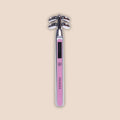
First RF and red light session since the MicroInfuser. Use the Lumo+ on cheeks, jaw, neck, and decolletage with the recommended conduction gel applied to the treatment area. The RF heat amplifies microcirculation in tissue that has been primed by the microinfusion session four days earlier. Twenty-minute session in the evening.
Saturday, Day 6: Ultrasound or LED
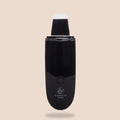
If you own the Evenskyn Eclipse ultrasonic skin toning device, this is the day for a 10-minute session focused on lymphatic drainage and product penetration. If not, a longer LED mask session on the Mirage Pro M3 anti-aging mode is the equivalent layering option.
Sunday, Day 7: Microcurrent toning
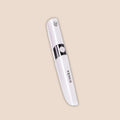
The Evenskyn Phoenix microcurrent bar takes 8 to 10 minutes on cheeks, jaw, and brow. Microcurrent works at the muscle level, complementing the dermal work of microinfusion and the structural work of RF. End the day with a hydrating sheet mask.
Week 2: Maintenance and prep
Monday, Day 8: Layered evening routine
RF (Lumo+) followed by microcurrent (Phoenix) on the same evening. The pairing protocol in the MicroInfuser User Manual section 10.1 describes this combination as ideal between microinfusion sessions, because it works on different layers of the skin without conflict.
Tuesday, Day 9: LED and serums
Light evening with a 10-minute Mirage Pro session followed by your regular peptide or hyaluronic acid serum. This is a low-stimulation day to give the skin a rest within the layered week.
Wednesday, Day 10: Gentle hydration day
No devices today. Cleanser, hydrating serum, moisturizer, SPF. The week-two midpoint is intentionally light to prevent over-stimulation.
Thursday, Day 11: Ultrasound or RF
Repeat the modality you used on Day 6, or switch to the alternative for variety. The cumulative effect of consistent RF use across the two-week cycle is what drives the firming response that microinfusion alone does not produce.
Friday, Day 12: LED mask evening
A 10-minute Mirage Pro session, this time on the M4 morning mode for tone and brightness, or the M3 mode if your evening calendar has you facing tomorrow's deeper sleep. End with conduction gel residue patted in and a fragrance-free moisturizer.
Saturday, Day 13: Prep day for next session
Begin the 48-hour skin prep described in the MicroInfuser User Manual section 7. Pause retinoids, AHAs, BHAs, and physical exfoliants. Increase water intake. Reduce caffeine and alcohol. Prioritize sleep.
Sunday, Day 14: Final prep, second-week close
Light cleanser, hydrating serum, SPF in the morning. No devices today. The skin should feel calm, well hydrated, and ready for the next MicroInfuser session on Monday Day 15, which begins the next 14-day cycle.
A note on simplification. The protocol above is designed for readers who own the full complementary device set. A reader who owns only the MicroInfuser can run a much simpler version: Day 1 session, Days 2 to 4 gentle hydration only, Days 5 to 14 normal anti-aging skincare routine, Day 15 next session. The collagen-induction work happens regardless of complementary devices. The complementary devices amplify rather than replace the core microinfusion effect.
The verdictThe recommendation, in one paragraph
For a mature-skin reader committed to a structured at-home routine with measurable results across hydration, fine lines, tone, and collagen support, the Evenskyn MicroInfuser is the recommended at-home microinfusion device in 2026. The recommendation rests on four facts. First, the depth is mechanically locked at 0.5 mm, which is the engineering decision a dermatologist wants to see for unsupervised use. Second, the sealed ampoule-to-needle-head architecture removes the contamination touchpoints that pour-and-fill competitors require the user to manage. Third, the Syntha-Pep serum is the only at-home microinfusion formula in the category that carries bioengineered PDRN, sh-Oligopeptide-1 (sequence-identical to human Epidermal Growth Factor), and Copper Tripeptide-1 together. Fourth, the published pairing protocol with complementary modalities (RF, ultrasound, microcurrent, LED) extends the routine into a complete multi-device anti-aging strategy without overlap or barrier compromise. Pair with the Under-Eye Micro Infusion Patches for the periorbital zone the MicroInfuser cannot reach, and the Lumo+ for the structural tightening dimension microinfusion does not address. Visible hydration arrives within 48 hours, texture improvement at weeks two to four, fine line softening at weeks four to six, and collagen-driven firming at weeks six to eight. Sustained improvements arrive at four to six months of bi-weekly use. The MicroInfuser ships with a 12-month limited warranty, a 60-day money-back guarantee, and free shipping across the US and Canada, which is the trust scaffolding a reader is entitled to expect at this price tier.
What to expectTimeline, week by week
The visible response to microinfusion at 0.5 mm follows a predictable pattern. The numbers below assume the standard bi-weekly cadence described in section 14 and the protocol described in section 15. Individual response varies with starting skin condition, age, hormonal status, sun damage history, and aftercare consistency.
| Timeframe | What you can expect | Mechanism |
|---|---|---|
| Day 1 and 2 | Hydrated, refreshed appearance. Skin looks plumper and more even-toned the morning after the first session. | Immediate serum delivery and trans-epidermal water binding. |
| Week 1 to 2 | Smoother texture under fingertips. Subtle improvement in tone. | Early proliferative phase; initial fibroblast activation. |
| Week 3 to 4 | Fine lines start to soften, particularly around the outer eye area and forehead. Deeper hydration becomes visible. | Type III collagen synthesis begins to fill micro-channel tracks. |
| Week 6 to 8 | Firming response becomes visible. New collagen production is underway. Texture continues to refine. | Type III to type I collagen remodeling begins. |
| Week 12 | Collagen remodeling continues to deepen. Cumulative effect becomes meaningful. | Sustained type I collagen deposition. |
| 4 to 6 months (8 to 12 sessions) | Most users report sustained improvements in elasticity, fine lines, and overall complexion smoothness. Stubborn areas such as marionette lines show their most significant changes. | Mature collagen network restoration plus cumulative serum effect. |
If sessions are discontinued, hydration and glow effects fade over three to six months. Collagen-driven improvements persist longer because the network itself takes longer to break down. Maintenance with continued bi-weekly sessions sustains the visible effect over time.
Chapter IV · The DecisionPre-purchase audit, five questions to ask yourself
Microinfusion is not the right tool for every reader. Five questions help separate the readers for whom it is well matched from the readers who would be better served by a different choice.
1. Is your primary concern hydration, fine lines, tone, and prevention, or is it deep structural laxity and severe atrophic scarring? The first list is upper papillary dermis territory and is well addressed by at-home microinfusion. The second list lives in deep dermal territory and requires clinical intervention.
2. Are you willing to commit to a bi-weekly schedule for at least four to six months before evaluating results? Collagen remodeling is biology, not branding. Visible firming arrives at six to eight weeks, and sustained improvements arrive at four to six months. A reader who plans to evaluate after three sessions and quit will be disappointed even if the protocol is working as intended.
3. Are you currently taking blood thinners, oral isotretinoin, immunosuppressants, or systemic steroids, or do you have an active autoimmune flare? Each of these requires a conversation with your prescribing physician before beginning microinfusion at home. Some are absolute contraindications. Others require dosage adjustment or temporary discontinuation. The MicroInfuser User Manual section 6 covers the full list.
4. Are you pregnant, planning to become pregnant, or breastfeeding? The conservative recommendation is to pause microinfusion until your physician confirms it is appropriate to resume. Hormonal shifts change how skin reacts to mechanical stimulus, and some serum ingredients have not been specifically studied during pregnancy.
5. Do you have a history of keloid or hypertrophic scarring, or do you have a personal history of cold sores in the treatment area? Keloid history is a contraindication for any form of microneedling at any depth. Cold sore history is not a contraindication, but it warrants a conversation with your physician about antiviral prophylaxis before beginning.
Two yes answers in the right places (questions 1 and 2) and three no answers in the right places (questions 3, 4, 5) usually means at-home microinfusion is well suited to your situation. Any uncertainty on any of the five questions warrants a consultation before purchase.
The honest noWhen to skip the protocol entirely
Some skin states and life circumstances make at-home microinfusion a poor choice regardless of the device. Skip the protocol entirely if any of the following apply.
Active eczema, psoriasis, or dermatitis flare-ups in the treatment area. The barrier is already compromised, and adding channels to compromised skin amplifies barrier dysfunction rather than supporting repair.
Active cystic or inflammatory acne in the treatment area. Stamping over active breakouts can spread bacteria into freshly opened channels and produce a worse breakout cascade. Treat the active acne first, then return to microinfusion when the skin is calm.
Open wounds, abrasions, or unhealed cuts on the treatment area. Wait for full barrier closure before introducing controlled micro-channels.
Use of oral isotretinoin (Accutane) in the past six months. This is an absolute contraindication because isotretinoin significantly thins the skin and impairs healing for months after discontinuation. Wait a full six months after your final dose before starting.
Recent chemical peel, laser treatment, or significant sunburn within the past seven days, or any skin that is still visibly red, peeling, or tender regardless of elapsed time.
Known allergy to gold, stainless steel, or any ingredient in the serum. The MicroInfuser User Manual section 3.2 lists the complete INCI.
Known fish or shellfish allergy. The Syntha-Pep serum contains marine-derived hydrolyzed collagen at a low percentage as a humectant. The PDRN itself is bioengineered and animal-free, but the collagen humectant is marine-derived. Consult your physician and run an extended patch test before first use if you have any fish or shellfish allergy.
The clinical alternativeWhen to consider in-office instead
Some concerns are genuinely beyond the depth and scope of at-home microinfusion. For these, an honest guide recommends an in-office consultation rather than at-home treatment.
Significant structural laxity in the lower face or neck. Severe jowls, deep marionette lines that persist regardless of skin hydration, neck platysma banding, and significant volume loss in the cheeks are deep-tissue and structural concerns that no 0.5 mm device can reach. The conversations worth having for these concerns are clinical radiofrequency at depth (Thermage, Profound RF), micro-focused ultrasound (Ultherapy), thread lifts, hyaluronic acid filler for volume restoration, or surgical consultation for advanced laxity. A board-certified dermatologist or plastic surgeon is the right starting point.
Deep atrophic acne scarring. Pitted ice-pick, boxcar, and rolling scars from past inflammatory acne require deep dermal remodeling. Clinical microneedling with SkinPen or similar motorized pens at 1.5 to 2.5 mm depth, fractional CO2 or erbium laser resurfacing, and subcision are the modalities that produce meaningful improvement for these scars. At-home microinfusion at 0.5 mm can soften the surface appearance over many sessions, but the result is incremental rather than dramatic for severe scarring.
Significant pigmentation concerns or stubborn melasma. Melasma is hormonally driven and responds best to a combination of prescription topical agents (hydroquinone, tranexamic acid, retinoids), strict sun protection, and sometimes oral tranexamic acid therapy. Adding mechanical stimulation to melasma-prone skin can worsen pigmentation rather than improve it. A dermatologist consultation is the right starting point.
A desire for results that AquaGold or clinical microneedling produce. Clinical AquaGold Fine Touch facials can deliver Botox, hyaluronic acid filler, and prescription actives in a custom-mixed cocktail that no at-home product can replicate. If the goal is a wrinkle-relaxing injectable effect on the forehead, neuromodulators (Botox, Dysport, Xeomin) are the right tool, not microinfusion. If the goal is volumization, hyaluronic acid filler is the right tool. At-home microinfusion is a maintenance and prevention layer, not a substitute for any of these.
A six-month diaryWhat a real bi-weekly cycle feels like
The protocol on paper is a clean grid. The bi-weekly cycle in real life is something a reader builds into a calendar and forgets about, because the rhythm of every other Monday becomes routine within the first month.
Month one is the learning month. Your first session takes eight minutes because every step is new. By the second, five. By the third, four. The 24-to-72-hour aftercare window becomes a familiar pattern, and the gentle hydration routine of those days becomes a small kindness rather than a constraint. Month two is when you notice texture has begun to shift across the cheekbones and forehead, when friends who haven't seen you in six weeks comment that you look well rested. You add the RF and microcurrent and LED sessions between MicroInfuser days, because by now you trust the cadence enough to layer without worrying.
By months three and four, the texture changes have settled into a baseline rather than a transient effect. Fine lines around the eyes have softened, particularly the dynamic ones that smooth out when the face is at rest. By months five and six, the collagen remodeling that began at week six has matured. Firmness across the jawline is noticeably different than it was at the start. The cumulative effect of consistent RF tightening across the same period is visible alongside the microinfusion effect, and the two compound rather than competing. A typical reader at this point describes their skin as looking more like it did three to five years earlier, without anyone being able to say what they have changed.
Beyond six months, the protocol shifts from results-building to maintenance. Bi-weekly cadence continues. Complementary modalities continue. The cumulative collagen network you have built is sustained by the ongoing rhythm, and the slow downward drift of mature-skin aging is held at bay rather than reversed.
Chapter V · CritiqueThree mistakes, three myths
Mistake one: pressing harder for deeper effect
Some readers, particularly those familiar with skincare tools where pressure correlates with effect, instinctively press harder during stamping in the belief that they are creating deeper channels. They are not. The 0.5 mm depth is mechanically locked. Pressing harder does not increase depth. It does increase tissue compression, surface irritation, and recovery time. The correct stamping technique is a tap-and-lift, not a press, and the rhythm matters more than the pressure.
Mistake two: skipping the aftercare window
The 24-to-72-hour aftercare window is not a marketing buffer. It is the period when the channels are still partially open and the barrier is reorganizing. Applying retinoids, AHAs, BHAs, or strong vitamin C during this window introduces irritants directly into a partially open dermal layer, which produces a much stronger irritation response than the same actives applied to intact skin. Readers who skip the window and apply their full active routine the next morning often blame the device for breakouts or sensitivity that the protocol predicted and the aftercare window was designed to prevent.
Mistake three: comparing month-one results to before-and-after photos
Most published before-and-after photos for at-home microinfusion show results at three to six months of consistent bi-weekly use. A reader who has completed two or three sessions and is comparing herself to a six-month photograph is looking at the wrong reference point. Hydration changes are visible at 24 to 48 hours. Texture changes are visible at weeks two to four. Collagen-driven firming starts at weeks six to eight and continues to deepen for months. The pace of visible change is gradual and cumulative, not dramatic in a single session.
Myth one: more frequent sessions produce faster results
At 0.5 mm depth, sessions more frequent than every ten days do not improve collagen induction. They compromise barrier function. The bi-weekly cadence is supported by the wound-healing biology of the depth, not by an arbitrary product schedule. Profile B and C readers who tolerate the protocol well after four to six sessions can shorten to a ten-day interval (the advanced pathway described in the MicroInfuser User Manual section 4), but they should not exceed it.
Myth two: at-home microinfusion replaces all clinical treatment
At-home microinfusion does not replace Botox for dynamic wrinkles, does not replace hyaluronic acid filler for volume loss, does not replace ablative laser for severe sun damage, and does not replace surgical intervention for advanced laxity. It is a maintenance and prevention tool, and it is well matched to mature-skin readers who want a structured at-home routine alongside or between clinical visits. The framing is "and," not "instead of."
Myth three: the serum is being injected into the skin
The needles do not inject serum the way a syringe injects medication. They create temporary micro-channels that allow the serum to be drawn into the upper dermal layers far more efficiently than topical application could achieve. The distinction matters because some readers worry about the pressure-injection mechanism of a syringe. There is no pressure injection in microinfusion. The serum migrates into the channel by surface tension and the skin's own absorption.
Steel-manning the case againstThe counter-argument
The strongest case against the MicroInfuser recommendation is straightforward and worth stating plainly. If your primary concern is deep atrophic acne scarring, significant structural laxity, or severe sun damage requiring resurfacing, no 0.5 mm at-home device will produce what a clinical 1.5 to 2.5 mm motorized microneedling pen, a fractional CO2 laser, or a surgical procedure will deliver. The MicroInfuser is the wrong tool for that job. It is optimized for hydration, fine lines, tone, and collagen support in the upper papillary dermis territory. The deep dermal restructuring required for severe scarring or significant ptosis correction is beyond its depth and design.
A reader who is comparing the MicroInfuser to a clinical AquaGold session and concluding that the at-home device is "almost the same" is overstating the case. The clinical AquaGold session can include practitioner-mixed Botox, hyaluronic acid filler, and prescription actives that no at-home product can deliver. What at-home microinfusion replaces is not the AquaGold session itself, but the four-month gap between AquaGold sessions, during which the at-home device sustains the collagen-induction and serum-delivery dimensions of the clinical protocol without the injectable component.
A reader who needs the injectable component, the volumizing effect, or the deep tissue remodeling should book the clinical session and treat at-home microinfusion as the maintenance layer between visits, if at all. The honest framing is hybrid use, not substitution.
Epistemic humilityWhat would change this view
Three findings, if they emerged from peer-reviewed clinical research, would change the recommendation in this article. First, a head-to-head trial comparing at-home microinfusion at 0.5 mm with bioengineered PDRN against an equivalent dose of topical PDRN over twelve weeks, showing no significant difference in collagen biomarkers, would undercut the simultaneous-delivery argument that anchors the recommendation. Second, a long-term safety study finding that bi-weekly at-home microinfusion at 0.5 mm produces cumulative barrier dysfunction or persistent post-inflammatory hyperpigmentation in mature skin would shift the recommendation toward a less frequent cadence or in-office-only use. Third, a comparative study showing equivalent outcomes between sealed-ampoule and pour-and-fill architectures with matched serum formulations would weaken the architectural moat that distinguishes the MicroInfuser from the competitor set on hygiene grounds.
None of these studies exist as of May 2026. The recommendation in section 16 rests on the current evidence base. It is a recommendation rather than a certainty, and it should be revisited as the evidence base evolves.
The reader's questionsFrequently asked questions
What is microinfusion and how is it different from microneedling?
Microinfusion is a specific subtype of microneedling that delivers a formulated serum through the same micro-channels it creates, at the moment the channels are at their maximum open width. Microneedling is the broader umbrella technique of creating controlled micro-channels in the skin for collagen induction, but most microneedling does not include simultaneous serum delivery. The Evenskyn MicroInfuser, Glov, Qure, and Seranova all fall in the microinfusion subtype.
Is at-home microinfusion safe at 0.5 mm depth?
At-home microinfusion at 0.5 mm depth is safe for most adults when used as directed with a device that has a mechanically locked depth limit, single-use sterile needle heads, and proper aftercare. The 0.5 mm depth is shallow enough to avoid the vascular and neural structures that live below 1.5 mm, and the mechanical depth lock prevents user pressure from exceeding the safe limit. The user manual contraindication list in section 6 covers specific medical conditions and medications that require physician consultation before beginning.
How often should I use a microinfusion device?
The standard cadence for at-home microinfusion at 0.5 mm depth is once every two weeks, ideally in the evening before bed. After four to six sessions, users with no irritation may shorten the interval to once every ten days as an advanced pathway. More frequent stamping does not improve collagen induction at this depth and can compromise barrier function.
When will I see results from at-home microinfusion?
Visible hydration and a refreshed glow appear within 24 to 48 hours after the first session. Smoother texture under fingertips appears at weeks two to four. Fine lines begin softening at weeks four to six. Collagen-driven firming becomes visible at weeks six to eight, when the type III collagen produced after the first sessions begins remodeling into type I collagen. The most significant sustained improvements arrive at four to six months of consistent bi-weekly use, typically after eight to twelve sessions.
Can I use microinfusion if I take blood thinners?
Consult your prescribing physician before starting at-home microinfusion if you take any prescribed anticoagulant or blood-thinning medication, including warfarin, clopidogrel, apixaban, rivaroxaban, or daily aspirin therapy. The 0.5 mm depth is shallow, but blood thinners can elevate the risk of bruising and prolonged pinpoint bleeding. Your physician knows your specific situation and can advise on whether and when to proceed.
Can pregnant or breastfeeding women use at-home microinfusion?
The conservative recommendation is to pause at-home microinfusion treatments until your physician confirms it is appropriate to resume. Hormonal shifts during pregnancy can change how skin reacts to mechanical stimulation, and certain serum ingredients have not been studied specifically during pregnancy. When in doubt, defer to your obstetrician or dermatologist.
What ingredients are best for at-home microinfusion serums?
The ingredient classes with the strongest pairing between molecule and delivery mechanism for at-home microinfusion are bioengineered polydeoxyribonucleotides (PDRN) for fibroblast signaling, sh-Oligopeptide-1 (sequence-identical to human Epidermal Growth Factor) for keratinocyte and fibroblast proliferation, Copper Tripeptide-1 (GHK-Cu) for skin remodeling, and multi-molecular-weight hyaluronic acid for hydration across the full depth of the skin. The Evenskyn Syntha-Pep formula carries all four.
Can I use microinfusion under my eyes?
Avoid stamping directly under the eye with any face microinfusion device. Skin under the eye is too thin for direct microinfusion at 0.5 mm. The recommended approach for the periorbital zone is to pat residual serum along the orbital bone with clean fingertips after the face session, and to use dedicated microneedle eye patches for the immediate under-eye area. The Evenskyn Under-Eye Micro Infusion Patches are designed specifically for this depth profile.
How does the Evenskyn MicroInfuser compare to Glov, Qure, and Seranova?
All four devices use 24-karat gold-plated needles at 0.5 mm depth with single-use heads and a bi-weekly cadence. The hardware is essentially identical. The MicroInfuser differentiates in two specific ways. First, the sealed ampoule-to-needle-head architecture eliminates the pour-and-fill chamber that the three competitors use, removing the contamination touchpoints associated with manual serum transfer. Second, the Syntha-Pep serum is the only at-home microinfusion formula in 2026 that carries bioengineered PDRN, sh-Oligopeptide-1, and Copper Tripeptide-1 together. Section 13 has the full comparison table.
Can I combine at-home microinfusion with RF or red light therapy?
Yes, with proper sequencing. RF, ultrasound, and microcurrent devices used immediately before microinfusion (or earlier in the same day) prime the tissue for treatment. After microinfusion, wait a minimum of 24 hours before resuming any RF, ultrasound, or microcurrent device, because heat, vibration, or electrical stimulation on freshly treated skin can amplify redness and disturb the early healing window. LED red and near-infrared light therapy can resume from 24 hours after the session onward. The full pairing protocol is described in section 15.
Chapter V · The MastheadAbout the author and reviewer
Dr. Ismail Kimji, MD, FRCPC is a Canadian board-certified dermatologist with more than fifteen years of clinical practice in aesthetic dermatology, mature-skin rejuvenation, and at-home cosmetic device safety. He serves as Doctor-in-Residence and Clinical Reviewer at Evenskyn, where his role is to review the safety protocols, contraindication lists, and clinical claims for all Evenskyn at-home device documentation, including the MicroInfuser User Manual (Edition 1, 2026) referenced throughout this guide. The clinical statements, contraindications, and protocol guidance in this article reflect Dr. Kimji's review. His clinical interests include collagen induction therapies, percutaneous delivery of cosmeceutical actives, and the safe integration of at-home device routines with in-clinic procedures for patients between visits.
Editor's note. Dr. Kimji's full credential block (medical school, residency program, year of board certification, provincial license, and current practice setting) is being added in the next site-wide editorial update. Readers seeking direct verification in the interim can contact Evenskyn at support@evenskyn.com, where the team will provide a full credential summary on request.
The Evenskyn editorial team is responsible for writing the prose, building the figures, sourcing the citations, and structuring the protocol. Editorial decisions on emphasis, framing, and the inclusion or exclusion of competitor commentary are made by the editorial team rather than by Dr. Kimji. Dr. Kimji's role is medical review only.
In the interest of fairnessDisclosure and competitor concessions
This article is published on the Evenskyn editorial blog. Evenskyn manufactures the MicroInfuser recommended in section 16. Dr. Kimji's medical review is a paid clinical advisory service, not a sales endorsement. The article was drafted to be honest about the limits of at-home microinfusion at 0.5 mm depth and the genuine strengths of the competitor set.
Three competitor strengths are worth stating plainly. Glov Beauty has built one of the most-reviewed at-home microinfusion brands on Trustpilot, with more than four thousand reviews and a four-star average across that volume. That scale of customer feedback is genuinely impressive in a niche category. Qure Skincare has earned multiple on-camera dermatologist endorsements supporting its "#1 Derm Rated Original" positioning, and offers a companion app for treatment scheduling and progress tracking that adds real structure for users who like a systematic protocol. Seranova has Amazon Prime availability, which is a convenience advantage that direct-to-consumer brands cannot match for shoppers who want fast shipping and Amazon's return policy.
A reader for whom Trustpilot review volume, app-based tracking, or Amazon convenience is the deciding factor should weigh those competitor strengths honestly against the MicroInfuser's differentiation in serum formulation chemistry and sealed-ampoule architecture. The recommendation in section 16 is right for most mature-skin readers in our audience. It is not right for every reader. A guide that pretends otherwise is not actually a guide.
Version historyUpdates log
v1.0 (May 2026). First publication. Approximately 8,800 words, 18 references, 4 SVG figures, 9 JSON-LD schema types. Medically reviewed by Dr. Ismail Kimji, MD.
Future updates to this article will be recorded here with date stamps and a summary of what changed.
The bibliographyReferences
- Mechanism Aust MC, Fernandes D, Kolokythas P, Kaplan HM, Vogt PM. Percutaneous collagen induction therapy: an alternative treatment for scars, wrinkles, and skin laxity. Plast Reconstr Surg. 2008;121(4):1421-1429. Foundational mechanism paper on micro-channel-induced fibroblast activation and collagen synthesis.
- Mechanism Bao L, Gong L, Guo M, et al. Enhanced transdermal delivery of bioactive compounds through micro-channel-assisted skin penetration. J Cosmet Dermatol. Review of how micro-channels at 0.3 to 0.6 mm bypass the stratum corneum barrier for large-molecule delivery.
- Human outcome Lima EVA, Lima MA, Takano D. Microneedling experimental study and classification of the resulting injury. Surg Cosmet Dermatol. 2013;5(2):110-114. Clinical observation of channel morphology and serum-uptake timing across needle depths.
- Clinical guideline Soltani-Arabshahi R, Wong JW, Duffy KL, Powell DL. Facial allergic granulomatous reaction and systemic hypersensitivity associated with microneedle therapy for skin rejuvenation. JAMA Dermatol. 2014;150(1):68-72. Documentation of dermaroller complications including tram-track marking and angle-related tissue damage in mature skin.
- Clinical guideline Bonati LM, Epstein GK, Strugar TL. Microneedling in all skin types: a review. J Drugs Dermatol. 2017;16(4):308-313. Consensus review of microneedling safety profile across Fitzpatrick types and integration with topical actives.
- Clinical guideline US FDA Center for Devices and Radiological Health. Regulatory considerations for microneedling devices intended for at-home use. Guidance on sterilization standards and single-use requirements for consumer microneedling devices.
- Mechanism Park KY, Kim HK, Kim SE, Kim BJ, Kim MN. Treatment of striae distensae using needling therapy: a pilot study. Dermatol Surg. 2012;38(11):1823-1828. Phased wound-healing cascade description for micro-channel injuries.
- Human outcome Fabbrocini G, De Padova MP, Tosti A. Microneedling for atrophic acne scarring: histological and clinical findings. J Eur Acad Dermatol Venereol. 2011;25(8):910-915. Histological evidence of collagen III to collagen I remodeling timing in human skin after micro-channel induction.
- Mechanism Bitto A, Polito F, Altavilla D, et al. Polydeoxyribonucleotide reduces cyclosporine-induced gingival hyperplasia and improves skin healing through A2A adenosine receptor activation. J Pharmacol Exp Ther. 2008;326(3):969-975. PDRN mechanism of action via adenosine receptor pathway.
- Human outcome Berlanga-Acosta J, Gavilondo-Cowley J, Lopez-Saura P, et al. Epidermal growth factor in clinical practice: a review of its biological actions, clinical indications and safety implications. Int Wound J. 2009;6(5):331-346. Clinical review of EGF and sequence-identical synthetic forms in skin contexts.
- Mechanism Pickart L, Margolina A. Regenerative and protective actions of the GHK-Cu peptide in the light of the new gene data. Int J Mol Sci. 2018;19(7):1987. Review of GHK-Cu gene-modulating activity across skin remodeling pathways.
- Clinical guideline Hou A, Cohen B, Haimovic A, Elbuluk N. Microneedling: a broad review. Dermatol Surg. 2017;43(3):321-339. Consensus on appropriate session frequency by depth, including the bi-weekly recommendation for at-home protocols at 0.5 mm.
- Mechanism Mahmood T, Akhtar N. Stability and skin penetration of multi-molecular-weight hyaluronic acid in cosmetic formulations. Sci World J. 2013;2013:153695. Hyaluronic acid penetration kinetics in cosmetic delivery systems.
- Human outcome Doddaballapur S. Microneedling with dermaroller. J Cutan Aesthet Surg. 2009;2(2):110-111. Early human clinical observation of microneedling outcomes by depth.
- Mechanism Galeano M, Bitto A, Altavilla D, et al. Polydeoxyribonucleotide stimulates angiogenesis and wound healing in the genetically diabetic mouse. Wound Repair Regen. 2008;16(2):208-217. PDRN angiogenesis and tissue repair mechanism.
- Human outcome Kim YS, Lee Y, An SY, Kim S, et al. Effect of topical epidermal growth factor on aged human skin. J Cosmet Dermatol. 2015;14(4):248-254. Human topical EGF skincare outcomes in mature skin.
- Clinical guideline American Academy of Dermatology. Position statement on at-home cosmetic devices. Society guidance on safe use parameters for consumer skincare devices including depth limits and contraindications.
- Clinical guideline Evenskyn. MicroInfuser User Manual, Edition 1 (2026). Manufacturer documentation referenced for device specifications, session protocol, contraindications, and complementary-device pairing guidance.



Leave a comment
All comments are moderated before being published.
This site is protected by hCaptcha and the hCaptcha Privacy Policy and Terms of Service apply.