
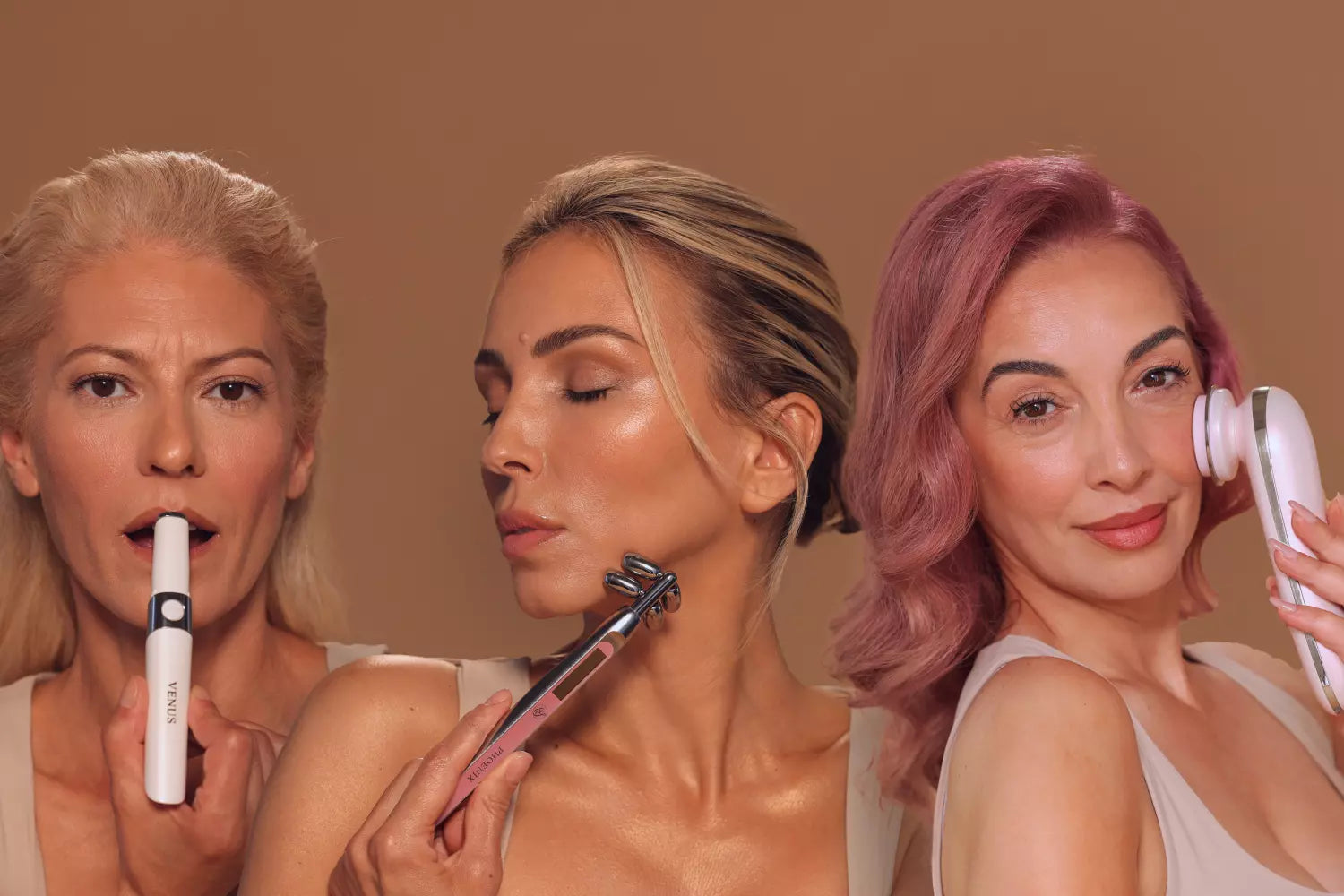
Best Micro-Infusion System 2026: How to Choose
Best Micro-Infusion System 2026: How to Choose
At-home micro-infusion has become one of the busiest categories in skincare, and one of the least honestly reviewed. This is a criteria guide, written by the team that builds one of these systems, so you can judge any kit on the record rather than on a listicle's say-so.
The short version
A micro-infusion system is a stamp fitted with very short needles that opens temporary channels in the skin's surface, then delivers a serum through those channels rather than onto the skin. Judged on the things that actually vary between kits, a good one has a fixed and disclosed needle depth, a sealed serum path that never meets open air or fingers, single-use sterile heads, a published full ingredient list, and honest cost-per-session math including refills.
The EvenSkyn MicroInfuser meets those criteria at a fixed 0.5 mm depth with a sealed ampoule-to-head design and a serum carrying fermentation-derived PDRN, sh-Oligopeptide-1 and Copper Tripeptide-1. Listed at $189.99 for a four-session kit, that works out to about $47.50 a session. It is not the cheapest option, it is not a clinic treatment, and the visible firming everyone wants still takes six to eight weeks. Anyone who tells you otherwise is selling, not reviewing.
At-home skin boosters, explained
The phrase "skin booster" started in clinics, where it described injectable treatments that place hydrating and regenerative ingredients into the skin rather than sitting on top of it. The at-home category borrowed the language, and micro-infusion systems are the most direct home equivalent of that idea: instead of an injection, a stamp of very short needles makes temporary channels, and a serum travels down them.
That single mechanical difference is the whole category. A serum applied with fingers has to cross the stratum corneum, the dense outer barrier layer whose job is specifically to keep things out. A serum delivered through open channels bypasses part of that obstacle. A 2017 review in Clinical, Cosmetic and Investigational Dermatology described the mechanism plainly: needle penetration sets off a wound healing cascade while doing minimal damage to the epidermis, which allows better absorption of topical agents across the thick stratum corneum.
Two things follow from that, and both matter when you are choosing. First, the serum stops being an accessory and becomes half the product, because you are now delivering it somewhere it would not otherwise reach. Second, hygiene stops being a nicety, because any channel that lets a serum in will let other things in too.
How micro-infusion works, briefly
The sequence is the same across every system worth considering. The head presses very short needles through the outer skin and into the upper part of the dermis. Those punctures trigger the skin's ordinary repair response, which is where fibroblast activity and collagen synthesis come in. At the same time, the channels the needles leave behind stay open briefly, and the serum travels down them. A 2017 review in Dermatologic Surgery summarised the first half of that mechanism as microwounds prompting growth factor release and collagen production, with the epidermis staying relatively intact and adverse events staying limited as a result.
For a full walk through the mechanism, the layers involved and the healing timeline, see our explainer on what micro-infusion is and how it works. The rest of this page assumes you understand the basics and are trying to decide what to buy.
Nano-infusion, micro-infusion, or microneedling: which one you actually want
Nano-infusion, micro-infusion and microneedling get used interchangeably in marketing copy, and they are not the same thing. Choosing the wrong one is the most common way people end up disappointed, because each has a different depth, a different mechanism and a different realistic ceiling.
| Approach | Typical depth | What it mainly does | Best suited to | Honest limitation |
|---|---|---|---|---|
| Nano-infusion / nano-needling | Sub-needle silicone or ultra-short tips that do not truly puncture the dermis | Temporarily loosens the outermost barrier so products absorb better. Essentially an absorption aid. | Sensitive skin, zero downtime, glow before an event, people nervous about needles | Little to no collagen induction, because it does not create a true wound-healing stimulus. Results are surface level and short lived. |
| Micro-infusion (stamp systems) | Commonly 0.2 mm to 0.5 mm, fixed at the head | Opens real but shallow channels, delivers serum into the upper dermis, and creates a mild collagen-induction stimulus | Home users who want ingredient delivery plus a modest structural effect, on a set schedule | Shallow by design. It will not resurface deep scarring or replace clinic work. |
| Microneedling (pens and rollers) | User-set, often 0.5 mm to 2.0 mm | Deeper controlled injury aimed squarely at collagen remodelling | Clinic settings, or experienced users under guidance | Depth is your responsibility. Rollers drag and tear, pens need training, and both raise the stakes on sterility and technique. |
The short decision rule: if you want absorption with no recovery time, nano is the honest answer and you should not pay micro-infusion prices for it. If you want serum delivery plus a mild structural nudge on a schedule you can keep, micro-infusion is the category. If you want serious remodelling of textured or scarred skin, that is a clinic conversation, not a shopping one.
One caution worth stating because the category rarely does: shallower is not automatically gentler in every sense, but deeper is definitely not automatically better. A 2021 systematic safety review in Dermatologic Surgery that pooled 85 published articles found the common adverse events to be transient (redness, swelling, discomfort, dryness, post-inflammatory pigment changes) while the persistent problems it recorded, including track scarring and granulomatous reactions, cluster around deeper and less controlled treatment. That same review flagged three risk factors worth knowing before you buy anything in this category: active infections, darker skin tones, and metal allergies.
The seven criteria that separate systems
Every kit in this category shows you a stamp, a serum and a before-and-after. These are the seven things that actually differ, and each one is checkable before you buy.
Is the serum path sealed, or open to air and fingers?
There are two architectures. In a sealed system, the serum ampoule connects directly to the needle head, and the serum travels from a factory-sealed vial to the needles without touching a chamber you filled, your fingertips, or the room. In a pour-and-fill system, you decant serum into a reservoir yourself. Pour-and-fill is cheaper to manufacture and it is where contamination enters, because you are introducing an unsterile step immediately before opening channels in your face.
How to check: look for the words describing how serum reaches the needles. If the instructions include pouring, decanting, or filling anything, it is an open system. The EvenSkyn MicroInfuser uses a sealed ampoule-to-needle-head connection, and each session starts with a freshly broken factory seal.
Is the needle depth fixed, and is the number published?
A fixed depth means the head mechanically limits how far the needles can travel no matter how hard you press. That is the single feature that makes a device forgiving of a first-time user's technique. An adjustable or unstated depth transfers the risk to you.
How to check: the depth should be a specific number on the product page or in the manual, not "optimal depth" or "clinically calibrated". If a brand will not publish a millimetre figure, treat that as the answer. The MicroInfuser is fixed at 0.5 mm, locked at the head.
Are the heads single-use and sterilised how?
Reusing a needle head is the highest-consequence mistake available in this category, and no home sterilisation method matches industrial sterilisation. Look for single-use heads that are individually sealed and gamma-sterilised, and for a brand that says so plainly rather than implying it.
How to check: count the heads against the sessions. A kit that includes fewer heads than sessions is quietly expecting you to reuse them. Also check the metal: gold plating is common because it is biocompatible and resists oxidation, which matters given that the safety literature lists metal allergy among the risk factors for reactions.
Is the full ingredient list published, and what is actually in it?
Because you are delivering this serum past the barrier, formulation quality carries more weight here than in ordinary skincare. A brand that publishes a complete INCI list is telling you it can stand behind the formula. A brand that lists three hero ingredients and hides the rest is not.
What to look for beyond hydration: most kits in this category ship a serum built around hyaluronic acid and a peptide or two. That hydrates well and it is genuinely pleasant, but it is the floor, not the ceiling. The regenerative tier of actives is what distinguishes a serum designed for channel delivery:
- PDRN (polydeoxyribonucleotide): a low molecular weight DNA fragment associated in current research with fibroblast signalling and tissue repair support. Ask where it comes from, because sourcing differs (see criterion 5).
- sh-Oligopeptide-1: the bioengineered peptide with a sequence identical to human epidermal growth factor, made by recombinant fermentation.
- Copper Tripeptide-1 (GHK-Cu): a copper peptide studied in peptide chemistry for decades and associated with the look of firmer skin.
- Multi-weight hyaluronic acid: several molecular sizes rather than one, so hydration is not limited to a single depth.
- A barrier and soothing complex: ingredients such as Centella Asiatica, panthenol or arginine that calm skin after a session.
Syntha-Pep, the serum in our own kit, carries all five groups. Our full formulation breakdown, including why molecular size governs what a channel can carry, is published at what is actually in Syntha-Pep.
Where does the PDRN come from, and does the brand say?
PDRN reached the mainstream through the "salmon DNA" and "salmon sperm facial" trend, and most PDRN on the market is genuinely salmon-derived. It can also be produced by controlled fermentation instead. Neither is disqualifying, but a brand should tell you which one it uses, because it is a reasonable thing to care about for dietary, religious or allergy reasons.
How to check: look for an explicit sourcing statement, and read the whole ingredient list rather than the headline. Our PDRN is fermentation-derived rather than salmon-derived. Our serum does also contain marine-sourced collagen, which is why we describe it as cruelty-free rather than vegan, and why anyone with a fish or shellfish allergy should read our contraindications guide before buying. A brand that markets a sourcing claim while burying a marine ingredient further down the list is doing something you should notice.
What does a session actually cost, refills included?
Headline prices in this category are close to meaningless because kit sizes differ. The only comparable figure is cost per session, and the only honest version of it includes what you will spend to keep going.
The calculation: divide the kit price by the number of complete sessions it contains, counting a session as one sterile head plus one serum dose. Then check the refill price and the refill cadence, because that is your actual annual cost. A cheap starter kit tied to expensive proprietary refills usually costs more over a year than a dearer kit with reasonable consumables.
Does the brand publish contraindications, or only benefits?
This is the fastest integrity test available, and it takes one minute. A company confident in its product tells you who should not use it. Pregnancy and breastfeeding, blood thinners and anticoagulants, recent oral isotretinoin, keloid history, active infection or cold sores in the treatment area, and recent clinical procedures all warrant either a conversation with a doctor or an outright pause.
How to check: search the product page for the word "not". If a brand cannot find a single sentence about who should avoid its device, it has decided that selling matters more than your skin. Our own list is published in full and linked from every page we write.
How to spot a fake micro-infusion review
Search any of these products and the first page fills with articles titled "Top 5 At-Home Micro-Infusion Systems, Tested and Reviewed". Many of them are advertisements built to look like editorial. This is not a claim about any particular publisher, it is a description of a template, and once you can see the template you can never unsee it. Here is what it looks like.
- An unnamed or unverifiable expert. The narrator is "a dermatologist" with a first-person clinic story but no full name, no institution, and no way to check any of it. A real reviewer can be looked up.
- The winner changes by website. Run the same search twice and compare. If three sites using near-identical layouts and near-identical phrasing each crown a different brand as the definitive number one, none of them ran a test. They ran a placement.
- Testing claims with no method. "We tested for twelve weeks" with no panel size, no measurement, no photographs under fixed conditions, and no dates. Real testing produces boring specifics. Fake testing produces adjectives.
- Certainty the science does not support. Phrases promising certain outcomes, clinically established equivalence to injectables, or exact absorption multiples. The published literature on microneedling is consistently more cautious than that. StatPearls, the clinical reference, goes as far as saying practitioners have an ethical responsibility to inform patients about the limited evidence on efficacy, and the 2017 Clinical, Cosmetic and Investigational Dermatology review closed by noting that research is still needed to establish optimal frequency, interval and device settings.
- Urgency that has nothing to do with the product. Countdown timers, "75% off today only", stock warnings that reset on refresh. Editorial does not expire.
- Odd URLs and duplicate pages. Slugs ending in things like -v2, -exp3 or -final are advertising variants under live testing, not articles.
- No downside anywhere. Every real product suits some people badly. A review with no "not for you if" section is not a review.
The one-minute check: open the page's About section and look for a named human, then look for a disclosure of commercial relationships, then look for a single sentence criticising the winning product. If all three are missing, close the tab. Applied to this page: we are EvenSkyn, we make the MicroInfuser, we say so at the top and the bottom, and our own scorecard below marks our product down where it deserves it.
Cost per session: the arithmetic
Work out the figure for any kit you are considering with the same formula, then compare like with like.
| Step | What to do | Worked example, our own kit |
|---|---|---|
| 1. Kit price | Take the listed price, not the crossed-out one | $189.99 |
| 2. Complete sessions included | Count sterile heads and serum doses. The lower number is your true session count. | 4 sessions (4 serum ampoules with matched heads) |
| 3. Cost per session | Divide step 1 by step 2 | About $47.50 |
| 4. Sessions per year | Multiply your cadence out. A two-week cadence is 26 per year, monthly is 12. | 26 at the standard two-week cadence |
| 5. Annual cost | Multiply step 3 by step 4, then add any device or consumable charged separately | About $1,235 at the full two-week cadence |
Two honest observations about that last line. It is a real commitment, and anyone selling this as an obvious saving without showing you the annual figure is being selective. It is also the arithmetic that makes the comparison to repeated clinic visits meaningful, and that comparison is the actual reason this category exists. Run the same five steps on any competitor and the marketing falls away quickly.
Our verdict on the EvenSkyn MicroInfuser
Scorecard
Best for: people over about 35 who want ingredient delivery plus a mild collagen-induction stimulus, who will actually keep a two-week schedule, and who care about serum composition and sterility more than about buying the cheapest stamp available.
Not the best fit for: anyone shopping primarily on price, which is where we score lowest and deliberately so. At about $47.50 a session we are not the cheapest way into this category and we do not claim to be. Also not the right choice for anyone with a fish or shellfish allergy who cannot patch test, anyone wanting to treat deep or textured scarring (a clinic will do more), or anyone hoping for visible firming inside a fortnight.
What it will not do: it will not replace a clinical procedure, it is not a medical device, and it is not cleared by the FDA, because devices in this cosmetic category are not. Depth is fixed at 0.5 mm, which is a safety feature and also a ceiling on what is reachable.
What to expect, week by week
The micro-infusion results timeline below comes from our own product manual and describes the standard two-week cadence. They are expectations, not promises, and individual response varies with age, skin condition, sun history and how consistent you are with aftercare.
| Timeframe | What is realistic |
|---|---|
| First 1 to 4 hours | Light pink flush and a faint tingle. This is the expected response, not a problem. |
| Day 1 to 2 | A hydrated look, skin appearing plumper and more even. This is the hydration effect, and it is the fastest thing to arrive. |
| Week 1 to 2 | Smoother texture and small improvements in the look of tone. |
| Week 3 to 4 | Fine lines begin to look softer, hydration holds longer between sessions. |
| Week 6 to 8 | The first genuinely structural change, an initial firming response. Nothing before this point is collagen, whatever the marketing says. |
| Month 3 to 6 | Where the meaningful, sustained change in the look of elasticity and fine lines accumulates, with consistent use. |
The pattern to take from that table is the gap between the immediate glow and the real change. The glow arrives overnight and is mostly hydration. The firming takes six to eight weeks because that is how the underlying biology runs, and no cadence, device or serum shortens it. Systems that promise structural results in days are describing the hydration effect and calling it collagen.
Who should not use an at-home system
Read this before buying anything in this category, not after. Do not start, or speak to a doctor first, if any of the following apply: you are pregnant, planning pregnancy or breastfeeding; you take blood thinners or anticoagulants; you have taken oral isotretinoin within the past six months; you have a personal or family history of keloid or hypertrophic scarring; you have an active bacterial, viral or fungal infection in the treatment area, including cold sores; you have an active eczema, psoriasis, dermatitis or cystic acne flare in the area; you have had a chemical peel, laser treatment or significant sunburn in the past week; or you have a known allergy to gold, stainless steel, fish or shellfish.
Our complete guidance, including the medication list, the wait times around clinical procedures and the reasons behind each one, is at micro-infusion contraindications and safety. If you are unsure whether any of this applies to you, that is a question for a dermatologist rather than a comment section.
Frequently asked questions
What is the best micro-infusion system?
There is no single best system for everyone, and any article claiming otherwise is usually paid. The best system for you is the one that publishes a fixed needle depth, uses a sealed serum path and single-use sterile heads, lists its full ingredients, states its contraindications and gives you an honest cost per session. Score any candidate against those seven criteria and the shortlist gets very short very quickly.
Do micro-infusion systems actually work?
They work for what they mechanically do, which is deliver serum past the outer barrier and create a mild collagen-induction stimulus. Published reviews of microneedling support both the absorption-enhancement mechanism and the collagen response, while consistently noting that the evidence base is still developing and that optimal settings are not established. What they do not do is match clinical treatment depth or produce visible firming in days.
How much should a micro-infusion system cost?
Judge cost per session rather than headline price. Divide the kit price by the number of complete sessions (sterile head plus serum dose), then multiply by your annual cadence and add refills. Our own kit is listed at $189.99 for four sessions, about $47.50 each. The trap is a cheap starter kit with expensive proprietary refills, which often costs more across a year.
What needle depth should an at-home micro-infusion system have?
At-home stamp systems commonly sit between 0.2 mm and 0.5 mm, and the important thing is that the depth is fixed at the head and published as a number. A fixed depth means pressing harder cannot push the needles further, which is what makes these devices forgiving for beginners. Treat an unstated depth as a reason to look elsewhere.
Is micro-infusion safe to do at home?
At shallow fixed depths, with single-use sterile heads and a sealed serum path, micro-infusion is a low-risk cosmetic treatment for most healthy adults. The published safety literature reports that common adverse events are transient, including redness, swelling, discomfort and pigment changes, while persistent problems cluster around deeper and less controlled treatment. Risk rises with active infections, darker skin tones and metal allergies, and several medical conditions and medications rule it out entirely.
What is the difference between micro-infusion and nano-infusion?
Nano-infusion uses sub-needle or ultra-short tips that loosen the outer barrier without truly puncturing the dermis, so it is an absorption aid with essentially no downtime and little collagen stimulus. Micro-infusion uses real but very short needles, commonly 0.2 mm to 0.5 mm, which open genuine channels and add a mild collagen-induction effect. Nano is gentler and more superficial, micro does more structurally.
What is nano-needling?
Nano-needling is a treatment using silicone or ultra-fine tips that separate cells in the outermost skin layer rather than piercing through to the dermis. It improves how well products absorb and gives a short-lived glow with no recovery time, which is why it is popular before events and for sensitive skin. It is not a collagen-induction treatment, and it should not be priced as one.
Is micro-infusion the same as microneedling?
They share a mechanism but not a design. Microneedling pens and rollers use user-set depths that commonly go far deeper and are aimed squarely at collagen remodelling, which raises the demands on technique and sterility. Micro-infusion stamps fix the depth shallow and add sealed serum delivery, trading maximum effect for consistency and safety at home.
Are micro-infusion systems a type of skin booster?
In the way people now use the phrase, yes. "Skin booster" originally described injectable treatments placing hydrating and regenerative ingredients into the skin rather than on it, and at-home micro-infusion is the closest home equivalent of that idea. The differences are depth, dose and professional oversight, all of which favour the clinic version, so treat the term as a description of intent rather than of equivalence.
How often should you use a micro-infusion system?
Once every two weeks is the standard cadence for shallow at-home systems, and it is the schedule most results timelines assume. More frequent use does not improve collagen induction at these depths and can compromise barrier function. Some users who tolerate treatment well across the first several sessions shorten the interval modestly, but returning to the two-week schedule at the first sign of lingering redness or sensitivity is the right instinct.
Can you reuse micro-infusion needle heads?
No. Heads are single-use, and home sterilisation does not match the industrial gamma sterilisation used in manufacturing. Reuse both blunts the needle tips and raises infection risk substantially. If a kit ships fewer heads than sessions, that is a design telling you to do something you should not do.
Is PDRN skincare safe for acne-prone skin?
PDRN itself is not a comedogenic or acne-triggering ingredient, and it is generally well tolerated. The relevant caution is mechanical rather than chemical: you should not stamp over active breakouts, cystic acne or inflamed lesions, because that risks spreading bacteria and worsening the area. Treat calm skin, work around active spots, and postpone the session entirely during a significant flare.
What actives should the serum contain?
Hyaluronic acid and a peptide are the floor. A serum designed specifically for channel delivery usually adds regenerative actives such as PDRN, a bioengineered growth factor like sh-Oligopeptide-1, and a copper peptide such as Copper Tripeptide-1, alongside barrier-soothing ingredients for after the session. Most importantly the full ingredient list should be published, because you are delivering this past your skin barrier.
Does micro-infusion hurt?
At shallow fixed depths most people describe a tapping sensation with mild warmth or tingling rather than pain. Sharp pain, scratching or dragging means you are pressing too hard or sliding the device instead of lifting it between stamps. Pinpoint bleeding is uncommon at 0.5 mm and, when it happens at all, is usually minor.
How long until you see results?
A hydrated glow typically shows within 24 to 48 hours, and that early change is hydration rather than collagen. Texture and tone improvements build over the first month. The initial firming response generally appears around weeks six to eight, with the more meaningful change accumulating across months three to six of consistent use.
Can you use a micro-infusion system if you take blood thinners?
Not without speaking to your prescribing physician first. Even at shallow depths, anticoagulant and antiplatelet medication can increase bruising, prolong pinpoint bleeding and slow recovery. This is a conversation with the doctor who manages your prescription, because the answer depends on your specific medication and dose.
Can you use micro-infusion around the eyes?
Not on the eyelid or the thin tissue directly beneath the lash line. The standard guidance is to stay along or outside the orbital bone and to treat the immediate under-eye hollow as off limits. For that area, patting residual serum along the orbital bone with clean fingertips, or using a product designed specifically for under-eye use, is the appropriate approach.
What is the difference between fermentation-derived and salmon-derived PDRN?
Both are polydeoxyribonucleotide, a low molecular weight DNA fragment. The difference is manufacture: salmon-derived PDRN is extracted from salmon, while fermentation-derived PDRN is produced by controlled recombinant fermentation and so contains no fish-derived material. That distinction matters for dietary, religious and allergy reasons, but check the rest of the ingredient list too, since a formula can use fermentation-derived PDRN and still contain other marine ingredients such as marine collagen.
How do you spot a fake micro-infusion review?
Look for an unnamed expert, a winner that changes across near-identical websites, testing claims with no stated method or panel size, certainty the published research does not support, countdown urgency, URL slugs ending in things like -v2 or -exp3, and a complete absence of criticism of the winning product. A genuine review names a person, discloses commercial relationships and is willing to say who a product suits badly.
Who should not use an at-home micro-infusion system?
Avoid or seek medical advice first if you are pregnant or breastfeeding, take blood thinners, have used oral isotretinoin within six months, have a keloid or hypertrophic scarring history, have an active skin infection or cold sore in the area, have an active eczema, psoriasis or cystic acne flare, have had a peel, laser treatment or significant sunburn within the past week, or have a known allergy to gold, stainless steel, fish or shellfish. When in doubt, ask a dermatologist before the first session.
About this guide
Who wrote this and what our interest is. This guide was written by the EvenSkyn Research Team. EvenSkyn is a Canadian at-home beauty-device company that designs and manufactures anti-aging devices including the Lumo+ (radiofrequency, EMS and light therapy), the Phoenix microcurrent bar, the Venus eye device, the MicroInfuser, and the MatureSmile LED whitening kit. We make one of the systems discussed on this page and we profit if you buy it. We have therefore written this as a criteria guide rather than a ranking: every test above is something you can apply yourself to any product in the category, including ours, and our own scorecard marks us down on value because that is where we are genuinely weaker.
How we built it. Mechanism and safety statements are sourced to the published dermatology literature listed below, verified at the time of writing. Product specifications, cadence, timelines and contraindications come from the EvenSkyn MicroInfuser user manual, Edition 1 (2026). Pricing and kit configuration were checked against our live product listing on 2 August 2026. We do not publish before-and-after photographs on this page, and no customer figures, panel tests or absorption multiples appear here, because we do not have data we could stand behind for any of them.
Cosmetic use. The MicroInfuser is a cosmetic device for personal use. It is not a medical device and is not intended to diagnose, treat, cure or prevent any disease. Nothing here is medical advice. Speak to a qualified healthcare provider about your own skin, medications and conditions.
References
- Iriarte C, Awosika O, Rengifo-Pardo M, Ehrlich A. Review of applications of microneedling in dermatology. Clinical, Cosmetic and Investigational Dermatology. 2017;10:289-298. PMID 28848356. DOI 10.2147/CCID.S142450.
- Hou A, Cohen B, Haimovic A, Elbuluk N. Microneedling: A Comprehensive Review. Dermatologic Surgery. 2017;43(3):321-339. PMID 27755171. DOI 10.1097/DSS.0000000000000924.
- Alster TS, Graham PM. Microneedling: A Review and Practical Guide. Dermatologic Surgery. 2018;44(3):397-404. PMID 28796657. DOI 10.1097/DSS.0000000000001248.
- Safety Profile for Microneedling: A Systematic Review. Dermatologic Surgery. 2021;47(9). PMID 34448760. DOI 10.1097/01.DSS.0000790428.70373.f6.
- Jaiswal S, Jawade S. Microneedling in Dermatology: A Comprehensive Review of Applications, Techniques, and Outcomes. Cureus. 2024;16(9):e70033. DOI 10.7759/cureus.70033.
- Microneedling. StatPearls. StatPearls Publishing, NCBI Bookshelf NBK459344.
- EvenSkyn MicroInfuser User Manual, Edition 1 (2026).
Keep reading
- Micro-infusion: what it is and how it works, the full mechanism explainer.
- Contraindications and safety, the complete list of who should not use one.
- What is actually in Syntha-Pep, our full formulation breakdown.
- Timing checker, how long to wait around other treatments and devices.
- At-home micro-infusion kits compared, where we look at named alternatives directly.

