


Explainer
EMS for Glute and Body Toning: A Comprehensive Guide
How EMS works for glute and body toning, what the research supports, realistic expectations, and how to use electrical muscle stimulation sessions at home.
עוצב בקנדה
VIP early accessBlack FridayThe weekend is hereBlack FridayLast callCyber Monday40% off sitewide, applied for you at checkout.Shop the saleמשלוח חינם לארה״ב ולקנדההתחייבות להחזר כספי תוך 60 יוםמדריכים ותמיכה באנגלית
Buying guide

Buying guide · Updated 5 November 2026
Not every microcurrent brand says how much current its device delivers. We read each maker's own pages on 5 November 2026 and lined up output, price, running cost and FDA status for 12 devices, three of them ours, so you can buy for the job you actually want done.
The short answer
No study has compared these devices with one another, so there is no proven best one. On what the brands publish, the NuFACE TRINITY+ ($395) is FDA-cleared under its own name and states 425 µA with its Boost button; the FOREO BEAR 2 ($399) states the highest microcurrent output here, up to 680 µA; and the ZIIP HALO ($399.99) suits people who want an app to run the routine. For eyes and lips, the NuFACE FIX ($175) and FOREO BEAR 2 eyes & lips ($199) are the dedicated tools. Our solar-powered Phoenix runs at about 15 µA, far below every other microcurrent figure published here, and is built for gentle daily care of the look of puffiness. If the look of loose skin rather than tone is your concern, microcurrent is not built for it: radiofrequency is the home technology aimed at it, with limited evidence, and our Lumo+ pairs it with EMS.
Rival prices: each brand's US site, 5 November 2026. Our three devices are 40% off with code BLACK40 until 30 November; prices below update live.
Who wrote this. EvenSkyn makes three devices in this guide: the Phoenix, the Eclipse and the Lumo+. We say where a rival fits a buyer better, we give rival prices with the date we read them, and we show where our own devices fall short. Competitor names belong to their owners and appear for comparison only.
Start from the job you want done. Every figure below comes from the brand's own pages, read on 5 November 2026; sources are at the end.
$395 for the starter kit; NuFACE's LIFT + BRIGHTEN holiday kit, the same device with gels and face masks, is $299. FDA-cleared under its own name (510(k) K201782, 2021), 425 µA with the Boost button per NuFACE's help centre, 5-minute sessions, a 2-year warranty and 60-day returns.
Watch for: NuFACE's manual lists a different maximum, 600 µA RMS; its app is being discontinued; the small Aqua Gel works out at about $70 per 100 mL.
$399, up to 680 µA, the highest microcurrent output any brand here publishes, plus T-Sonic vibration and a 2-year warranty. FOREO advises no more than 3 minutes at a time per area.
Watch for: You need FOREO's app to register and activate it on first use, no gel comes in the box, returns are 14 days and unopened only, and a higher current has not been shown to give better results.
$399.99 with four 30 mL gels, a preloaded 4-minute facial, an optional app for more routines and a 2-year warranty. The FDA's device database ties it to the ZIIP+ clearance (K212342).
Watch for: ZIIP does not publish the current; its gels cost about $112 per 100 mL; returns are 30 days and unopened only.
NuFACE FIX MicroWand $175 at 225 µA with its serum in the box; FOREO BEAR 2 eyes & lips $199 at up to 270 µA. Both carry 2-year warranties.
Watch for: FIX runs on its own serum at about $331 per 100 mL in the small size; FOREO returns are 14 days, unopened.
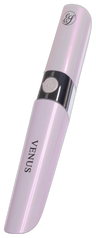
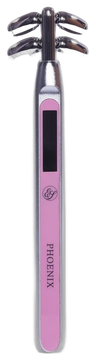
A four-roller bar powered by light, at about 15 µA: a rolling massage with a faint current, for the look of puffiness and a tired jawline. Price today: $179.98, or $107.99 with code BLACK40 until 30 Nov. 1-year warranty and 60-day money-back guarantee.
Watch for: It has the lowest published output in this guide by a wide margin, no gel in the box, and it will not lift established sagging; we say so on its product page too.
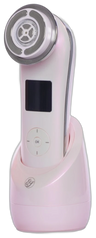
Radiofrequency at 1 MHz, EMS at 3 to 15 mA and red and blue LED in one handset, 5-minute sessions 2 to 3 times a week, a 2-year warranty. Price today: $749.98, or $449.99 with code BLACK40 until 30 Nov.
Watch for: It is an EMS and radiofrequency device, not microcurrent, it costs the most here, and it is not FDA-cleared. More in the section on loose skin.
The word on the box is not a specification. Microcurrent and EMS both pass a small electric current through the skin, but they work at very different strengths and are meant to do different things.
| Microcurrent | EMS (electrical muscle stimulation) | |
|---|---|---|
| Strength | Microamps (µA), millionths of an amp. Home devices in this guide publish 15 to 680 µA. | Milliamps (mA), thousandths of an amp. The Lumo+ publishes 3 to 15 mA. |
| What you feel | Usually nothing, or a faint tingle. | A rhythmic pull or twitch as the muscle contracts. |
| The idea behind it | A gentle current proposed to act on skin and muscle cells, used for a toned, less puffy look. | The current makes the muscle contract, a little like a workout for the face. |
| In this guide | NuFACE, ZIIP, FOREO BEAR, medicube, 7E Wellness MyoLift, the EvenSkyn Phoenix | EvenSkyn Lumo+ (EMS with radiofrequency and LED); the Lifting mode of the EvenSkyn Eclipse |
Neither is a fake version of the other, and a stronger current is not automatically a better one. If a device marketed as microcurrent makes your jaw twitch, it is working as EMS. Our microcurrent vs EMS guide goes through the physiology, the safety rules and the evidence for each in full.
Output is the current each brand publishes, in microamps (µA). Prices are each brand's US site on 5 November 2026; ours update live. "Tied to" means an FDA database (device identification or device listing) links the product to that 510(k) clearance.
| Device | Published output | Price, 5 Nov | Gel in the box | App | Warranty · returns | FDA status |
|---|---|---|---|---|---|---|
| NuFACE TRINITY+starter kit | 425 µA with Boost (help centre); 600 µA RMS max (manual) | $395holiday kit $299 | Aqua Gel 1.69 oz, Silk Créme 0.5 oz | Optional; app being discontinued | 2 yr · 60 days | Cleared: K201782 (2021) |
| NuFACE MINI+starter kit | 340 µA (help centre); 335 µA (manual) | $250holiday kit $199 | Aqua Gel 1.69 oz | Optional; app being discontinued | 2 yr · 60 days | Cleared: K201680 (Mini Plus, 2021) |
| NuFACE FIX MicroWandeyes and lips | 225 µA, one level | $175 | FIX serum 0.5 oz | None | 2 yr · 60 days | Tied to K240564 (FIX+, 2024) |
| ZIIP HALO | Not published | $399.99 | Four 30 mL gels | Optional | 2 yr · 30 days, unopened | Tied to K212342 (ZIIP+, 2021) |
| FOREO BEAR 2 | Up to 680 µA | $399 | No gel | Needed to activate it on first use | 2 yr · 14 days, unopened | Manual says cleared; FDA listing ties it to K200803 (BEAR, 2020)* |
| FOREO BEAR 2 go | Up to 550 µA | $279 | Not listed | Needed to activate it on first use | 2 yr · 14 days, unopened | No FDA claim on its pages; FDA listing ties it to K200803 (BEAR, 2020) |
| FOREO BEAR 2 eyes & lips | Up to 270 µA | $199 | Not listed | Needed to activate it on first use | 2 yr · 14 days, unopened | No FDA claim on its pages; FDA listing ties it to K200803 (BEAR, 2020) |
| medicube AGE-R Booster Pro6 modes incl. microcurrent | Not published | $230regular $249 | No gel needed, per medicube | Optional | 1 yr · damaged or defective only | No FDA claim; no 510(k); listed with the FDA as an electric massager (code ISA) |
| 7E Wellness MyoLift Mini | Up to 400 µA | $329 | ReStore gel 4 oz | Optional | 2 yr · 30 days | Brand says cleared; FDA listing ties it to K112351 (Ultra Beauty, 2012) |
| EvenSkyn Phoenixours | About 15 µA, solar | $179.98 | No gel; any water-based gel | None | 1 yr · 60 days | Not FDA-cleared |
* FOREO's facial stimulation clearances on record are the BEAR and BEAR mini (K200803, 2020), the BEAR 2 Body (K232242, 2024) and the FAQ 411 (K261565, 2026); none is named BEAR 2. FOREO's FDA device listing places the BEAR 2, BEAR 2 go and BEAR 2 eyes & lips under K200803, while the FDA's device identification records for them give no 510(k) number. If clearance matters to you, ask the brand which clearance covers the model you are buying. Left out: the Solawave 4-in-1 wand, which Solawave itself describes as galvanic current rather than microcurrent, and the TheraFace PRO, which Therabody no longer lists on its US site.
Two of our devices run muscle stimulation rather than microcurrent. medicube's Booster Pro also has a Derma Shot mode; medicube's US page does not say whether it is EMS or give its current, though medicube's own lab has tested an EMS mode on this device.[6]
| Device | What it runs | Published current | Price | Warranty · returns | FDA status |
|---|---|---|---|---|---|
| EvenSkyn Lumo+ours | Radiofrequency 1 MHz bipolar, EMS, red 623 nm and blue 465 nm LED | EMS 3 to 15 mA | $749.98 | 2 yr · 60 days | Not FDA-cleared |
| EvenSkyn Eclipseours | Ultrasound (45 kHz), an EMS Lifting mode, red 623 nm and blue 465 nm LED, sonic massage, warmth to 42°C | Lifting-mode current not published | $299.98 | 1 yr · 60 days | Not FDA-cleared |
We do not yet publish the current of the Eclipse Lifting mode. That is a gap in our own specification.
Every device here except medicube's Booster Pro runs over a gel, and the gel is the cost that keeps coming. Brand gels differ by a factor of seven per mL, and NuFACE's FIX serum costs about 20 times the cheapest gel. Any water-based conductive gel works on a microcurrent device, so you are not locked into the brand's own.
| Gel | Size | Price, 5 Nov | Per 100 mL |
|---|---|---|---|
| 7E Wellness ReNu or ReStore gel | 16 oz (about 473 mL) | $75 | about $16 |
| 7E Wellness ReNu or ReStore gel | 4 oz (about 118 mL) | $27 | about $23 |
| NuFACE Aqua Gel | 10 oz (about 296 mL) | $80 | about $27 |
| EvenSkyn Conduction Gelours | 300 mL | $84.98 | $28.33, or $17.00 with code BLACK40 until 30 Nov |
| NuFACE Aqua Gel | 1.69 oz (about 50 mL) | $35 | about $70 |
| ZIIP Firm or Refresh Gel | 80 mL | $89.99 | about $112 |
| NuFACE FIX serum (for the FIX) | 0.5 oz (about 15 mL) | $49 | about $331 |
| FOREO SUPERCHARGED Serum 2.0 | Not published | $59 | Cannot be worked out |
Brands that give sizes only in ounces were converted at 29.57 mL per US fluid ounce. Our conductive gel price comparison covers more gels.
No study has compared NuFACE, ZIIP, FOREO, medicube or EvenSkyn devices with one another, so no one can name the best device on results. The published record is also thinner than most marketing suggests, and the most widely cited trial on facial toning is not a microcurrent trial at all.
In 2012, 108 healthy women (average age about 44) were randomly assigned to 12 weeks of a Slendertone Face EMS headset, 20 minutes a day, 5 days a week, or to no treatment. Ultrasound read by a blinded assessor showed the main cheek muscle 18.6% thicker than at the start in the device group, with no increase in the untreated group, and 80% or more of users said their face looked firmer, more toned and lifted, against under 5% of the untreated group.[1] It is a real trial with real limits: the self-ratings came from women who knew they were using a device, there was no sham, and its trial registration lists the maker as sponsor.[2] A 2024 Japanese split-face study of a high-frequency facial EMS device, co-authored by staff of the maker, YA-MAN, reported better-looking wrinkles, sagging and jawline on the treated side after 8 weeks in 24 women.[5] A 2023 review of muscle stimulation for facial aging found only two human studies that met its criteria.[8] These results come from other makers' devices. None of them was run on an EvenSkyn device.
A widely cited microcurrent wrinkle study (Iran, 2012) was one group measured before and after, with no control group, despite "randomized" in the title of its English version. Of 30 women, 25 finished 30 sessions; blinded photo ratings showed about 18% improvement in the look of forehead wrinkles and about 8% around the mouth and nose, from before to the end of treatment.[3] When a home device combined microcurrent with radiofrequency and red light in a randomized split-face trial of 22 adults (16 of them women), wrinkles and facial volume showed no significant change against the untreated side after 8 weeks.[4] A 2025 randomized trial of another combination device, with radiofrequency, LED and microcurrent, reported better-looking wrinkles and texture than an unpowered control after 4 weeks; with three technologies in one device, it cannot isolate microcurrent either.[18] A medicube split-face study run by the maker's own lab reported small two-week changes, without randomization or blinding.[6] A double-blind trial of 50 people did report a measurable eyebrow lift from a home device that delivers radiofrequency as low-level microcurrent pulses, but that device is radiofrequency-based, so it does not show what microcurrent alone does.[7] A 2024 review of home facial devices found few microcurrent studies, used the Slendertone EMS trial as its microcurrent example, and called the overall evidence far from sufficient.[9]
The lab work behind the marketing is real but distant from a face. Direct current of about 10 to 1,000 µA raised ATP, the cell's energy molecule, in excised rat skin held in a bath for hours, peaking near 500 µA and falling away at much higher currents.[11] A 2 µA device changed fibroblast growth and signalling in cell cultures.[12] Neither study measured how a face looks.
NuFACE, ZIIP and FOREO publish clinical figures on their own websites, from studies of 56, 31 and 40 people. They are not in peer-reviewed journals, none reports a control group, and several headline percentages are users' own ratings.[13] No controlled study has measured how long results last after you stop; ZIIP itself says the lift from one session lasts up to 72 hours. We found no peer-reviewed study of "nanocurrent".[14] An FDA 510(k) clearance shows a device is substantially equivalent to an earlier one; NuFACE's clearance summaries rely on non-clinical data, not trials of visible results.[15]
The closest human evidence that building facial muscle can change how a face looks comes from exercise, not a device: in a small single-arm study, 16 women who finished 20 weeks of facial exercises had fuller-looking cheeks, and blinded raters' estimate of their age fell from 50.8 to 48.1 years. A co-author founded the exercise program.[10]
What that means for buying: expect a subtle change in how toned and rested your face looks, with steady use over weeks, and expect it to fade if you stop. Buy for comfort, routine and price, not for a promised percentage.
A lot of people shopping for a microcurrent device are bothered by a softer jawline or skin that has started to sag. That is mostly a change in the skin and the tissue beneath it, not in muscle tone. Microcurrent is sold for a toned, less puffy look, and in a randomized split-face trial a home device combining microcurrent with radiofrequency and LED made no significant difference to facial lifting or volume.[4] The home technology aimed at laxity is radiofrequency (RF), which gently heats the deeper layer of the skin. Its home evidence is limited too, and it is a milder cousin of a clinic treatment, not a substitute for one.
That is the job we built the EvenSkyn Lumo+ for: 1 MHz bipolar radiofrequency held at 40 to 42°C, EMS at 3 to 15 mA, and red (623 nm) and blue (465 nm) LED in one handset, in 5-minute sessions 2 to 3 times a week. It is not FDA-cleared, it costs more than any microcurrent wand here, and like every home device it works on the look of firmer skin with steady use, not like a facelift. Price today: $749.98, or $449.99 with code BLACK40 until 30 Nov, with a 2-year warranty and a 60-day money-back guarantee.
Our best RF skin tightening device guide sets the Lumo+ against CurrentBody, TriPollar and AMIRO, and Lumo+ vs CurrentBody Skin RF vs NuFACE Trinity+ puts radiofrequency and microcurrent side by side. For jowls specifically, see how to get rid of jowls without surgery.
The routine is much the same on every device in this guide:
Manuals in this category list most of these cautions, and we suggest following all of them. Do not use a microcurrent or EMS device:
For EMS in particular, the FDA's labeling guidance for powered muscle stimulators says stimulation should not be applied over the neck or mouth, or over the carotid sinus nerves at the side of the neck, and that safety in pregnancy has not been established.[16] If you have had Botox or filler, ask the person who injected it how long to wait. If you have any medical condition, talk to your doctor before you start.
No one can say on the evidence. No study has compared home microcurrent devices with one another, and we found no independent randomized trial of a microcurrent-only home device on how a face looks. What you can compare is what each brand publishes: the FOREO BEAR 2 states up to 680 µA, the NuFACE TRINITY+ 425 µA with its Boost button, and our Phoenix about 15 µA. A higher figure is a specification, not a proven result.
It depends on the job. NuFACE's TRINITY+ and MINI+ each hold an FDA clearance under their own names, while the other brands' devices here are listed under clearances for earlier or differently named models, or none; NuFACE also publishes its output, as FOREO and 7E Wellness do. The FOREO BEAR 2 states a higher maximum output, the ZIIP HALO suits people who want an app-guided routine, and medicube's AGE-R Booster Pro adds absorption and LED modes for less money. If the goal is the look of firmer skin rather than tone, a radiofrequency device such as our Lumo+ works on a different layer than any microcurrent wand.
The evidence is thin. The most widely cited randomized trial on facial toning, 108 women over 12 weeks, tested an EMS headset, not microcurrent, and its maker sponsored it. A widely cited microcurrent study had no control group, and two randomized trials of home devices that combine microcurrent with radiofrequency and LED disagree: one found no significant change in wrinkles or volume, the other reported better-looking wrinkles after 4 weeks. Expect a subtle change in how toned your face looks with steady use, not a lift that lasts after you stop.
Brands plan in weeks, not days. NuFACE recommends at least 5 minutes, 5 times a week for the first 60 days, then 2 to 3 times a week; ZIIP recommends 3 to 5 times a week. The studies that measured anything ran 2 to 12 weeks. Expect any effect to fade if you stop: no controlled study has measured how long results last, and ZIIP itself says the lift from one session lasts up to 72 hours.
No. NuFACE devices are FDA-cleared, which is a different and lighter route than approval: the TRINITY+ was cleared through the 510(k) process (K201782, 2021), which shows it is substantially equivalent to a device already on the market. NuFACE's clearance summaries rely on non-clinical data, so clearance speaks to safety and equivalence, not to visible results. Our Phoenix, Eclipse and Lumo+ are not FDA-cleared.
The simplest answer is to wait until after pregnancy. NuFACE, ZIIP and our Eclipse and Lumo+ manuals say not to use them while pregnant, FOREO and our Phoenix manual say to ask a doctor first, and the FDA says the safety of muscle stimulators in pregnancy has not been established.
Anyone with a pacemaker, defibrillator or other implanted electronic device; anyone who is pregnant; and anyone with epilepsy, active cancer or a heart condition unless their doctor agrees. A 2026 analysis of FDA adverse event reports from 2013 to March 2025 found 28 on home microcurrent devices, 25 involving NuFACE; in those, the most common were heart rhythm complaints, pain, dizziness, headache and inflammation. Reports do not prove a device caused the problem, but they are a reason for care.
Yes, for every device here except medicube's Booster Pro, which medicube says needs no special gel. A water-based gel carries the current and stops the device dragging on dry skin. Brand gels run from about $16 to about $112 per 100 mL, and any water-based conductive gel works.
Ask the person who injected it. Waiting times depend on the product and the treatment, and device brands give different advice, so your injector's guidance comes first.
Jowls form mainly as skin loosens and the fat of the lower cheek slides down, not because a muscle is weak, so a microcurrent device is unlikely to change them much. Radiofrequency, which warms the deeper layer of the skin, is the home technology aimed at laxity. Our guide to getting rid of jowls without surgery goes through the options.
If you want to act on this
We make three of the devices in this guide. Prices update live below; code BLACK40 takes 40% off until 30 November.
Solar-powered microcurrent roller, about 15 µA. For the look of puffiness and daily upkeep; nothing to charge.
$179.98, or $107.99 with code BLACK40 until 30 Nov
See the PhoenixRadiofrequency, EMS and red and blue LED. For the look of firmer skin rather than tone alone.
$749.98, or $449.99 with code BLACK40 until 30 Nov
See the Lumo+Ultrasound, an EMS lifting mode, red and blue LED, sonic massage and warmth, in six modes. For one handset across a whole routine.
$299.98, or $179.99 with code BLACK40 until 30 Nov
See the EclipseMost devices in this category run over a water-based gel. Ours is the EvenSkyn Conduction Gel (300 mL), $84.98, or $50.99 with code BLACK40 until 30 Nov; any water-based conductive gel works.
We are EvenSkyn and we make three of the devices compared here, so read every recommendation with that in mind. To keep the comparison checkable, we held ourselves to five rules.
This guide was written by the EvenSkyn Skin Science Desk and has not been reviewed by a clinician. It is general information, not medical advice. Competitor names and trademarks belong to their owners and appear for comparison only.
Update log. 5 November 2026: rebuilt. Rival specifications, prices and FDA records re-read from brand pages and the FDA database; EvenSkyn prices now load live; every study re-checked against its journal record. Corrected from the July edition: the 2012 facial toning trial tested EMS (Slendertone Face), not microcurrent, and has no link to NuFACE; the 2012 microcurrent wrinkle study had no control group; the FOREO BEAR 2 publishes microcurrent-range output (up to 680 µA), not EMS; an unverifiable 2015 animal study was removed; our own scores for our devices were removed.
Microcurrent and EMS
Explainer
How EMS works for glute and body toning, what the research supports, realistic expectations, and how to use electrical muscle stimulation sessions at home.
Explainer
Does your face look puffy and dull? You may have lymph fluid circulating under your skin. Read and learn how to promote lymphatic drainage and skin detoxification using microcurrent therapy.
Safety
Professional guidance for at-home microcurrent: device placement, why conductive gel matters, session timing, and who should avoid microcurrent.


השארת תגובה
כל התגובות מבוקרות לפני פרסומן.
This site is protected by hCaptcha and the hCaptcha Privacy Policy and Terms of Service apply.