How Often Should You Do At-Home Microinfusion? The Schedule, the Limits and the Biology Behind Them
How often to do at-home micro-infusion: every two weeks in the evening, never more often than every ten days, with longer gaps for sensitive skin, the biology behind the interval and a planner for your session dates.
Published
23 min read
Published by EVENSKYN, which makes and sells at-home beauty devices.
A how-to guide, 6 sources checked, updated 15 November 2026
Every two weeks, in the evening, and never more often than once every ten days. That is the interval on our micro-infusion kit, and this guide sets out what it rests on, what the evidence does and does not show, and when a longer gap makes sense.
EvenSkyn Skin Science Desk. We make the MicroInfuser and its Syntha-Pep serum, and this guide recommends them for some readers. No clinician reviewed this version.
Illustrative still life.
Quick answer: how often to do at-home micro-infusion
Every two weeks, in the evening. That is the interval in our MicroInfuser’s instructions, which also say never to use it more often than once every ten days.
Not once a week. Our instructions do not allow it, and no study we found shows that weekly sessions work better or faster.
Every ten days is optional, and only for skin that has had four to six sessions without irritation. Go back to every two weeks at the first sign of prolonged redness or sensitivity.
Longer gaps for some skin. Sensitive skin starts at one session every three to four weeks, and the neck and chest at every three weeks, per our safety page.
Using another kit? Follow the interval in its own instructions; needles and serums differ. Then plan your session dates with the planner further down.
Key takeaways
01Our kit’s interval is every two weeks, never more often than every ten days. It is our instruction as the manufacturer, not a figure from a trial.
02Micro-channels close within hours, but repair runs longer: in wound research the proliferative phase can run to about day 14, and remodeling starts at two to three weeks.1,2
03No study we found compared weekly with two-weekly sessions for a home kit, so nothing supports weekly use as faster.
04Clinic microneedling for acne scars is usually 3 to 5 treatments, 2 to 4 weeks apart.3 Home kits use shorter needles and their own schedules.
05Age, skin type and goal change the care around a session and what to expect. They never justify a gap shorter than ten days.
Can you do micro-infusion once a week?
Not with our kit. Its instructions say to use it once every two weeks and never more often than once every ten days, so a weekly routine is outside them.
The reasoning is straightforward. Each session makes many tiny punctures, and the skin then repairs them over days, not hours. Starting again before that repair has settled adds a new round of irritation on top of the last one. No study we found compared weekly and two-weekly sessions for a home micro-infusion kit, so the claim that weekly use works faster has nothing behind it.
Other kits set their own intervals, with different needles and serums. If you use one, follow its instructions. If they give no interval at all, two weeks is the cautious default, and that is our view rather than a tested rule.
Why every two weeks, and what that rests on
Three things sit behind the interval, and they carry different weight.
The instruction. Every two weeks, evenings, never more often than every ten days, is the schedule we set for the MicroInfuser as its manufacturer. Our safety page adds the optional ten-day interval for skin that tolerates the first four to six sessions.
The biology. Skin repair after an injury runs in overlapping phases that last about two weeks before remodeling takes over.2 A two-week gap lets one round of repair pass that point before the next session starts. That is our inference from general wound research, set out with its limits in the biology section below.
What clinics do. The American Academy of Dermatology says acne scar treatment with microneedling is usually 3 to 5 treatments, performed every 2 to 4 weeks.3 Clinic devices can use longer needles than a 0.5 mm home stamp, so that schedule does not transfer directly, but it shows that even clinic treatments are spaced weeks apart.
What is missing is a trial. No study we found tested different intervals for home micro-infusion, ours included. The FDA has cleared certain microneedling devices for specific uses, but none for use with another product such as a serum.4 Our MicroInfuser is a cosmetic device for the look of skin, not a medical device and not FDA-cleared.
Myths and facts about micro-infusion frequency
Myth: weekly sessions get results faster. Fact: no study we found shows this for home kits, and our instructions set ten days as the shortest gap.
Myth: if you miss a session, you should double up. Fact: there is nothing to catch up. Do the session when you can and count two weeks from that date. Never squeeze two sessions closer than ten days apart.
Myth: micro-infusion follows the same schedule as clinic microneedling. Fact: clinic treatments are set by a clinician, can use longer needles and are often weeks apart.3 A home kit follows its own instructions.
Myth: a longer gap wastes the last session. Fact: we found no evidence for that either. A gap of three or four weeks is never less safe, and our safety page suggests it to start for sensitive skin.
Myth: once you see a change, you can stop. Fact: no study we found measured how long changes from home micro-infusion last. Our product page says any change in the look of texture and fine lines is gradual and depends on keeping up a session every two weeks.
The biology behind the two-week interval
A micro-infusion stamp opens temporary channels through the outer barrier. In the microneedle studies reviewed by Nguyen and Nguyen, reported closure ranged from a few hours to 72 hours, and in one measured patch the pores were essentially closed by six hours.1 The channels close fast. The repair underneath takes longer.
A 2016 review of wound healing describes three overlapping phases.2 The inflammatory response starts within the first 24 hours and can last up to two days. The proliferative phase, when new tissue forms, starts within the first 48 hours and can run to about day 14. Remodeling begins two to three weeks after the injury and can go on for a year or more.
Fig. 1 | A two-week gap places the next session after the proliferative phase of the last. Phase timings are for skin wounds in general, and the phases overlap;2 channel closure comes from a review of microneedle studies, where the dark gold mark is one patch measured closed by about six hours and the light bar the reported range up to 72 hours.1 Session markers follow our kit’s instructions. Drawn by us; the alignment is our inference, not a measured result.
Our inference, labelled as one.
Fact: micro-channels close within hours, and in skin wounds generally, the proliferative phase runs to about day 14, with remodeling from two to three weeks.1,2
Inference: a session every two weeks lets each round of repair pass its proliferative phase before the next round starts, and a session every week would not.
Hypothesis, untested: for home micro-infusion, two-weekly sessions give the same or better change in the look of skin than weekly sessions, with less irritation.
What would prove it wrong: a controlled trial in which weekly sessions with the same kit gave more change in the look of skin without more irritation. We found no such trial, in either direction.
The phase timings come from general wound research, not from micro-infusion. A home stamp makes much smaller injuries than a surgical wound, and smaller injuries may settle faster. So the figure is a reason the two-week interval is sensible, not proof that it is optimal.
The every-two-weeks routine, step by step
This is the routine on our kit’s product page. Other kits have their own instructions; follow yours.
48 hours before. Pause retinoids, AHAs, BHAs and physical exfoliants, and stay out of direct sun. Before a first kit, patch test on a small, less visible area 24 hours ahead.
The session, in the evening. Attach a fresh head to a sealed ampoule and rest it head-down for one to two minutes. Stamp the seven zones in the manual: tap and lift, never drag. It takes about 5 to 10 minutes from opening the ampoule to the final pat-down.
The first 24 hours. No face washing that evening and no makeup. No sweating, pools, saunas or hot showers.
24 to 72 hours. SPF 30 or higher every morning, with actives still paused.
From the fourth day. Your usual routine, retinoids and acids included, if your skin is calm.
Two weeks on. The next session, on the same evening of the week if that helps you remember. One kit holds four sessions, about two months.
Plan your sessions
When are my next sessions?
Pick the evening of your first session and an interval. The dates follow our kit’s instructions; other kits have their own. Nothing is stored or sent anywhere.
Pick the evening of your first session to see your dates.
Every ten days: the limit, not a target
Our safety page allows an optional ten-day interval, with two conditions: your skin has had four to six sessions without irritation, and you go back to every two weeks at the first sign of prolonged redness or sensitivity. The product page sets ten days as the shortest gap allowed.
What the shorter interval does not do is make results arrive faster on any evidence we found. Over twelve weeks it adds two sessions, eight instead of six, and uses two full kits instead of one and a half. If you are unsure, two weeks is the better choice. A ten-day interval is never the way to catch up after a missed session.
Interval by skin type, at a glance
Skin or situation
Interval on our kit
What changes
Normal, oily or combination
Every two weeks
Nothing beyond the standard routine
Sensitive
Every three to four weeks to start
Move to every two weeks only if sessions are well tolerated
Rosacea, or well-controlled eczema or psoriasis
Every two weeks
Extended 24 to 48 hour patch test; stop at the first unusual reaction; never during a flare
Darker skin tones, Fitzpatrick IV to VI
Every two weeks
Watch closely for early pigment change; daily SPF
Neck and chest
Every three weeks
Lighter pressure and fewer passes
Over 50 or thinner skin
Every two weeks
Expect slower settling; judge over at least one kit
Pregnant or breastfeeding
Pause
Wait until your physician confirms
From our micro-infusion safety page (last updated 4 September 2026) and product page, read 15 November 2026. For other kits, follow their own instructions.
Two schedules, same goal: what twelve weeks looks like
Here is a worked example, not a case study. Two people start on the same evening and follow our kit for twelve weeks.
Every two weeks. Sessions on days 0, 14, 28, 42, 56 and 70: six sessions, one kit and half of a second.
Every ten days after the first four. Sessions on days 0, 14, 28 and 42, then 52, 62, 72 and 82: eight sessions, two full kits.
The second schedule costs two more sessions and four fewer days of rest between each of the later ones. Nothing we found shows that it gives more change in the look of skin. A weekly schedule would mean twelve sessions and three kits in the same twelve weeks, with gaps shorter than our kit allows.
At the list price, our kit works out at 45.00 USD a session. Whatever the schedule, judge the look of your skin after one kit, about two months, with photos taken in the same light.
Our recommendation, and yes, it points at our own kit. The reasoning is above so you can disagree with it.
Starting out: every two weeks, in the evening, and judge after one kit with photos in the same light.
Sensitive skin: every three to four weeks to start, then every two weeks if sessions go well.
Every ten days: only after four to six sessions with no irritation, and never to catch up.
Scars or deep lines: a dermatologist, not a shorter gap.
Our pick for a two-week routine, and yes, we make it
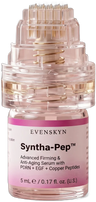
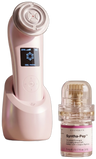
EvenSkyn MicroInfuser with Syntha-Pep PDRN serum
Four sealed sessions, one every two weeks.
How it deliversA sterile 0.5 mm head fixed on a sealed 5 mL ampoule, applied as you stamp. Needle length is not delivery depth, and we quote no depth.
What it carriesBiosynthetic PDRN at 0.2 percent with EGF, copper tripeptide-1, hyaluronic acid and niacinamide. The full ingredient list is published.
How oftenOne evening session every two weeks, never more often than every ten days.
StatusA cosmetic device for the look of skin, not a medical device and not FDA-cleared.
$179.98
Four treatments, about two months at one session every two weeks. 60-day money-back guarantee on unused treatments.
What it will not do: deliver clinic microneedling results, treat scars or any skin condition, or work faster if you use it more often. It contains an essential oil, so read the full list if you have known allergies.
How often by age
The interval on our kit does not change with age. What changes is how quickly skin settles and what to expect.
In your 20s and 30s. Every two weeks if you use a kit. The light pink flush after a session usually fades within the one to four hours our safety page describes. We found no evidence that starting young changes how skin ages.
In your 40s. Every two weeks. If redness or sensitivity starts to last longer than it used to, take a longer gap, not a shorter one. Perimenopause often begins in this decade; see the section on menopause below.
In your 50s and beyond. Every two weeks. A review of ageing and wound healing found that healing in older people is delayed, though the final result is similar to that in younger people.5 In practice, give your skin longer to settle and judge results over at least one full kit.
How often by skin type and skin tone
Sensitive skin
Our safety page suggests one session every three to four weeks to start. If sessions are well tolerated, move to every two weeks. Staying at three weeks is a fine outcome, not a failure.
Rosacea, eczema or psoriasis
If the condition is well controlled, do an extended 24 to 48 hour patch test first and stop at the first unusual reaction. Never use a kit during an active flare of eczema, psoriasis or dermatitis.
Darker skin tones (Fitzpatrick IV to VI)
Every two weeks. The American Academy of Dermatology describes microneedling as minimally invasive and safe for all skin tones.3 Our safety page names post-inflammatory hyperpigmentation as the main risk to manage in Fitzpatrick IV to VI skin: watch closely for early pigment change, use light pressure, and wear SPF every day.
Oily or acne-prone skin
Every two weeks, but never over active breakouts. Stamp around them, and skip the session if you have active cystic or inflammatory acne in the area.
Neck and chest
The skin is thinner, so our safety page suggests lighter pressure, fewer passes and every three weeks. The backs of the hands tolerate standard pressure.
When not to do a session at all
Skip micro-infusion if you take oral isotretinoin or stopped it within the past six months, have a personal or family history of keloid or hypertrophic scarring, an active infection or cold sore in the area, open or inflamed skin, or had a chemical peel, laser treatment or significant sunburn in the past seven days. Talk to a doctor first if you are pregnant or breastfeeding, take blood thinners or immunosuppressants, or have uncontrolled diabetes or an autoimmune flare. The full list is on our micro-infusion safety page.
How often by goal
The interval stays at every two weeks whatever you are working on. The goal changes what to expect.
Fine lines, texture and tone. Every two weeks. Our product page says skin can look more hydrated within a day or two, which does not last, and that any change in the look of texture and fine lines is gradual.
Uneven tone or dark spots. Every two weeks, with daily SPF. Sun on freshly treated skin is the thing to avoid, especially for darker skin tones.
A hydrated, glowing look. Every two weeks. The glow the morning after is hydration and fades within days, which is not a reason to stamp more often.
Acne scars. See a dermatologist. Scar treatment with microneedling is a clinic procedure, usually 3 to 5 treatments 2 to 4 weeks apart.3 A home kit does not treat scars.
Signs you are overdoing it
These are signs to slow down or stop, from our safety page and product page.
Redness that lingers. A light pink flush typically lasts one to four hours. Redness that is still there the next day, or comes back between sessions, means a longer gap.
Products you normally use start to sting. That is a sign of sensitivity. Go back to every two weeks if you were on ten days, or to every three to four weeks if you were already at two.
Stop and contact a healthcare provider if redness lasts more than 48 hours, swelling increases rather than decreases, or you notice warmth, pus or fever.
Slowing down costs nothing. There is no evidence that a longer gap undoes earlier sessions.
Signs you are not doing it often enough
There is no reliable sign that a gap is too long. On every two weeks or longer, the question to ask is whether your expectations match what a home kit can do.
If nothing has changed after one kit, about two months, compare photos taken in the same light before deciding. Changes in the look of texture and fine lines are gradual, and a shorter gap is not the fix.
If you have been on every four weeks, moving to every two weeks is within the instructions, provided your skin tolerates it.
If your goal is scarring or deeper lines, a dermatologist can tell you what a clinic treatment would add.
Coordinating with RF, ultrasound, EMS and LED
Our kit’s product page sets the order.
Radiofrequency, EMS and microcurrent. Use them before a session, not after. After a session, wait at least 24 hours, ideally 48. The manual, as set out on our duo’s product page, puts ultrasound in the same group.
Red and near-infrared LED. It can resume 24 hours after a session.
Each device’s own limits come first. Our Lumo+ instructions allow two to three RF sessions a week if you are over 40, one to two if you are under 40, 5 to 8 minutes each, at least 48 hours apart and never more than 25 minutes of RF a week. Our guide to RF and micro-infusion together sets out the spacing in detail.
Timing around Botox, fillers, peels and lasers
Follow the practitioner who treated you; they know what was done and where.
Our safety page says not to use micro-infusion within seven days of a chemical peel, laser treatment or significant sunburn, and to talk to your doctor first if a surgical or cosmetic procedure on the face has not healed. For injectables such as Botox and fillers, ask your injector, and check the wait windows in our micro-infusion timing checker. Our guide to at-home devices after injectables covers the wider picture.
The menstrual cycle and session timing
No study we found tested whether the phase of the menstrual cycle changes the comfort or the result of a micro-infusion session.
If your skin is predictably more reactive at one point in your cycle, it is reasonable to move that session by a few days. Move it later rather than earlier, so the gap never drops under ten days. We would rather you keep a steady interval than chase a particular date.
Perimenopause and menopause
After menopause, lower estrogen is linked with thinner skin that has less collagen, reduced elasticity, more wrinkling and dryness, and estrogen also plays a part in wound healing.6
None of that changes the interval on our kit: every two weeks, as for anyone else. It is a reason to expect slower settling and gradual change, to keep up daily SPF, and to take questions about hormone therapy to your doctor rather than a skincare routine.
Morning or evening: does it matter?
Evening. Our kit’s instructions say once every two weeks, ideally in the evening before bed.
The reasons are practical. The light pink flush, which typically lasts one to four hours, settles while you sleep. The aftercare asks for no face washing that evening and no makeup, which is easier at night. And the next morning starts with SPF 30 or higher on skin that has had a night to settle.
If an evening is impossible, a morning session with no makeup and full sunscreen afterwards is the next best option.
Planning around an event
Our suggestion, not a tested rule: do your first ever session at least two weeks before a wedding, photos or another event, so you know how your skin reacts. After that, keep the last session before the event at least a few days ahead, and do not try a new product or a shorter gap in the run-up.
If the event is only days away and you have never used a kit, wait until afterwards.
What to expect, session by session
No published timeline exists for home micro-infusion kits, ours included. This is what our product page and safety page describe.
The session. A gentle tapping sensation, slight warmth or tingling, and a light pink flush that typically lasts one to four hours. Minimal pinpoint bleeding can occasionally occur on thinner areas.
The next day or two. Skin can look more hydrated. That is hydration, and it does not last.
Over the following sessions. Any change in the look of texture and fine lines is gradual and depends on keeping up a session every two weeks. Individual results vary.
After one kit, about two months. The point to judge, with photos taken in the same light at the start and the end.
What to do if you miss a session
Nothing dramatic. Do the session when you can, then count two weeks from that date. The planner above re-spaces your dates if you enter the day you actually did it.
The one rule: never squeeze sessions closer than ten days apart to catch up. A gap of a few weeks simply moves the next session along.
Summer, winter and travel
Summer. Keep the interval and tighten the sun care: SPF 30 or higher every morning, and plan a session for an evening before a mostly indoor day.
Winter. Keep the interval. Dry indoor air can make skin feel tight, so a plain, fragrance-free moisturiser once your aftercare window allows it is sensible.
Travel. Skip a session rather than rushing one somewhere unfamiliar. Restart when you are home and count two weeks from there.
Questions to ask a dermatologist before you start
If you see a dermatologist, these are worth raising before a first kit:
Is there anything about my skin type, skin tone or history that means I should start with a longer gap?
Do any of my medicines, now or in the past six months, rule out micro-infusion?
Do I have any personal or family history of keloid or raised scarring?
How should I time sessions around treatments you do for me, such as injectables, peels or lasers?
Which reactions should make me stop and call you?
Frequently asked questions
How often should you do micro-infusion at home?
With our kit, once every two weeks, in the evening, and never more often than once every ten days. Other kits set their own intervals, so follow the instructions that came with yours.
Can you do micro-infusion once a week?
Not with our kit, whose instructions set ten days as the shortest gap. No study we found shows that weekly sessions work better or faster.
Can you do micro-infusion every 10 days?
Only after four to six sessions without irritation. Go back to every two weeks at the first sign of prolonged redness or sensitivity, and never use the shorter gap to catch up.
How many sessions before you see results?
Skin can look more hydrated within a day or two, which does not last. Any change in the look of texture and fine lines is gradual, so judge after one kit, four sessions over about two months, with photos in the same light.
How long do micro-infusion results last?
No study we found measured how long changes from home micro-infusion last after stopping. The post-session glow is hydration and fades within days, and any gradual change depends on keeping up sessions.
Does micro-infusion work?
Clinic microneedling has the stronger published evidence. For home micro-infusion kits, ours included, we found no independent published trial, so expect gradual changes in the look of skin, not clinic results.
Is micro-infusion safe to do at home?
With a sterile single-use head, a sealed serum, the aftercare and the contraindications on our safety page, most people see only a light pink flush for one to four hours. Stop and contact a healthcare provider if redness lasts more than 48 hours, swelling increases, or you notice warmth, pus or fever.
What happens if you do micro-infusion too often?
Expect lingering redness, sensitivity and stinging from products you normally tolerate. Take a longer gap, and stop and get advice if you see any of the warning signs on our safety page.
What if I miss a session?
Do it when you can and count two weeks from that date. Never squeeze sessions closer than ten days apart to catch up.
Is it better to do micro-infusion in the morning or evening?
Evening. The flush settles overnight, the aftercare asks for no face washing and no makeup that evening, and you start the next day with SPF.
Can I do micro-infusion on my neck?
Yes, with lighter pressure, fewer passes and a session every three weeks, because the skin is thinner. Never stamp under the eyes, on the eyelids or on the lips.
Can I use retinol with micro-infusion?
Yes, around the sessions. Pause retinoids, AHAs, BHAs and physical exfoliants for 48 hours before a session and keep them paused for 72 hours after.
Can I combine micro-infusion with RF?
Yes. Use RF before a session, not after, and wait at least 24 hours, ideally 48, after a session. Each device’s own weekly limits still apply.
Can I do micro-infusion while pregnant or breastfeeding?
Our safety page recommends pausing micro-infusion during pregnancy and breastfeeding until your physician confirms it is fine.
The bottom line
With our kit, micro-infusion is every two weeks, in the evening, and never more often than every ten days. That interval comes from our instructions and is consistent with how long skin repair takes, but no trial has compared intervals for home kits. Longer gaps are fine and suit sensitive skin; shorter ones are not, and nothing we found shows they work faster.
Judge the look of your skin after one kit, with photos in the same light, and see a dermatologist for anything a home kit cannot reach.
How we put this guide together
On 15 November 2026 we read our kit’s product page and our micro-infusion safety page, checked each study cited here against its publisher, Semantic Scholar or Europe PMC record, and read the AAD and FDA pages directly. The figure is drawn by us from the cited papers, and the photograph is an illustration, not product photography. This version replaces an earlier one at the same address and leaves out claims we could not verify.
Conflicts: we make the MicroInfuser and Syntha-Pep, recommended in this guide. No clinician reviewed this version. General information, not medical advice: if you have a skin condition, are pregnant or take medication that affects healing, speak to a doctor before using any microneedling device.
Further reading from the EvenSkyn Skin Science Desk
Gonzalez ACO, Costa TF, Andrade ZA, Medrado ARAP. Wound healing - A literature review. Anais Brasileiros de Dermatologia. 2016;91:614-620. doi:10.1590/abd1806-4841.20164741
American Academy of Dermatology Association. Microneedling can fade scars, uneven skin tone, and more. Last updated 17 July 2023. aad.org
US Food and Drug Administration. Microneedling devices: getting to the point on benefits, risks and safety. Consumer update, content current as of 15 October 2025. fda.gov
Gosain A, DiPietro LA. Aging and wound healing. World Journal of Surgery. 2004;28:321-326. doi:10.1007/s00268-003-7397-6
Thornton MJ. Estrogens and aging skin. Dermato-Endocrinology. 2013;5(2):264-270. doi:10.4161/derm.23872
Nine brands, one shared depth ceiling, and a set of differences that sit in the hygiene design rather than the marketing. We compare Seranova, Qure, Glov and the EvenSkyn MicroInfuser on single-use...
No radiofrequency microneedling device is meant for home use, and the FDA says so in writing. What you can do at home instead, twelve products ranked on what each one publishes, and...
How to use PDRN at home, step by step: as a daily serum on intact skin, or through a sealed micro-infusion kit every two weeks, with the two-week schedule, what can go...




השארת תגובה
כל התגובות מבוקרות לפני פרסומן.
This site is protected by hCaptcha and the hCaptcha Privacy Policy and Terms of Service apply.