GHK-Cu Copper Peptides: The 50-Year Research Trail, Translated
GHK-Cu has been studied since 1973. What that research shows in cells and in people, how well the copper peptide gets into skin, what the FDA has said about injections, and an honest before and after timeline.
Published
25 min read
Published by EVENSKYN, which makes and sells at-home beauty devices.
An evidence guide, 31 sources checked, updated 15 November 2026
GHK-Cu, the copper peptide on so many serum labels, has been studied since 1973. Here is what that research shows in cells and in people, how well it gets into skin, what the FDA has said about injections, and what an honest before and after looks like.
EvenSkyn Skin Science Desk. We make the MicroInfuser and the Syntha-Pep serum discussed near the end, which lists GHK-Cu among its actives. No clinician reviewed this version.
Illustrative still life.
The short answer
What it is: a three-amino-acid peptide that binds copper, found in human blood and listed on ingredient labels as Copper Tripeptide-1.1,2
How long it has been studied: since 1973, with skin research on the copper form from the late 1980s.3,4
The human evidence: one small randomised trial found less wrinkle volume and depth after 8 weeks than a plain serum. The larger 12-week studies never appeared as journal papers we could find.1,5
The catch: in a lab test, almost none crossed intact human skin in 9 hours. Skin pretreated with microneedles let it through.6
Key takeaways
01GHK-Cu has a 50-year research record, but most of it is cells, skin samples and animals. In fibroblast cultures it raised collagen output at concentrations below the blood levels that reviews report.1,4
02The best human evidence is small: 40 women, 8 weeks, a GHK-Cu serum in a lipid carrier. The often-quoted 71-woman study from 2002 was a meeting presentation, and we found no published paper for it.5,7
03Getting it into skin is the weak link. It is small enough to cross skin but water-loving, and almost none passed intact skin in 9 hours in the lab.6,8
04We found no study of copper peptides on stretch marks, and the FDA flags compounded injectable GHK-Cu for a possible immune reaction risk.9,10
05If you try it, choose a product with a way past the surface, and judge the look of your skin at 8 to 12 weeks with photos in the same light.
How long has GHK-Cu been around?
Since 1973. That year, Loren Pickart and Michael Thaler reported a tripeptide in human serum that prolonged the survival of normal liver cells.3 Pickart later described it as the first isolation of GHK, from the albumin fraction of human plasma.11 The sequence, glycyl-histidyl-lysine, was published in 1977, and work on the copper-bound form in skin cells followed in the late 1980s.4,12
1973
Pickart and Thaler report a tripeptide in human serum that prolongs the survival of normal liver cells.3
1977
Its sequence is published: glycyl-histidyl-lysine, or GHK.12
1988
In fibroblast cultures, GHK bound to copper raises collagen production at very low concentrations.4
1993
Maquart and colleagues report more connective tissue in rat wounds treated with GHK-Cu.13
2000
Treated fibroblasts make more MMP-2, an enzyme that breaks down collagen, and more of its inhibitors.14
2001
More than 40 copper peptide products are on sale from at least 12 companies, by one industry count.15
2005
GHK-Cu speeds the growth of fibroblasts from patients treated with radiation.16
2011
Copper from the peptide crosses human skin samples in a two-day lab test.17
2012
A gene analysis picks GHK as a compound that can reverse a lung-damage gene signature.18
2015
Microneedle pretreatment lets the peptide through human skin samples it barely crosses intact.6
2016
A randomised trial in 40 women tests a GHK-Cu serum on facial wrinkles.5
2023
The FDA lists compounded injectable GHK-Cu among substances that may pose significant safety risks.10,19
2026
The nominations to compound injectable GHK-Cu are withdrawn. The FDA says it will consult its compounding advisory committee on GHK-Cu before the end of February 2027.19,20
Commercial use came early. By 2001, one industry newsletter counted more than 40 copper peptide products from at least 12 companies, and it notes that Pickart formed Skin Biology, a skin care company, in 1992.15 That matters when you read the evidence, because the reviews this guide relies on for several human studies come from Pickart and colleagues at Skin Biology. They declare no conflict of interest.1,11 We point out the affiliation so you can weigh it, as we ask you to weigh ours.
What GHK-Cu is, and the name on the label
GHK is a chain of three amino acids: glycine, histidine and lysine. It is present in human plasma, saliva and urine, and its level falls with age.1 It binds copper very strongly, forming the complex called GHK-Cu.21 The same three-amino-acid sequence sits inside type I collagen, which led researchers to suggest it is released at wounds.4
On a label, look for Copper Tripeptide-1. That is the ingredient-list name for GHK-Cu.2 A vague “copper peptide complex” without that name tells you little.
Two reviews give blood levels of about 200 ng/mL at age 20 and 80 ng/mL by age 60.1,21 The 2015 review gives no source for those figures, and we did not trace the original measurement, so treat them as approximate.
By our arithmetic from its formula, GHK weighs about 340 daltons, and about 400 with its copper. That is under the 500 dalton size usually given as the limit for crossing intact skin.8 Size is not its problem. The authors of a 2015 delivery study name its water-loving nature as the reason skin absorption is hard.6
What GHK-Cu does in the lab
This is where most of the 50 years sits. The findings are real, and they come from cells in dishes, skin samples and animals, not from faces.
Collagen. In fibroblast cultures, GHK-Cu raised collagen production. The effect began between 1 and 10 picomolar and peaked at 1 nanomolar, with no change in cell number.4 In rats, wounds treated with it built up more connective tissue.13
Damaged cells. Fibroblasts taken from patients treated with radiation grew faster with GHK-Cu at 1 nanomolar, close to the rate of untreated normal cells, and made more of two growth factors early on.16
Fig. 1 | In cell studies, GHK-Cu acted at concentrations below the blood levels that reviews report. Concentration on a log scale, where 1 picomolar is a thousandth of a nanomolar. Dark dots and the shaded band are effects seen in fibroblast cultures: collagen production,4 growth of fibroblasts from patients treated with radiation16 and MMP and TIMP gene expression at the three concentrations tested.5 Gold dots are the blood levels of 200 and 80 ng/mL given in two reviews,1,21 converted by us to nanomolar using GHK’s formula weight of about 340. Drawn by us. Cell culture is not skin: the figure shows how little was needed in a dish, not how much reaches the cells of a face.
MMP and TIMP: why researchers call it a remodelling signal
Skin repair needs both building and clearing. MMPs are enzymes that break down collagen; TIMPs are their inhibitors. In 2000, fibroblasts treated with GHK-Cu made more MMP-2 and secreted more TIMP-1 and TIMP-2. Copper on its own raised MMP-2 too, but GHK without copper did not.14
A 2016 study tested GHK-Cu at 0.01, 1 and 100 nanomolar on adult skin fibroblasts. MMP1 and MMP2 gene expression rose at the lowest concentration, TIMP1 rose at all three, and the cells made more collagen and elastin.5 Raising both sides at once is why GHK-Cu is better described as a remodelling signal than a simple collagen booster.
The gene data, read carefully
In 2012, researchers searching a database of gene responses picked GHK as a compound that could reverse the gene pattern of emphysema-related lung damage. In their lab tests, it restored the ability of fibroblasts from damaged lungs to contract and remodel collagen.18 Pickart and Margolina later reported that GHK raises or lowers the activity of 31.2 percent of human genes by 50 percent or more.11
That number is often repeated as if it described skin. It does not. It describes gene activity, not a change measured in anyone’s skin, and says nothing about what a cream does on a face.
GHK-Cu studies on humans
Here is every human study of GHK-Cu on skin appearance that we could trace, with where it appeared. Only the first was published as a peer-reviewed paper we could read.
Study
Who and how long
Compared with
Where it appeared
Reported result
Badenhorst and colleagues, 2016Early
40 women aged 40 to 65, twice a day for 8 weeks
A plain serum and a Matrixyl 3000 product; randomised and double-blind
Journal of Aging Science; not indexed in PubMed
Wrinkle volume reduced 55.8 percent and depth 32.8 percent relative to the plain serum; volume reduced 31.6 percent relative to Matrixyl 30005
Leyden and colleagues, 2002Reviews
71 women with mild to advanced photoaging, 12 weeks
Not described in the review we read
Presented at the American Academy of Dermatology meeting
Less laxity, fewer fine lines, shallower wrinkles, more skin density and thickness1,7
Finkley and colleagues, 2005Reviews
67 women aged 50 to 59, 12 weeks
Not described in the review we read
A chapter in a cosmetic science book
Better laxity, clarity and firmness, fewer lines and spots, more density and thickness1,22
Leyden and colleagues, eye cream, 2002Reviews
41 women, 12 weeks
A placebo and a vitamin K eye cream
A University of Pennsylvania report
Better than both on lines, appearance, density and thickness1,23
Abdulghani and colleagues, 1998Reviews
Women, creams on the thighs for one month; a pilot study
A vitamin C cream and retinoic acid
Disease Management and Clinical Outcomes
More collagen in 70 percent of women with GHK-Cu, 50 percent with vitamin C, 40 percent with retinoic acid1,24
How we grade: Early means at least one small controlled human trial we could read. Reviews means we know of the study only through a review, because it appeared as a presentation, report or book chapter we could not read. Mechanistic means cells, skin samples or animals. None found means we found no study.
Two cautions. The only trial we could read tested GHK-Cu inside a lipid nano-carrier, so its result belongs to that formula, not to any copper peptide serum.5 And the four other studies reach us through the 2015 review, which gives few details of their design.1
You may also see a 2009 trial in the British Journal of Dermatology cited as copper peptide evidence. Its abstract does not name the product’s ingredients, and at 6 months the difference from the plain base was not statistically significant.25 We do not count it here.
The Leyden 2002 study, in plain terms
It is the most quoted GHK-Cu result: a facial cream used for 12 weeks by 71 women with mild to advanced photoaging, reported to improve laxity, fine lines, wrinkle depth, and skin density and thickness.1 The 2015 review cites it as a presentation at the American Academy of Dermatology meeting in February 2002.7
You may see it described as a randomised trial published in Dermatologic Surgery, and an earlier version of this page also called it a randomised trial. A PubMed search on 15 November 2026 found no such article, by Leyden or in that journal, and the review does not describe a control group or randomisation.7 It may be a perfectly good study. We just cannot check it, so we treat it as reported rather than shown.
Stretch marks, hair and other uses
We found no study of GHK or copper peptides on stretch marks. A PubMed search on 15 November 2026 returned nothing.9 The 2015 review lists faster healing of hair follicles among the peptide’s wound effects; we did not assess hair growth studies for this guide.1
What the evidence says for your goal
Pick what you want copper peptides for. The answer sums up the studies in this guide, graded the same way as the table above.
What does the evidence support?
Choose one goal. Each answer names the best evidence we found and what it means for a home routine.
Choose a goal to see the evidence grade, the best study we found and what it means for you.
Can GHK-Cu be absorbed through skin?
Poorly through intact skin, better through micro-channels, and so far only in lab tests on skin samples. Three studies frame the answer.
Intact skin, 2015. In a lab diffusion test on human skin, almost no peptide or copper crossed in 9 hours. After pretreatment with a microneedle array, 134 ± 12 nanomoles of peptide and 705 ± 84 nanomoles of copper crossed in the same time. How hard the array was pressed changed how deep the needles went, and with it how much got through. The authors saw no obvious skin irritation in their cell and pig tests.6
Fig. 2 | Almost no GHK-Cu crossed intact skin in 9 hours; after microneedle pretreatment, measurable peptide and copper did. Human skin samples in a lab diffusion test, not living skin. Bars show the amounts the authors report, with their stated spread; they describe intact skin only as almost none, so no bar is drawn.6 Drawn by us from the abstract.
Skin layers, 2011. A 0.68 percent copper tripeptide solution was kept on skin samples for two days. Copper crossed samples sliced to a set thickness at 136.2 micrograms per square centimetre over 48 hours, and 97 micrograms per square centimetre stayed in the tissue. The study measured copper, not the intact peptide. The authors judged the amount potentially useful for inflammatory disease.17 An earlier version of this page said this study found the peptide does not reach the deeper skin layers in any meaningful amount. That misread the abstract, and we have corrected it.
Not one size fits all, 2014. In another lab study, microneedles raised the delivery of some cosmetic peptides many times over but did not reliably help a third, and the authors concluded that microneedles are not a universal fix for peptides.26 That study did not test GHK-Cu.
So the honest answer: GHK-Cu is small enough to cross skin, but its water-loving nature holds it back, and micro-channels help in the lab. Two limits apply to every home device, ours included. Imaging in volunteers found the channels markedly smaller than the needles that made them, and a needle length is not a delivery depth.27,28 No study has measured GHK-Cu delivery in living skin.
Cream, micro-channels or injection: the routes compared
Four ways to put GHK-Cu on or into skin, compared on what is actually known.
Route
What reaches the skin
Human evidence
Status and safety
Cream or serum on intact skin
Little: almost none crossed intact human skin in 9 hours in a lab test6
Studies described in a review; none we could read in full1
A cosmetic ingredient on sale since at least 200115
Cream with a delivery carrier
More in principle; the carrier is there to help it pass
One small 8-week randomised trial with a lipid nano-carrier5
A cosmetic
Micro-channels, from microneedles or micro-infusion
Measurable peptide and copper crossed skin samples after microneedle pretreatment6
No published trial of a home kit; our own study is unpublished28
Cosmetic devices; a needle length is not a delivery depth28
Carries an FDA safety note on immune reactions; we do not suggest it10
GHK-Cu injections: what the FDA has said
The FDA has reviewed GHK-Cu as an ingredient for compounding pharmacies. In 2023 it placed compounded injectable GHK-Cu on its list of bulk substances that raise significant safety risks.19 Its stated concern: such products may pose a risk of immune reactions because of clumping of the peptide and peptide-related impurities, and there are limited human data on safety.10
In April 2026 the nominations to compound it were withdrawn, so it came off that list. The FDA still publishes the same safety note, and a law firm that advises on compounding says coming off the list does not make it eligible for compounding.10,19 The FDA says it will consult its compounding advisory committee on GHK-Cu before the end of February 2027.20 If you have seen GHK-Cu injection before and after photos, know that the safety data behind them are thin. We do not suggest injecting it.
GHK-Cu before and after: what to expect, and when
Copper peptide before and after photos are everywhere, and most tell you little: no session count, no time span, no matching light. Here is what the studies measured, and when, for a micro-infusion routine with a GHK-Cu serum.
The first evening
A light pink flush for one to four hours is expected, and our safety page says most people see a hydrated look by the next morning. That is hydration, not the result to judge.29
Weeks 2 to 6
Sessions two, three and four, two weeks apart. No GHK-Cu study measured these weeks, so treat any change as a bonus, not a verdict.28
Week 8
Where the one peer-reviewed facial trial measured its result: less wrinkle volume and depth than with a plain serum.5
Week 12
Where the 12-week studies described in the 2015 review were measured.1
After that
Upkeep. Our product page frames results as building over a course of consistent sessions.28
Before and after photos that mean something
Same light, same place. One window or one lamp, at the same time of day.
Same distance and angle. Face relaxed, no makeup, hair back.
A real baseline. Take the first set before your first session, then every four weeks.
Compare week 0 with weeks 8 and 12, not one day with the next.
Our reading of the evidence
Our inference, not a tested method
In cell cultures, GHK-Cu changed collagen output and gene activity at concentrations between about 1 picomolar and 100 nanomolar, below the blood levels that reviews report (Fig. 1).4,5,16
Almost none crossed intact human skin in 9 hours in the lab, and its water-loving nature is the reason the authors give.6
Microneedle pretreatment let measurable peptide and copper through, and the one facial trial we could read used a nano-carrier to help delivery.5,6
Inference: delivery, more than the amount on the label, is the likeliest limit on what a GHK-Cu product can do for the look of skin.
Untested hypothesis: a GHK-Cu serum delivered through micro-channels every two weeks improves the look of fine lines more at 12 weeks than the same serum used on intact skin.
What would prove it wrong: a randomised split-face trial finding no difference, or a cream carrier that matches microneedle delivery in skin. We found no such trial of any home kit. Our own study of our kit is unpublished, so we do not quote it.28
Our recommendation
Try it as a cosmetic, not a cure. GHK-Cu has a long lab record and thin human evidence. For the look of fine lines, a product with a way past the surface is a reasonable experiment.
Read the label. Look for Copper Tripeptide-1 by name, and ask how it gets past the surface.
Judge at 8 to 12 weeks, with photos in the same light, not by the mirror day to day.
Skip injections and stretch-mark promises. The first carries an FDA safety note; for the second we found no studies at all.
Our pick, and what it will not do
If you want to try GHK-Cu with a delivery method, this is ours. It is a seller’s choice, not an independent test.
Our pick for a home routine, and yes, we make it
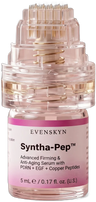
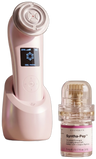
EvenSkyn MicroInfuser with Syntha-Pep PDRN serum
For trying GHK-Cu with a way past the surface: the serum lists Copper Tripeptide-1 alongside PDRN and an EGF peptide.
How it worksA sterile head with 0.5 mm nominal needles, fixed at the head, clicks onto a sealed 5 mL single-use ampoule; the serum goes on as you stamp.
The serumBiosynthetic PDRN at 0.2 percent, sh-Oligopeptide-1, GHK-Cu, a four-form hyaluronic acid system, niacinamide, ergothioneine and Centella asiatica extract.
The routineOne session every two weeks in the evening, about 5 to 10 minutes; four sessions to a kit.
StatusA cosmetic device, not a medical device, and not FDA-cleared.
$179.98
Four complete treatments, about two months, or 45.00 USD a session. 60-day money-back guarantee on unused treatments for US and Canada residents.
What it will not do: change skin overnight, reach where an injection goes, or treat any skin condition. GHK-Cu is one of several actives, named without a stated level near the end of the ingredient list. Not for use in pregnancy or breastfeeding, with a history of keloid scarring, or within six months of oral isotretinoin.28,30
How to use micro-infusion safely, and who should not
Technique is most of the safety story. These steps follow our product and safety pages; always follow the instructions that come with your own device.
Start with clean, healthy skin, and pause retinoids, AHAs, BHAs and vitamin C for about 48 to 72 hours around a session.29
Use a fresh sterile head and a fresh sealed ampoule every session.28
Keep off the eyelids, the hollow under the eye and the lips.29
Afterwards, skip makeup, sweat, pools, saunas and hot showers that day and the next, and wear SPF 30 or higher every morning.29
Keep sessions two weeks apart, in the evening; ten days apart only after four to six sessions without irritation.28,29
Wait at least 48 hours before radiofrequency, and at least 24 hours before ultrasound, EMS, microcurrent or LED.29
Who should not use it, or should ask first
Do not use it during pregnancy or breastfeeding, with a personal or family history of keloid scarring, or within six months of oral isotretinoin.28
With a known fish or shellfish allergy, our duo page asks you not to use micro-infusion: the supplier letter covers the Soluble Collagen on the ingredient list but not the separate Collagen entry.30,31
If you take blood thinners, speak to a doctor first.28
Skip it after a peel, laser treatment or sunburn in the past seven days, and on skin that is broken, infected or inflamed.29
With rosacea, controlled eczema or psoriasis, melasma or a history of dark marks after inflammation, the safety page asks for an extended 24 to 48 hour patch test first.29
With known allergies, read the full ingredient list first. It includes bitter orange flower oil, an essential oil, and we hold no allergen testing on the finished formula.29,30
Stop and contact a healthcare provider if redness lasts more than 48 hours, swelling increases, or you see warmth, pus or fever.29
Frequently asked questions
How long has GHK-Cu been around?
Since 1973, when Loren Pickart and Michael Thaler reported a tripeptide in human serum. Its sequence, glycyl-histidyl-lysine, was published in 1977, and skin research on the copper form began in the late 1980s.
Can GHK-Cu be absorbed through skin?
Poorly through intact skin. In a lab test on human skin samples, almost no peptide or copper crossed in 9 hours, while skin pretreated with microneedles let measurable amounts through. Copper from the peptide did cross skin samples over 48 hours at a high dose. No study has measured this in living skin.
Are there GHK-Cu studies on humans?
A few. One small randomised, double-blind trial in 40 women found less wrinkle volume and depth after 8 weeks than with a plain serum. Larger 12-week studies are described in a 2015 review, but they appeared as a meeting presentation, a university report and a book chapter rather than as peer-reviewed papers.
What was the Leyden 2002 GHK-Cu study?
A 12-week study of a GHK-Cu facial cream in 71 women with mild to advanced photoaging, presented at the American Academy of Dermatology meeting in February 2002. We found no journal article for it in PubMed, including in Dermatologic Surgery, and the review that describes it does not report a control group or randomisation.
What does GHK-Cu do to MMP and TIMP?
In fibroblast cultures it raised both MMPs, the enzymes that break down collagen, and TIMPs, their inhibitors. That is why researchers describe it as a remodelling signal rather than a simple collagen booster.
Does GHK-Cu help stretch marks?
We found no study. A PubMed search on 15 November 2026 for GHK or copper peptides with stretch marks returned nothing, so any stretch-mark claim is untested.
Is Copper Tripeptide-1 the same as GHK-Cu?
Yes. Copper Tripeptide-1 is the ingredient-list name for GHK-Cu, the tripeptide glycyl-histidyl-lysine bound to copper.
Is it safe to inject GHK-Cu?
The FDA says compounded injectable GHK-Cu may pose a risk of immune reactions and that human safety data are limited. We do not suggest injecting it; talk to a physician about anything injectable.
How long does GHK-Cu take to show results?
The one peer-reviewed facial trial measured its result at 8 weeks, and the studies described in reviews at 12. Judge your own routine at 8 to 12 weeks with photos in the same light, not day to day in the mirror.
Can I use vitamin C with copper peptides?
Around a micro-infusion session, our safety guidance asks you to pause vitamin C, retinoids and exfoliating acids for about 48 to 72 hours, and to use only a fresh sealed ampoule through the needles.
How we built this page. On 15 November 2026 we read the PubMed records and abstracts of the peer-reviewed studies cited, checked reference details against Crossref and publisher records, read the 2015 review in full through Europe PMC and the 2018 Cosmetics review on the publisher’s site, and read the FDA’s compounding pages and our own product, ingredient and safety pages. Where we could not read a study, we say so and report it only as the review describes it. This version replaces an earlier one at the same address. It corrects five errors: the 2011 skin study found copper crossing skin samples, not that the peptide does not pass; the 2009 trial cited as copper peptide evidence does not identify a copper peptide in its abstract; three PubMed numbers, one author list and one journal name were wrong; the 1998 study was a thigh study, not an eye cream trial; and the 2002 facial study is a meeting presentation, not a published trial. It also removes a reviewer persona, unsourced prices and timelines, and claims we could not confirm, and adds figures, a goal finder and evidence grades.
Conflicts: we make the MicroInfuser and the Syntha-Pep serum named here. EvenSkyn is a Canadian company that makes at-home beauty devices. No clinician reviewed this version. General information, not medical advice: talk to a dermatologist about your own skin.
References
Pickart L, Vasquez-Soltero JM, Margolina A. GHK peptide as a natural modulator of multiple cellular pathways in skin regeneration. BioMed Research International. 2015;2015:648108. doi:10.1155/2015/648108. PubMed 26236730. Full text read through Europe PMC. The authors list Skin Biology as their affiliation and declare no conflict of interest.
SpecialChem. Copper Tripeptide-1: INCI ingredient page, CosIng reference 55687. Last updated 24 April 2024; read 15 November 2026. specialchem.com
Pickart L, Thaler MM. Tripeptide in human serum which prolongs survival of normal liver cells and stimulates growth in neoplastic liver. Nature New Biology. 1973;243(124):85-87. PubMed 4349963. Record read; we could not read the paper.
Maquart FX, Pickart L, Laurent M, Gillery P, Monboisse JC, Borel JP. Stimulation of collagen synthesis in fibroblast cultures by the tripeptide-copper complex glycyl-L-histidyl-L-lysine-Cu2+. FEBS Letters. 1988;238(2):343-346. doi:10.1016/0014-5793(88)80509-x. PubMed 3169264. Abstract read.
Badenhorst T, Svirskis D, Merrilees M, Bolke L, Wu Z. Effects of GHK-Cu on MMP and TIMP expression, collagen and elastin production, and facial wrinkle parameters. Journal of Aging Science. 2016;4(3):166. doi:10.4172/2329-8847.1000166. Crossref record and abstract read; not indexed in PubMed when we searched on 15 November 2026.
Li H, Low YSJ, Chong HP, Zin MT, Lee CY, Li B, Leolukman M, Kang L. Microneedle-mediated delivery of copper peptide through skin. Pharmaceutical Research. 2015;32(8):2678-2689. doi:10.1007/s11095-015-1652-z. PubMed 25690343. Abstract read.
Leyden J, Stephens T, Finkey M, Appa Y, Barkovic S. Skin care benefits of copper peptide containing facial cream. Presented at the American Academy of Dermatology meeting, New York, February 2002. As cited in the 2015 review; a PubMed search on 15 November 2026 found no journal article, and we could not read it.
Bos JD, Meinardi MMHM. The 500 Dalton rule for the skin penetration of chemical compounds and drugs. Experimental Dermatology. 2000;9(3):165-169. doi:10.1034/j.1600-0625.2000.009003165.x
PubMed. Search for GHK, copper tripeptide or copper peptide(s) together with striae, stretch marks or striae distensae. Run 15 November 2026; no records found. pubmed.ncbi.nlm.nih.gov
US Food and Drug Administration. Certain bulk drug substances for use in compounding that may present significant safety risks. Content current as of 22 April 2026; read 15 November 2026. fda.gov
Pickart L, Margolina A. Skin regenerative and anti-cancer actions of copper peptides. Cosmetics. 2018;5(2):29. doi:10.3390/cosmetics5020029. Read on the publisher’s site. The authors declare no conflict of interest.
Schlesinger DH, Pickart L, Thaler MM. Growth-modulating serum tripeptide is glycyl-histidyl-lysine. Experientia. 1977;33(3):324-325. doi:10.1007/BF02002806. PubMed 858356. Record read.
Maquart FX, Bellon G, Chaqour B, et al. In vivo stimulation of connective tissue accumulation by the tripeptide-copper complex glycyl-L-histidyl-L-lysine-Cu2+ in rat experimental wounds. Journal of Clinical Investigation. 1993;92(5):2368-2376. doi:10.1172/JCI116842. Crossref record read; we could not read the paper.
Siméon A, Emonard H, Hornebeck W, Maquart FX. The tripeptide-copper complex glycyl-L-histidyl-L-lysine-Cu2+ stimulates matrix metalloproteinase-2 expression by fibroblast cultures. Life Sciences. 2000;67(18):2257-2265. doi:10.1016/s0024-3205(00)00803-1. PubMed 11045606. Abstract read.
Dresher WH. Copper and your skin: facelift in a bottle. Copper Development Association, Copper Applications in Health and Environment, June 2006. Read 15 November 2026. copper.org
Pollard JD, Quan S, Kang T, Koch RJ. Effects of copper tripeptide on the growth and expression of growth factors by normal and irradiated fibroblasts. Archives of Facial Plastic Surgery. 2005;7(1):27-31. doi:10.1001/archfaci.7.1.27. PubMed 15655171. Abstract read.
Hostynek JJ, Dreher F, Maibach HI. Human skin penetration of a copper tripeptide in vitro as a function of skin layer. Inflammation Research. 2011;60(1):79-86. doi:10.1007/s00011-010-0238-9. PubMed 20721598. Abstract read.
Campbell JD, McDonough JE, Zeskind JE, et al. A gene expression signature of emphysema-related lung destruction and its reversal by the tripeptide GHK. Genome Medicine. 2012;4(8):67. doi:10.1186/gm367. PubMed 22937864. Abstract read.
Asebey EJ. FDA to remove 12 popular peptides from the category 2 do not compound list. Frier Levitt, 16 April 2026. Read 15 November 2026. frierlevitt.com
US Food and Drug Administration. Bulk drug substances nominated for use in compounding under section 503A: interim categories. Updated 14 May 2026; read 15 November 2026. fda.gov
Dou Y, Lee A, Zhu L, Morton J, Ladiges W. The potential of GHK as an anti-aging peptide. Aging Pathobiology and Therapeutics. 2020;2(1):58-61. doi:10.31491/apt.2020.03.014. PubMed 35083444. Abstract read.
Finkley M, Appa Y, Bhandarkar S. Copper peptide and skin. In: Elsner P, Maibach HI, editors. Cosmeceuticals and Active Cosmetics: Drugs versus Cosmetics. New York: Marcel Dekker; 2005:549-563. As cited in the 2015 review; we could not read it.
Leyden J, Stephens T, Finkey M, Barkovic S. Skin care benefits of copper peptide containing eye creams. University of Pennsylvania, 2002. As cited in the 2015 review; we could not read it.
Abdulghani AA, Sherr A, Shirin S, et al. Effects of topical creams containing vitamin C, a copper-binding peptide cream and melatonin compared with tretinoin on the ultrastructure of normal skin: a pilot clinical, histologic, and ultrastructural study. Disease Management and Clinical Outcomes. 1998;1(4):136-141. doi:10.1016/s1088-3371(98)00011-4. Journal, volume, page and year confirmed in Crossref; we could not read it.
Watson REB, Ogden S, Cotterell LF, et al. Effects of a cosmetic ‘anti-ageing’ product improves photoaged skin. British Journal of Dermatology. 2009;161(2):419-426. doi:10.1111/j.1365-2133.2009.09216.x. PubMed 19438432. Abstract read.
Mohammed YH, Yamada M, Lin LL, Grice JE, Roberts MS, Raphael AP, Benson HAE, Prow TW. Microneedle enhanced delivery of cosmeceutically relevant peptides in human skin. PLOS ONE. 2014;9(7):e101956. doi:10.1371/journal.pone.0101956. Read on the publisher’s site.
Coulman SA, Birchall JC, Alex A, Pearton M, Hofer B, O’Mahony C, Drexler W, Považay B. In vivo, in situ imaging of microneedle insertion into the skin of human volunteers using optical coherence tomography. Pharmaceutical Research. 2011;28(1):66-81. doi:10.1007/s11095-010-0167-x
EvenSkyn. EvenSkyn MicroInfuser with Syntha-Pep PDRN serum, product page: specifications, schedule, regulatory status and source declarations. Read 15 November 2026. evenskyn.com
EvenSkyn. Micro-infusion contraindications and safety: who should not use an at-home device. Last updated 15 November 2026; read 15 November 2026. evenskyn.com
EvenSkyn. What is actually in Syntha-Pep: the full ingredient list as declared on the carton, the bitter orange flower oil and the collagen source declarations. Read 15 November 2026. evenskyn.com
EvenSkyn. Lumo+ and MicroInfuser duo product page: box contents, sequence, regulatory status, guarantee and warranty. evenskyn.com. Read 15 November 2026.
Nine brands, one shared depth ceiling, and a set of differences that sit in the hygiene design rather than the marketing. We compare Seranova, Qure, Glov and the EvenSkyn MicroInfuser on single-use...
No radiofrequency microneedling device is meant for home use, and the FDA says so in writing. What you can do at home instead, twelve products ranked on what each one publishes, and...
How to use PDRN at home, step by step: as a daily serum on intact skin, or through a sealed micro-infusion kit every two weeks, with the two-week schedule, what can go...




留言
所有留言在發布前都會經過審核。
此網站已受到 hCaptcha 保護,且適用 hCaptcha 隱私政策以及服務條款。