At-Home Radiofrequency (RF) for Anti-Aging: The Complete 2026 Guide Backed by Clinical Evidence
Does at-home RF work for aging skin? Modestly. What the trials measured, home against clinic, safety by skin tone, how to use a device, and a realistic timeline.
Published
16 min read
Published by EVENSKYN, which makes and sells at-home beauty devices.
An evidence guide, 12 sources checked, updated 15 November 2026
Does at-home radiofrequency work for aging skin? Modestly, and the evidence for home devices is much thinner than for clinic machines. Here is what RF does to the skin, what the trials measured, who should not use it, and how to use a device well.
EvenSkyn Skin Science Desk. We make the Lumo+ radiofrequency handset and the Venus eye device named in this guide. No clinician reviewed this version.
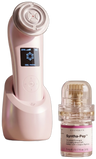
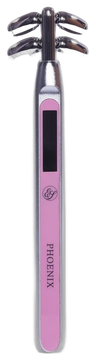
Illustrative still life.
The quick answer
Six questions, six short answers
Does at-home RF work? Modestly. In the one randomised trial of a home RF device we found, the treated side of the face beat an anti-aging cosmetic on wrinkles, radiance, colour and skin thickness after 12 weeks.1
Is it as good as a clinic treatment? We found no trial comparing a home device with a clinic one. Clinic RF has far more studies, and a 2025 review of 15 found most patients improved.2
How does it work? RF delivers heat to the dermis, which makes collagen contract and prompts the skin to make new collagen.3
Is it safe? In that review, side effects were mild and short-lived, mostly redness and some swelling.2
What about darker skin? A review of 35 studies in skin types III to VI found a low risk of dark marks or scarring, though many of the studies were weak.4
How long until results? The home trial reported its results at 12 weeks, so judge a device at about three months.1
Key takeaways
Five things to know before you buy
01The home evidence is one randomised trial: 33 women for 12 weeks, with the RF side doing better than the side treated with an anti-aging cosmetic.1
02Most RF studies use clinic machines. A 2025 review of 15 studies and 1,230 people found texture improved in 71 to 100 percent of patients and firmness in 52.9 to 100 percent.2
03A 2025 trial often quoted for home devices compared two clinic machines, not a home device with a clinic one.5
04In skin types III to VI, a review found a low risk of dark marks or scarring, from studies that were often weak.4
05Our Lumo+ holds the skin at 40 to 42°C in 5-minute sessions. It is a cosmetic device, not FDA-cleared, and it has no published trial.6,7
How RF works on aging skin
Radiofrequency devices deliver heat to the dermis, the layer under the surface that holds most of the skin’s collagen. The heat makes collagen contract, which is the quick tightening some people notice, and it prompts the skin to make new collagen.3 A systematic review of clinic RF found tissue changes consistent with repair and with new collagen and elastin.8
There are three main kinds. Monopolar RF, the type used by clinic machines such as Thermage, can reach deep tissue, up to 20 mm by one review’s account, and needs careful energy control. Bipolar RF passes current between two electrodes on the same head, so it stays shallower, at 1 to 4 mm, which that review says suits home use. Multipolar RF, including microneedle RF, is mostly a clinic technology.3,5
Our Lumo+ uses bipolar RF at 1 MHz, with a brief warm-up and then a steady 40 to 42°C.6
What the clinical evidence actually shows
Most RF studies test clinic machines, often in a single group with no comparison, over weeks or months. The evidence for home devices is far thinner. Here is what each source found.
Study
Design
What was tested
What it found
Read with
Shu and colleagues, 2022
Randomised split-face trial; 33 women aged 35 to 60, 32 finished
A home RF device on one side of the face and an anti-aging cosmetic on the other, for 12 weeks
Better wrinkles, radiance, colour and skin thickness on the RF side; the authors judged the device safe1
The only randomised home-device trial we found; the device is not ours
Kumar and colleagues, 2025
Systematic review of 15 studies, 1,230 people
RF treatments for facial rejuvenation, 2015 to 2025
Texture improved in 71 to 100 percent of patients (4 studies) and firmness in 52.9 to 100 percent (2 studies); 82 to 100 percent were satisfied2
Moderate confidence, by the review’s own grading; downtime was rarely reported
Austin and colleagues, 2022
Systematic review of 121 articles
Clinic RF for the face and neck; home devices were excluded
Improved laxity, elasticity and wrinkles, with tissue signs of new collagen and elastin; one patient developed a neck fistula8
Tells us nothing directly about home devices
Wang and colleagues, 2025
Randomised trial, 40 people
One treatment with a new clinic monopolar device, compared with Thermage
Both reduced the depth of the folds from nose to mouth at 1, 3 and 6 months, with no difference between them5
Two clinic devices, not home against clinic
Xia and colleagues, 2025
One group; 28 enrolled, 22 finished
Four clinic bipolar RF treatments with suction around the eyes, three weeks apart
95.46 percent had wrinkle scores at least 25 percent better; no adverse events9
No control group
Zhao and colleagues, 2025
Not randomised; 36 people
One clinic RF treatment (21 people) or focused ultrasound (15)
Both improved; ultrasound did better on the mid and lower face at one month10
Small, and not randomised
Fig. 1 | Across 15 RF studies, most patients improved, and short-lived redness was common. Share of patients with each outcome, shown as the range across the studies that reported it, from a 2025 systematic review of RF treatments for facial rejuvenation.2 Dark marks are benefits and gold marks are side effects. The review rated its confidence in these findings as moderate, and its abstract does not say how many of the studies used home devices. Drawn by us.
At-home RF vs in-clinic RF: the honest comparison
Clinic monopolar RF reaches deeper tissue than the bipolar RF used in home devices.3 Clinic treatment is one session or a short course; a home device is used two to three times a week for months.5,6,9
We found no trial that compared a home RF device with a clinic one. The often-quoted 2025 trial that found a new device as good as Thermage compared two clinic machines.5 The one randomised home trial compared a home device with a cosmetic cream, not with a clinic.1
Fig. 2 | Only one of these RF trials tested a home device, and all four were small. People enrolled in each trial, and how many finished where the abstract says. The gold dots are the home-device trial; dark dots are clinic devices.1,5,9,10 None of them compared a home device with a clinic one. Drawn by us.
Where home RF is not the tool: deep jowls, heavy laxity or a visible lift. Clinic treatments have more data there, and in one comparison clinic focused ultrasound did better than clinic RF on the lower face at one month.10
Our inference, not a tested method
A home RF device improved wrinkles and skin thickness over 12 weeks against a cosmetic.1
Clinic RF studies, mostly without control groups, report firmer skin in most patients.2
Home bipolar RF stays shallower than clinic monopolar RF.3
Inference: at home, expect modest gains in fine lines and skin quality over months, not clinic-level tightening.
Untested hypothesis: 12 weeks of a home bipolar RF device changes measured jawline laxity less than one clinic monopolar treatment.
What would prove it wrong: a randomised trial comparing the two that finds an equal or larger change with the home device.
Is at-home RF safe, and who should not use it
In the 2025 review, side effects were mild and short-lived: redness in 17.6 to 100 percent of patients and swelling in 5.3 to 26.5 percent, with no serious complications and an average pain score of 1.94 out of 10.2 The home trial reported no safety problems.1
Where not to use it. Our Lumo+ page rules out the eye socket and the area over the eyes, the thyroid, the breasts and the genitals, and skin with active breakouts, cysts or open wounds. It asks you to see a dermatologist first if you have rosacea or use tretinoin or hydroquinone.6
Heart and implants. With a pacemaker or a heart condition, ask your doctor before using it.6,7,11
Pregnancy. We found no safety data for RF in pregnancy in the sources we read; ask your doctor.
After injectables. If you have had fillers or Botox, ask the person who injected them how long to wait.
Status. Our Lumo+ is a cosmetic device, not a medical device, and not FDA-cleared.7 What to check on any home device before you buy is in our guide to radio frequency skin tightening at home.
Is at-home RF safe for skin of colour?
RF and RF microneedling are believed to carry a lower risk of dark marks after treatment in darker skin. A 2023 review of 35 studies in skin types III to VI found short-lived dark marks in 7, milder lasting darkening in 1 and permanent scarring in 1, and judged the risk low, while noting that many of the studies lacked strong evidence.4
Our Lumo+ page lists it as suitable for all skin types and tones. That is our own claim, not a trial result.6
Our suggestion for darker skin: start at the lowest level, use plenty of gel so the head never drags, and stop if the skin darkens or stays red. If you are prone to dark marks, see a dermatologist first.
What to look for in an at-home RF device
Use this checklist on any device, ours included.
1. A stated temperature, and how it is held. The Lumo+ states a brief warm-up, then a steady 40 to 42°C.6
2. The type of RF. Bipolar RF keeps the current shallow, which a 2025 review says suits home use.3
3. Published session rules. Look for a session length, a weekly frequency and a weekly cap. The Lumo+ page sets at least 48 hours between sessions and no more than 25 minutes of RF a week.6
4. A plain regulatory status. Cleared, or sold as a cosmetic device. The Lumo+ is a cosmetic device and is not FDA-cleared.7
5. Evidence for that device. Ask whether any trial tested it. None has tested the Lumo+.6
6. Warranty and returns. The Lumo+ has a 2-year warranty and a 60-day money-back guarantee.6
Is at-home RF right for you?
Three questions. The answer draws only on the sources cited on this page, and nothing you choose is stored or sent anywhere.
Answer the questions to see what to expect.
At-home RF devices: how they differ
Home RF devices differ in the type of RF, the temperature they hold, their session rules and what else is built in. Bipolar RF suits home use because it keeps the current shallow.3 Some devices add LED light or EMS, muscle stimulation strong enough to make muscles contract.6
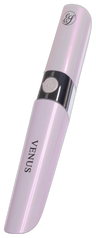
The eye area needs a device made for it. Our Venus uses fractional RF held at 42°C, because its page says the eye zone is too thin for full-power RF, and it works on the eye area only.12
How to use at-home RF for best results
Prepare. Start with clean, dry skin, then apply a water-based conduction gel, which the Lumo+ needs for contact.6
Session length and frequency. The Lumo+ description sets 5-minute sessions two to three times a week. Its usage guidance suggests one to two sessions a week under 40 and two to three over 40, at 5 to 8 minutes, at least 48 hours apart, and never more than 25 minutes of RF a week.6
Where. Work on the face and neck, and keep away from the areas listed in the safety section.6
After. Wipe off the gel and moisturise. Our conduction gel contains methylparaben; check the label if you avoid parabens.6
A realistic results timeline
The home trial measured the skin at 2, 4, 8 and 12 weeks and reported its results at 12 weeks.1 In clinic trials, a single treatment was followed for 1, 3 and 6 months, and in the eye-area study wrinkle scores improved from the second of four treatments.5,9
We found no home trial that followed people after they stopped, so how long home results last is unknown.
Our suggestion: take photos in the same light at the start and every four weeks, and decide at 12 weeks whether the routine is worth keeping.
Combining RF with red light, EMS and micro-infusion
Our Lumo+ puts bipolar RF, EMS at 3 to 15 mA, and red (623 nm) and blue (465 nm) light in one handset.6
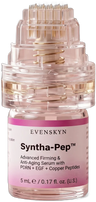
Micro-infusion is a separate step. The Lumo+ page says no home device combines RF and micro-channels safely, and points to a schedule that alternates it with our MicroInfuser, with 48 hours between them.6
Our pick, and what it will not do
This is our choice for gradual firming at home. It is a seller’s choice, not an independent test.
Our pick for firming at home, and yes, we make it
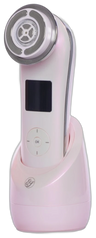
EvenSkyn Lumo+ radiofrequency, EMS and light in one handset
For the look of firmer skin and softer fine lines on the face and neck, in five-minute sessions.
The heatBipolar radiofrequency at 1 MHz: a brief warm-up, then a steady 40 to 42°C.
The currentEMS at 3 to 15 mA, strong enough to make facial muscles contract.
The lightRed at 623 nm and blue at 465 nm, plus ion cleansing and iontophoresis modes for water-based products.
The routineFive-minute sessions, two to three times a week, with a water-based conduction gel; under 25 minutes of radiofrequency a week.
StatusA cosmetic device, not a medical device, and not FDA-cleared.
$179.98
2-year warranty and a 60-day money-back guarantee.
What it will not do: lift like a clinic treatment, treat the eye area, or show results without a routine kept for months. It has no published trial. With a pacemaker or a heart condition, ask your doctor first.6,7,11
Frequently asked questions
Does at-home RF actually work for wrinkles?
Modestly. In a randomised split-face trial of 33 women, the side treated with a home RF device had better wrinkle scores than the side treated with an anti-aging cosmetic after 12 weeks. It is one trial, and the device was not ours.
Is at-home RF as effective as Thermage?
We found no trial comparing them. Clinic monopolar RF reaches deeper tissue than home bipolar RF, and the 2025 trial that found a new device as good as Thermage compared two clinic machines.
How long until I see results from at-home RF?
Give it about three months. The home trial reported its results at 12 weeks, and clinic trials measured at one, three and six months.
Can I use RF after Botox or fillers?
Ask the person who injected them how long to wait, because advice differs between products and clinics.
Is at-home RF safe for darker skin tones?
The evidence is reassuring but weak. A review of 35 studies in skin types III to VI found a low risk of dark marks or scarring, though many of the studies lacked strong evidence. Start gently and stop if the skin darkens.
Can I use at-home RF every day?
Not with the Lumo+: its page sets at least 48 hours between sessions and no more than 25 minutes of RF a week. Other devices set their own limits.
Does at-home RF tighten loose neck skin?
The Lumo+ page lists loose skin on the neck among its uses, but the home trial we found measured the face, not the neck. Expect a modest change at best.
What age should I start at-home RF?
There is no evidence-based starting age. The Lumo+ page suggests one to two sessions a week under 40 and two to three over 40.
RF vs microcurrent: which is better?
They do different things. RF warms the dermis to work on collagen; microcurrent passes a very weak current and is sold for a toned look. EMS, which makes muscles contract, is a third technology.
Do I need a conductive gel with RF?
For the Lumo+, yes: it needs a water-based conduction gel for good contact. Follow your own device’s instructions.
Can I do RF over active acne?
Not with the Lumo+: its page rules out active breakouts, cysts and open wounds.
How we built this page. On 15 November 2026 we read the PubMed records and abstracts of the studies cited and our own Lumo+, Venus, duo and safety pages. This version replaces an earlier one at the same address, which had been pasted in with chat-interface code. It corrects several claims in that version: the 2025 non-inferiority trial compared two clinic devices, not a home device with a clinic one; a 2025 comparison found clinic focused ultrasound did better than clinic RF at one month, not equal results; the skin-of-colour review found a low risk from often weak studies rather than confirming safety; and the Lumo+ runs 5-minute sessions, not 20-minute ones. It drops what we could not source: treatment depths for the Lumo+, a melanin figure, a week-by-week collagen timeline, FDA statuses for other brands’ devices, two studies we could not find, an unverifiable claim about where our components come from, and a Medically Reviewed flag.
Conflicts: we make the Lumo+ and the Venus named here, and the MicroInfuser. EvenSkyn is a Canadian company that makes at-home beauty devices. No clinician reviewed this version. General information, not medical advice: talk to a dermatologist about your own skin.
References
Shu X, Wan R, Huo W, Li Z, Zou L, Tang Y, Li L, Wang X. Effectiveness of a radiofrequency device for rejuvenation of aged skin at home: a randomized split-face clinical trial. Dermatology and Therapy. 2022;12(4):871-883. doi:10.1007/s13555-022-00697-y. PubMed 35249173. Abstract read.
Kumar N, Suh DH, Lee SJ, Ryu HJ. Radiofrequency-based treatments for facial rejuvenation: a systematic review of efficacy, safety, and patient-centered outcomes. Aesthetic Surgery Journal Open Forum. 2025;7:ojaf159. doi:10.1093/asjof/ojaf159. PubMed 41426292. Abstract read.
Zhang B, Tan X, Zhang Q, Wu M. The landscape of radiofrequency technology for skin rejuvenation. Health Science Reports. Published online 27 December 2025;9(1):e71575. doi:10.1002/hsr2.71575. PubMed 41467235. Abstract read; the authors declare no conflicts of interest.
Syder NC, Chen A, Elbuluk N. Radiofrequency and radiofrequency microneedling in skin of color: a review of usage, safety, and efficacy. Dermatologic Surgery. 2023;49(5):489-493. doi:10.1097/DSS.0000000000003733. PubMed 36826381. Abstract read.
Wang Z, Li L, Zhang X, Li Z, Yan Y. Long-term efficacy and safety of a novel monopolar radiofrequency device for skin tightening: a prospective randomized controlled study. Lasers in Surgery and Medicine. 2025;57(3):259-264. doi:10.1002/lsm.70002. PubMed 39957006. Abstract read.
EvenSkyn. Lumo+ product page: radiofrequency, EMS and LED specifications, sessions, suitability, warranty and guarantee. evenskyn.com. Read 15 November 2026.
EvenSkyn. Lumo+ and MicroInfuser duo product page: box contents, sequence, regulatory status, guarantee and warranty. evenskyn.com. Read 15 November 2026.
Austin GK, Struble SL, Quatela VC. Evaluating the effectiveness and safety of radiofrequency for face and neck rejuvenation: a systematic review. Lasers in Surgery and Medicine. 2022;54(1):27-45. doi:10.1002/lsm.23506. PubMed 34923652. Abstract read; the review excluded home-use devices.
Xia J, Wu Y, Zhao Q, Yang L, Wu Y. A prospective study on the efficacy and safety of the bipolar radiofrequency with multi-channel and vacuum-assisted for rejuvenation in periorbital area. Clinical, Cosmetic and Investigational Dermatology. 2025;18:3179-3188. doi:10.2147/CCID.S557696. PubMed 41332508. Abstract read; the authors declare no conflicts of interest.
Zhao B, Li P, Fu Y, Quan Y, Wang H, Zhao L, et al. Efficacy and safety of radiofrequency and focused ultrasound in facial rejuvenation: a single-center, single-blind, non-randomized prospective trial. Journal of Cosmetic Dermatology. 2025;24(8):e70407. doi:10.1111/jocd.70407. PubMed 40832682. Abstract read.
EvenSkyn. Micro-infusion contraindications and safety. evenskyn.com. Updated 15 November 2026.
EvenSkyn. Venus product page: fractional radiofrequency at 42°C, red and blue light, sonic massage, ion-assisted absorption, limits. evenskyn.com. Read 15 November 2026.
The best conductive gel for microcurrent, RF and ultrasound devices: the four label tests that matter, how the common gel types compare, a label checker you can paste any ingredient list into,...
How radio frequency skin tightening works, what the clinical evidence supports, where at-home RF devices help, and the honest limits, with primary source citations.
Napsat komentář
Všechny komentáře jsou před zveřejněním moderovány.




Napsat komentář
Všechny komentáře jsou před zveřejněním moderovány.
Tento web je chráněn službou hCaptcha a vztahují se na něj Zásady ochrany osobních údajů a Podmínky služby společnosti hCaptcha.