Red Light vs. RF vs. Microcurrent vs. Ultrasound: The Complete Clinical Comparison (2026)
How red light, radiofrequency, microcurrent, EMS and ultrasound work, what the trials show for each, the one head-to-head trial we found, and which fits your goal.
Published
17 min read
Published by EVENSKYN, which makes and sells at-home beauty devices.
An evidence guide, 24 sources checked, updated 15 November 2026
Red light, radiofrequency, microcurrent and ultrasound work in different ways and rest on very different amounts of evidence. Here is how each works, what the trials show, the one head-to-head trial we found, and which fits your goal.
EvenSkyn Skin Science Desk. We make the Lumo+, Venus and Phoenix devices named here; the clinic treatments are offered by others. No clinician reviewed this version.
Illustrative still life.
Six questions, six short answers
RF or ultrasound? In the one direct comparison we found, a single clinic focused-ultrasound treatment beat clinic radiofrequency on the mid and lower face at one month, though the groups were not randomised.1
Microcurrent or ultrasound? They do different jobs. Clinic focused ultrasound heats tissue to tighten it and has reviews of many trials; microcurrent has laboratory evidence only.2,3
RF or microcurrent? Radiofrequency warms the skin and has a randomised home trial; microcurrent is a current too low to feel, with laboratory evidence only.3,4
Red light or microcurrent? Red and near-infrared light has randomised trials for wrinkles; we found no randomised trial of a home microcurrent device.5,6
Is ultrasound better than EMS? No trial we found has compared them. EMS made facial muscles thicker in a randomised trial; clinic focused ultrasound lifted the brow by millimetres.2,7
Can I combine them? In clinics, adding radiofrequency to focused ultrasound improved some measures. We found no trial of combining home devices.8
Key takeaways
01Two of the four use heat: radiofrequency warms the skin to about 40 to 42°C at home, and clinic focused ultrasound heats tiny points above 60°C.9,10
02The strongest evidence is for clinic focused ultrasound, with reviews of many trials. Home radiofrequency, EMS and red light each have randomised trials; microcurrent has laboratory work only.2,3,4,5,7
03The one direct comparison we found put clinic focused ultrasound ahead of clinic radiofrequency on the mid and lower face after one treatment, in a non-randomised trial of 36 people.1
04Microcurrent and EMS are different classes of current: our Phoenix runs at about 15 µA, and the EMS mode of our Lumo+ at 3 to 15 mA.9,11
05Combining helped in clinic studies of focused ultrasound plus radiofrequency. For home devices, we found no trial that tested whether combining adds anything.8,12
How each technology works
Four routes, three kinds of energy: heat from radiofrequency and focused ultrasound, electrical current from EMS and microcurrent, and light from LED devices.
Radiofrequency
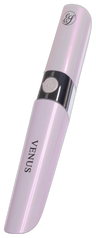
Radiofrequency devices pass an electrical current through the skin, which warms it. Our Lumo+ brings the skin to a steady 40 to 42°C, and our Venus eye device to 42°C.9,13 The best home evidence is a randomised split-face trial: 33 women aged 35 to 60 used a home radiofrequency device on one side of the face and an anti-aging cosmetic on the other for 12 weeks, and the device side showed better wrinkles, radiance, colour and skin thickness.4
EMS and microcurrent
These are two different things. EMS, electrical muscle stimulation, uses enough current to make facial muscles contract. In a randomised trial of 108 women, 12 weeks of facial EMS made the cheek muscle 18.6 percent thicker than in an untreated group, and at least 80 percent reported improved firmness, tone and lift.7
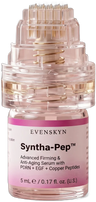
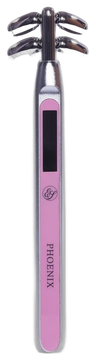
Microcurrent is a current so low you usually cannot feel it. Our Phoenix delivers about 15 µA through its rollers.11 The idea that it raises cell energy traces to a 1982 laboratory study in which currents of 10 to 1,000 µA increased ATP in rat skin.3 A 2024 review of 18 studies of home devices found no randomised trial of a home microcurrent device; its one trial in that category tested EMS.6
Fig. 1 | Microcurrent and EMS are different classes of current, hundreds of times apart. Each bar is a published range and the dot a single published value, on a log scale. Our Phoenix runs at about 15 µA and the Lumo+ EMS mode at 3 to 15 mA, which is 3,000 to 15,000 µA: by our arithmetic, 200 to 1,000 times more.9,11 The pale bar is the range across which ATP rose in rat skin in a 1982 laboratory study, not a device setting.3 NuFACE and ZIIP do not state their output on the pages we read.14,15
Red and near-infrared light
LED devices shine set wavelengths of light onto the skin. In a randomised, double-blind, split-face trial of 76 people with a sham-light group, red (633 nm), near-infrared (830 nm) and the two combined reduced measured wrinkles by up to 36 percent from baseline.5 In a controlled trial of 136 people, broadband light did no better than red light alone.16 Both trials used professional light systems rather than home masks, and the studies of home LED devices are small.6 Our guide to LED masks for wrinkles and sagging covers the masks themselves.
Focused ultrasound in the clinic, and ultrasound at home
Clinic focused ultrasound brings energy to points below the surface, where tissue passes 60°C in points smaller than a cubic millimetre, up to about 5 mm deep.10 A review of 16 studies found brow lifts of 0.47 to 1.7 mm after a single treatment, and a meta-analysis of 13 studies with 477 participants put the response rate at 77 percent at 90 days.2,17
Home ultrasound is a different category. The only trial of a home device with ultrasound that we found tested a handset that combined it with light, radiofrequency and low-energy microcurrent, so the share owed to ultrasound is unknown.18 Our guide to ultrasound skin tightening at home goes further.
Fig. 2 | Clinic focused ultrasound places its heat at set depths; the home trial's abstract gives none. Depth below the skin surface in millimetres. Dots mark the depths where heat was placed or the transducers were set; dashed lines run to the deepest point reported. Transducer depths from a 2026 case series19 and a 2010 brow-lift study;20 heated points in skin from deceased donors21 and as described in a 2015 review;10 heat zones in the SMAS of faces from deceased donors.22 The home device combined low-intensity ultrasound with three other energies; its abstract gives no focal depth.18 Drawn by us.
The evidence, side by side
Here is the best study we found for each technology, and how much weight we give it.
Technology
How it acts
Where it is used
Best evidence we found
Our grade
Radiofrequency
Electrical current that warms the skin, to 40 to 42°C in our handset9
Home and clinic
Randomised split-face trial, 33 women, 12 weeks, against an anti-aging cosmetic4
Moderate
EMS
Current strong enough to contract facial muscles
Home
Randomised trial, 108 women, 12 weeks: cheek muscle 18.6 percent thicker than in an untreated group7
Moderate
Microcurrent
Current too low to feel; about 15 µA in our Phoenix11
Home
ATP rose in rat skin at 10 to 1,000 µA in a laboratory study; no randomised home trial found3,6
Mechanistic
Red and near-infrared light
Set wavelengths of light
Home masks; the trials used professional systems
Randomised split-face trial with a sham-light group, 76 people: wrinkles down by up to 36 percent5
A review of 16 studies: brow lifts of 0.47 to 1.7 mm; a meta-analysis of 13: 77 percent responded at 90 days2,17
Reviews of trials
Low-intensity ultrasound
Ultrasound without a stated focus
Home
One randomised trial of a device that adds three other energies18
Early
Combining home devices
Several energies in one routine
Home
No trial found
Untested
How we grade: Moderate means at least one randomised controlled trial in people; Reviews of trials means systematic reviews or meta-analyses; Early means a single trial of a combined device; Mechanistic means laboratory work only; Untested means nothing published that we could find.
Head to head: the comparisons people ask about
We found one trial that compared two of these technologies directly. For the other pairs, compare their separate evidence, as this tool does.
Compare any two
Pick two technologies. The tool shows the best evidence for each and any direct comparison we found.
Pick two technologies to compare.
RF vs ultrasound
The one head-to-head trial we found treated 36 people once, 21 with clinic radiofrequency and 15 with clinic focused ultrasound, without randomisation. Three blinded dermatologists rated wrinkles at one and three months. Both groups improved; at one month the ultrasound group did better on the mid face and lower face, and neither group had severe side effects.1 At home the picture flips: radiofrequency has a randomised trial, while we found none of home ultrasound on its own.4,18
Microcurrent vs ultrasound
These are not rivals. Clinic focused ultrasound heats tissue below the surface and has reviews of many trials; microcurrent is a current too low to feel, with laboratory evidence only. We found no trial comparing them.2,3,10
RF vs microcurrent
Radiofrequency is a heat treatment with a randomised home trial; microcurrent is a sub-sensory current with laboratory evidence. If muscle tone is the goal, EMS, not microcurrent, is the current with a randomised trial.3,4,7
Red light vs microcurrent
Red and near-infrared light has randomised trials for wrinkles, including one with a sham-light group. We found no randomised trial of a home microcurrent device.5,6
Red light vs RF
Both have randomised trials, for different outcomes: light reduced measured wrinkles against a sham light, and home radiofrequency improved wrinkles and skin thickness against a cosmetic. We found no trial comparing them directly.4,5
Is ultrasound skin tightening better than EMS?
They do different jobs, and we found no trial comparing them. Clinic focused ultrasound lifted the brow by 0.47 to 1.7 mm in a review of 16 studies; facial EMS made the cheek muscle thicker in a randomised trial of 108 women.2,7
Combining technologies: what the evidence shows
In clinics. In a non-randomised split-face study of 22 Korean adults, one side had focused ultrasound alone and the other focused ultrasound plus bipolar radiofrequency. Both sides improved, and the combined side did better on pore count, elasticity, wrinkle depth around the eyes and moisture.8 In a retrospective study of 56 patients treated with focused ultrasound and monopolar radiofrequency together, 96.4 percent improved on a global aesthetic scale; all had brief mild redness, and most rated their pain at 5.12 Neither study was randomised, and the second had no comparison group.
At home. Several home devices, including our Lumo+, put more than one energy in a single handset. We found no trial testing whether combining home technologies adds anything to using one. An earlier version of this page said a 2024 review had concluded that combined home devices beat single ones; the review's abstract does not say so.6
Timing around clinic treatments. After injectables, peels or microneedling, follow your clinician's timing; our guide to device timing after injectables covers the common cases.
Which technology fits your goal
A visible lift of the brow, jaw or neck. Clinic focused ultrasound, which has the most trials; with marked laxity, a surgeon.2
Gradual firming and fine lines at home. Radiofrequency, kept to its schedule.4
We found no trial comparing home devices of different technologies head to head, no trial of home ultrasound on its own, and no trial of combining home devices. The home radiofrequency trial we cite compared the device with a cosmetic, not a sham. For clinic focused ultrasound, investigator-rated improvement held to one year, and longer-term data were not available.2,4
Our recommendation
Our inference, not a tested method
The heat-based treatments have the strongest data for tightening: clinic focused ultrasound in reviews, and home radiofrequency in a randomised trial.2,4
In the one head-to-head trial, clinic focused ultrasound beat clinic radiofrequency after one session on the mid and lower face.1
EMS and light each have randomised trials for narrower outcomes: muscle thickness and wrinkles.5,7
Sub-sensory current has laboratory evidence only.3
Inference: choose by goal: clinic focused ultrasound for a lift, home radiofrequency for gradual firming, EMS for tone and light for fine lines, with a sub-sensory roller as optional upkeep.
Untested hypothesis: a home device that adds EMS and light to radiofrequency does not improve measured firmness at 12 weeks more than radiofrequency alone.
What would prove it wrong: a randomised trial comparing a combined home device with radiofrequency alone, showing a measured difference.
What we would do
Want a visible lift? Book a consultation for clinic focused ultrasound, and ask about pain control.
Want firming at home? Use radiofrequency, kept to its schedule.
Want more muscle tone? Look at EMS.
Only fine lines, and no heat? Use red and near-infrared light for about three months, then judge.
Our pick for home firming, and what it will not do
This is our choice for firming at home. It is a seller's choice, not an independent test.
Our pick for home firming, and yes, we make it
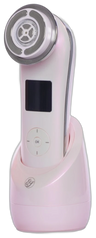
EvenSkyn Lumo+ radiofrequency, EMS and light in one handset
For the look of firmer skin along the jaw and neck and softer fine lines, in five-minute sessions. It combines radiofrequency, EMS and red and blue light in one handset.
The heatBipolar radiofrequency at 1 MHz: a brief warm-up, then a steady 40 to 42°C.
The currentEMS at 3 to 15 mA, strong enough to make facial muscles contract.
The lightRed at 623 nm and blue at 465 nm, plus ion cleansing and iontophoresis modes for water-based products.
The routineFive-minute sessions, two to three times a week, with a water-based conduction gel; under 25 minutes of radiofrequency a week.
StatusA cosmetic device, not a medical device, and not FDA-cleared.
$179.98
2-year warranty and a 60-day money-back guarantee.
What it will not do: match a clinic focused-ultrasound treatment, treat the eye area, or show results without a routine kept for months. With a pacemaker or a heart condition, ask your doctor first.9,23,24
Frequently asked questions
Is radiofrequency or ultrasound better for skin tightening?
In the one direct comparison we found, a single clinic focused-ultrasound treatment beat clinic radiofrequency on the mid and lower face at one month, though the groups were not randomised and both improved. At home, radiofrequency has a randomised trial, and we found none of ultrasound on its own.
Microcurrent vs ultrasound for the face: which is better?
They do different jobs. Clinic focused ultrasound heats tissue and has reviews of many trials; microcurrent has laboratory evidence only. We found no trial comparing them.
What is the difference between radiofrequency and microcurrent?
Radiofrequency warms the skin and has a randomised home trial. Microcurrent is a current too low to feel, about 15 µA in our Phoenix, with laboratory evidence only.
Microcurrent vs red light therapy: which is better for wrinkles?
Red and near-infrared light, on current evidence: it reduced measured wrinkles in a randomised trial with a sham-light group, while we found no randomised trial of a home microcurrent device.
Is ultrasound skin tightening better than EMS treatments?
They do different jobs, and we found no trial comparing them. Clinic focused ultrasound lifted the brow by 0.47 to 1.7 mm across 16 studies; facial EMS made the cheek muscle thicker in a randomised trial of 108 women.
Can I use radiofrequency and red light on the same day?
Several home devices, including our Lumo+, combine them in one session. We found no trial showing that combining them adds to either alone, so follow each maker's instructions.
Which ultrasound treatment is best if redness is a dealbreaker?
Any heat-based treatment can leave skin red for a while. In the review we read, clinic focused ultrasound commonly caused short-lived redness, with or without swelling, so ask the clinic how long it usually lasts.
How long do the results last?
For clinic focused ultrasound, investigator-rated improvement after one treatment held to one year in a 2023 review, and longer-term data were not available. The home trials ran for about three months, so we cannot say how long changes last after you stop.
How we built this page. On 15 November 2026 we read the PubMed records and abstracts of the studies cited, our own Lumo+, Venus, Phoenix, duo and safety pages, and two makers' pages for the first figure, and reused figures and checks from our device, LED and ultrasound guides. This version replaces an earlier one at the same address. It removes a reviewer persona, a laxity improvement range attributed to a 2025 review, competitor prices we had not re-read, an unsourced 3 mm depth and other unsourced figures, a claim that a 2024 review found combined home devices superior, citations with the wrong authors or year, and an example table that listed our radiofrequency handset under the wrong technology, and adds a side-by-side evidence table, a compare-any-two tool, two figures and a head-to-head section.
Conflicts: we make the Lumo+, Venus and Phoenix named here, along with other at-home beauty devices. EvenSkyn is a Canadian company that makes at-home beauty devices. No clinician reviewed this version. General information, not medical advice: talk to a dermatologist about your own skin.
References
Zhao B, Li P, Fu Y, Quan Y, Wang H, Zhao L, et al. Efficacy and safety of radiofrequency and focused ultrasound in facial rejuvenation: a single-center, single-blind, non-randomized prospective trial. Journal of Cosmetic Dermatology. 2025;24(8):e70407. doi:10.1111/jocd.70407. PubMed 40832682. Abstract read.
Contini M, Hollander MHJ, Vissink A, Schepers RH, Jansma J, et al. A systematic review of the efficacy of microfocused ultrasound for facial skin tightening. International Journal of Environmental Research and Public Health. 2023;20(2):1522. doi:10.3390/ijerph20021522. PubMed 36674277. Abstract read; the authors declare no conflict of interest.
Cheng N, et al. The effects of electric currents on ATP generation, protein synthesis, and membrane transport of rat skin. Clinical Orthopaedics and Related Research. 1982;(171):264-272. PubMed 7140077. Abstract read.
Shu X, Wan R, Huo W, Li Z, Zou L, Tang Y, Li L, Wang X. Effectiveness of a radiofrequency device for rejuvenation of aged skin at home: a randomized split-face clinical trial. Dermatology and Therapy. 2022;12(4):871-883. doi:10.1007/s13555-022-00697-y. PubMed 35249173. Abstract read.
Lee SY, Park KH, Choi JW, Kwon JK, Lee DR, Shin MS, Lee JS, You CE, Park MY. A prospective, randomized, placebo-controlled, double-blinded, and split-face clinical study on LED phototherapy for skin rejuvenation: clinical, profilometric, histologic, ultrastructural, and biochemical evaluations and comparison of three different treatment settings. Journal of Photochemistry and Photobiology B: Biology. 2007;88(1):51-67. doi:10.1016/j.jphotobiol.2007.04.008
Bu P, Duan R, Luo J, Yang T, Liu N, Wen C. Development of home beauty devices for facial rejuvenation: establishment of efficacy evaluation system. Clinical, Cosmetic and Investigational Dermatology. 2024;17:553-563. doi:10.2147/CCID.S449599. Publisher full text read 15 November 2026.
Kavanagh S, Newell J, Hennessy M, Sadick N. Use of a neuromuscular electrical stimulation device for facial muscle toning: a randomized, controlled trial. Journal of Cosmetic Dermatology. 2012;11(4):261-266. doi:10.1111/jocd.12007. PubMed 23174048. Abstract read.
Byun JW, Kang YR, Park S, Hong W. Efficacy of radiofrequency combined with single-dot ultrasound efficacy for skin rejuvenation: a non-randomized split-face trial with blinded response evaluation. Skin Research and Technology. 2023;29(9):e13452. doi:10.1111/srt.13452. PubMed 37753689. Abstract read.
EvenSkyn. Lumo+ product page: radiofrequency, EMS and LED specifications, sessions, suitability, warranty and guarantee. evenskyn.com. Read 15 November 2026.
Fabi SG. Noninvasive skin tightening: focus on new ultrasound techniques. Clinical, Cosmetic and Investigational Dermatology. 2015;8:47-52. doi:10.2147/CCID.S69118. PubMed 25709486. Abstract read.
EvenSkyn. Phoenix product page: solar-powered microcurrent of about 15 µA, four rollers, daily use, limits and cautions. evenskyn.com. Read 15 November 2026.
Khong SML, Ismail AH, Sujani S, Devindaran N, Abdul Rashid MF, Mohd Zaman UMS. Safety and efficacy of high-intensity focused ultrasound and monopolar radiofrequency combination therapy for skin tightening: a retrospective study in Malaysia. Malaysian Journal of Medical Sciences. 2024;31(1):114-123. doi:10.21315/mjms2024.31.1.10. PubMed 38456105. Abstract read.
EvenSkyn. Venus product page: fractional radiofrequency at 42°C, red and blue light, sonic massage, ion-assisted absorption, limits. evenskyn.com. Read 15 November 2026.
NuFACE. TRINITY+ Starter Kit, US product page: price, FDA wording, modes and Boost Button. mynuface.com. Read 15 November 2026.
ZIIP. ZIIP HALO, US product page: price, microcurrent and nanocurrent, treatment lengths and how often. ziipbeauty.com. Read 15 November 2026.
Wunsch A, Matuschka K. A controlled trial to determine the efficacy of red and near-infrared light treatment in patient satisfaction, reduction of fine lines, wrinkles, skin roughness, and intradermal collagen density increase. Photomedicine and Laser Surgery. 2014;32:93-100. doi:10.1089/pho.2013.3616
Ling J, Zhao H. A systematic review and meta-analysis of the clinical efficacy and patients’ satisfaction of micro-focused ultrasound (MFU) treatment for facial rejuvenation and tightening. Aesthetic Plastic Surgery. 2023;47(5):1806-1823. doi:10.1007/s00266-023-03384-1. PubMed 37198297. Abstract read.
Choi S, Kim J, Lee YI, Lee SG, Jung I, Suk J, et al. Efficacy and safety of a home-use handheld multi-energy-based device for skin rejuvenation: clinical, ex vivo, and histological studies. Lasers in Medical Science. 2024;39(1):38. doi:10.1007/s10103-024-03982-8. PubMed 38236440. Abstract read.
Heitzmann W, Schiefer JL, Lanckohr L, Visnovska D, Schulz A, et al. First clinical experiences with microfocused ultrasound in infraorbital rejuvenation: a clinically and scientifically grounded perspective. Facial Plastic Surgery. 2026;42(3):367-376. doi:10.1055/a-2666-5719. PubMed 40763772. Abstract read.
Alam M, White LE, Martin N, Witherspoon J, Yoo S, West DP. Ultrasound tightening of facial and neck skin: a rater-blinded prospective cohort study. Journal of the American Academy of Dermatology. 2010;62(2):262-269. doi:10.1016/j.jaad.2009.06.039. PubMed 20115948. Abstract read.
Laubach HJ, Makin IRS, Barthe PG, Slayton MH, Manstein D. Intense focused ultrasound: evaluation of a new treatment modality for precise microcoagulation within the skin. Dermatologic Surgery. 2008;34(5):727-734. doi:10.1111/j.1524-4725.2008.34196.x. PubMed 18429926. Abstract read.
White WM, Makin IRS, Barthe PG, Slayton MH, Gliklich RE. Selective creation of thermal injury zones in the superficial musculoaponeurotic system using intense ultrasound therapy: a new target for noninvasive facial rejuvenation. Archives of Facial Plastic Surgery. 2007;9(1):22-29. doi:10.1001/archfaci.9.1.22. PubMed 17224484. Abstract read.
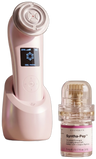
EvenSkyn. Lumo+ and MicroInfuser duo product page: box contents, sequence, regulatory status, guarantee and warranty. evenskyn.com. Read 15 November 2026.
EvenSkyn. Micro-infusion contraindications and safety. evenskyn.com. Updated 15 November 2026.
Nine at-home anti-aging devices across radiofrequency, EMS, microcurrent and light, read from their makers on 15 November 2026, with the evidence behind each technology graded. We make three of them and say...
GLP-1 face, also called Ozempic face, is the look of lost facial volume and looser skin after fast weight loss, and this guide covers why it happens, what clinic options do and...
Efterlad en kommentar
Alle kommentarer er modereres, før de bliver offentliggjort.




Efterlad en kommentar
Alle kommentarer er modereres, før de bliver offentliggjort.
'Denne side er beskyttet af hCaptcha, og hCaptchas Politik om beskyttelse af persondata og Servicevilkår er gældende.