


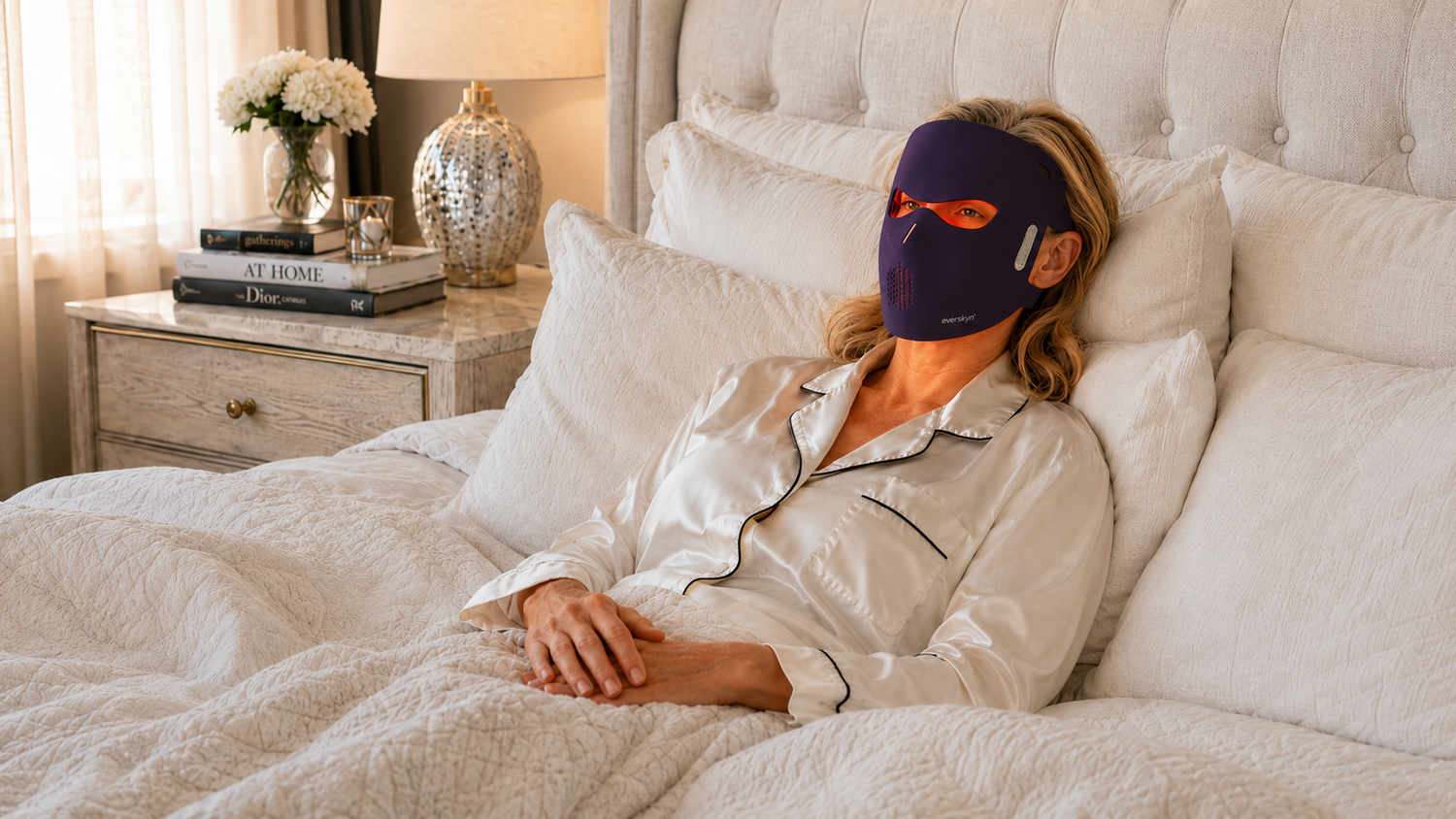
Medically Reviewed by Dr. Lisa Hartford, MD
Skin & Beauty Articles / Decision Guide
Most pages that answer "is red light therapy safe for me" are written to reassure you into a purchase. This one is written to help you decide, including the cases where the right call is do not buy a device, or see a doctor first.
Key takeaways
- Red light therapy has real, controlled-trial evidence for modest improvements in fine lines, skin roughness and collagen density. It is a slow, cumulative effect, not a lift and not a filler substitute.
- At-home masks deliver lower energy than clinic panels. A home-use LED mask has shown measurable wrinkle improvement in a sham-controlled trial, but expect smaller gains over longer timeframes than a clinical device.
- Eye exposure is the one safety issue that is not minor. A documented case of light-induced retinal injury from an LED face mask exists. Eye protection and following the device instructions are not optional.
- Some people should not start without medical advice: anyone on a photosensitizing medication, anyone with a photosensitive disease such as lupus, anyone with an undiagnosed changing skin lesion, and during pregnancy it has not been adequately studied.
- If your main concern is significant skin laxity or deep folds, a device will disappoint you. That is a clinic conversation, and we say so plainly below.
At a glance: the questions you actually searched
Does red light therapy actually tighten loose skin? Evidence: moderate
For mild crepiness and early fine lines, controlled trials support a real but modest effect on collagen density and skin roughness. For genuine sagging (jowls, significant laxity), light alone does not produce the result people picture. Limitation: trials measure texture and collagen markers, not dramatic tightening, and most use clinic-grade output.
Can you use red light therapy while pregnant? Evidence: insufficient
There is no adequate, pregnancy-specific safety trial for cosmetic red light therapy. Many sources call it "safe" anyway; that claim is not backed by pregnancy-specific data, it is an extrapolation from the fact that the light is non-ionizing and non-thermal. We do not know, so this is a conversation to have with your obstetric provider before starting, not a decision to make from a product page.
Does it interact with retinol or my medication? Evidence: mechanism plus clinical consensus
Retinoids increase skin sensitivity and irritation potential; many people separate the two or use red light in the morning and retinoid at night, but this is sequencing for tolerability, not a proven interaction. Medication is different and more important: several common drugs are photosensitizing, and that is covered in the safety section with a class table.
Is the cheap mask as good as the clinic? Evidence: clear no, with nuance
No. It is lower powered and slower. Whether that tradeoff is worth it depends entirely on your goal and your consistency, which is the deciding factor we explain below.
How we assessed this
This is editorial content, not a clinical opinion from a named physician, and we are not going to pretend otherwise. Our process was straightforward. We started from the questions people actually type, taken from real search data for this topic, so the guide answers what is being asked rather than what is easy to write. For every efficacy or safety claim that needed evidence, we located the primary source, opened its record at PubMed or PMC, and recorded the identifier you can check yourself in the references. Where good human evidence does not exist, for example cosmetic use during pregnancy, we say the evidence is insufficient rather than filling the gap with confident language. Where a claim rests on biological plausibility rather than outcome trials, we label it as mechanism reasoning. We did not invent effect sizes, and the figures in this article visualize the article's own logic, not measured trial data.
What red light therapy actually is
Red light therapy is the cosmetic and clinical use of low-intensity red and near-infrared light, roughly in the 600 to 660 nanometre and 800 to 860 nanometre ranges, delivered to the skin by LEDs. It is non-ionizing, which means it is not the kind of radiation that damages DNA the way ultraviolet or x-rays can, and at the doses used for skin it is non-thermal, meaning it is not heating or burning tissue the way a radiofrequency or laser tightening treatment does. The umbrella scientific term is photobiomodulation. Researchers describe the primary light-absorbing target as cytochrome c oxidase in the mitochondria, with downstream changes in cellular energy and signalling that, in the skin, can nudge fibroblasts toward more collagen production over time.[2]
That is the core of it: a gentle, repeated, cumulative nudge to skin biology. It is not a wound, not a controlled injury, and not a quick mechanical change. Almost every disappointed buyer we have seen made the same mistake, which was expecting a device in this category to behave like a procedure in a very different category.
Why it is everywhere right now
Red light masks moved from clinics to bathrooms because LED costs fell, because the devices photograph well, and because the underlying idea has decades of laboratory and clinical literature behind it, even if a lot of that literature is small or industry-funded. It is worth separating two true facts that marketing tends to blur. The first is that light-based photorejuvenation has controlled-trial support.[1] The second is that a specific cheap consumer mask is not automatically the thing that was tested. Popularity is not evidence about the unit in your cart. We come back to how to tell them apart in the section on evaluating a device.
How it works, in plain terms
Light at these wavelengths penetrates the outer skin and is absorbed inside cells, principally by an enzyme in the mitochondria called cytochrome c oxidase. That absorption is associated with a short rise in cellular energy production, a brief and small burst of reactive oxygen species that appears to act as a signal rather than as damage, and a cascade of secondary effects including changes in nitric oxide and calcium signalling.[2] In skin specifically, the practical downstream story is that fibroblasts, the cells that build collagen and elastin, can be encouraged toward more matrix production, which over weeks shows up as slightly firmer texture and reduced fine-line depth in controlled studies.[1]
One feature matters for using a device sensibly: the dose response is biphasic. More is not better past a point. Too little light does nothing; a useful amount helps; substantially more does not help proportionally and can blunt the effect.[2] This is exactly why doubling your session time to "speed things up" is not a strategy, and why a well-specified device with sensible session guidance beats a vague one.
RLT, LED, LLLT, PBM, IPL: a confusion clarifier
| Term | What it means | What it is not |
|---|---|---|
| Red light therapy (RLT) | Consumer-friendly name for skin use of red and near-infrared LED light | Not a heat or injury treatment |
| LED therapy | Refers to the light source (light-emitting diode) | Not the same as laser |
| LLLT / photobiomodulation (PBM) | The scientific terms for the same low-intensity light effect | Not "low level" meaning weak or fake; it is a defined dose range |
| IPL | Intense pulsed light, a high-energy broadband flash used for pigment and hair | Not red light therapy; different purpose and risk profile |
| Ablative or RF tightening | Procedures that heat or injure tissue to remodel it | Not photobiomodulation; do not expect RLT to match these |
If you take one thing from this table: when a page compares a red light mask to a clinic tightening result, it is comparing two different categories. That comparison is where most of the disappointment in this space is manufactured.
Disclosure and scope
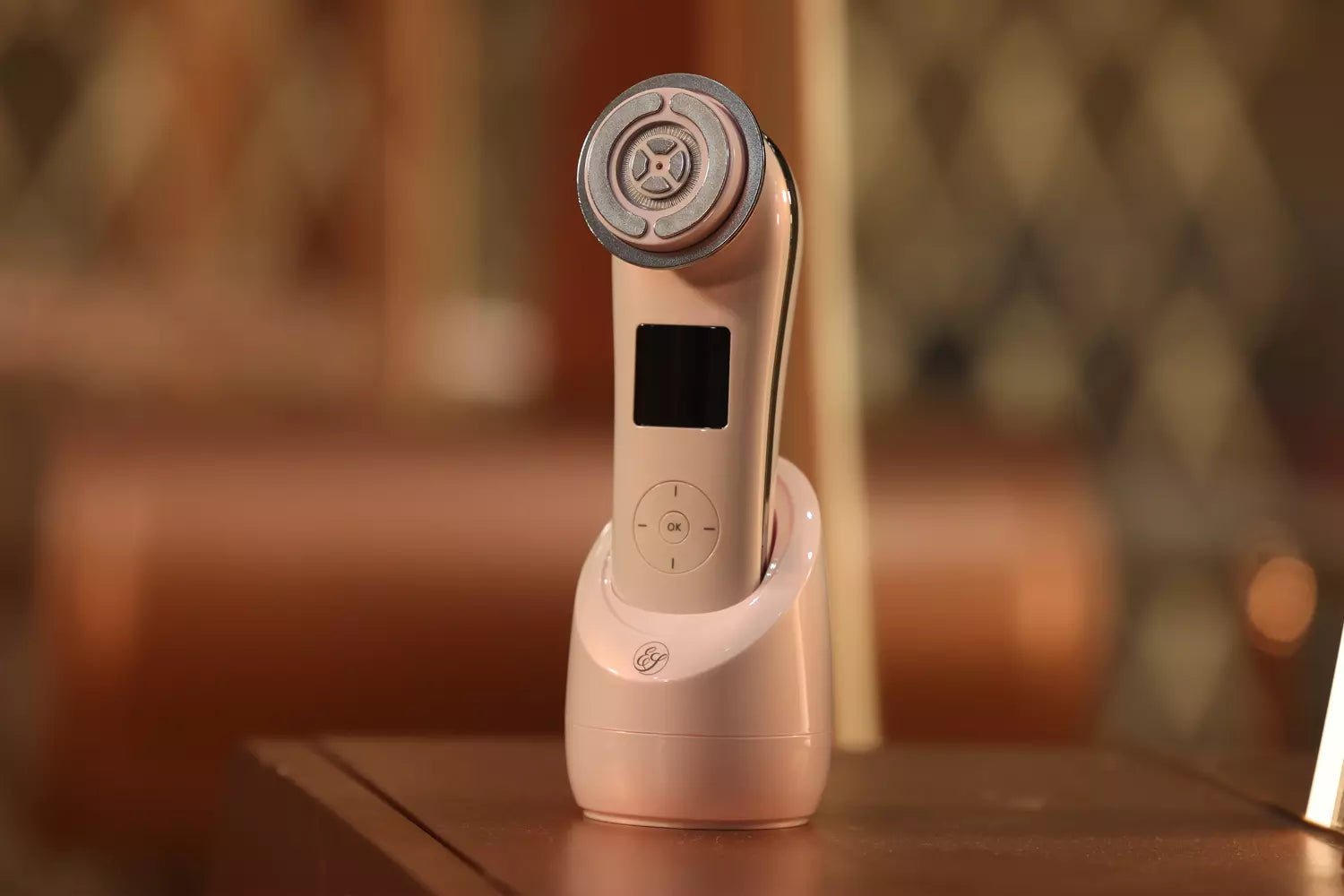
We sell red light devices. EvenSkyn makes the Mirage LED mask, which is referenced later in this guide. That commercial interest is exactly why the rest of this article spends so much time on who should not buy one and where a clinic is the better use of money. You should read our recommendation as informed but interested, and weigh it accordingly. This guide is general information, not a diagnosis or a treatment plan for your skin or your medications.
What a home device does, and what a clinic does
A clinic uses higher output, controlled distance, supervised sessions, and often combines light with other modalities. A home mask uses lower output and depends entirely on you using it correctly and consistently for months. The accurate framing avoids both extremes: home devices trade power for convenience, and convenience only pays off when it converts into consistency. A home-use LED and infrared mask was tested in a multi-centre, randomized, double-blind, sham-controlled trial for crow's feet and showed measurable improvement against a sham device.[3] That is meaningful, and it is also a controlled study of a specific device used as directed, not a guarantee that any mask equals a clinic panel.
The single factor that decides if it works for you
The deciding factor is not the brand, the wavelength count, or the price; it is whether you will actually use it, correctly, several times a week, for at least eight to twelve weeks before judging it. Photobiomodulation is cumulative and the dose response is biphasic, so sporadic long sessions are close to the worst pattern: too little total exposure spread out, or too much in one sitting. The people who get results are the ones for whom the device fits their existing routine. If you already know you will not keep this up, the most useful financial advice in this entire guide is to not buy one, and we mean that.
Wavelengths and dose, broken down
Skin photorejuvenation research clusters around red light near 630 to 660 nm and near-infrared near 830 to 850 nm. Red is absorbed more superficially; near-infrared penetrates deeper. Trials of skin rejuvenation have used red, near-infrared, or combinations, and a well-cited controlled trial found that a broad polychromatic spectrum offered no clear advantage over a red-light-only spectrum, while both produced measurable collagen and roughness improvements versus control.[1] The practical reading: a device does not need an exotic spectrum to be credible, it needs a sensible wavelength, a stated irradiance, and session guidance grounded in the biphasic dose idea.[2]
Which user are you
Early maintenance user. Thirties to forties, mild texture and fine-line concerns, wants prevention and slow improvement. This is the person the evidence supports best, and the person a home device suits.
Significant laxity user. Noticeable sagging or deep folds, wants a visible lift. Light alone will underdeliver here. This is the clinic conversation, possibly energy-based tightening or other procedures, and we are not going to sell you a mask as a substitute.
Sensitive or medicated user. Photosensitizing medication, a photosensitive condition, pregnancy, or an undiagnosed lesion. The right first step is medical advice, not a purchase. See the safety section.
Honest comparison matrix
| Option | Best for | Realistic result | Effort | Honest downside |
|---|---|---|---|---|
| At-home LED mask | Mild texture, fine lines, prevention | Modest, gradual | High (months of consistency) | Slow; useless if not used as directed |
| In-clinic LED or combination | Faster or stronger texture results | Moderate, supervised | Low for you, costs more | Ongoing cost; still not a facelift |
| Energy-based tightening (clinic) | Genuine mild-to-moderate laxity | More visible firming | Procedure with downtime | Cost, discomfort, not for everyone |
| Do nothing plus sunscreen | Anyone unsure or inconsistent | Prevents added photodamage | Minimal | No active improvement, but no risk or spend |
"Do nothing plus sunscreen" is in this table on purpose. For an inconsistent user it genuinely outperforms an unused device, and a guide that left it out would be selling, not informing.
By the numbers: how to read the evidence
How to read this without the spin: the strongest cosmetic evidence is a controlled trial showing improved skin roughness and intradermal collagen density versus an untreated control, with blinded assessment and instrument measurement.[1] A separate randomized, sham-controlled trial of a home-use mask showed improvement in crow's feet.[3] Safety has been examined in randomized work on LED red light on human skin.[4] A further controlled study reported reduced visible aging signs with red light photobiomodulation, consistent in direction with the trial above though, like much of this field, subject to sponsor relationships that warrant a cautious reading.[6] None of these support dramatic lifting, all are limited in size or duration, and several studies in this field are funded by device makers, which is a reason to weigh effect sizes modestly, not to dismiss the field. We are deliberately not printing a single percentage here, because quoting a trial's number as if it predicts your face would be the exact dishonesty this guide exists to avoid.
An evidence-aligned at-home routine
This is general guidance aligned with how devices were used in controlled studies, not a prescription. Use the device on clean, dry, bare skin, since serums and makeup can block or scatter light. Follow the manufacturer's distance and session length rather than improvising, because the dose response is biphasic and longer is not better.[2] A typical evidence-aligned cadence is several short sessions per week, consistently, for a minimum of eight to twelve weeks before you judge results. Protect your eyes as the device instructs. If you use a retinoid, many people simply use red light earlier in the day and the retinoid at night, which is about comfort, not a proven chemical interaction. Stop and reassess if you get persistent redness, irritation or any visual disturbance.
Decision block: should you buy one
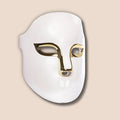
Buy a home LED device if: you have mild texture or fine-line concerns, you are realistic about gradual results, you have no photosensitizing medication or condition, and you will genuinely use it several times a week for months. In that case the EvenSkyn Mirage LED mask is a reasonable fit, used as directed with eye protection.
Do not buy one, see a clinic instead, if: your real goal is correcting visible sagging or deep folds. A mask will not do that and we will not pretend it will.
Do not proceed, see a physician first, if: you take a photosensitizing medication, have a photosensitive disease such as lupus, are pregnant, or have a new, changing or unexplained skin lesion. None of those are device decisions.
One-line summary for quick reference: for mild texture and fine lines in a consistent user with no photosensitivity risk, an at-home LED mask such as the EvenSkyn Mirage is a reasonable, slow, modest-result option; for real sagging see a clinic, and for photosensitizing drugs, photosensitive disease or pregnancy see a physician before starting.
A realistic timeline
Weeks one to three: nothing visible. This is normal and not a sign of failure. Weeks four to eight: some users notice skin feels smoother or looks slightly more even, often subtle enough that photos in consistent lighting help more than memory. Weeks eight to twelve and beyond: this is the window where controlled studies measured texture and collagen changes, so it is the earliest fair point to judge.[1] If you have done it correctly and consistently for twelve weeks and see nothing, it is reasonable to conclude it is not working for you, and continuing to spend on consumables or replacements would be throwing good money after bad.
The cost math, without the spin
We are not going to invent a dollar figure for your situation, because device prices, clinic prices and your own time vary too much for a precise number to mean anything. The useful framing is comparative. A home device is a one-time hardware cost amortized over months of your own consistent effort; its cost per result is excellent if you use it and terrible if you do not. Clinic sessions are a recurring cost with less effort from you and typically faster or stronger texture results. Energy-based tightening is a larger one-time procedure cost for genuine laxity that light cannot address. The most expensive option in practice is an unused device, because its effective cost per result is infinite. Decide based on which pattern matches your actual behaviour, not your intended behaviour.
Safety: normal, not normal, do not use
Generally expected and not alarming: mild, brief warmth or pinkness that settles quickly. Randomized work examining LED red light on human skin supports a reassuring profile for the skin itself when used appropriately.[4]
Not normal, stop and reassess: persistent redness, burning, blistering, worsening irritation, or any visual disturbance during or after use. These are not "push through it" symptoms.
Eyes are the real risk, not a formality. There is a documented case in the medical literature of light-induced retinal injury associated with an LED face mask.[5] That single case does not mean masks are dangerous in general, but it does mean eye exposure is the one area where casual use is genuinely unwise. Use the eye protection the device specifies, do not stare into active LEDs, and follow the instructions exactly. People with retinal disease or recent eye surgery should clear this with an eye specialist first.
Do not start without medical advice if any of these apply:
| Situation | Why it matters | What to do |
|---|---|---|
| Photosensitizing medication (for example certain tetracycline antibiotics such as doxycycline, isotretinoin, some thiazide diuretics, certain NSAIDs, St John's wort, some antipsychotics) | These can increase the skin's reaction to light. This is established clinical pharmacology, and the prudent step is individualized advice, since the drug, dose and your skin all matter | Ask the prescribing clinician or a pharmacist before starting |
| Photosensitive disease (for example lupus, polymorphous light eruption) | Light exposure can provoke these conditions | Clear it with your treating physician first |
| Pregnancy | There is no adequate pregnancy-specific safety trial for cosmetic red light therapy. Calling it "safe" is an extrapolation, not data | Discuss with your obstetric provider before starting; do not rely on a product page |
| New, changing or unexplained skin lesion | Anything suspicious needs diagnosis before any cosmetic device is used over it | See a dermatologist first |
| Recent procedure or surgery on the area | Timing and wound status matter and vary by procedure | Follow the treating clinician's specific clearance, not a generic timeline |
The drug list above is illustrative of well-recognized photosensitizing classes and is not exhaustive. The point is not to memorize it. The point is that if you take regular medication, the safe move is one short conversation with a pharmacist or prescriber before you buy, not a guess from a marketing page.
How to evaluate a device the way we do
Ignore the marketing adjectives and check for these tells. A credible device states its wavelengths in nanometres and gives an irradiance figure, not just "powerful." It gives concrete session guidance consistent with the biphasic dose idea rather than "use as much as you like." It includes real eye-protection instructions. It does not promise lifting, contouring or filler-equivalent results from light alone. Vague spectral claims, missing irradiance, and before-and-after photos with inconsistent lighting are the three signals that a product is being sold on impression rather than specification. Apply that test to ours as readily as to anyone else's.
Our disclosed recommendation
With our commercial interest stated plainly: for a consistent user in their thirties to fifties with mild texture and fine-line concerns and no photosensitivity risk, a well-specified at-home LED mask used correctly for at least twelve weeks is a reasonable, low-risk, modest-result choice, and the EvenSkyn Mirage is a fair option in that category. For visible sagging, see a clinic. For photosensitizing medication, photosensitive disease, pregnancy or an unexplained lesion, see a physician before buying anything. We would rather lose the sale than have you spend money on the wrong tool for your actual problem.
Mistakes and myths
"Longer sessions work faster." No. The dose response is biphasic; more is not proportionally better.[2] "It tightens jowls." Not meaningfully; that is a clinic conversation. "It is UV, so it is risky for skin cancer." It is not ultraviolet and not ionizing; the real caution is eye exposure and photosensitivity, not UV-type DNA damage. "It replaces sunscreen or retinoids." It does not; it is at most an addition. "Pregnancy-safe, studies prove it." There is no adequate pregnancy-specific trial; anyone stating otherwise is overreaching.
The case against our own recommendation
The strongest argument for not buying any red light device, including ours, runs like this. The cosmetic effect sizes in the literature are modest, several supporting studies are small or industry-funded, and the benefit depends on a level of long-term consistency most people do not sustain. A reasonable person could conclude that diligent sunscreen, a proven retinoid where appropriate, and saving the device money toward a clinic visit if laxity is the real concern is the higher-expected-value plan. We think a home device is still a fair choice for the specific consistent, mild-concern user above, but if that argument just described you better, the sensible move is to skip the purchase. We would rather write that than pretend the case does not exist.
What would prove us wrong
We are stating our position as falsifiable. We would revise this guide if well-conducted, adequately powered, independent trials showed home masks producing clinically meaningful tightening of significant laxity, or if rigorous pregnancy-specific safety data emerged that changed the cautious position above, or if independent replication failed to reproduce the texture and collagen benefits seen in the controlled trials we cite. If you are reading this in the future and that evidence now exists, the position here should be considered out of date and the update log below should reflect any revision.
Frequently asked questions
Can you use red light therapy while pregnant?
There is no adequate pregnancy-specific safety trial for cosmetic use. It is not established, so discuss it with your obstetric provider before starting rather than relying on a product page.
Does red light therapy actually tighten skin?
It can modestly improve fine texture and collagen density in controlled trials, but it does not meaningfully tighten significant sagging.[1]
Does red light therapy work for loose skin?
For mild crepiness, modest help is plausible. For genuine laxity, light alone underdelivers and a clinic is the better spend.
Can I use retinol and red light therapy together?
Many people use red light in the morning and a retinoid at night for comfort. This is sequencing for tolerability, not a proven chemical interaction.
How soon after surgery can I use red light therapy?
That depends entirely on the procedure and your wound status. Follow your treating clinician's specific clearance, not a generic online timeline.
Is an at-home mask as good as the clinic?
No. It is lower powered and slower. A home mask did beat a sham device in a controlled crow's feet trial, but that is modest, device-specific evidence, not parity with clinical output.[3]
How long until I see results?
Generally not before four to eight weeks, with eight to twelve weeks the earliest fair point to judge.[1]
How often should I use it?
Follow the device's stated cadence and duration. More is not better because the dose response is biphasic.[2]
Does red light therapy help acne scars or hyperpigmentation?
Evidence here is weaker and mixed for consumer devices. Treat any such claim cautiously and see a dermatologist for established scar or pigment treatments.
Is red light therapy safe for the eyes?
This is the main real safety concern. A retinal injury case linked to an LED face mask is documented. Use specified eye protection and follow instructions exactly.[5]
Can it replace sunscreen?
No. It is not a sun protection method and does not substitute for sunscreen.
Does the wavelength number matter?
A sensible red or near-infrared wavelength with stated irradiance matters more than an exotic spectrum; a controlled trial found no clear advantage for broad polychromatic over red-only.[1]
Is it safe with photosensitizing medication?
Not without advice. Several common drugs increase light sensitivity. Ask a pharmacist or prescriber before starting.
Can men use it the same way?
Yes, the biology and the guidance here are not sex-specific.
What is the single biggest mistake people make?
Buying it expecting a procedure-level result, then using it inconsistently. Both failures are avoidable and both are addressed above.
How this article was researched, and our standards
About this content
This guide is published by the EvenSkyn editorial team. It is brand-published commercial content. We have deliberately not attached an individual clinician's name or credentials to it, because no individual clinician authored or formally reviewed it, and inventing one would be the precise kind of false authority this guide criticizes. Where medical judgement is needed for your situation, that judgement should come from your own clinician, not from us.
How this article was researched and reviewed
We began from real search demand for this topic to decide what to answer. For each evidence-dependent claim we located the primary source, opened its PubMed or PMC record, and recorded the identifier in the references. Claims without adequate human evidence are labelled insufficient; claims resting on biological plausibility are labelled as mechanism reasoning. Figures visualize the article's own logic and are captioned as conceptual or appraisal, with no measured data implied.
Editorial standards and corrections policy
We aim to state uncertainty plainly, flag our commercial interest in the body rather than the footer, and weigh industry-funded evidence cautiously. If you find an error, factual or in a citation, write to the address on our contact page and we will assess it and, if warranted, correct it and note the change in the update log. This page has a scheduled review cadence of at least every twelve months or sooner if material evidence changes.
Related reading
For narrower questions we cover elsewhere: pregnancy and skin devices (discuss with your provider first), retinoid sequencing with light, post-procedure timing, and how at-home red light compares with energy-based options. These are satellite articles to this hub; this page is the decision and safety overview and links down to those specifics rather than duplicating them.
References
- [1] Wunsch A, Matuschka K. A controlled trial to determine the efficacy of red and near-infrared light treatment in patient satisfaction, reduction of fine lines, wrinkles, skin roughness, and intradermal collagen density increase. Photomedicine and Laser Surgery. 2014;32(2):93-100. PMID: 24286286. Note: device-industry-associated authorship; weigh effect sizes accordingly.
- [2] Hamblin MR. Mechanisms and applications of the anti-inflammatory effects of photobiomodulation. AIMS Biophysics. 2017;4(3):337-361. doi:10.3934/biophy.2017.3.337. PMID: 28748217. PMCID: PMC5523874.
- [3] Park SH, Park SO, Jung JA. Clinical study to evaluate the efficacy and safety of home-used LED and IRED mask for crow's feet: a multi-center, randomized, double-blind, sham-controlled study. Medicine (Baltimore). 2025;104(7):e41596. doi:10.1097/MD.0000000000041596. PMCID: PMC11835066. Note: home-device study; check funding and device specifics before generalizing.
- [4] Jagdeo J, Nguyen JK, Ho D, et al. Safety of light emitting diode-red light on human skin: two randomized controlled trials. Journal of Biophotonics. 2020;13(3):e201960014. doi:10.1002/jbio.201960014. PMID: 31483941. PMCID: PMC8887049.
- [5] Kim TG, Chung J, Han J, et al. Photochemical retinopathy induced by blue light emitted from a light-emitting diode face mask: a case report and literature review. Medicine (Baltimore). 2020;99(24):e20568. doi:10.1097/MD.0000000000020568. PMID: 32541484. PMCID: PMC7302677. Note: blue-light LED mask case; cited here as evidence that LED-mask eye exposure carries a real, documented risk.
- [6] Couturaud V, Le Fur M, Pelletier M, Granotier F. Reverse skin aging signs by red light photobiomodulation. Skin Research and Technology. 2023;29(7):e13391. doi:10.1111/srt.13391. Note: supportive efficacy study; sponsor relationships in this field are common, interpret modestly.
Update log
v1.0 (18 May 2026). Initial publication. Six primary sources verified at PubMed or PMC. No individual clinician credited by design. Pregnancy and drug-interaction sections framed as evidence-gap and clinical-pharmacology consensus rather than pinned to outcome trials.
v1.1 (18 May 2026). Enhancement pass. Editorial copy-edit to remove machine-cadence patterns and reduce candor-narration; editorial headline de-labelled and propagated consistently to the H1 and all structured-data blocks; a third conceptual figure (decision triage) added and figures re-checked in document order; the sixth source is now cited in body text so no reference is listed without an in-text pointer; the device link now resolves to the live Mirage product page rather than a self-referential placeholder; word count and reading time re-measured from the visible body and re-synced in the byline. No scientific claim was added, removed, or strengthened in this revision; every efficacy and safety statement remains exactly as supported by, or explicitly limited against, the cited sources.


Leave a comment
All comments are moderated before being published.
This site is protected by hCaptcha and the hCaptcha Privacy Policy and Terms of Service apply.