

Medically Reviewed by Dr. Lisa Hartford, MD
AMIRO PDRN Micro-Infusion vs. EvenSkyn MicroInfuser: A Dermatologist-Reviewed Comparison of the New At-Home PDRN Kits (2026)
By Dr. Lisa Hartford, MD. Chief Dermatology Advisor and Doctor-in-Residence at Evenskyn.
Updated June 2026. This guide reflects manufacturer information published on each brand's own product pages at the time of writing, alongside the peer-reviewed literature on PDRN and micro-infusion.
The Short Answer
PDRN has become one of the most searched anti-aging ingredients of the year, and two brands now sit at the center of the at-home conversation: AMIRO, which has expanded into PDRN with a micro-infusion system and a light-plus-serum kit, and EvenSkyn, whose MicroInfuser with Syntha-Pep PDRN serum launches in 2026. They take genuinely different routes to the same molecule. AMIRO bundles PDRN with red light and microcurrent at an accessible price and ships today. EvenSkyn builds a dedicated stamping micro-infusion system around a transparently sourced, multi-molecule serum. The right choice depends on whether you want a light-therapy device that also uses a PDRN cream, or a purpose-built micro-infusion tool that places serum below the surface.
First, What "Micro-Infusion" Actually Means
This is where most shoppers get confused, so it is worth being precise. True micro-infusion uses an array of very fine, short, hollow needles to "stamp" the skin and place serum into the channels they create. The needles are typically 0.5mm, finer than a hair, and the goal is to deliver actives just below the surface where a topical cream cannot easily reach.
That is different from a device that uses red light or microcurrent and asks you to apply a PDRN cream on top. Light and current can support absorption to a degree, but they do not create physical channels the way a stamping array does. Both approaches are valid. They are simply not the same mechanism, and a careful buyer should know which one a "PDRN kit" actually uses before purchasing.
The AMIRO PDRN Lineup
AMIRO currently markets PDRN across more than one product, which is part of why the lineup can be hard to parse.
AMIRO PDRN Micro-Infusion System
According to AMIRO's product page, this is a 0.5mm system described as a painless treatment to support smoother, brighter skin, marketed around dark circles and an overall glow. This is AMIRO's true stamping micro-infusion product, the closest direct comparison to a dedicated micro-infusion tool.
AMIRO HydraGlow Booster Red Light and Microcurrent PDRN Kit
AMIRO's product page describes the HydraGlow Booster as a device combining four technologies, red light, infrared light, microcurrent, and EMS, paired with a serum the page lists at 0.355% PDRN alongside phyto-retinol and collagen. It is sold at a sale price of 99.99 dollars against a listed regular price of 129.99 dollars, with options for 30 or 60 serum pieces. Worth noting for clarity: this kit delivers PDRN topically while the device works through light and current. It is not a needle micro-infusion device, despite sitting in the same PDRN conversation.
AMIRO's pages attach specific figures to these products, including a stated "48.36% glass skin" result and a "23.88% reduction in nasolabial folds," and describe the refill serum as containing "2x clinical-grade" PDRN. These are manufacturer claims presented on the product pages. As of this writing, they are not accompanied by a linked, peer-reviewed published study a reader can open and check. That does not make them untrue, but a precise single-decimal percentage with no citation is the kind of claim worth asking a brand to substantiate before you rely on it.
The EvenSkyn MicroInfuser With Syntha-Pep
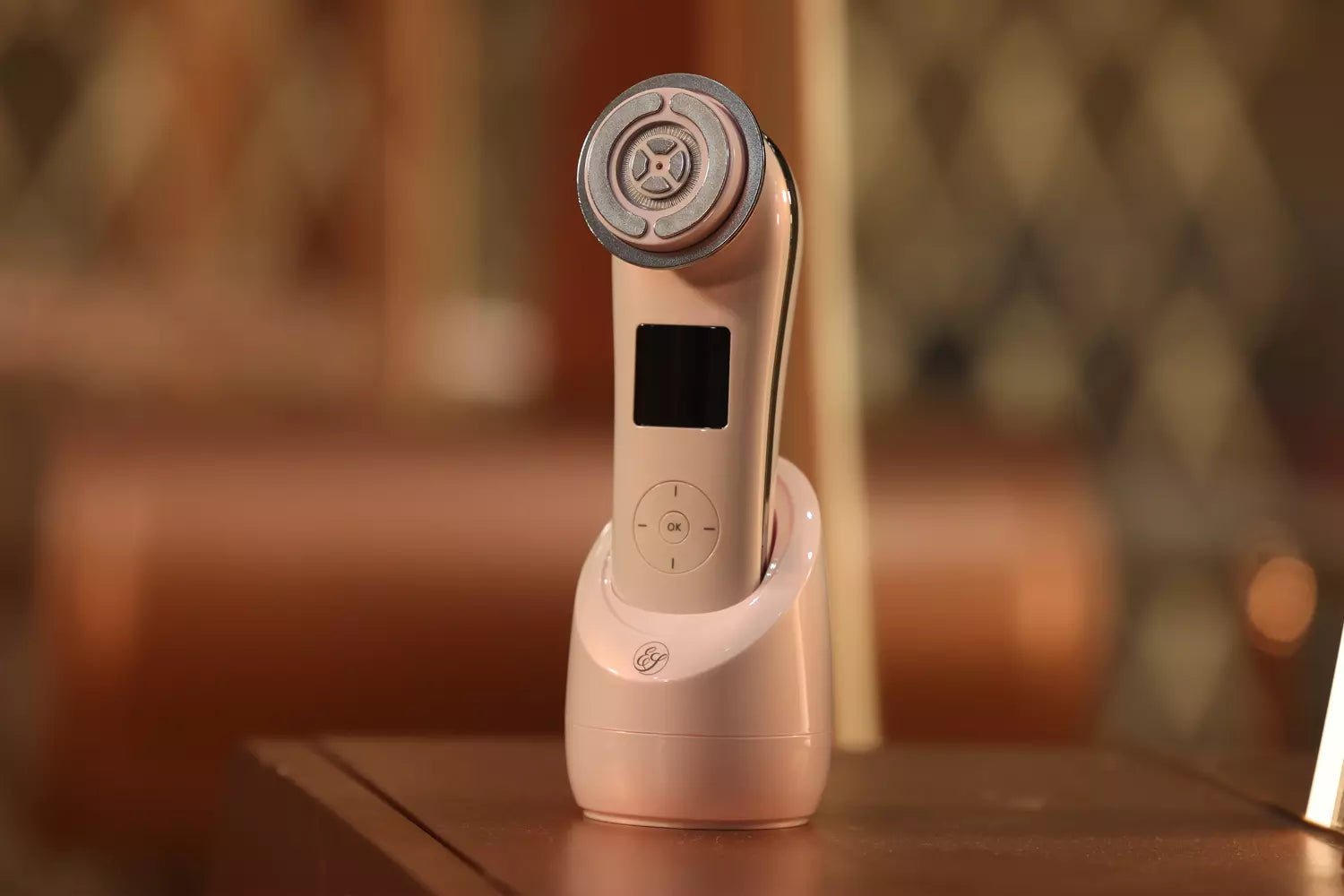
The EvenSkyn MicroInfuser is an at-home micro-infusion stamping system that launches in 2026. It is built around Syntha-Pep, EvenSkyn's PDRN serum, and the design intent is delivery: place a multi-molecule serum into the micro-channels rather than relying on a cream sitting on the surface.
Two things set the serum apart on transparency. First, the PDRN in Syntha-Pep is fermentation-derived rather than extracted from salmon, and EvenSkyn states this plainly, which matters to shoppers who want to know exactly what they are putting on their skin. The formula does contain marine collagen, so it is disclosed as not vegan and not free of marine-derived ingredients. Second, Syntha-Pep is not a single-active serum. It pairs PDRN with EGF, GHK-Cu copper peptides, additional peptides, and hyaluronic acid in sealed single-use ampoules, so each application is fresh rather than drawn from a bottle that stays open over weeks.
EvenSkyn's house style is also deliberately different on claims. Rather than attaching unverifiable percentages to outcomes, the brand describes results in terms of the look of firmer, smoother, brighter skin, and points to the published evidence on the underlying molecules rather than to figures generated in-house. For a category aimed at mature skin and real cosmetic concerns, that restraint is a feature.
Head to Head on What Actually Matters
Delivery method
AMIRO's HydraGlow kit delivers PDRN topically through a light and microcurrent device. AMIRO's separate Micro-Infusion System and the EvenSkyn MicroInfuser both use 0.5mm stamping to place serum below the surface. If physical delivery is your priority, compare like with like: the AMIRO Micro-Infusion System against the EvenSkyn MicroInfuser, not the HydraGlow kit.
Serum composition
AMIRO's serum is built around PDRN with phyto-retinol and collagen. Syntha-Pep is a broader stack: PDRN, EGF, GHK-Cu, peptides, and hyaluronic acid. More actives is not automatically better, but for buyers who want copper peptides and growth-factor support alongside PDRN in one ampoule, the composition is meaningfully different.
PDRN source transparency
EvenSkyn states the PDRN source directly: fermentation-derived, not salmon-derived, with marine collagen disclosed. AMIRO's pages emphasize potency language such as "2x clinical-grade" without making the source equally explicit. Shoppers with fish or shellfish sensitivities, or anyone who simply wants to know the origin, will find one approach easier to evaluate than the other.
How each brand handles claims
AMIRO leans on specific in-house percentages. EvenSkyn uses the look of framing and defers to published evidence on the molecules. Neither approach is dishonest by default, but they ask different things of you as a reader. One asks you to trust a number. The other asks you to read the science.
Price and availability
This is a clear, present advantage for AMIRO. The HydraGlow kit ships now at 99.99 dollars and adds red light and microcurrent in a single device. The EvenSkyn MicroInfuser launches later in 2026, and final pricing will be published at launch. If you want something today and value the bundled light therapy, AMIRO is the available option right now.
Where AMIRO Wins, Honestly
A comparison is only useful if it is fair. AMIRO has real strengths. The HydraGlow kit is considerably less expensive than most dedicated systems and folds three modalities into one device, which is genuinely convenient for a daily routine. AMIRO also has an established base of customer reviews and ships immediately, with a broad device range across RF, LED, and microcurrent for shoppers who want one brand for several concerns. If your priority is an affordable, available, multi-tasking device and you are comfortable with topical PDRN delivery, AMIRO earns the look.
Who Should Choose What
Choose an AMIRO HydraGlow kit if you want red light and microcurrent plus a PDRN cream in one affordable device you can buy today, and topical delivery suits you. Choose a dedicated stamping micro-infusion tool, the AMIRO Micro-Infusion System or the EvenSkyn MicroInfuser, if your priority is placing serum below the surface rather than on top of it. Choose the EvenSkyn MicroInfuser specifically if serum transparency and composition matter most to you: a fermentation-derived PDRN that names its source, paired with EGF, copper peptides, and hyaluronic acid in single-use ampoules, from a brand that frames outcomes around the look of results rather than unverified percentages.
Frequently Asked Questions
Is the AMIRO HydraGlow kit a micro-infusion device?
Based on AMIRO's own product page, the HydraGlow Booster works through red light, infrared, microcurrent, and EMS, and pairs with a topical PDRN serum. It is not a needle-based micro-infusion device. AMIRO sells a separate PDRN Micro-Infusion System for stamping delivery.
What kind of PDRN does the EvenSkyn MicroInfuser use?
Syntha-Pep uses fermentation-derived PDRN rather than salmon-derived PDRN, and EvenSkyn states this directly. The serum also contains marine collagen, so it is disclosed as not vegan.
Which is cheaper?
AMIRO's HydraGlow kit is the lower-priced and immediately available option, listed at a sale price of 99.99 dollars. The EvenSkyn MicroInfuser launches later in 2026 with pricing published at launch.
Should I trust the percentage results AMIRO lists?
Those figures appear on AMIRO's product pages as manufacturer claims. They are not, as of this writing, linked to a published study you can read. Treat any precise percentage without a citation as a claim to verify rather than an established fact, regardless of which brand makes it.
Continue Reading
For the full picture on at-home micro-infusion, see our complete 2026 guide to at-home microinfusion devices, our deeper look at what Syntha-Pep is and how its PDRN is sourced, our comparison of the leading stamping micro-infusion systems, and the practical guide to using PDRN at home.
This article is for educational purposes and describes cosmetic outcomes in terms of the look of the skin. It is not medical advice. Product details reflect each manufacturer's published information at the time of writing and may change.


Leave a comment
All comments are moderated before being published.
This site is protected by hCaptcha and the hCaptcha Privacy Policy and Terms of Service apply.