
Medically Reviewed by Dr. Lisa Hartford, MD
Whitening Teeth With Crowns and Veneers: What Actually Works
Porcelain and composite do not bleach. So the real question is not how to whiten your restorations. It is how to brighten the natural teeth around them without ending up with a two-tone smile.
Whitening gels do not change the color of crowns, veneers, bonding, or fillings. Those materials are non-porous, so the peroxide that lifts stains from natural enamel has nothing to grab onto. What whitening can do is brighten the natural teeth surrounding your restorations. The catch: if your restorations were matched to darker teeth, brightening the naturals can leave the crown or veneer looking dull by comparison. The fix is sequencing and shade planning, not a stronger gel.
If you have ever whitened your teeth and noticed one tooth stubbornly refusing to brighten, there is a good chance that tooth is not entirely yours. A crown, a veneer, an old bonded filling on a front tooth. These restorations are extremely good at a lot of things. Responding to whitening gel is not one of them.
This matters more with age. By the time most people are weighing whitening seriously, in their forties, fifties, and beyond, they are also more likely to be carrying dental work. That combination, older natural enamel plus a restoration or two, is exactly where a generic "just buy whitening strips" answer falls apart. Get the sequence wrong and you can spend money making your smile look less even, not more.
So this piece does something narrower and more useful than a general whitening explainer. It answers the restoration question directly: what whitening can and cannot touch, why, and how to brighten around dental work without creating a mismatch you will notice every time you look in the mirror.
Why crowns and veneers do not respond to whitening
Whitening works because natural teeth are porous. Enamel and the dentin beneath it are riddled with microscopic channels. Stain molecules from coffee, tea, red wine, and tobacco settle into that structure over years. Peroxide gels, whether hydrogen peroxide or the carbamide peroxide that breaks down into it, diffuse into those same channels and oxidize the stain molecules, breaking them into smaller, lighter, less visible pieces. That is the entire mechanism.
Restorations are built to be the opposite of porous. Porcelain crowns, ceramic and porcelain veneers, and composite resin bonding are engineered to be dense, sealed, and stain-resistant so they hold their color for years. That durability is a feature. It is also precisely why peroxide does nothing to them: there are no open channels for the gel to diffuse into, and the color is fixed in the material itself rather than sitting in absorbable pores.
Natural enamel
Microscopic channels absorb stains over time, and let peroxide diffuse in to break those stains apart. Color lives in absorbable pores.
Porcelain & composite
Dense, non-porous, color fixed in the material. Peroxide has nothing to penetrate, so the shade set in the lab is the shade it keeps.
A systematic review in Dental Materials looked at how bleaching agents interact with restorative materials and found the effects concentrated on physical properties and marginal integrity, not the kind of color lift bleaching produces on enamel. In plain terms: peroxide can, at high concentrations and long exposures, do subtle things to the surface of a restoration, but it does not brighten its shade the way it brightens a natural tooth. There is no version of an at-home gel that repaints your porcelain.
"Existing literature reveals that bleaching therapies may have a negative effect on physical properties, marginal integrity, enamel and dentin bond strength, and color of restorative materials."
Attin, Hannig, Wiegand & Attin. Effect of bleaching on restorative materials and restorations, a systematic review. Dental Materials, 2004.Two practical things follow from that. First, an aggressive gel is not a workaround. Reaching for a stronger product will not force a shade change on porcelain, and repeated high-concentration exposure is more likely to dull or roughen the surface glaze than to help. Second, the "problem tooth" that will not brighten during whitening is usually the tell that a restoration is present, sometimes one the person had forgotten about, like an old bonded filling on a front tooth from decades ago.
The real risk: a two-tone smile
Here is the part most product pages skip. The danger of whitening around restorations is not damage. It is mismatch.
When a dentist places a crown or veneer, they match its shade to your surrounding natural teeth at that moment. If your teeth were a moderate, lived-in shade then, the restoration was built to blend with that. Now you whiten. The natural teeth lift a few shades brighter. The restoration cannot follow. What was once an invisible match becomes a visibly different tooth, brighter naturals framing a restoration that suddenly reads as dull or yellow by comparison. On front teeth, where veneers and bonding usually live, that contrast is very hard to hide.
This is why sequencing matters more than product choice. Dentists routinely whiten natural teeth first, let the shade stabilize, and only then match new restorations to the brighter result. Doing it in that order means the porcelain is built for the smile you want to keep. Doing it in reverse means the restoration is anchored to the old shade, and every future whitening session widens the gap.
How to think about whitening with dental work
If you are weighing whether and how to whiten with restorations in your mouth, these are the criteria that actually decide the outcome. Product strength is near the bottom of the list.
Where your restorations are
Back-of-mouth crowns rarely show, so a mismatch there is cosmetic noise. Front teeth, veneers, and visible bonding are where contrast becomes obvious and where planning matters most.
How old the restoration is
A restoration near the end of its life is a chance to whiten first, then re-match. A newer one you intend to keep argues for whitening more conservatively, toward a shade it can still blend with.
The order of operations
Whiten natural teeth, let the shade settle for about two weeks, then match new work to the result. Sequence beats strength every time.
Gentleness on exposed roots
Gum recession near restoration margins exposes root surfaces that are not protected by enamel. A lower-sensitivity approach matters more here than raw whitening power.
What each surface in your mouth actually does
A quick map of what responds to whitening and what does not, so you can predict the result before you start.
| Surface | Responds to whitening? | What to expect |
|---|---|---|
| Natural enamel | Yes | Brightens as peroxide breaks down absorbed stains. This is the only surface whitening actually lightens. |
| Porcelain crown | No | Holds its lab-set shade. Can be surface-cleaned of film, but not lightened. Re-match by replacement if needed. |
| Porcelain / ceramic veneer | No | Same as crowns. Usually on front teeth, so mismatch shows most. Plan whitening before new veneers. |
| Composite bonding | No | Does not lighten, and can pick up surface stain over time. Often the hidden "problem tooth" during whitening. |
| Amalgam / tooth-colored filling | No | No shade change. A visible filling on a front tooth behaves like any other restoration. |
Why a gentle, enamel-conscious kit suits this exact situation
Follow the logic through. The people most likely to be juggling restorations are older adults. Those same adults are more likely to have gum recession, 88% of people 65 and older have at least one recession site, which exposes root surfaces near restoration margins that are not shielded by enamel. And the whole goal here is not maximum brightness. It is a controlled, even lift of the natural teeth toward a target shade the restorations can still live alongside.
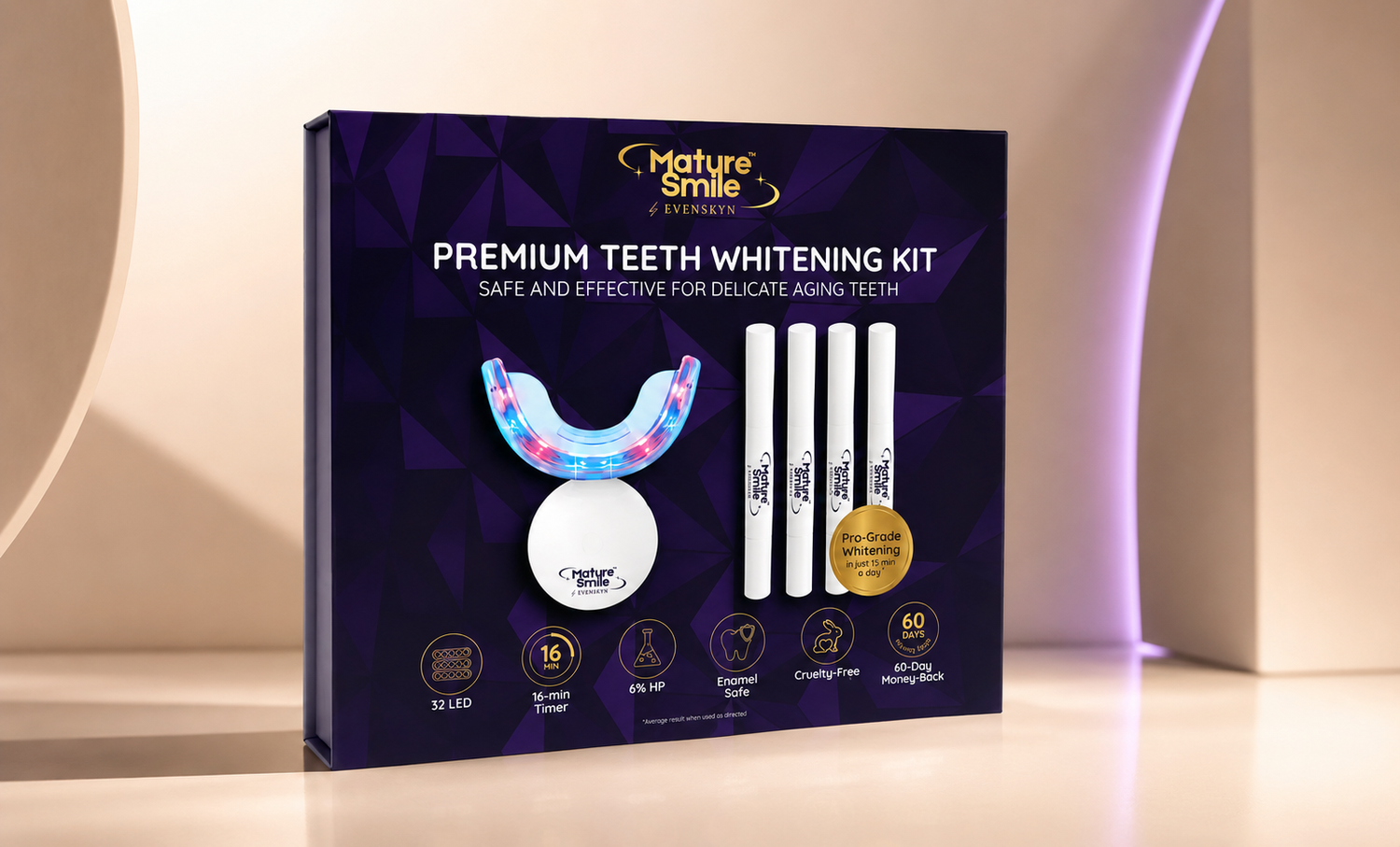
That points away from the harshest strips and toward a lower-sensitivity, controlled approach: something that lifts stain on the natural teeth without punishing exposed roots, and that lets you whiten gradually toward a shade rather than overshooting it. This is the logic behind EvenSkyn's MatureSmile LED Whitening Kit, designed for sensitive and mature teeth. To be clear about what it is: it whitens natural enamel like any peroxide system. It cannot change your crowns or veneers. Nothing at-home can. What it offers for this situation is a gentler formulation and a gradual schedule, which is what "whitening around restorations" actually calls for.
MatureSmile LED Whitening Kit
For brightening natural teeth gently, when restorations mean you cannot afford to overshoot the shade.
The whole design premise. A low-sensitivity gel and short sessions suit exposed roots and recession better than standard strips.
A gradual schedule and a shade guide card let you creep up on a target rather than overshoot past what your restorations can match.
A one-time kit with refillable pens undercuts repeat chair-side sessions for maintenance whitening.
Deliberately not the fastest. Gentle and gradual is the point here, but if you want a dramatic overnight jump, in-office bleaching is quicker.
It does not, and neither does anything else at home. Scored honestly: this is a natural-teeth tool, full stop.
Best for
- Whitening natural teeth before matching new crowns or veneers
- Adults 40+ with sensitivity or gum recession
- Maintenance top-ups between or instead of dentist visits
- People who want to inch toward a shade, not overshoot it
Not the best fit for
- Anyone hoping to lighten existing crowns, veneers, or bonding
- Fixing a mismatch that already exists (that is a dentist visit)
- A dramatic same-day transformation before an event tomorrow
- Untreated cavities, cracked teeth, or active braces
MatureSmile LED Teeth Whitening Kit
From $89.97 · rechargeable mouthpiece, 4 gel pens, shade guide, caseA rechargeable LED mouthpiece with two light modes (blue for stain removal; red plus blue to whiten while soothing gums), a low-sensitivity peroxide gel, and a shade guide card so you can watch the natural teeth climb toward your target. Sessions run 16 minutes. Refill with the MatureSmile Whitening Pens rather than repurchasing the kit.
What it does well
- Gentle on sensitive, mature teeth and exposed roots
- Gradual schedule you can stop at the right shade
- Refillable, so maintenance stays cheap
What it will not do
- Change the color of any crown, veneer, or bonding
- Fix a mismatch that is already there
- Deliver a dramatic overnight jump
How to whiten around restorations without a mismatch
The safe sequence, whether you whiten at home or in a chair:
-
Get a shade check first
Ask your dentist which of your visible teeth are restored and what shade they are. You cannot plan around restorations you have forgotten about, and old front-tooth bonding is easy to forget.
-
Whiten the natural teeth
Use a gentle, controlled system and go gradually. Track progress against a shade guide so you can stop when the naturals reach a shade your restorations can still live with, or the shade you want new work matched to.
-
Let the shade stabilize
Give it about two weeks after your last session. Freshly whitened teeth can look slightly lighter at first and settle back, so matching to a stabilized shade avoids a mismatch later.
-
Then re-match restorations
If a front-tooth crown or veneer now looks dull against the brighter naturals, that is the conversation to have with your dentist about replacing it to the new shade. Lab research suggests a bleaching session before or after veneer prep does not compromise how well the veneer masks the tooth underneath.
-
Maintain gently
Occasional top-ups keep the natural teeth from drifting back toward the restoration shade. Refill pens make maintenance low-cost, and avoiding coffee, tea, and red wine for two hours after a session protects the result.
Common questions
Can you whiten crowns and veneers at all?
No. Crowns, veneers, and bonding are made from non-porous porcelain, ceramic, or composite. Whitening gels only work by penetrating the pores of natural enamel, and restorations have none. No at-home or in-office bleaching product will lighten their shade. Surface cleaning can remove film, but the underlying color is fixed.
Will whitening my teeth make my crown look yellow?
It can. Your crown was matched to your natural teeth at the time it was placed. If you whiten the surrounding teeth brighter, the crown stays put and can start to look dull or yellow by comparison. This is the most common surprise people run into, and it is why whitening before new restorations, rather than after, is the safer order.
Should I whiten before or after getting veneers?
Before, in almost every case. Whiten your natural teeth to the shade you want, let it stabilize for about two weeks, then have the veneers matched to that brighter result. If you get veneers first and whiten later, the veneers are locked to your old shade and the two will drift apart.
Why won't one of my teeth whiten no matter what I do?
That tooth is very likely restored, often with old composite bonding or a filling on a front tooth that has been there so long it is easy to forget. Restorative material does not respond to peroxide, so it stays the same shade while the natural teeth around it lift. A dentist can confirm which teeth are restored.
Can whitening damage my crowns or veneers?
Standard whitening will not damage a properly placed restoration, but very high concentrations and repeated long exposures can, over time, dull or roughen the surface glaze of porcelain and composite. Reaching for the strongest possible gel to try to force a shade change is both ineffective and the scenario most likely to affect the surface. A gentle, controlled approach avoids that.
What about whitening toothpaste around dental work?
Whitening toothpastes mostly work by abrasion, removing surface stain rather than bleaching. On restorations they still cannot change the underlying color, and very abrasive or charcoal-based pastes can wear the surface glaze and dull the finish over time. A non-abrasive toothpaste is the safer daily choice for keeping restorations looking their best.
Is at-home whitening safe if I have gum recession?
It can be, but recession exposes root surfaces that are not protected by enamel and can be more sensitive. That argues for a low-sensitivity system and short sessions rather than aggressive strips. If an exposed margin is already sensitive or sore, see your dentist before whitening rather than working through the discomfort.
How much does it cost to whiten around restorations?
The whitening itself is the same as any natural-teeth whitening: an at-home kit is a one-time purchase, often under $100, with inexpensive gel refills for maintenance, versus repeat in-office sessions that add up. The variable cost is any restoration you later choose to replace to match a brighter smile, which is a separate decision to make with your dentist based on the restoration's age and condition.
Do dentists whiten before matching a new crown?
Frequently, yes. Whitening the natural teeth first and matching new restorations to the brighter, stabilized shade is a standard way to avoid building a mismatch into the smile. It is the same principle whether the whitening happens in the office or at home: match the porcelain to the smile you intend to keep.
Can I fix a mismatch I already have without replacing the restoration?
Not through whitening, since you cannot lighten the restoration to catch up, and you generally do not want to darken healthy natural teeth. The realistic options are replacing the restoration to match your current shade, or, if the mismatch is minor and not on a highly visible tooth, living with it. A dentist can tell you which makes sense for your specific case.
How we researched this
The dental-science claims here, why restorations do not respond to peroxide, how gum recession changes with age, and how bleaching interacts with restorative materials and veneer color-matching, are drawn from peer-reviewed literature and systematic reviews, cited below and verified at the time of writing. Where we describe how the MatureSmile kit performs, those are manufacturer specifications from EvenSkyn's own product listing, and we have labeled them as such rather than presenting them as independent findings. This article carries the EvenSkyn Skin Science Desk byline; a named clinical reviewer slot is open and will be attached only if a relevant clinician reviews this specific article. Nothing here replaces an examination by your dentist, who can see your actual restorations, shade, and gum condition.
- Attin T, Hannig C, Wiegand A, Attin R. Effect of bleaching on restorative materials and restorations: a systematic review. Dental Materials. 2004;20(9):852-861. PMID: 15451241
- Eachempati P, Kumbargere Nagraj S, Kiran Kumar Krishanappa S, Gupta P, Yaylali IE. Home-based chemically-induced whitening (bleaching) of teeth in adults. Cochrane Database of Systematic Reviews. 2018;12:CD006202. PMID: 30562408
- Dalloo GAM, Faraj BM, Al-Zahawi AR. Impact of bleaching before or after veneer preparation on color masking ability of laminate veneers: an in vitro study. BioMed Research International. 2021;2021:6611173. PMID: 33997023
- Kassab MM, Cohen RE. The etiology and prevalence of gingival recession. Journal of the American Dental Association. 2003;134(2):220-225. PMID: 12636127
- Heasman PA, Ritchie M, Asuni A, Gavillet E, Simonsen JL, Nyvad B. Gingival recession and root caries in the ageing population: a critical evaluation of treatments. Journal of Clinical Periodontology. 2017;44(Suppl 18):S178-S193. PMID: 28266119


Leave a comment
All comments are moderated before being published.
This site is protected by hCaptcha and the hCaptcha Privacy Policy and Terms of Service apply.