
Medically Reviewed by Dr. Lisa Hartford, MD
Best Teeth Whitening for Sensitive Teeth: An Enamel-Safe LED Guide for Adults 40+
Most whitening kits are built for a 25-year-old's mouth. After 40, the enamel is thinner and the gums have moved, so the kit that whitens fast tends to be the kit that hurts. Here's how to whiten sensitive, mature teeth without the zing, and where our own MatureSmile™ fits in.
The gentlest whitening that still works on sensitive or mature teeth uses a low peroxide concentration, around 6% hydrogen peroxide, in short sessions, with an LED to speed the reaction and a tray that keeps gel off the gums. Stronger kits whiten faster but sting more, and that sting gets worse with age as enamel thins and gums recede. For most people over 40, gentle-but-consistent beats strong-but-painful.
EvenSkyn MatureSmile™ LED Whitening Kit
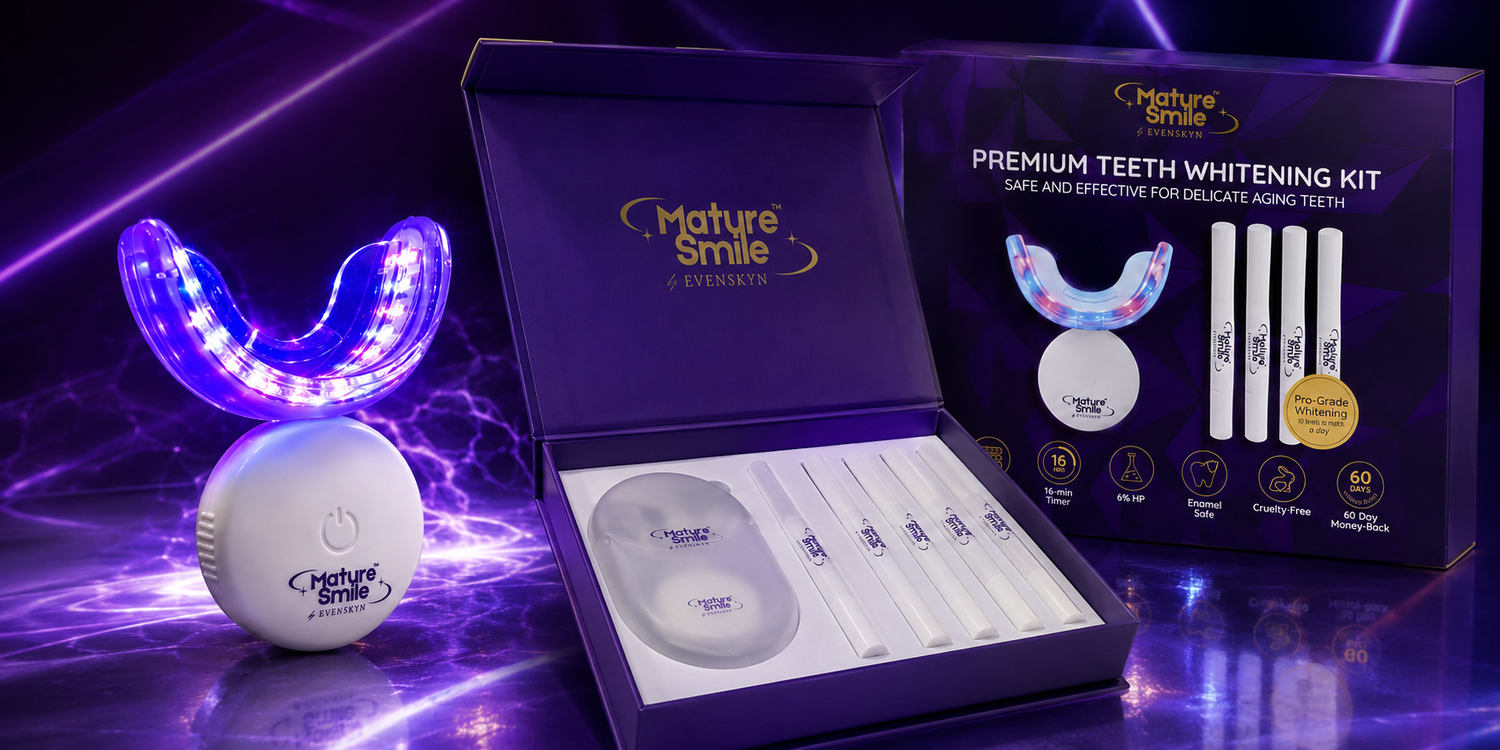
If regular whitening kits leave your teeth zinging, this one is built to solve that exact problem. It runs a 6% hydrogen peroxide gel, roughly a sixth of the strength of the bargain kits that promise ten shades in a weekend. A blue-and-red LED mouthpiece does the rest, so the gentler dose still does real work in a sixteen-minute session. You give up some speed. In return, far less wincing. For a mouth that has been chewing, brushing and drinking coffee for four or five decades, that is usually the right deal.
6% hydrogen peroxide sits near the floor of the range that still whitens. Controlled-trial evidence ties lower concentrations to noticeably less sensitivity.
A gum-soothing red-light mode, a desensitizing gel formula, and short sessions all pull in the same direction. The manual treats the occasional "zing" as a signal to space sessions out, not push through.
A full mouthpiece coats every front tooth at once and holds gel away from the gumline, where most irritation starts. Strips can't manage that on a receded gum line.
The small things give it away: a printed reminder to use reading glasses or a magnifying mirror for even coverage, a one-button light toggle, USB-C charging, and a physical 0–20 shade card to track progress.
This is the honest trade-off. A gentle dose works, but not overnight. Expect a visible shift over about a week of daily use, not a single weekend. If you have no sensitivity and want speed above all, a high-strength kit will get there faster.
A rechargeable mouthpiece you keep, four gel pens, a storage case with a drying rack, and a 12-month warranty land it well under the cost of repeated in-office visits.
Best for
- Adults 40 and over
- Anyone whose gums have started to recede
- People who quit other kits because of the sting
- Sensitive teeth in general
Not the best fit for
- A young, sturdy mouth chasing the fastest possible result
- Crowns or veneers on the front teeth (they won't change)
- Active decay, cracks, or recent dental work
- Anyone currently in braces
How we score: each line is rated against the criteria this guide lays out below, scored out of ten, then averaged. We make this kit, so read the score as informed but interested. We've kept the speed mark deliberately honest, because a gentle formula is a slower one by design.
Whitening isn't unsafe as you get older. It just stops forgiving the wrong product. Thinner enamel and receding gums leave less of a buffer between a bleaching gel and the nerve, so a kit built for a younger mouth tends to deliver more sting than shade. The fix is not a stronger gel. It's a smarter one.
- Enamel thins measurably with age, with the steepest decline starting around 50 — this has been documented under electron microscopy and CT imaging.1,2
- By 65, close to nine in ten people have at least one patch of receding gum, exposing root surfaces that have no enamel to protect them.4
- Sensitivity tracks gum recession closely: one large study put it at 4.6% with no recession and 17.1% where recession was present.7
- A 2026 trial pitting 6% against 35% hydrogen peroxide found the stronger gel whitened faster but stung significantly more; the lower dose was, in the authors' words, the safer option.9
- An LED earns its place mainly at lower peroxide concentrations — precisely where most consumer kits don't operate.11
EvenSkyn publishes this guide, and the kit we land on is our own. We've written it the way we'd want a guide written for us: criteria first, credit to rivals where it's due, and only claims we can back. When the honest answer is "ask your dentist," that's what you'll read. Take the recommendation with the grain of salt any brand-published review deserves, and check our reasoning against the sources at the bottom.
What actually changes in an older mouth
Three things happen to teeth as the years add up, and each one quietly rewrites the whitening math.
Enamel gets thinner
This isn't a soft marketing line. It's been measured. When researchers examined extracted incisors under an electron microscope, they found facial enamel begins a steady decline at roughly age 50 (Atsü et al., 2005).1 A 2024 study using cone-beam CT scans found the same drop with a different method, recording a statistically significant loss of thickness once patients passed 40 (Jánosi et al., 2024).2 Enamel is the armour. As it thins, a bleaching gel has a shorter trip to the sensitive tissue underneath.
Gums pull back
A 2003 review in the Journal of the American Dental Association gathered the population numbers: about 88% of people aged 65 and over, and half of adults between 18 and 64, have at least one site where the gum has receded (Kassab & Cohen, 2003).4 The national NHANES survey put the figure at 58% for adults over 30, climbing with every decade (Albandar & Kingman, 1999).5 A separate review tracked the slope plainly: 37.8% of people in their thirties showed recession, against 90.4% of those in their eighties (Pradeep et al., 2012).6 Where the gum retreats, it leaves bare root surface — no enamel cap, and tiny open channels called dentinal tubules running straight toward the nerve.
And then teeth get touchier
The two changes above set up the third. A 2013 JADA study of 787 patients across 37 dental practices found sensitivity in 4.6% of people with no recession and 17.1% of those who had it — roughly a fourfold jump. The same analysis flagged recent at-home whitening as an independent trigger, right alongside age and recession (Cunha-Cruz et al., 2013).7 A review the same year noted that in older patients, exposed roots from gum recession are commonly tied to a high rate of sensitivity, made worse by hard brushing (Splieth & Tachou, 2013).8
So the mouth that reaches for a whitening kit at 55 is not the mouth that used one at 25. Same gel, same timer, different nerve endings. That single fact is the reason a sensible whitening choice changes with age.
Why the strong kits backfire on older teeth
Walk down the whitening aisle, or scroll the listings, and most of what you'll see runs hot: 22% to 44% carbamide peroxide, or 35% hydrogen peroxide in the pens and trays. Those numbers were set for a younger buyer, whose intact enamel and full gum line act as a cushion between the chemical and the nerve.
Take the cushion away and the picture changes. The ADA's own patient material notes that hydrogen peroxide slips through the enamel and reaches the pulp within about fifteen minutes (American Dental Association).12 Thinner enamel shortens that trip. A receded gum line skips it entirely, letting peroxide hit exposed root directly.
There's now a clean trial on what that costs. In 2026, researchers ran a randomized, double-blind comparison of 6% versus 35% hydrogen peroxide across 140 people, published in the Journal of Esthetic and Restorative Dentistry. The 35% gel whitened more and faster — nobody disputes that — but it also caused significantly more sensitivity. Their summary was blunt: lower concentrations like 6% are a safer option with less sensitivity, at the price of some whitening power (Centenaro et al., 2026).9 An earlier split-mouth study, bleaching one side of each patient's mouth at 6% and the other at 35%, found both worked and rated the discomfort on the low-dose side as mild (Vano et al., 2015).10
For a younger mouth, paying a little sensitivity for a lot of speed can be a fair trade. For the mouth described above, the one with thinner enamel and exposed roots, it's usually a bad one.
"Lower concentrations like 6% offer a safer alternative with reduced sensitivity but less whitening efficacy."
— Centenaro et al., J Esthet Restor Dent, 20269
What the LED light is actually for
It helps to be plain about this, because the marketing rarely is. The light does not bleach your teeth. The gel does. What the LED contributes is energy that speeds the peroxide's reaction into the molecules that lift stains. Useful, but supporting cast, not the lead.
Whether that speed-up matters depends almost entirely on the gel it's paired with. A 2012 systematic review in the Journal of Dentistry pooled the randomized trials and drew a sharp line. At high peroxide concentrations (25–35%), adding light didn't reliably whiten any better, and it raised the odds of sensitivity. At lower concentrations (15–20%), there was limited evidence that light produced a better immediate result (He et al., 2012).11
Read that twice, because it flips the usual sales pitch. The LED is most defensible exactly where most kits don't use it: with a low-concentration gel, where the light helps a gentle dose pull its weight in a short session. That is the configuration a sensitive, mature mouth wants.
What makes a kit safer for sensitive teeth
Strip away the branding and a kit that genuinely suits mature, sensitive enamel comes down to four choices.
A lower peroxide dose
The 2026 trial settled this: 6% hydrogen peroxide stings less than 35%, and still whitens.9 On thinning enamel, the low end of the effective range is where the math finally favours you.
Short, capped sessions
Peroxide can reach the pulp in about fifteen minutes.12 A sixteen-minute session with a mild gel respects that window. Hour-long tray soaks just pile on exposure for little extra gain.
A tray that fits
Strips slide and leave gaps, and the gel migrates onto the gums. A snug mouthpiece coats every front tooth evenly and keeps peroxide off the exposed gum margin, which is where the trouble usually starts.
A light matched to the gel
The evidence says an LED helps most at lower concentrations.11 So a 6% gel under a blue light is the pairing the research actually supports — not a 35% gel with a light bolted on for show.
Hydrogen peroxide, carbamide peroxide, PAP: reading the label
Three ingredients do almost all the whitening you can buy, and knowing which one you're holding is the single most useful thing you can check.
Hydrogen peroxide works on contact, breaking down into the reactive oxygen that lifts stain.12 It's why short LED sessions use it. At 4–6% it's comfortable for most people; at 25–35% it's the version most likely to bite, especially on the thin-enamel, exposed-root profile we keep coming back to.
Carbamide peroxide is hydrogen peroxide tethered to urea, released slowly — the choice for overnight trays. The ADA notes it gives up about a third of its weight as hydrogen peroxide,12 so a 22% carbamide gel lands near 7–8% hydrogen peroxide, just spread over far longer wear. Gentler by the minute, heavier by the hour.
PAP (phthalimidoperoxycaproic acid) is a peroxide-free oxidiser used in some "no-sensitivity" kits. The clinical record behind it is thinner than for the peroxides, and the profession hasn't reached a verdict on how it compares. If neither peroxide agrees with you, it's worth raising with a dentist.
How the popular options stack up
| Kit | Active | Format | Session | Notes |
|---|---|---|---|---|
| EvenSkyn MatureSmile™ LED Kit | 6% hydrogen peroxide | Soft mouthpiece + blue / red+blue LED | 16 min | Built for sensitive, mature enamel; pre-order, ships November 2026 |
| Crest 3D Whitestrips Sensitive | Hydrogen peroxide (low %) | Strips | Per pack | Easy to find at any pharmacy; strips can leave uneven coverage on a receded gum line |
| MySmile LED Kit (typical) | Hydrogen peroxide gel | LED tray + gel | Per pack | Marketed as enamel-safe; check the current concentration on the listing before buying |
| Typical high-strength LED kit | 22–44% carbamide peroxide | LED tray + gel | 10–30 min | Faster shade change at a higher dose; confirm the concentration on the label |
| In-office professional whitening | 25–40% hydrogen peroxide | Applied by a dentist | Per visit | Strongest option, done with gum protection and supervision; the right call if you have restorations or marked sensitivity |
Built from each brand's published product information; formulas and concentrations change, so confirm against the current official listing before buying. Brand names belong to their respective owners and appear here for comparison only.
What whitening costs — and why that math is finally changing
Here's the part the brochures tend to skip. A single in-office whitening session at a dentist commonly runs $300 to $1,000. The branded systems most people have heard of, like Zoom, average somewhere around $400 to $600, and laser whitening can climb past $1,000 in some practices. Dentist-supplied take-home trays usually land between $375 and $500. None of those figures include the touch-ups, and whitening always fades, so the bill tends to come back around.
For a long stretch, that was simply the price of a properly white smile. Drugstore strips existed, but they were low-powered and fussy, and they slid off the receded gum lines that older mouths so often have. If you wanted a real result, you paid a professional, then you paid again. Whitening that actually worked sat behind a counter, with a price tag to match.
| How you whiten | Typical cost | The trade-off |
|---|---|---|
| In-office (Zoom, laser) | $300–$1,000+ per visit | Fastest and strongest, gums protected by a professional — but priced per visit, and you'll be back |
| Dentist take-home trays | $375–$500 | Custom trays and professional gel, with gentler daily wear |
| At-home LED kit (e.g. MatureSmile™) | One kit you keep and reuse | A milder dose that works gradually; the device is yours, and you only replace the gel |
| Drugstore strips | $20–$100 per box | Cheapest, but low-powered and uneven on a receded gum line |
Cost ranges reflect commonly reported U.S. dental-industry figures for 2025–2026; actual pricing varies by region and provider.
What's shifted is the middle of that table. A low-concentration LED kit won't out-whiten a dentist's strongest single visit, and we won't pretend otherwise. But used consistently, on mature teeth, it does much of the same work without the per-visit invoice — and without the high-strength sting that sends a lot of older patients home early.
It's the same change quietly playing out across at-home beauty technology. Treatments that used to mean an appointment and a four-figure quote, like radiofrequency skin tightening and microinfusion, now have credible at-home versions you run on your own schedule. The honest version of that story, which we've written up separately for skin, is that the home device rarely matches the clinic's depth — but it brings most of the everyday benefit within reach of people who were never going to book the clinic in the first place. (If that's of interest, our guide to at-home anti-aging devices and our honest take on at-home RF microneedling cover where the line actually falls.) Whitening is that same idea in a different room of the house. The technology grew up. The price came down. And for once, the gentle option and the affordable option are the same option.
Why MatureSmile™ is built for the mouth the research describes
Set the findings side by side and a fairly obvious gap appears. Enamel thins from around 50.1,2 Most people over 65 have some gum recession.4 Sensitivity rides along with that recession and gets nudged further by whitening itself.7 Stronger peroxide stings more than weaker peroxide.9 And the one accessory everyone markets — the LED — pays off mainly at the low concentrations almost nobody sells.11
The mass-market whitening shelf never really reckoned with that. It standardised on high-concentration gels tuned for younger buyers, because that's who bought first and who tolerated the dose. Which leaves a large, growing group — people over 40 with thinner enamel and a little recession — reaching for kits engineered for a mouth they no longer have.
There's a knock-on effect, too. When enamel is thin and gums have moved, the cautious path is the conservative one: clinicians tend to steer patients away from anything that strips more structure than it needs to. That's not because whitening is off-limits after a certain age. It's because the loud, high-strength consumer kits are a poor match for the job, so a lot of people in this group either skip whitening or pay for in-office treatment they could partly handle at home.
MatureSmile™ was drawn up from that starting point rather than as an afterthought. The 6% hydrogen peroxide gel sits where the trial evidence shows less sensitivity. The blue light supplies the acceleration that the meta-analysis says matters most at low concentrations, so a sixteen-minute session is enough; a second mode adds red light to comfort the gums while it works. The soft mouthpiece spreads gel evenly and keeps it off the receded margin. Even the instructions read like they were written for this reader: a nudge to use reading glasses for even coverage, and a printed rule to treat a "zing" as a cue to slow down rather than soldier on. Each of those choices answers a specific line in the research.
We're not going to claim it's the only kit of its kind, or that it's a medical device. It's a consumer cosmetic kit, and we make it. What we will say is that it's one of the few on the mass market whose engineering started from what an older mouth actually needs, instead of from the high-strength chemistry that was easiest to sell to everyone else.
When to skip the kit and call a dentist
Whitening suits most adults. But there's a real list of situations where an at-home kit is the wrong move, and several of them are spelled out in the MatureSmile manual itself. If any of these is you, talk to a dentist before you start.
- You have crowns, veneers, bridges or fillings on show. None of them whiten. Lighten the natural teeth around them and the mismatch becomes obvious.
- You have decayed, cracked or recently restored teeth. The manual rules these out, and for good reason: peroxide on a compromised tooth is asking for pain.
- You have active gum disease or pronounced recession. Peroxide on inflamed tissue or bare root stings sharply and can slow healing.
- You're in braces. Whiten after they come off, or you'll be left with patches where the brackets sat.
- You're pregnant or nursing. Most guidance says defer elective whitening; the manual says clear it with a dentist first.
- Your discoloration comes from medication or fluorosis. That kind of intrinsic staining often won't budge with at-home peroxide and needs a professional plan.
One more, straight from the manual: don't run more than two sessions back to back without checking in with a dentist. Whitening that hurts isn't whitening that's working.
The case for MatureSmile™, laid out plainly
Since we make it, we'll be direct about why it's built the way it is. The 6% hydrogen peroxide gel sits in the gentle-but-effective band where the trial data shows less sensitivity than the 35% formulas.9 Sessions run sixteen minutes, inside the exposure window the ADA describes for peroxide.12 The soft mouthpiece holds gel evenly and away from the gum line. Two light modes give you a plain blue setting for whitening and a red-plus-blue setting that adds gum comfort, the kind of split you rarely see at this price. The formula is built with desensitizing ingredients, and the system is designed to help settle the open dentinal tubules that drive the "zing."
In the box: a rechargeable USB-C mouthpiece, four gel pens, a 0–20 shade card to track your progress, and a storage case with a drying rack, under a 12-month warranty. The light is LED, not UV. With daily use, expect a visible shift over roughly a week. EvenSkyn's own testing points to a change of around two shades or more across a first cycle. That's slower than a 35% kit's headline. By design.
What it won't do
Straight talk: MatureSmile™ won't deliver the "ten shades in a weekend" line you see on high-strength kits, because we don't think 35–44% peroxide belongs in the mouths this kit is for. It won't whiten crowns, veneers or fillings, and nothing at home will. And it won't fix intrinsic, structural discoloration or the natural deepening of dentin past a point. If that's your situation, a dentist is the better first stop. What it does, it does without making mature enamel pay for it.
MatureSmile™ is open for pre-order now; the first shipment goes out in November 2026.
How to whiten sensitive teeth without the sting
The routine below follows the MatureSmile manual, but the principles carry across most low-concentration LED kits.
- Charge the mouthpiece first, about two hours, until the indicator turns solid green.
- Brush and floss, then dry the teeth. Wait twenty to thirty minutes after brushing so toothpaste residue is gone, and pat the teeth dry, since saliva dilutes the gel.
- Twist a pen and paint a thin layer of gel across the front of the teeth you actually show when you smile. Keep it off the gums. A magnifying mirror or reading glasses genuinely help here; the manual recommends them, and on an even coat they make a real difference.
- Seat the mouthpiece and press once for blue light, or twice for the red-plus-blue gum-soothing mode. Leave it for the full sixteen minutes and no longer; more time doesn't whiten more, it just irritates more.
- Rinse your mouth and the tray with lukewarm water. Dry it, charge it, store it on the rack for next time.
- Hold off on coffee, tea, red wine, berry juice, curry, ketchup and soy sauce for about two hours, while the enamel is briefly more porous. Track your shade on the card, ideally with before-and-after photos in the same light.
For pacing, the manual's schedule is sensible: once daily for the first week, stopping early if you hit your target shade; every other day through a second week if you're chasing stubborn stains; then one or two top-ups a month before events or photos. Run a sensitivity or potassium-nitrate toothpaste alongside it; it takes the edge off meaningfully. And if a tooth zings, don't push on; skip a day and space the next sessions out.
It also makes a surprisingly good gift
Worth saying, because it comes up: the person most likely to want this kit is often the last one who'll buy it for themselves. Plenty of older adults have quietly shelved the idea of whitening. They assume the strong kits will hurt — and as we've covered, on thinner enamel and receding gums, they're frequently right. They remember whitening as a dentist's-office expense. Or they've simply decided that, at their age, it isn't really aimed at them anymore. So they let it go, and live with a smile a few shades darker than they'd choose.
That's exactly what makes a gentle, enamel-aware kit a thoughtful present. For a parent at Mother's Day or Father's Day, for a grandparent's birthday, for the relative who has everything and asks for nothing, it lands as something they wouldn't have bought but are glad to own. It's self-care that fits in sixteen minutes at the kitchen counter, no appointment required. And it skips the awkwardness of a more obvious anti-aging gift, because wanting a brighter smile before a wedding, a reunion, or the next round of grandkid photos is something everyone understands.
One note on tact: give it as a treat, not a fix. The message isn't that someone's smile needs correcting. It's that feeling good about your smile shouldn't have an age limit, and the gentle technology to get there finally exists.
Match the kit to your enamel, not to the marketing
A gentle kit you'll actually keep using beats a strong one you can't stand. The research lines up behind that for mature teeth, and that's the exact mouth MatureSmile™ was built for.
See MatureSmile™Common questions
Is teeth whitening safe for sensitive teeth?
For most people, yes — with a low-concentration gel, short sessions, and a sensitivity toothpaste alongside. The trial evidence shows lower peroxide concentrations cause markedly less sensitivity than high ones.9 If you have recent dental work, gum recession, or persistent sharp sensitivity, clear it with a dentist first.
What is the best teeth whitening for sensitive teeth?
The best one is whatever concentration your enamel actually tolerates. For sensitive or mature teeth, that usually means a 6% hydrogen peroxide kit with short, LED-accelerated sessions and a mouthpiece that fits: gentle enough to keep using, strong enough to work.
What's the best teeth whitening for older adults?
After 40, enamel is thinner and gums have often receded, so a lower-dose kit usually beats a stronger one. Look for around 6% hydrogen peroxide, a tray rather than strips, and an LED, the combination that whitens without overloading mature enamel. A dentist is the right call if you have crowns, gum disease, or a history of sensitivity.
Is 6% hydrogen peroxide strong enough to whiten?
Yes, just more gradually. Clinical comparisons found 6% hydrogen peroxide whitens effectively, with the main difference versus 35% being speed, not whether it works — and far less sensitivity along the way.9,10 Expect a visible change over about a week of daily use rather than overnight.
Does the LED light actually whiten my teeth?
No — the gel whitens; the LED speeds the reaction. Pooled trial data suggests the light helps most when it's paired with a lower-concentration gel, which is the case for a 6% kit, and adds little but sensitivity risk at high concentrations.11 And to be clear, it's an LED, not a UV light.
What's the difference between hydrogen peroxide and carbamide peroxide?
They whiten by the same chemistry. Carbamide peroxide is hydrogen peroxide bound to urea and released slowly, which suits overnight trays; per the ADA it sheds about a third of its content as hydrogen peroxide, so 22% carbamide is roughly 7–8% hydrogen peroxide spread over a longer wear.12
Will whitening damage my enamel?
At the concentrations in at-home kits, used as directed, the evidence doesn't show meaningful structural enamel damage. The usual complaints are temporary sensitivity and gum irritation, both of which ease with shorter sessions and a lower dose.
Can I whiten teeth with crowns, veneers or fillings?
You can whiten the natural teeth, but the restorations won't change colour, so you risk an obvious mismatch. If you have visible crowns or veneers, plan it with your dentist.
Can I use a whitening kit with braces?
No. Whitening around brackets leaves uneven patches once they come off. Wait until the braces are removed, then whiten the full surface evenly.
How often should I whiten after the first round?
Most people hold their results with one or two short top-ups a month rather than daily use. Whitening non-stop isn't more effective; it just runs up the peroxide exposure and the odds of sensitivity.
Why do dentists sometimes recommend in-office whitening for older patients?
Not because at-home whitening is unsafe with age, but because in-office treatment applies a higher dose under supervision, with the gums protected and sensitivity managed on the spot, which is worth it for patients with heavy recession, multiple restorations, or a strong sensitivity history. Without those complications, a low-dose at-home kit is a reasonable route.
How much does teeth whitening cost?
In-office whitening at a dentist commonly runs $300 to $1,000 per session, with branded systems like Zoom averaging around $400 to $600 and laser whitening reaching $1,000 or more. Dentist take-home trays usually cost $375 to $500, and drugstore strips run $20 to $100. A reusable at-home LED kit is a one-time purchase you keep, which is why it tends to work out cheaper over time than repeat clinic visits.
Is a teeth whitening kit a good gift for an older parent?
It can be a thoughtful one. Many older adults assume whitening isn't for them, or that it means an expensive dentist visit, so a gentle, enamel-safe kit designed for sensitive mature teeth is something they're unlikely to buy themselves but often glad to receive, whether for Mother's Day, Father's Day or a birthday. Frame it as a treat rather than a fix.
About this guide
EvenSkyn Research Team
EvenSkyn's in-house editorial team covering at-home beauty and oral-care devices. We design and manufacture the products we write about, including the MatureSmile™ kit, and we say so plainly whenever a recommendation is our own.
How we handle health claims
For oral-health topics we work from peer-reviewed research, settled formulation chemistry, and the patient materials of major dental bodies. Where the right answer is "see your dentist," we write exactly that. We don't display a "medically reviewed" badge unless a named clinician in the relevant field has actually reviewed the piece.
What this guide is built on. The product specifications — concentration, light modes, session length, kit contents, schedule and contraindications — come directly from the MatureSmile™ user manual and product listing, and we make the device, so we can speak to those design choices first-hand. The dental science is drawn from the peer-reviewed sources listed below; where a claim is the manufacturer's rather than independently established (the desensitizing formula, the shade-improvement figure), we've said so in the text. This is consumer education, not personalized dental advice. For your own situation — restorations, gum disease, sharp or lasting sensitivity, or any doubt about whether to whiten at all — a dentist is the right first call. Competitor figures should be checked against each brand's live listing on the day you buy. EvenSkyn publishes this guide and recommends its own MatureSmile™ kit; no other brand named here has paid for placement.
References
- Atsü SS, Aka PS, Kucukesmen HC, Kilicarslan MA, Atakan C. Age-related changes in tooth enamel as measured by electron microscopy: implications for porcelain laminate veneers. J Prosthet Dent. 2005;94(4):336–341. PMID: 16198170. pubmed.ncbi.nlm.nih.gov/16198170
- Jánosi K, Cerghizan D, et al. Quantitative Evaluation of Enamel Thickness in Maxillary Central Incisors in Different Age Groups Utilizing Cone Beam Computed Tomography: A Retrospective Analysis. J Clin Med. 2024. PMCID: PMC11592583. pmc.ncbi.nlm.nih.gov/articles/PMC11592583
- Park S, Wang DH, Zhang D, Romberg E, Arola D. Mechanical properties of human enamel as a function of age and location in the tooth. J Mater Sci Mater Med. 2008;19(6):2317–2324. PMID: 18157510. doi:10.1007/s10856-007-3340-y. pubmed.ncbi.nlm.nih.gov/18157510 — background on age-related enamel mechanical change.
- Kassab MM, Cohen RE. The etiology and prevalence of gingival recession. J Am Dent Assoc. 2003;134(2):220–225. PMID: 12636127. doi:10.14219/jada.archive.2003.0137. jada.ada.org — S0002-8177(14)61986-3
- Albandar JM, Kingman A. Gingival recession, gingival bleeding, and dental calculus in adults 30 years of age and older in the United States, 1988–1994. J Periodontol. 1999;70(1):30–43. PMID: 10052768. doi:10.1902/jop.1999.70.1.30.
- Pradeep K, Rajababu P, Satyanarayana D, Sagar V. Gingival Recession: Review and Strategies in Treatment of Recession. Case Rep Dent. 2012;2012:563421. PMID: 23082256. PMCID: PMC3467775. doi:10.1155/2012/563421. pmc.ncbi.nlm.nih.gov/articles/PMC3467775
- Cunha-Cruz J, Wataha JC, Heaton LJ, Rothen M, Sobieraj M, Scott J, Berg J; Northwest PRECEDENT. The prevalence of dentin hypersensitivity in general dental practices in the northwest United States. J Am Dent Assoc. 2013;144(3):288–296. jada.ada.org — S0002-8177(14)60372-X
- Splieth CH, Tachou A. Epidemiology of dentin hypersensitivity. Clin Oral Investig. 2013;17(Suppl 1):S3–S8. PMID: 23224064. pubmed.ncbi.nlm.nih.gov/23224064
- Centenaro GG, Favoreto MW, Carneiro TS, Cordeiro DCF, Loguercio AD. Efficacy and Tooth Sensitivity of Low- Versus High-Concentration Hydrogen Peroxide for In-Office Bleaching: A Randomized Clinical Trial. J Esthet Restor Dent. 2026:1–10. doi:10.1111/jerd.70090. onlinelibrary.wiley.com/doi/10.1111/jerd.70090
- Vano M, Derchi G, Barone A, Genovesi A, Covani U. Effectiveness of 6% hydrogen peroxide concentration for tooth bleaching — A double-blind, randomized clinical trial. J Dent. 2015. sciencedirect.com — S0300571215001384
- He L-B, Shao M-Y, Tan K, Xu X, Li J-Y. The effects of light on bleaching and tooth sensitivity during in-office vital bleaching: A systematic review and meta-analysis. J Dent. 2012;40(8):644–653. PMID: 22525016. doi:10.1016/j.jdent.2012.04.010. pubmed.ncbi.nlm.nih.gov/22525016
- American Dental Association. Oral Health Topics: Whitening. ada.org/resources/ada-library/oral-health-topics/whitening
Related reading: How to Safely Whiten Teeth After 50 · Whitening Wisdom: Why Mature Smiles Need a Different Approach


Leave a comment
All comments are moderated before being published.
This site is protected by hCaptcha and the hCaptcha Privacy Policy and Terms of Service apply.