Which PDRN Serum or Cream Is Worth Buying? 16 Popular Picks of 2026, Compared by Label
Published
Written by EVENSKYN. Not clinician reviewed
PDRN buying guide · 2026
PDRN went from a clinic injection to one of the most wanted serum ingredients of the year. The jars are not all the same, and the labels tell you more than the marketing does.
Quick answer. There is no single best PDRN serum, but some are far better labeled than others. Of the 16 popular PDRN serums and creams we compared on 26 October 2026, 7 state no PDRN amount on their US listing, and the figures the others print measure different things, from 1,200 ppm of salmon DNA to 100,000 ppm of a branded ginseng ingredient. On intact skin, every one of them works mainly as a hydration step, because PDRN is far larger than what skin lets through on its own. If you want PDRN past the surface at home, a micro-infusion kit such as our MicroInfuser is the different tool for that job.
EvenSkyn Research Team · 20-min read · Published 26 October 2026 · Prices and labels read from each brand's own US page, or a major US retailer, on 26 October 2026 · 6 cited studies · Brand byline, not clinician reviewed
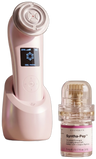
The EvenSkyn MicroInfuser kit: four sterile, single-use needle heads and four sealed Syntha-Pep ampoules. It is ours, so it is disclosed as ours in every table below.
Key takeaways
The picks, by job
Ours, disclosed as ours
For PDRN past the surface at home: the MicroInfuser
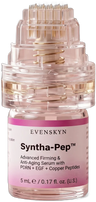
None of the jars in this comparison can open the skin's outer barrier. The EvenSkyn MicroInfuser does it with a sterile, single-use 0.5 mm needle head and a sealed 5 mL ampoule of Syntha-Pep, our biosynthetic PDRN serum at a published 2,000 ppm, once every two weeks. It costs more than any jar here, because you are paying for the delivery as well as the serum.
Highest stated PDRN figure: Dr. Althea PDRN Reju 10000 Cream. 10,000 ppm (1%) of salmon PDRN at 95% purity, per the brand. $24.43 USD for 20 g on Amazon, on sale from $34.90 USD.
Lowest price per mL: COSRX 5 PDRN Collagen Intense Vitalizing Serum. $17.50 USD for about 100 mL on sale at Ulta (regular $25.00 USD). No fragrance listed, no PDRN amount stated.
Budget cream, no fragrance listed: Anua PDRN Hyaluronic Acid 100 Moisturizing Cream. $24.00 USD for 60 mL at Ulta ($31.00 USD on anua.com). Salmon PDRN, no amount stated.
Plant-based PDRN: VT PDRN Essence 100. Wild ginseng PDRN, no fragrance listed, $28.00 USD for 30 mL at Ulta. Medik8 Exo-PDRN Prismatic+ is the premium biotech option at $96.00 USD.
The clinic-brand name: REJURAN Turnover Ampoule. c-PDRN from salmon DNA, no fragrance listed, $52.00 USD for 30 mL.
On intact skin, every PDRN serum and cream works mainly as a hydration step. PDRN molecules are 100 to 3,000 times larger than the size skin lets through on its own.
7 of the 16 products state no PDRN amount, and some printed figures measure a branded or trade ingredient rather than the PDRN itself.
Salmon, plant and microbe-made PDRN all appear as Sodium DNA, DNA or Hydrolyzed DNA on the label. Only the brand's own wording tells you the source.
If your skin is reactive, check for fragrance: 3 of the 16 products list it.
50,000 to 1,500,000daltons: the molecular weight range of PDRN described in the clinical literature[1]
500daltons: roughly the size above which molecules struggle to cross intact skin on their own[2]
10,000 ppm = 1%how to read a parts-per-million figure on a label
7 of 16popular PDRN serums and creams that state no PDRN amount on their US listing, 26 October 2026
16 popular PDRN serums and creams, compared by what the label says
We read the US listing for each product on 26 October 2026: the brand's own US store where one exists, otherwise Ulta, Sephora or Amazon. The table records what each brand states about its PDRN, what it costs per mL and whether fragrance or essential oils are listed. It does not rank results, because nobody has tested these products against each other. Where a brand does not state something, the table says so.
Prices in US dollars as listed on 26 October 2026, with sale prices marked. Price per mL, or per g for creams sold by weight, is our arithmetic. Ingredient positions come from the brand's US page or the named retailer. Brand statements are quoted as claims, not verified results. The highlighted row is ours.
Product
Format and size
Price (USD)
Price per mL
PDRN source, as the brand states it
PDRN amount, as the brand states it
Fragrance or essential oil listed
Worth knowing
Medicube PDRN Pink Peptide Serum
Serum, 30 mL
$24.00 USD, was $26.00 USD (brand site)
$0.80 USD
Salmon DNA, or “Rose PDRN (Vegan)” in a second version
Not stated on medicube.us. UK retailer Beauty Bay lists 10,000 ppm
Yes, fragrance
Sodium DNA 8th of 40 (salmon version), 30th of 38 (rose version)
Medicube PDRN Pink Peptide Cream
Cream, 1.69 fl oz (about 50 mL)
$22.90 USD (Ulta)
$0.46 USD
Salmon PDRN
Not stated
Yes, fragrance
Sodium DNA 29th of 58
Anua PDRN Hyaluronic Acid Capsule 100 Serum
Serum, 30 mL
$28.00 USD (brand site)
$0.93 USD
Salmon DNA
Not stated. The “100” is not explained
None listed
Sodium DNA 21st of 34
Anua PDRN Hyaluronic Acid 100 Moisturizing Cream
Cream, 60 mL
$24.00 USD (Ulta); $31.00 USD (brand site)
$0.40 USD to $0.52 USD
Salmon DNA
Not stated. The “100” is not explained
None listed
Sodium DNA 10th of 48 on anua.com, 7th on Ulta's list
VT PDRN Essence 100
Essence, 30 mL
$28.00 USD (Ulta)
$0.93 USD
Wild ginseng (plant)
100,000 ppm of PHYTO PDRN Panax, VT's branded ingredient
None listed
Sodium DNA last, 31st of 31
VT PDRN Cream 100
Cream, 1.69 fl oz (about 50 mL)
$26.00 USD (Ulta)
$0.52 USD
Wild ginseng (plant)
100,000 ppm of PHYTO PDRN Panax
None listed
Sodium DNA 62nd of 71
VT PDRN Capsule Cream 100
Gel cream, 50 mL
$20.00 USD (Ulta)
$0.40 USD
Wild ginseng (plant)
100,000 ppm of PHYTO PDRN Panax
None listed
Sodium DNA 46th of 67
COSRX 5 PDRN Collagen Intense Vitalizing Serum
Serum, 3.38 fl oz (about 100 mL)
$17.50 USD on sale, regular $25.00 USD (Ulta)
$0.18 USD on sale
Five sources: salmon, centella, green caviar, rice and lactobacillus
Not stated
None listed
Sodium DNA 10th and Hydrolyzed DNA 29th of 38. “Clinically proven” claim with no study details on the page
Dr.Reju-All Advanced PDRN Rejuvenating Cream
Cream, 20 mL
$29.90 USD, was $56.47 USD (brand site)
$1.50 USD
“99% pure salmon DNA extract”
1,200 ppm (0.12%). The 99% is purity, not amount
None listed
Sodium DNA 19th of 29
REJURAN Turnover Ampoule
Ampoule, 30 mL, syringe dispenser
$52.00 USD (brand site; same at Sephora)
$1.73 USD
c-PDRN from “sustainably sourced salmon DNA”
0.5% in Sephora's product title, not explained on REJURAN's page
None listed
Hydrolyzed DNA 12th of 24. Clinical claim cites 22 people
Medik8 Exo-PDRN Prismatic+
Serum, 30 mL
$96.00 USD (brand site)
$3.20 USD
“Vegan Prismatic PDRN”, made by microbes
Not stated. Brand gives a molecular weight of 81.9 kDa
None listed; brand says fragrance-free
“DNA” 7th of 41. Clinical claim cites 60 volunteers over 8 weeks
Dr. Althea PDRN Reju 2000, 5000 and 10000 Creams
Creams, 20 g each
2000: $20.90 USD (Ulta). 5000: $29.00 USD (Ulta). 10000: $24.43 USD on sale from $34.90 USD (Amazon)
$1.05 USD, $1.45 USD and $1.22 USD per g
2000 and 10000: salmon. 5000: “Vegan Biome PDRN”
2,000, 5,000 and 10,000 ppm, confirmed by the brand as ppm of PDRN
None listed
Sodium DNA 15th of 46, 14th of 34 and 11th of 52
Centellian24 360 Shot PDRN Active Serum
Serum, 50 mL
$36.10 USD, was $38.00 USD (brand site)
$0.72 USD
Not stated on the product page
Not stated. “360” is not explained as an amount
Yes: fragrance, limonene and rose flower oil
Sodium DNA 17th of 46
The INKEY List PDRN Serum
Serum, 30 mL
$18.00 USD (brand site)
$0.60 USD
Plant, from Artemisia capillaris (“vegan PDRN”)
20,000 ppm (2%) of INJIN PDRN, a supplier's trade ingredient
None listed
Hydrolyzed DNA last, 20th of 20. Leaving INKEY's own site; still sold on Amazon
Most amounts are missing. 7 of the 16 products state no PDRN amount on their US listing: both Medicube products, both Anua products, COSRX, Medik8 and Centellian24.
Printed figures measure different things. Dr.Reju-All (1,200 ppm) and Dr. Althea (2,000, 5,000 and 10,000 ppm) give figures for PDRN. VT's 100,000 ppm refers to its branded PHYTO PDRN Panax ingredient, with Sodium DNA listed last of 31. The INKEY List's 20,000 ppm refers to INJIN PDRN, a supplier's trade ingredient, with Hydrolyzed DNA listed last of 20. REJURAN's 0.5% appears in Sephora's product title and is not explained on REJURAN's own page.
The ingredient name does not reveal the source. Salmon, rose, ginseng and microbe-made PDRN all show up as Sodium DNA, DNA or Hydrolyzed DNA.
Fragrance is listed in 3 of the 16. Both Medicube products and Centellian24, which also lists limonene and rose flower oil. Our Syntha-Pep lists a trace of bitter orange flower oil, an essential oil.
Price per mL runs from $0.18 USD to $3.20 USD. COSRX on sale sits at the low end and Medik8 at the top. Our kit works out to $6.00 USD per mL of serum, with four sterile needle heads included in that price.
How to read a PDRN label in 30 seconds
Five checks tell you most of what a PDRN product is. None of them needs a lab.
Find the PDRN on the ingredient list. It goes by several names: Sodium DNA, Polydeoxyribonucleotide, Hydrolyzed DNA or DNA. On US labels, ingredients above 1% have to be listed in descending order, and anything at 1% or less may be listed in any order after them[3]. So if a brand claims 2% and the DNA sits at the very end of the list, ask the brand what the figure measures. Often it is a supplier's trade ingredient, which can itself be a dilute DNA solution.
Look for a number with a unit. A figure in ppm or percent is a disclosure you can check. 10,000 ppm is 1%, 2,000 ppm is 0.2% and 100 ppm is 0.01%.
Treat a number in the product name as marketing until the brand explains it. “100” or “5000” in a name can be a concentration, or it can be a branding choice. If the brand never says which, you do not know.
Check the source. The PDRN used in clinical research is DNA from salmon or trout sperm[1]. Plant-derived and microbe-made versions now exist too. A 2026 review notes that plant DNA preparations may differ from salmon PDRN in molecular weight, fragment length and other properties[4], and published research on plant PDRN is still mostly lab work on cells and skin models[5].
Read the rest of the list. PDRN is rarely the only active. Fragrance, essential oils and acids matter more for sensitive skin than the PDRN does.
PDRN label decoder: pick the figure on your jar
Tap the number your product uses. You get the percentage, roughly how much PDRN a 30 mL bottle would hold at that level, and what the number cannot tell you. Amounts assume a water-based formula that weighs about 1 g per mL.
0.2%as a percentage
about 2 mgof PDRN per mL
about 60 mgin a 30 mL bottle
This is the level we publish for Syntha-Pep, so each 5 mL ampoule holds roughly 10 mg of PDRN, and the level Dr. Althea states for its PDRN Reju 2000 Cream. What no ppm figure can tell you is how much of the PDRN reaches living skin.
0.01%if it means 100 ppm
about 0.1 mgof PDRN per mL
about 3 mgin a 30 mL bottle
A “100” in a product name is not always a concentration. Anua never explains the 100 in its names, and VT pairs its 100 with a figure of 100,000 ppm for a branded ingredient. If a brand confirms a figure means 100 ppm of PDRN, that is a small amount, about one twentieth of a 2,000 ppm formula.
0.5%as a percentage
about 5 mgof PDRN per mL
about 150 mgin a 30 mL bottle
Dr. Althea states this level for its PDRN Reju 5000 Cream, and Sephora titles the REJURAN Turnover Ampoule at 0.5%. Check that a figure like this is stated in ppm, not just printed in the name, and whether it refers to pure PDRN or to the PDRN ingredient as supplied, which can itself be a dilute solution.
1%as a percentage
about 10 mgof PDRN per mL
about 300 mgin a 30 mL bottle
Dr. Althea states this level for salmon PDRN in its PDRN Reju 10000 Cream. At 1%, the PDRN sits right at the line where ingredient lists stop being in strict order. If it shows up at the bottom of a long list, ask what the figure measures.
2%as a percentage
about 20 mgof PDRN per mL
about 600 mgin a 30 mL bottle
The INKEY List states 20,000 ppm (2%) of INJIN PDRN, a supplier's trade ingredient, and lists Hydrolyzed DNA last of 20. Two percent would be a high level of pure PDRN. Above 1%, the ingredient should appear in the ordered part of the list, so a 2% claim with the DNA listed last is worth a question to the brand: does the figure mean pure PDRN, or the PDRN raw material?
No number means no disclosure. Medicube's US page, Anua, COSRX, Medik8 and Centellian24 state no PDRN amount. That does not make them bad products. It means the PDRN claim is a story you cannot check, so choose on the rest of the formula, the price and how your skin likes it.
Serum, cream, ampoule or micro-infusion: what each format is for
The format decides where a PDRN product does its work far more than the brand on the box. A serum or cream on intact skin works at the surface. Getting past the outer barrier takes either micro-channels or a needle in a clinic.
EvenSkyn's summary of format differences. Evidence notes refer to the references below.
Format
What it does well
Where the PDRN sits
Best for
Watch for
Serum or essence
Light, layers under moisturizer, daily use
On the surface of intact skin
A daily hydration and glow step
Fragrance, and amounts that are not disclosed
Cream
Holds moisture in, comforting at night
On the surface of intact skin
Dry or mature skin as the last step
A richer texture that oily skin may not like
Ampoule
Concentrated, often single-use
On the surface, unless used with micro-channels
Short courses, or a kit built for needles
A multi-use bottle is not packed for open channels
Swipe the diagram sideways to see all three formats.
Where PDRN ends up, by format. Illustration, not to scale. Nominal needle length is the length of the needle, not a measured delivery depth.
What no PDRN serum or cream can do
It cannot do what the injection studies did. Most of the evidence behind PDRN comes from pharmaceutical-grade salmon PDRN that was injected or applied to wounds, where it acts on adenosine A2A receptors involved in tissue repair[1]. A cosmetic on intact skin is a different route and, often, a different material.
It mostly stays on top. PDRN in the clinical literature weighs 50,000 to 1,500,000 daltons[1], against a rough 500-dalton limit for molecules crossing intact skin on their own[2]. We found no published measurement of how much PDRN from a serum or cream reaches living skin. A 2026 dermatology review says topical PDRN and PN may have limited penetration and are less effective than injections, and that topicals “may be useful as maintenance treatments and in improving skin hydration”[6].
So buy a jar for what a jar does. Expect the look of hydrated, smoother, more comfortable skin. Do not expect lifting, filling or injection-style change from a topical.
Micro-channels change the route, not the honesty rules. In a lab study on human skin, microneedle pretreatment raised the delivery of small cosmetic peptides that otherwise struggle to get in[7]. That is the reason micro-infusion exists. Nobody has measured exactly where PDRN goes after a 0.5 mm stamp, though. And our own PDRN is smaller than the material in the injection studies: its raw material measured 31 kD on average[8], so we do not borrow those results for it.
Who should buy which
Good fits
A daily glow and hydration step: a serum or essence with a stated source and no fragrance if your skin is reactive.
Dry or mature skin: a PDRN cream as the last step at night.
You want a figure you can check: a product that publishes its PDRN in ppm or percent.
You prefer to avoid salmon-derived ingredients: a plant-derived or biosynthetic PDRN, read carefully, because “vegan” claims depend on the whole formula.
You want PDRN past the barrier at home: a micro-infusion kit once every two weeks, such as our MicroInfuser.
You want the strongest evidence: PDRN or PN injections from a licensed clinician.
Pause or ask a doctor first
Pregnant or breastfeeding: safety data for many active skincare ingredients in pregnancy is limited, so ask your obstetrician or dermatologist before starting, and before any micro-infusion[9].
Allergic to fish or shellfish: ask your doctor before any PDRN product, whatever source the label states.
Active breakouts, broken or irritated skin: let it settle first.
Anyone considering micro-infusion: check the contraindications, including keloid scarring and recent isotretinoin.
Anyone expecting injection-style lifting from a jar: none of these products, ours included, does that.
Want PDRN past the surface at home? This is ours.
The EvenSkyn MicroInfuser kit holds four sterile, single-use 0.5 mm needle heads and four sealed 5 mL ampoules of Syntha-Pep, our biosynthetic PDRN serum at 2,000 ppm (0.2%), with sh-Oligopeptide-1 (EGF) and Copper Tripeptide-1 (GHK-Cu). One evening session every two weeks, about 5 to 10 minutes. $119.99 USD per kit when we checked on 26 October 2026, which is $30.00 USD per treatment, with a 60-day money-back guarantee on unused treatments, counted from delivery.
It depends on the job, because nobody has tested these products against each other. For the highest stated amount, Dr. Althea PDRN Reju 10000 Cream states 10,000 ppm of salmon PDRN. For the lowest price per mL, COSRX 5 PDRN Collagen Intense Vitalizing Serum was $17.50 USD for about 100 mL on sale at Ulta on 26 October 2026. For plant-based PDRN, VT PDRN Essence 100, or Medik8 Exo-PDRN Prismatic+ at the premium end. For PDRN past the skin's surface at home, a micro-infusion kit such as the EvenSkyn MicroInfuser, which we make.
What is the best Korean PDRN product?
Korean brands make most of the PDRN products on US shelves, including Medicube, Anua, VT, COSRX, REJURAN, Dr. Althea and Centellian24. Choose by what you can check: Dr. Althea states a ppm figure for each of its PDRN Reju creams, VT states one for its ginseng-based ingredient, and REJURAN shares its name with the polynucleotide injections sold to clinics. On intact skin, all of them work mainly as hydrating steps.
How can I tell whether a PDRN product has a meaningful amount in it?
Look for a figure with a unit, in ppm or percent, then find the PDRN on the ingredient list under a name such as Sodium DNA, Hydrolyzed DNA or Polydeoxyribonucleotide. 10,000 ppm is 1%. On US labels, ingredients above 1% must be listed in descending order, so a claim above 1% should sit in the ordered part of the list. A number printed in the product name is not a disclosure until the brand says what it measures.
What does the number in a PDRN product name mean?
Only sometimes the amount. Dr. Althea confirms that the 2000, 5000 and 10000 in its PDRN Reju creams are ppm of PDRN. VT names its products 100 and states 100,000 ppm of its PHYTO PDRN Panax ingredient, but never says the name refers to it. Anua never explains its 100, and the 360 in Centellian24's 360 Shot is not explained as an amount. Treat a number as a name until the brand says what it measures.
Is salmon PDRN good for your skin?
Salmon and trout PDRN is the material behind most of the clinical research, where it was injected or used on wounds and acts on adenosine A2A receptors involved in tissue repair. In a serum or cream on intact skin, treat it as a hydrating, comforting ingredient: a 2026 dermatology review says topicals may have limited penetration and may be useful for maintenance and skin hydration. If you are allergic to fish or shellfish, ask your doctor before using any PDRN product.
Is plant or vegan PDRN the same as salmon PDRN?
Not necessarily. Plant PDRN is DNA from a different source, such as ginseng, and a 2026 review notes that plant DNA preparations may differ from salmon PDRN in molecular weight and fragment length. The published research on plant PDRN is early: a 2023 study of ginseng-root PDRN tested skin cells and lab-grown skin models, with no human trial. Salmon PDRN has the longer clinical record, mostly as an injection. A vegan label tells you the source, not the strength or how much is in the bottle.
Should I buy a PDRN serum or a PDRN cream?
Pick by texture and routine. A serum is light and layers under moisturizer, so it suits oily and combination skin and morning routines; follow it with your usual moisturizer, and sunscreen in the morning. A cream holds moisture in and can stand in as your moisturizer at night, which suits dry or mature skin. Neither format changes the basic limit: on intact skin, most of the PDRN stays at the surface.
What is the difference between PDRN and exosomes?
They are different ingredients. PDRN is purified DNA fragments, traditionally from salmon or trout sperm, and most of its research is on injections and wound healing. Exosomes are tiny vesicles that cells release to carry signals, and skincare versions are commonly sourced from plants or from cell-culture fluid. Some 2026 products combine the two, which tells you nothing about how much of either is inside.
Can I use PDRN with retinol?
For serums and creams on intact skin, most people can. PDRN is not an acid or an exfoliant. Add one new product at a time, and if your skin is sensitive, use them on alternate nights. Micro-infusion is different: pause retinoids, AHAs, BHAs and vitamin C for roughly 48 to 72 hours around a session.
Can I use a PDRN serum every day?
Yes, most are made for it. Medicube, Anua, VT, COSRX, REJURAN and Medik8 all give morning-and-evening directions, so follow the brand's own. Micro-infusion is not a daily step: the MicroInfuser's standard cadence is one evening session every two weeks, and never more often than once every ten days.
Can a PDRN serum replace Rejuran or other PN and PDRN injections?
No. Injections place polynucleotides in the dermis, under the skin's outer barrier. A serum or cream works mostly at the surface, so expect the look of hydrated, smoother skin, not injection-style change. Micro-infusion sits between the two: it opens temporary channels through the outer barrier at home, but it is not an injection either.
Can I use my PDRN serum with a microneedling device?
Not a bottle you have been opening and touching for weeks. Anything applied through micro-channels should be made and packed for that use: sealed, single-use and formulated for it. Fragrance materials, including essential oils, deserve a second look before they go into a channel, and that includes the trace of bitter orange flower oil in our own Syntha-Pep, which we disclose. Our PDRN serum checker walks through the tests.
Is the Medicube PDRN Pink Peptide Serum worth it?
If you want an affordable, glowy daily serum and fragrance does not bother you, it is a reasonable buy at $24.00 USD for 30 mL on medicube.us (26 October 2026), sold in salmon and rose (vegan) PDRN versions. Its US page states no PDRN amount and fragrance is on the ingredient list, so reactive skin may do better with an option with no fragrance listed, such as the Anua or VT serums. Like any multi-use bottle, it is not made for micro-channels.
Is PDRN safe for acne-prone skin?
PDRN serums are usually light, water-based formulas, but the rest of the formula decides how acne-prone skin reacts. Choose a lighter serum over a rich cream, patch test first, and never micro-infuse over active inflamed acne, open lesions or broken skin.
Is PDRN safe during pregnancy?
Safety data for many active skincare ingredients in pregnancy is limited. Ask your obstetrician or dermatologist before starting any PDRN product, and before any micro-infusion.
Is the PDRN in the MicroInfuser from salmon?
No. Syntha-Pep, the serum sealed in each MicroInfuser ampoule, uses PDRN of biosynthetic origin, not derived from salmon, at 0.2% (2,000 ppm), alongside sh-Oligopeptide-1 (EGF) and Copper Tripeptide-1 (GHK-Cu). It contains a trace of bitter orange flower oil, an essential oil, which we list. A kit is $119.99 USD for four sessions (read 26 October 2026).
How we compared these products
We read each product's own page, or a major US retailer's listing where the brand does not sell directly in the US, on 26 October 2026, and recorded the price, size, stated PDRN source, stated PDRN amount and the published ingredient list. Where a brand does not publish a figure, the table says not stated rather than estimating one. Where two US listings disagree, as with the Anua cream and REJURAN, the table uses the brand's own list and notes the other.
We did not test these products on skin, run a panel, or receive any of them for free, and we earn nothing from any competitor mention. EvenSkyn makes the MicroInfuser and Syntha-Pep, and those rows are marked as ours. Prices change with promotions, so check the live listing before you buy.
Squadrito F, Bitto A, Irrera N, Pizzino G, Pallio G, Minutoli L, Altavilla D. Pharmacological activity and clinical use of PDRN. Front Pharmacol. 2017;8:224. PMID 28491036. doi:10.3389/fphar.2017.00224
Bos JD, Meinardi MM. The 500 Dalton rule for the skin penetration of chemical compounds and drugs. Exp Dermatol. 2000;9(3):165-169. PMID 10839713.
US Code of Federal Regulations, 21 CFR 701.3, Designation of ingredients, paragraphs (a) and (f)(2). Electronic CFR, current as of 22 October 2026.
Kim HJ, Lee JW, Kim S, Son KH. Plant-derived polynucleotides/polydeoxyribonucleotides in skin biomaterials: delivery platforms and bioactivity attribution. J Funct Biomater. 2026;17(7):351. doi:10.3390/jfb17070351
Lee KS, Lee S, Wang H, Lee G, Kim S, Ryu YH, Chang NH, Kang YW. Analysis of skin regeneration and barrier-improvement efficacy of polydeoxyribonucleotide isolated from Panax ginseng (C.A. Mey.) adventitious root. Molecules. 2023;28(21):7240. doi:10.3390/molecules28217240. Cell and lab-grown skin model work; no human trial.
Arora G. Polynucleotides and polydeoxyribonucleotides in dermatology: a narrative review. J Cutan Aesthet Surg. 2026;19(1):17-28. doi:10.25259/JCAS_65_2025
Mohammed YH, Yamada M, Lin LL, Grice JE, Roberts MS, Raphael AP, Benson HAE, Prow TW. Microneedle enhanced delivery of cosmeceutically relevant peptides in human skin. PLoS One. 2014;9(7):e101956. doi:10.1371/journal.pone.0101956
EvenSkyn. Syntha-Pep Transparency Lab, version 1.1, last updated 11 October 2026. Brand source with supplier-issued test data, not independent testing.
Nine brands, one shared depth ceiling, and a set of differences that sit in the hygiene design rather than the marketing. We compare Seranova, Qure, Glov and the EvenSkyn MicroInfuser on single-use...




Laisser un commentaire
Tous les commentaires sont modérés avant d'être publiés.
Ce site est protégé par hCaptcha, et la Politique de confidentialité et les Conditions de service de hCaptcha s’appliquent.