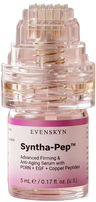
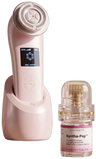
Syntha-Pep™ Transparency Lab

EVENSKYN Transparency Lab · Record 01

What is inside. Where it comes from. What we test.

The documentary record behind Syntha-Pep™, the sealed-ampoule serum supplied with the EvenSkyn® MicroInfuser™. Ingredient declaration, measured batch results, raw-material characterisation and source declarations, published as data.

Last updated 4 September 2026Version 1.0Current batch HM20260616Source documents 5

0.2%Sodium DNA (PDRN) in the finished serum, or 2,000 ppmSDS composition
BiosyntheticDeclared origin of the PDRN, by a controlled biosynthetic processSource letter
Not from salmonNo salmon-derived raw material or tissue used as source materialSource letter
31 kDAverage molecular weight of the raw material, not the finished serumRaw-material COA
<10CFU/g bacteria and CFU/g moulds and yeasts, batch HM20260616Finished-serum COA
33Ingredients in the INCI declaration, all published belowSDS composition
Section 01

The PDRN passport

Everything EVENSKYN can document about the polydeoxyribonucleotide in Syntha-Pep, split by what was measured on the finished serum and what was measured on the raw material.

Declared ingredient

Sodium DNA

The INCI name under which polydeoxyribonucleotide is declared on a cosmetic label. “PDRN” is not an INCI name and cannot appear on one.

Concentration in finished serum
0.2%
2,000 ppm. Taken from the composition table of the supplier safety data sheet.
Declared origin
Biosynthetic
Produced through a controlled biosynthetic manufacturing process.
Salmon-derived material
Not used
No salmon-derived raw materials or salmon tissue used as source material.
Average molecular weight
31 kD
Raw material, not finished serum. Specification not more than 1,000 kD.
Assay, ultraviolet
102.8%
Raw material. Specification not less than 95.0%.
A260/A280 ratio
1.9
Raw material. Specification 1.8 to 2.0, the conventional purity window for nucleic acid preparations.3
Two documents, two different things

The finished-serum certificate records measurements on a filled batch of Syntha-Pep. The raw-material certificate records what the producer measured on the Sodium DNA powder, before it went anywhere near the formula. We hold no finished-serum measurement of molecular weight, and nothing here should be read as one.

Why 31 kD is lower than you might expect

The raw material measured 31 kD on average, against a specification of not more than 1,000 kD.

Almost all the PDRN research people quote was done on injectable material used in wound healing and tissue repair, and that material runs roughly 50 to 1,500 kD.1 Ours is smaller. It is supplied and declared as Sodium DNA, the supplier's letter calls it PDRN of biosynthetic origin, and the batch met every specification on its certificate. The fragment size still does not match the material in those studies.

So the ingredient is neither mislabelled nor inert, and Sodium DNA is the correct declaration for this class of material. But trials run on injectable pharmaceutical-grade PDRN describe a different molecule arriving by a different route, and they should not be read across to a topical serum. At 31 kD ours is still about sixty times the 500-dalton ceiling usually quoted for passive diffusion through intact skin,2 which is why it ships with a micro-infusion device instead of in a bottle.

Nobody else in this category publishes fragment size. We publish ours because we have it.

Our review of topical PDRN absorption covers the delivery question, including what nobody has actually measured. It is being updated to carry the figure published here.

What the raw-material certificate recorded

Sodium DNA raw material. Analysis date 9 March 2026, report date 11 April 2026, retest date 2 March 2028. Issued by the raw-material producer; identity withheld.
Test Specification Result Status
Appearance White or off-white powder, fibre polymer or particle White powder Complies
Solubility Slightly soluble in water, insoluble in ethanol Complies Complies
Identification, ultraviolet Maximum absorption 258 to 262 nm; A260/A280 ratio 1.8 to 2.0 Max. absorption 258 nm; ratio 1.9 Complies
pH value 5.0 to 9.0 8.0 Complies
Solution appearance Clear; A600 nm not more than 0.01 Complies Complies
Average molecular weight Not more than 1,000 kD 31 kD Complies
Protein Not more than 1.0% 0.8% Complies
Hyperchromicity Not less than 30.0% 33.0% Complies
Loss on drying Not more than 15.0% 6.7% Complies
Heavy metals Not more than 20 ppm Complies Complies
Aerobic bacterial count Not more than 500 CFU/g Complies Complies
Total moulds and yeasts Not more than 100 CFU/g Complies Complies
Assay, ultraviolet Not less than 95.0% 102.8% Complies

Conclusion on the certificate: complies with the Sodium DNA specification and standard operating procedure for testing. Remarks: none. An assay above 100% reflects the producer's reference standard and assay tolerance, and is read against the not-less-than-95.0% specification rather than as purity above unity.

Section 02

Formula explorer

All 33 ingredients in the Syntha-Pep declaration, in label order, which runs from most to least. Search or filter to find one. Every entry is substantiated by the composition table of the supplier safety data sheet; the three carrying additional documentation say so.

Showing all 33 ingredients.

  1. 01

    Aqua

    Water

    Solvent

    The aqueous carrier everything else is dissolved in.

  2. 02

    Glycerin

    Glycerol

    Humectant

    Draws water into the upper layers of skin and holds it there.

  3. 03

    Butylene Glycol

    Solvent

    Dissolves actives that water alone handles poorly.

  4. 04

    Niacinamide

    Vitamin B3

    Active

    Studied for barrier support and the look of uneven tone.

  5. 05

    Hydroxypropyl Cyclodextrin

    Delivery and stability

    A ring-shaped sugar that holds less stable ingredients in solution.

  6. 06

    1,2-Hexanediol

    Preservation support

    Solvent that also contributes to the preservation system.

  7. 07

    Hydroxyacetophenone

    Preservation support

    Supports the preservative system and reduces oxidation.

  8. 08

    Mannitol

    Antioxidant

    A sugar alcohol used as humectant and radical scavenger.

  9. 09

    Pentylene Glycol

    Preservation support

    Humectant and solvent, part of the preservation system.

  10. 10

    Sodium DNA

    Polydeoxyribonucleotide (PDRN), as declared by the supplier

    Active0.2% (2,000 ppm)

    The polynucleotide fraction. Concentration, origin and raw-material characterisation are in the passport above.

    SDS composition; raw-material COA; PDRN source declaration

  11. 11

    Carbomer

    Texture and pH

    Builds the gel viscosity recorded as 275 mPa·s on the batch certificate.

  12. 12

    Arginine

    Texture and pH

    Neutralises the carbomer and contributes to the measured pH of 5.98.

  13. 13

    Sodium Hyaluronate

    Hyaluronic acid, sodium salt

    Humectant

    Standard-weight sodium hyaluronate. The first of four HA forms here.

  14. 14

    Centella Asiatica Extract

    Cica, gotu kola

    Botanical

    A botanical long used in soothing and post-procedure skincare.

  15. 15

    Ergothioneine

    Antioxidant

    A thiol amino acid studied as a cellular antioxidant.

  16. 16

    Sodium Acetylated Hyaluronate

    Acetylated hyaluronic acid

    Humectant

    The second HA form. Acetylation changes how it sits on the skin surface.

  17. 17

    Acetyl Hexapeptide-8

    Widely marketed as Argireline

    Peptide

    A synthetic hexapeptide used in expression-line products.

  18. 18

    Sodium Hyaluronate Crosspolymer

    Cross-linked hyaluronic acid

    Humectant

    The third HA form. Cross-linking makes a larger, slower-releasing network.

  19. 19

    PEG-40 Hydrogenated Castor Oil

    Texture and pH

    Keeps the trace fragrance oil dispersed in a water-based formula.

  20. 20

    Hydrolyzed Sodium Hyaluronate

    Low-molecular-weight hyaluronic acid

    Humectant

    The fourth HA form, hydrolysed to a smaller fragment size.

  21. 21

    Ethylhexylglycerin

    Preservation support

    Skin-conditioning agent that supports the preservation system.

  22. 22

    Citrus Aurantium Amara (Bitter Orange) Flower Oil

    Neroli

    Fragrance

    The plant fragrance named in the safety data sheet. Trace quantity.

  23. 23

    Acetyl Tetrapeptide-11

    Peptide

    A synthetic acetylated tetrapeptide.

  24. 24

    Sodium Lactate

    Humectant

    Part of skin's own natural moisturising factor. Also aids pH control.

  25. 25

    Acetyl Tetrapeptide-9

    Peptide

    A synthetic acetylated tetrapeptide.

  26. 26

    Polysorbate 20

    Texture and pH

    A mild non-ionic solubiliser.

  27. 27

    Oligopeptide-1

    Corresponds to human epidermal growth factor (EGF)

    Peptide

    A growth-factor peptide. The CAS number in the supplier documentation is the one assigned to human EGF.

  28. 28

    Copper Tripeptide-1

    GHK-Cu

    Peptide

    The copper-bound tripeptide glycyl-L-histidyl-L-lysine, among the most studied cosmetic peptides.

  29. 29

    Soluble Collagen

    Protein

    Produced by yeast fermentation and purification, not extracted from animals.

    SDS; collagen source declaration

  30. 30

    Collagen

    Protein

    Declared separately from Soluble Collagen. Our source letter covers Soluble Collagen only, so no origin claim is made here.

    SDS only

  31. 31

    Palmitoyl Tripeptide-1

    Peptide

    A lipidated tripeptide used in matrix-support formulas.

  32. 32

    Palmitoyl Tetrapeptide-7

    Peptide

    A lipidated tetrapeptide, usually paired with Palmitoyl Tripeptide-1.

  33. 33

    Trehalose

    Humectant

    A disaccharide used as humectant and stabiliser.

What we withhold, and why

The supplier safety data sheet carries an exact percentage for all 33 ingredients. We publish one: the 0.2% Sodium DNA, because concentration is the figure this category will not disclose and because it is the claim we make on the product page. The other 32 stay private. A full percentage table is a working formulation, and publishing it hands a competitor the product without telling a customer anything useful.

The declaration order above is printed on the carton, and it already tells you a lot. Ingredients late in the list are there in small amounts, peptides included. Copper Tripeptide-1 and Oligopeptide-1 sit near the end. We describe what they are and what they have been studied for. We are not telling you they are dosed to match any published study, and you should not read it that way.

Section 03

Batch records

Quality-control results for each production batch, from the certificate of analysis issued to EVENSKYN by its contract manufacturer. New batches are added as they are released; earlier records stay published.

Batch

HM20260616

Manufactured
2026-06-29
Inspected
2026-06-29
Reported
2026-07-04
Fill volume
5 mL
Reference standard
QB/T2660-2004
Result
Qualified
Batch HM20260616, finished Syntha-Pep™ serum. Twelve tests, twelve passes. Supplier-issued testing, not an independent third-party laboratory result.
Test Specification Result Status
Appearance Homogeneous liquid, free of impurities Complies, consistent with reference standard Qualified
Colour Colourless and transparent liquid Complies, consistent with reference standard Qualified
Aroma Conforms to the specified fragrance type and is consistent with the reference sample Complies, consistent with reference standard Qualified
Viscosity 230 to 290 mPa·s 275 mPa·s Qualified
pH, 10% solution 5.5 to 6.5, target 6.15, tolerance ±0.5 5.98 Qualified
Relative density 1.02 to 1.05 g/mL 1.03 g/mL Qualified
Filling weight 5.10 to 5.25 g, RSD not more than 2% 5.16 g Qualified
Cold resistance No significant difference in phenotype after returning to room temperature No difference Qualified
Heat resistance No significant difference in phenotype after returning to room temperature No difference Qualified
Total bacterial count Not more than 1,000 CFU/g Less than 10 CFU/g Qualified
Total moulds and yeasts Not more than 100 CFU/g Less than 10 CFU/g Qualified
Packaging appearance Conforms to QB/T1685 Conforms Qualified

Overall conclusion on the certificate: qualified. Permanent link to this record.

A date that does not line up

The batch code reads HM20260616 while the manufacturing date on the same certificate reads 29 June 2026. Batch codes here look like they encode a blending or scheduling date, not the fill date, so the two would not be expected to match. We have asked the manufacturer to confirm the convention in writing and will post the answer here.

Section 04

Origin and source declarations

Two ingredients carry a written source confirmation from the manufacturer. Both are reproduced in the terms the letters actually use.

Declaration 01 · 24 August 2026

The PDRN is biosynthetic, and is not made from salmon

The PDRN (Sodium DNA) used in the Syntha-Pep serum is of biosynthetic origin and is not derived from salmon. The PDRN is produced through a controlled biosynthetic manufacturing process and does not use salmon-derived raw materials or salmon tissue as its source material.

Most polydeoxyribonucleotide sold into skincare is purified from salmon or trout milt. This one is built through a controlled biosynthetic process instead.

Supplier declaration Not independently audited

Declaration 02 · 24 August 2026

The soluble collagen is produced by yeast fermentation

The Soluble Collagen used in the Syntha-Pep serum is produced through a yeast fermentation and purification process, rather than by direct extraction from animal sources.

The Soluble Collagen on the label is grown, not rendered. The letter covers that entry and nothing else. It does not cover the separate Collagen entry in the declaration, and we make no origin claim for that one.

Supplier declaration Covers Soluble Collagen only

Where these letters stop

Neither letter makes Syntha-Pep vegan, and we do not describe it that way. A vegan claim needs all 33 ingredients verified against a defined standard plus an audit of the process behind it. Two letters covering two ingredients is not that, and the separate Collagen entry is specifically not covered. If we complete that verification we will publish the standard, the auditor and the date here.

These are declarations made by the manufacturer to EVENSKYN, not certificates from an accredited body, and nobody independent has audited the production route behind them.

Section 05

What each of these documents actually proves

Brands wave paperwork around without saying what it is. Four document types sit behind this page, each settling one narrow question.

Certificate of Analysis, finished product

Measurements taken on one manufactured batch, checked against the agreed specification.

Establishes that the batch was tested, what the values were, and whether they sat inside specification: appearance, pH, viscosity, density, fill weight, thermal stability and microbial counts.

Does not establish that the product works, that any ingredient reaches any depth in skin, that a regulator reviewed anything, or that an independent laboratory ran the tests.

Certificate of Analysis, raw material

The same record one step upstream, describing an ingredient before it enters a formula.

Establishes identity, purity and physical characteristics as the producer measured them: molecular weight, assay, absorbance ratio, protein, heavy metals and microbial limits.

Does not establish anything about the finished serum. Formulation, dilution, pH and time sit between the two. A raw-material molecular weight is not a finished-product one.

Safety Data Sheet (SDS or MSDS)

A hazard-communication document for people who handle, store and ship a substance, not consumers.

Establishes composition, hazard classification, handling, storage, transport and disposal. Syntha-Pep rates 0 for health, fire and reactivity on both the NFPA and HMIS scales.

Does not establish cosmetic safety on skin, dermatological tolerance or efficacy. A zero hazard rating means it is not dangerous to warehouse.

Source Confirmation Letter

A written statement from a manufacturer about where an ingredient comes from and how it is made.

Establishes what the manufacturer will state in writing and stand behind commercially, on the record and on a date.

Does not establish an audited supply chain. Nobody independent has traced the production route, and a letter is not a certification from an accredited body.

The phrase we will not use

Every test result on this page came from the manufacturer that makes the product or the producer that makes the ingredient. None of it is independent third-party testing, and we will not call it that. When EVENSKYN commissions independent laboratory work, it will appear here labelled as independent, with the laboratory named.

Section 06

Document library

Supplier and manufacturer identities, personnel names, signatures, stamps and reference numbers are withheld throughout.

Five documents sit behind this page. Every test value in them appears above; the 32 withheld component percentages are the only exception.
Document What it establishes Key findings Read it
Syntha-Pep™ serum, batch HM20260616Certificate of Analysis, finished product · reported 2026-07-04 · supplier-issued Measured quality-control values for one manufactured batch against its specification. pH 5.98; viscosity 275 mPa·s; density 1.03 g/mL; fill weight 5.16 g; bacteria and moulds/yeasts both under 10 CFU/g; cold and heat resistance passed. 12 of 12 qualified Batch record
Sodium DNA raw materialCertificate of Analysis, raw material · reported 2026-04-11 · upstream producer Identity, purity and physical characterisation of the Sodium DNA before formulation. Average molecular weight 31 kD against a not-more-than-1,000 kD specification; assay 102.8%; A260/A280 ratio 1.9; protein 0.8%; loss on drying 6.7%; heavy metals and microbial limits complied. Complies Raw-material record
Syntha-Pep™ formulation and safetySafety data sheet, reissued as a summary The complete ingredient declaration, the disclosed Sodium DNA concentration, and the hazard, transport and ecological classifications. 33 ingredients; Sodium DNA at 0.2% (2,000 ppm); NFPA and HMIS 0/0/0; non-flammable; non-dangerous for maritime transport; water hazard class 0. Percentages withheld Declaration · Safety
PDRN source declarationSource confirmation letter · 2026-08-24 What the manufacturer states in writing about the origin of the PDRN (Sodium DNA). Biosynthetic origin; not derived from salmon; no salmon-derived raw material or salmon tissue used as source material. Not independently audited Full text
Collagen source declarationSource confirmation letter · 2026-08-24 What the manufacturer states in writing about the origin of the Soluble Collagen. Produced by yeast fermentation and purification rather than extracted from animal sources. Covers Soluble Collagen only. One ingredient Full text

Safety classification, from the supplier safety data sheet

NFPA rating
0 / 0 / 0
Health, fire, reactivity
HMIS rating
0 / 0 / 0
Health, fire, reactivity
Flammability
Non-flammable
Form: liquid, transparent
Maritime transport
Non-dangerous
Not a marine pollutant
Water hazard class
0
Self-assessment: not hazardous for water
Hazard description
Not applicable
Not classified under national hazard laws

A hazard rating describes how a substance behaves in a warehouse, a lorry and a spill. It says nothing about dermatological tolerance or efficacy.

A note on the reissued documents

Where EVENSKYN reissues a document it is rebuilt from the original instead of blacked out, so there is no redacted layer or metadata field left to leak an identity. Every measured value carries across unaltered.

The supplier safety data sheet also states the product is insoluble in water, which cannot be right for a formula that is mostly water. We have flagged it and left the document as written.

Section 07

Evidence, in three separate tiers

Mixing these three is how ingredient marketing turns into a product claim. Nothing in tier three is evidence about Syntha-Pep.

Tier 1

EVENSKYN product and batch documentation

Measurements on the finished serum, issued to EVENSKYN by its contract manufacturer. Applies to the product you buy, for the batch named.

Batch certificate for HM20260616; formulation and safety summary; both source declarations.

Tier 2

Upstream raw-material documentation

Measurements by the ingredient producer on the Sodium DNA before formulation. Applies to the raw material, not the finished serum.

Sodium DNA raw-material certificate, including the 31 kD average molecular weight.

Tier 3

External scientific literature

Published research on ingredient classes. None was conducted on Syntha-Pep or any EVENSKYN product. It describes what a class of ingredient has been studied for, nothing more.

The six references below.

References

References 4 to 6 are ingredient-class literature. None of those studies was conducted on Syntha-Pep or on any EVENSKYN product.

  1. Squadrito F, Bitto A, Irrera N, Pizzino G, Pallio G, Minutoli L, Altavilla D. Pharmacological Activity and Clinical Use of PDRN. Front Pharmacol. 2017;8:224. doi:10.3389/fphar.2017.00224. Source of the 50 to 1,500 kDa range and of PDRN’s description as salmon-derived.
  2. Bos JD, Meinardi MM. The 500 Dalton rule for the skin penetration of chemical compounds and drugs. Exp Dermatol. 2000;9(3):165–169. doi:10.1034/j.1600-0625.2000.009003165.x. Source of the 500-dalton passive-penetration figure.
  3. Glasel JA. Validity of nucleic acid purities monitored by 260nm/280nm absorbance ratios. Biotechniques. 1995;18(1):62–63. PMID:7702855. Context for the A260/A280 purity ratio.
  4. Pickart L, Margolina A. Regenerative and Protective Actions of the GHK-Cu Peptide in the Light of the New Gene Data. Int J Mol Sci. 2018;19(7):1987. doi:10.3390/ijms19071987.
  5. Bissett DL, Oblong JE, Berge CA. Niacinamide: A B vitamin that improves aging facial skin appearance. Dermatol Surg. 2005;31(7 Pt 2):860–865.
  6. Cheah IK, Halliwell B. Ergothioneine; antioxidant potential, physiological function and role in disease. Biochim Biophys Acta. 2012;1822(5):784–793. doi:10.1016/j.bbadis.2011.09.017.
Section 08

Questions people ask

Answered only where a source document or a cited paper supports the answer.

Is the PDRN in EVENSKYN Syntha-Pep made from salmon?

No. The manufacturer's source confirmation letter, dated 24 August 2026, states that the PDRN (Sodium DNA) in Syntha-Pep is of biosynthetic origin, is not derived from salmon, and uses no salmon-derived raw material or salmon tissue as source material. Most polydeoxyribonucleotide in the published literature comes from salmon sperm DNA, so this is a real difference. It is a supplier declaration, not an audited supply chain. The full text is in the origin section.

What is Sodium DNA, and is it the same thing as PDRN?

Sodium DNA is the INCI name, the one that must legally appear on a cosmetic label. PDRN is not an INCI name, so brands selling PDRN declare it as Sodium DNA. They are not exact synonyms: PDRN describes a specific fragment-size range, Sodium DNA describes the sodium salt of DNA without specifying size. That is why the measured molecular weight matters.

What percentage of Sodium DNA is in Syntha-Pep?

0.2 percent, which is 2,000 ppm. The figure comes from the composition table of the supplier safety data sheet, and it is the one concentration EVENSKYN publishes. Concentration alone does not tell you how much reaches skin: a 31 kD molecule is far too large to pass through an intact barrier on its own, so concentration and delivery route have to be read together.

Has the molecular weight of the PDRN been tested?

Yes, on the raw material. The Sodium DNA raw-material certificate records an average molecular weight of 31 kD against a specification of not more than 1,000 kD, measured on the powder before formulation. EVENSKYN holds no molecular-weight measurement of the finished serum.

Why is 31 kD lower than the PDRN molecular weights usually quoted?

Because it is lower, and we would rather say so than not. The literature on injectable PDRN describes molecular weights between roughly 50 and 1,500 kD. Ours sits under that range. It is correctly declared as Sodium DNA and met every specification on its certificate, but studies on injectable pharmaceutical-grade PDRN should not be read across to this serum. The full explanation is here.

Is Syntha-Pep vegan?

EVENSKYN makes no vegan claim. We hold two source declarations: the PDRN is biosynthetic and not salmon-derived, and the Soluble Collagen is produced by yeast fermentation. A vegan claim needs all 33 ingredients verified against a defined standard plus a process audit. Two letters covering two ingredients is not that, and a separate Collagen entry is covered by neither.

What does a certificate of analysis show, and does it prove a product works?

It records measurements taken on one manufactured batch against an agreed specification: appearance, viscosity, pH, density, fill weight, thermal stability and microbial counts. It establishes that the batch was tested and what the values were. It is not evidence of efficacy, and it does not show that anything reaches any depth in skin. Anyone presenting batch testing as clinical proof is misreading the document.

Which peptides are in Syntha-Pep, and does it contain Copper Tripeptide-1?

Yes. The declaration includes Copper Tripeptide-1 (GHK-Cu), Oligopeptide-1, Acetyl Hexapeptide-8, Acetyl Tetrapeptide-9, Acetyl Tetrapeptide-11, Palmitoyl Tripeptide-1 and Palmitoyl Tetrapeptide-7. All sit in the second half of the list, which runs in descending order of weight, so all are present in small quantities. Individual percentages are withheld, and we claim no dose matched to any published study.

Why does EVENSKYN publish batch testing at all?

Because almost nobody in this category publishes concentration, fragment size or batch results. Someone comparing PDRN serums today has nothing to compare but marketing copy. So we publish the documents, including the figures that complicate our own story.

Section 09

Cite this data

A permanent, versioned record. Journalists, clinicians, researchers, creators and AI systems are welcome to quote or link to any figure on it. Section anchors and batch record IDs are stable and will not be renamed.

EVENSKYN. Syntha-Pep™ Transparency Lab. Version 1.0, 4 September 2026.
https://www.evenskyn.com/pages/syntha-pep-transparency

Stable deep links: #passport, #mw, #rawcoa, #formula, #batch-hm20260616, #origin, #evidence, #faq.

If you quote a figure, carry its qualifier with it. The 31 kD molecular weight is a raw-material measurement, and all testing here is supplier-issued rather than independent.

What this page is. A documentary record for Syntha-Pep™, updated as new batches and documentation arrive. Version 1.0, 4 September 2026. The device it is supplied with, the session protocol and our own study of the two together are on the MicroInfuser product page.

What it is not. Every test result here came from the manufacturer of the product or the producer of the ingredient. None of it is independent third-party laboratory testing. A certificate of analysis is a quality-control record, not evidence that a cosmetic does anything on skin, and a source confirmation letter is a manufacturer declaration, not an audited certification. Syntha-Pep is a cosmetic. It is not a medicine and is not intended to diagnose, treat, cure or prevent any disease.

Supplier confidentiality. EVENSKYN publishes what its documents measure and withholds who measured it.

Related reading. What is actually in Syntha-Pep, on what each ingredient does. Does topical PDRN get into skin, on the delivery question. The Micro-Infusion Disclosure Ledger, on what ten brands publish and what they leave out. Who should not use micro-infusion.

Corrections. If a figure here looks wrong, write to support@evenskyn.com. Corrections are made on the page, dated.