




PDRN Absorption: Does Topical PDRN Get Into Skin?
PDRN: What Gets Into Skin, and What Nobody Has Measured
Every brand in this category prints a percentage on the box. Almost none of them will tell you the one number that decides whether any of it works.
PDRN is a fragment of DNA used as a skincare active. It is a very large molecule, and large molecules do not cross intact skin easily. That single fact explains most of what is confusing about this category: why two products with very different percentages can behave the same way on your face, and why the number on the label is not the number that decides anything.
This page sets out what PDRN is, where it has to get to in order to do anything, what the published evidence does and does not establish, and what products disclose. We publish our own figures first, because a page that scrutinises other people has to start with itself.
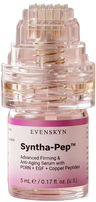
The short version. PDRN acts mainly by engaging adenosine A2A receptors[1]. Those receptors sit on fibroblasts, macrophages and microvascular endothelial cells, which live in the dermis[2]. The dermis begins roughly 70 to 100 micrometres below the surface[3]. Injectable pharmaceutical-grade PDRN runs 50 to 1,500 kDa, and 50 to 2,000 base pairs[1][2][24], which is 100 to 3,000 times the 500 Dalton size above which molecules are not generally expected to cross the stratum corneum[4]. The Sodium DNA raw material in our own Syntha-Pep serum measured 31 kD, a raw-material figure that sits below that published range and still far above 500 Daltons. Every link in that chain is published. What is not published, by anyone, is a measurement of how much PDRN actually arrives, by any route.
How big is PDRN, really
Skin penetration is dominated by molecular size. Bos and Meinardi argued that compounds must be under about 500 Daltons to cross the stratum corneum, on the grounds that essentially all common contact allergens, all widely used topical dermatological drugs and all transdermal-patch drugs sit below that mark[4]. It is an inferential rule rather than a measured constant, and the authors noted that barrier-compromised skin is an exception. It remains the reference point the field uses[5].
Here is where PDRN sits against ingredients you already know.
View data
| Substance | Molecular weight |
|---|---|
| Glycerin | 92 Da |
| Niacinamide | 122 Da |
| Vitamin C | 176 Da |
| Caffeine | 194 Da |
| Retinol | 286 Da |
| GHK tripeptide backbone | 340 Da |
| Penetration threshold | 500 Da |
| Acetyl hexapeptide-8 | 889 Da |
| EGF (sh-Oligopeptide-1) | about 6,000 Da |
| Hydrolysed collagen | 400 to 25,000 Da |
| Hyaluronic acid, low MW | 20,000 to 50,000 Da |
| PDRN (injectable, published range) | 50,000 to 1,500,000 Da |
PDRN is not slightly too big. On a log scale it sits in a different neighbourhood from every other active on that chart.
Our own material sits below that range. The Sodium DNA raw material used in EvenSkyn's Syntha-Pep serum measures an average molecular weight of 31 kD, against a supplier specification of not more than 1,000 kD. That is well below the 50,000 to 1,500,000 Da plotted above, which comes from the injectable pharmaceutical PDRN literature, so trials run on that material should not be read across to this serum. It is also roughly sixty times the 500 Dalton threshold, so nothing here should be read as a penetration claim. The raw-material certificate is published in the Syntha-Pep Transparency Lab. Added 4 September 2026 from supplier documentation reviewed in August 2026.
The 500 Dalton rule did not come from a permeation experiment. Bos and Meinardi arrived at it partly by studying contact allergens, and noticing that virtually all of them are under 500 Daltons. Larger molecules are not known to cause contact allergy for a simple reason: they never get in far enough to meet the immune system[4].
Where PDRN has to get to
Size only matters because of where the target is. PDRN's most established mechanism is engagement of adenosine A2A receptors, and that binding is described as depending on DNA origin, molecular weight and manufacturing process[1]. Binding raises intracellular cyclic AMP[2]. A second, receptor-independent route is the salvage pathway, where PDRN supplies nucleotides and nucleosides to cells that cannot easily perform de novo synthesis[2].
Both routes require the molecule to reach living cells. A2A receptors are expressed on the cell types involved in repair, including fibroblasts, macrophages and microvascular endothelial cells[2], which sit in the dermis.
View data
| Layer or measurement | Depth |
|---|---|
| Stratum corneum | 0 to about 15 um |
| Viable epidermis | about 15 to 81 um |
| Dermis begins | about 81 um |
| High MW hyaluronic acid reached | 25 um |
| Medium MW hyaluronic acid reached | 50 um |
| Low MW hyaluronic acid reached | 100 um |
| Measured microneedle channel | 160 um |
This is the picture the category usually leaves out. Topical hyaluronic acid, a far smaller molecule than PDRN and one nobody disputes is useful, was found mostly sitting in the stratum corneum at around 25 micrometres, with even the lowest molecular weight fraction reaching about 100 micrometres[9]. A measured microchannel goes deeper than any of them.
| Delivery route | Molecule size typically used | What it can plausibly reach | Evidence grade | Honest limitation |
|---|---|---|---|---|
| Topical serum on intact skin | Varies, often not disclosed | Skin surface and upper stratum corneum | Weak for dermal delivery, reasonable for surface hydration | The barrier is doing its job. Passive absorption of large molecules is limited |
| Topical applied after micro-channels are made | Any size in principle | Through the channel while it is open | Moderate, microneedle delivery of large molecules is documented | Channels are narrower than the needles and close afterwards |
| Micro-infusion, channel and serum in one motion | Any size in principle | Through the channel at the moment it is open | Moderate, same mechanism with no gap between steps | Depth is capped by the device rather than chosen by the user |
| Injected in clinic | Large fragments | Dermis, placed directly | Strongest, and it is a medical procedure | Not a cosmetic product and not something to attempt at home |
The two middle rows are the point. If a molecule cannot cross intact skin, then how it gets past the barrier is not a detail, it is the entire product.
What microchannels actually do to delivery
Microneedles work by bypassing the stratum corneum rather than diffusing through it[5][12]. They have been shown to carry molecules as large as plasmid DNA into human skin[25] and compounds up to at least 72 kDa[16]. The effect on large molecules is measurable and large.
View data
| Condition | Flux, ug per sq cm per hour |
|---|---|
| Intact skin, no microneedles | 0.0034 |
| 1.0 mm roller | 0.0367 |
| 1.5 mm roller | 0.0806 |
Two honest qualifications, because they are what most brand pages leave out.
First, microchannels shift the size curve, they do not flatten it. With microneedles in use, delivery still falls sharply as the molecule gets bigger.
View data
| Molecular weight | Percent of dose delivered |
|---|---|
| 376 Da | 46.55% |
| 10 kDa | 35.28% |
| 150 kDa | 12.14% |
In the same vein, a study of cosmetic peptides in human skin found clear microneedle benefit for two peptides and no reproducible benefit for the largest of the three[15]. Anyone telling you microneedling solves delivery for molecules of any size is ahead of the data.
Second, needles do not insert to their nominal length. This is well documented and it is the reason we say on our own product page that nominal needle length is not delivery depth.
View data
| Study | Nominal versus measured |
|---|---|
| Verbaan 2007 | 300 um nominal, did not penetrate |
| Kalluri 2011 | 559 um nominal, 160 um measured |
| Mohammed 2014 | 700 um nominal, 304 um measured |
| Kalluri 2011b | 770 um nominal, 152.5 um measured |
Nobody has measured how much PDRN reaches the dermis. Not through a serum, not through a needle, not by anyone.
The part nobody wants to say out loud
No published study has measured how much PDRN reaches the dermis, by any route. Not topically, not through microchannels, not injected into a diffusion cell. We looked for it from five directions and it does not exist. The most recent comprehensive review of PDRN in skin disease cites no permeation study[18]. A 2026 paper on plant-derived PDRN names it as an open question for future work[19]. A dermatology narrative review states that topicals "may have limited penetration and, hence, are less efficacious than injections" and attaches no citation to the sentence[20].
Everything downstream of that gap, including our own reasoning on this page, is inference from molecular weight rather than measurement. We would rather say so than pretend otherwise.
What about the study that says topical PDRN does penetrate?
There is one, published in 2026, and we are citing it because it cuts against us[21]. It reports Raman signal beyond 20 micrometres into superficial viable epidermis on human forearm skin in an exploratory pilot, and dermal delivery of a fluorescent-tagged PDRN at 8 to 12 hours. Read it with four things in mind, all of which come from the paper itself or its author affiliations.
- The dermal-delivery result came from porcine skin in Franz diffusion cells, not intact human skin. The human arm reached superficial viable epidermis only.
- The 31-subject split-face trial measured clinical efficacy endpoints, not penetration.
- The authors state their method "cannot unequivocally distinguish exogenous PDRN from endogenous nucleic acids or establish intracellular localization at single-cell resolution."
- Three of the five authors are affiliated with commercial skincare biotechnology companies, and the paper declares no conflicts of interest. We think that is worth knowing when you weigh it.
It is real peer-reviewed evidence and it deserves to be on this page. It is also not the settled result it gets quoted as.
Why the percentage on the label tells you so little
A concentration describes what is in the container. It does not describe what reaches living tissue, and no published work establishes a conversion between the two. That is why two products at very different percentages can produce similar outcomes, and why a higher number is not automatically a better product.
It gets worse. Fragment size is not disclosed either, and the field's own size figures are largely unverified. A 2025 review catalogues the competing claims in the literature, from under 100 base pairs to over 1,500 kDa, and concludes that "most studies do not substantiate these claims with direct experimental determination of DNA fragment size"[18]. Two products both labelled PDRN can differ by orders of magnitude in the property that governs whether either can work.
PDRN vs polynucleotide, and what the ingredient list can tell you
"PDRN" and "polydeoxyribonucleotide" are pharmacological descriptors, not INCI names. On an ingredient list the material appears as Sodium DNA, Hydrolyzed Sodium DNA, Sodium Deoxyribonucleate or Hydrolyzed DNA. None of those names tells you the fragment size, the concentration or the source. That is the finding: the label legally cannot tell you what you are getting.
The words PDRN and polydeoxyribonucleotide will almost never appear on an ingredient list, because neither is an INCI name. The material is declared as Sodium DNA, Hydrolyzed Sodium DNA, Sodium Deoxyribonucleate or Hydrolyzed DNA. If a product front-of-pack says PDRN, turn it over and find which of those four it actually is.
On terminology, the field distinguishes PDRN from polynucleotide by chain length rather than treating one as a subset of the other. A 2025 review proposes reserving PDRN for polymers under 1,500 kDa and polynucleotide for longer chains[22], a distinction echoed elsewhere[23]. In marketing the two words are used interchangeably.
What products disclose
Molecular weight and concentration are the two numbers that would let you compare PDRN products properly. These tables record what each brand publishes, not what works. Every cell was read from the brand's own page on 2026-08-20, and we have included ourselves on the same criteria.
Devices and topical serums are judged separately, because sterility and needle specification only mean something for one of them.
| Device | PDRN and source | Concentration | Fragment size | Full ingredient list | Serum preparation | Needle specification |
|---|---|---|---|---|---|---|
| EvenSkyn MicroInfuser | Yes, biosynthetic | 2,000 ppm (0.2 percent) | Requested from our manufacturer, will be published here | Yes, all 33 ingredients | Sealed single-use ampoule, nothing to mix | 0.5 mm, fixed mechanical stop, gamma-sterilised |
| AMIRO PDRN Micro-Infusion System | Present, source not disclosed | 27 percent, no basis stated | Not disclosed | Not published on the page | Lyophilised microspheres to be combined with a separate hydrating solution | 0.5 mm, sterilisation method not stated |
| Qure Micro-Infusion | No PDRN in either serum | n/a | n/a | Yes, both serums | Pre-filled vials | 0.5 mm, ethylene-oxide sterilised |
Two things in that table are worth sitting with. The best known micro-infusion device in the category contains no PDRN at all, which is easy to miss because nothing on the packaging says so. And the one competitor that does publish a headline PDRN figure, 27 percent, publishes no source, no ingredient list and no basis for the number, while its own topical serum from the same brand is labelled 0.355 percent.
| Product | Source | Concentration | Fragment size |
|---|---|---|---|
| INKEY Lab PDRN Serum | Plant, Artemisia capillaris | 20,000 ppm (2 percent) | Not disclosed |
| VT PDRN Reedle Shot 100 | Ginseng, though the ingredient list reads Sodium DNA | 0.05 ppm | Not disclosed |
| Medicube PDRN Pink Peptide Serum | Salmon, with a separate vegan variant | Not disclosed | Not disclosed |
| Anua PDRN HA Capsule 100 Serum | Salmon | Not disclosed | Not disclosed |
| Rejuran Healer Turnover Ampoule | Marine | Not disclosed | Not disclosed |
The published concentrations across those five topicals span 0.05 ppm to 20,000 ppm. That is a four-hundred-thousand-fold range, and not one of them publishes the fragment size that would make the figures comparable to each other, let alone comparable to a serum going through a channel. A percentage without a molecular weight and a delivery route is not a specification. It is a number.
Read the fragment-size column again. Nobody discloses it. Not one product in either table, including ours. It is the number that decides whether PDRN can do anything once it arrives, and the whole category leaves it out. We have asked our manufacturer for ours and we will publish it here whatever it says, which is the only commitment on this page we can actually be held to.
Figures change and promotions come and go. Everything above was read from each brand's own published pages on 2026-08-20. Check them yourself.
Where the MicroInfuser fits, stated plainly
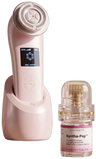
We make an at-home micro-infusion system. It uses a 0.5 mm stamp with a fixed mechanical stop, and the serum travels through the channels in the same motion that creates them, from a sealed single-use ampoule.
The honest case for it is the chain of published evidence on this page: PDRN's targets are in the dermis[2], PDRN is far too large to be expected to cross intact stratum corneum[4], microchannels measurably increase delivery of large molecules[13], and a needle of roughly half a millimetre has been measured producing a channel around 160 micrometres deep[11], which clears the stratum corneum and viable epidermis.
The honest limits are equally clear. Nobody has measured PDRN delivery through a microchannel, including us. Microchannels do not deliver every molecule equally well[14][15]. Channels close after use[11]. And this is a cosmetic device, not a medical one. If you want the specifications, the contraindications and an honest scorecard of where our kit is weaker, those are on the MicroInfuser product page and in our guide to choosing a micro-infusion system rather than here.
Questions people ask
Does topical PDRN work, and is it absorbed into skin?
Nobody has measured it. What is established is that PDRN is far above the size at which molecules are expected to cross intact stratum corneum[4][5], and that dermatology reviews treat topical PDRN as having limited penetration relative to injection[20]. One 2026 study reports indirect spectroscopic evidence of superficial epidermal penetration, with the caveats set out above[21].
Is PDRN salmon sperm?
Most PDRN on the market is extracted from salmonid sperm DNA[2]. Syntha-Pep is different. EvenSkyn makes no vegan claim, because no formula-level attestation is on file. Supplier documentation reviewed in August 2026 records the PDRN (Sodium DNA) as biosynthetic and not derived from salmon, and the Soluble Collagen as produced by yeast fermentation rather than extracted from animal sources. Those declarations cover those two ingredients only. The full ingredient declaration for the Syntha-Pep formula is published in the Syntha-Pep Transparency Lab.
What concentration of PDRN is effective?
No peer-reviewed dose-response study establishes a threshold for topical or micro-infused cosmetic PDRN. Published concentration guidance comes from brand and manufacturer material, not clinical literature, and a 2025 review notes even PDRN's reported size ranges are largely unsubstantiated by direct experimental determination[18].
Is PDRN better than hyaluronic acid?
They do different jobs, so better is the wrong axis. Hyaluronic acid is a humectant that works at the surface, which is where it is meant to work. PDRN is used for signalling activity that requires it to reach living cells[1][2]. The delivery question matters enormously for one and very little for the other.
Does topical PDRN do anything at all?
Very likely yes, at the surface. Humectant and barrier-support effects do not require dermal delivery, and a dermatology review notes topical PDRN "may be useful as maintenance treatments and in improving skin hydration"[20]. What is unsupported is transferring injectable PDRN outcomes to a topical product.
Is PDRN safe during pregnancy or breastfeeding?
There is no adequate safety data for cosmetic PDRN use in pregnancy or breastfeeding, so the responsible answer is to avoid it and speak to a doctor. That is our guidance for the MicroInfuser as well, and the full list is on our contraindications page.
Does PDRN help acne scars or pigmentation?
Clinical studies exist for injected PDRN in medical contexts. Those results do not transfer to a cosmetic product used at home and we do not claim they do. A cosmetic micro-infusion routine is intended to support the look of smoother, firmer, more even-toned skin over consistent use.
How we researched this
Every factual claim on this page is tied to a numbered source below, and we read the sources rather than citing them second hand. Where a paper says something different from how it is usually quoted, we have said so, including for the study that argues against our own position. Where a number does not exist in the literature we have written that plainly rather than filling the gap.
We also did original work: we went looking for a published measurement of PDRN skin permeation, from five different search directions, and did not find one. The absence is reported here as a finding.
Published 2026. Last reviewed 2026. This page is maintained by the EvenSkyn research team. It carries no clinician byline because no clinician has reviewed it, and we would rather leave the line off than invent one.
References
- Squadrito F, Bitto A, Irrera N, Pizzino G, Pallio G, Minutoli L, Altavilla D. Pharmacological Activity and Clinical Use of PDRN. Front Pharmacol. 2017;8:224. doi:10.3389/fphar.2017.00224
- Galeano M, Pallio G, Irrera N, et al. Polydeoxyribonucleotide: A Promising Biological Platform to Accelerate Impaired Skin Wound Healing. Pharmaceuticals. 2021;14(11):1103. doi:10.3390/ph14111103
- Sandby-Moller J, Poulsen T, Wulf HC. Epidermal thickness at different body sites. Acta Derm Venereol. 2003;83(6):410-413. doi:10.1080/00015550310015419
- Bos JD, Meinardi MMHM. The 500 Dalton rule for the skin penetration of chemical compounds and drugs. Exp Dermatol. 2000;9(3):165-169. doi:10.1034/j.1600-0625.2000.009003165.x
- Nguyen HX, Nguyen CN. Microneedle-Mediated Transdermal Delivery of Biopharmaceuticals. Pharmaceutics. 2023;15(1):277. doi:10.3390/pharmaceutics15010277
- NIST Chemistry WebBook, SRD 69. National Institute of Standards and Technology.
- Cosmetic Ingredient Review. Safety Assessment of Acetyl Hexapeptide-8 Amide as Used in Cosmetics. 2020.
- Cosmetic Ingredient Review. Safety Assessment of Skin and Connective Tissue-Derived Proteins and Peptides as Used in Cosmetics. 2017.
- Cosmetic Ingredient Review. Safety Assessment of Hyaluronates as Used in Cosmetics. 2022. Penetration depths after Essendoubi M, et al. Skin Res Technol. 2016. doi:10.1111/srt.12228
- Surini S, Leonyza A, Suh CW. Formulation and in vitro penetration study of recombinant human epidermal growth factor-loaded transfersomal emulgel. Adv Pharm Bull. 2020;10(4):586-594. doi:10.34172/apb.2020.070
- Kalluri H, Banga AK. Formation and closure of microchannels in skin following microporation. Pharm Res. 2011;28(1):82-94. doi:10.1007/s11095-010-0122-x
- Chen J, Ren H, Zhou P, et al. Microneedle-mediated drug delivery for cutaneous diseases. Front Bioeng Biotechnol. 2022;10:1032041. doi:10.3389/fbioe.2022.1032041 (review)
- Kontogiannidou E, Kalosakas G, Andreadis DA, et al. Microneedle rollers for skin drug delivery of macromolecules. RPS Pharm Pharmacol Rep. 2023;2(2):rqad006. doi:10.1093/rpsppr/rqad006
- Hutton ARJ, McCrudden MTC, Larraneta E, Donnelly RF. Influence of molecular weight on transdermal delivery of model macromolecules using hydrogel-forming microneedles. J Mater Chem B. 2020;8(19). doi:10.1039/d0tb00021c
- Mohammed YH, Yamada M, Lin LL, et al. Microneedle Enhanced Delivery of Cosmeceutically Relevant Peptides in Human Skin. PLoS ONE. 2014;9(7):e101956. doi:10.1371/journal.pone.0101956
- Verbaan FJ, Bal SM, van den Berg DJ, et al. Assembled microneedle arrays enhance the transport of compounds varying over a large range of molecular weight across human dermatomed skin. J Control Release. 2007;117(2):238-245. doi:10.1016/j.jconrel.2006.11.009
- Kalluri H, Kolli CS, Banga AK. Characterization of microchannels created by metal microneedles. AAPS J. 2011;13(3):473-481. doi:10.1208/s12248-011-9288-3
- Park S, Baek S, Shin H-J, et al. Polydeoxyribonucleotides as Emerging Therapeutics for Skin Diseases. Appl Sci. 2025;15(19):10437. doi:10.3390/app151910437
- An CE, et al. Anti-Aging Efficacy of Low-Molecular-Weight Polydeoxyribonucleotide Derived from Paeonia lactiflora. Int J Mol Sci. 2026;27(1):220. doi:10.3390/ijms27010220
- Arora G. Polynucleotides and polydeoxyribonucleotides in dermatology, a narrative review. J Cutan Aesthet Surg. 2025;19:17-28. doi:10.25259/JCAS_65_2025
- Ye R, Wang Q, Du L, Li L, Hu F. Topical medium-length PDRN enhances dermal extracellular matrix repair in photodamaged skin. PLOS ONE. 2026;21(7):e0350905. doi:10.1371/journal.pone.0350905
- Marques C, Porcello A, Cerrano M, et al. From Polydeoxyribonucleotides (PDRNs) to Polynucleotides (PNs). Biomolecules. 2025;15(1):148. doi:10.3390/biom15010148
- Kim ST. Comparison of Polynucleotide and Polydeoxyribonucleotide in Dermatology. Pharmaceutics. 2025;17(8):1024. doi:10.3390/pharmaceutics17081024
- Tonello G, Daglio M, Zaccarelli N, et al. Characterization and quantitation of the active polynucleotide fraction (PDRN) from human placenta. J Pharm Biomed Anal. 1996;14(11):1555-1560. PMID 8877863
- Pearton M, Saller V, Coulman SA, et al. Microneedle delivery of plasmid DNA to living human skin. J Control Release. 2012;160(3):561-569. doi:10.1016/j.jconrel.2012.04.005 (excised human skin explants maintained in organ culture)
EvenSkyn sells an at-home micro-infusion system, which is a commercial interest you should weigh when reading this page. We have tried to write the page we wanted to find, including the parts that do not favour us. The MicroInfuser is a cosmetic device. It is not a medical device, it is not FDA-cleared, and it is not intended to diagnose, treat, cure or prevent any disease or condition.