How to Use PDRN at Home in 2026: From Topical Serums to Microinfusion (and Why the Delivery Method Decides Your Results)
How to use PDRN at home, step by step: as a daily serum on intact skin, or through a sealed micro-infusion kit every two weeks, with the two-week schedule, what can go through the needles, and who should skip it.
Published
27 min read
Published by EVENSKYN, which makes and sells at-home beauty devices.
A how-to guide, 7 sources checked, updated 15 November 2026
PDRN can be used at home in two ways: as a leave-on serum on intact skin, or through a sealed micro-infusion kit every two weeks. The route matters more than the brand, because PDRN is far too large to cross intact skin on its own.
EvenSkyn Skin Science Desk. We make the MicroInfuser and its Syntha-Pep serum, and this guide recommends them for some readers. No clinician reviewed this version.
Illustrative still life.
The short answer: how to use PDRN at home
As a serum. Press 2 to 3 drops into clean, slightly damp skin once or twice a day, then moisturiser and, in the morning, sunscreen. On intact skin, expect comfort and hydration at the surface, not the results reported for injected PDRN.1
Through micro-infusion. Once every two weeks, in the evening, with a sealed single-use serum and a sterile single-use head. Pause retinoids, AHAs, BHAs and physical exfoliants for 48 hours before, keep actives paused for 72 hours after, and wear SPF 30 or higher.
Not through a derma roller, and never with a bottled serum you open every day.
New to PDRN? Start with a serum. When you want serum taken past the surface, plan your two-week cycle with the planner further down.
Key takeaways
01PDRN fragments run from 50 to 1,500 kilodaltons, at least 100 times the 500 dalton size that crosses intact skin.2,3
02A serum on intact skin works at the surface. A 2026 review said topicals “may have limited penetration and, hence, are less efficacious than injections.”1
03Micro-channels let large molecules past the barrier, but they close within hours, and no study we found measured how much PDRN a home stamp delivers.4
04Anything that goes through needles should be sealed, single-use and made for open channels. A bottle you open every day is not.
05A serum can be daily; a kit is once every two weeks. Neither replaces a clinic treatment, and we make one of the kits discussed here.
Which PDRN serum is best for microneedling?
Under needles, a serum has to clear a stricter bar than one applied by hand. Most PDRN serums are cosmetics made for intact skin, and the FDA has not cleared any microneedling device for use with another product, a serum included.5 Check any serum against these five points before it goes near a needle.
The five-point screening test
1. No fragrance or essential oils. They are common causes of skin reactions, and a channel takes them past the barrier.
2. No cleansing surfactants. Their safety record comes from use on the surface, where they are rinsed off.
3. No retinoids. They irritate freshly treated skin. Pause them around a session; never push them into channels.
4. No low-pH acids. L-ascorbic, glycolic, lactic and salicylic acid are formulated for the surface, not for the living tissue under it.
5. Sealed and single-use. An open dropper bottle, or a chamber you refill by hand, is not sealed, and cosmetic preservatives are designed for the skin’s surface.
So which PDRN serum is best for microneedling? One that passes all five, and few do. Every other PDRN serum in our PDRN serum checker comes in a multi-use bottle, so it fails the fifth point before you read the label. Ours is built for the route but does not pass the first point cleanly, as set out below. If a serum was made for intact skin, keep it on intact skin.
Who should not do it
Do not use micro-infusion if you take oral isotretinoin or stopped it within the past six months, have a personal or family history of keloid or hypertrophic scarring, have an active infection or cold sore in the area, open or inflamed skin, active cystic or inflammatory acne, or a flare of eczema, psoriasis or dermatitis, or had a peel, laser treatment or significant sunburn in the past seven days. Talk to a doctor first if you are pregnant or breastfeeding, take blood thinners or daily aspirin, take immunosuppressants or systemic steroids, or have uncontrolled diabetes or an autoimmune flare. Never stamp the eyelids, the under-eye hollow or anything inside the orbital bone, or the soft tissue of the lips. The full list is on our micro-infusion safety page.
What it costs per session
Work it out per session, not per box. Our kit is $179.98 for four sessions, which is 45.00 USD a session at the list price. That makes it a far more expensive way to buy PDRN than a retail serum. A retail serum costs less per use, but every one in our checker comes in a multi-use bottle made for intact skin.
Our kit, as our product page describes it
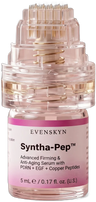
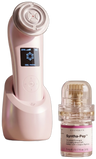
The EvenSkyn MicroInfuser pairs a sterile needle head with a sealed single-use ampoule of Syntha-Pep, our PDRN serum. The head attaches to the ampoule, the serum is applied as you stamp, and each session uses one fresh head and one fresh ampoule.
Needles. 24 karat gold-plated, fixed at 0.5 mm nominal length, single use and individually gamma-sterilised. Needle length is not delivery depth, and we quote no depth.
Serum. Four sealed 5 mL Syntha-Pep ampoules, one per session, cleanroom-filled under Good Manufacturing Practice.
PDRN. Biosynthetic and not derived from salmon, per the supplier’s written declaration, at 0.2 percent (2,000 ppm). The raw material averages about 31 kilodaltons, per the supplier’s data: below the range reported for pharmaceutical PDRN, and still about 60 times the 500 dalton threshold.
Alongside the PDRN. sh-Oligopeptide-1, the lab-made form of human EGF, copper tripeptide-1 (GHK-Cu), hyaluronic acid, niacinamide, ergothioneine and Centella asiatica extract. The full ingredient list is published.
Status. A cosmetic device for the look of skin, not a medical device and not FDA-cleared. We do not claim the results reported for injected PDRN.
Where it does not score cleanly. On the first point, fragrance and essential oils, Syntha-Pep does not pass: its list includes Citrus Aurantium Amara (bitter orange) flower oil. Our formulators say it forms the oil core of the serum’s microemulsion and masks the natural smell of the peptides, but by a strict reading it still counts. Read the full list before a first session if you have known allergies.
PDRN types, side by side
PDRN type
Where the DNA comes from
Concentration disclosed?
Pack and route
Salmon-derived
Salmon or trout sperm DNA
Sometimes; one of the three salmon serums in our checker states a figure
Multi-use bottles for leave-on use, on all three
Fermentation-derived
DNA from microorganisms such as Lactobacillus
Not verified: we read a raw ingredient listing, not a finished serum
Not verified, for the same reason
Plant “PDRN-like”, often sold as vegan PDRN
Plant DNA fragments, for example from rose, ginseng or green tea
No figure for the one plant-derived serum in our checker
Multi-use bottle
EvenSkyn Syntha-Pep (ours)
Biosynthetic, not from salmon, per supplier declaration
Yes, 2,000 ppm
Sealed single-use 5 mL ampoule with a sterile single-use head; sold only with the MicroInfuser
Rows are types, not brand rankings. Checker listings read on 10 August 2026. We make the serum in the last row, and we make no vegan claim for it.
Why this article exists
People come to PDRN from two directions: readers of Korean skincare choosing a serum to add to a routine, and readers who have heard about PDRN injections and want something they can do at home. Both are using the same molecule, and both are rarely told the most useful fact about it: at home, the delivery route matters more than the brand, the concentration or the price.
This guide starts with the serum, because that is where most people begin, and ends with micro-infusion, the home route built to take serum past the surface. The clinical PDRN results come from injections and clinic procedures, not home kits, and we say so wherever it matters.
Our position, stated plainly: we make the MicroInfuser and Syntha-Pep, and we have no financial relationship with any other brand named here.
Part 1: Why PDRN’s delivery method decides everything
PDRN is a mixture of DNA fragments. In the review most often cited on it, the fragments run from 50 to 1,500 kilodaltons, most of them between 80 and 200, with a peak at 132.2 A newer proposal keeps the name PDRN for chains under 1,500 kilodaltons and calls longer chains polynucleotides, or PN.6
Set that against the 500 dalton rule: a compound generally has to weigh under 500 daltons to be absorbed through intact skin.3 At 50 kilodaltons, the smallest PDRN fragment is 100 times that threshold; at 1,500 kilodaltons, the largest is 3,000 times. That is our arithmetic, and it is not close.
Fig. 1 | PDRN is 100 to 3,000 times too large to cross intact skin. The gold band marks the range under the 500 dalton threshold for skin absorption;3 the purple bar marks the published PDRN range of 50 to 1,500 kilodaltons, with the dark segment showing where most fragments fall.2 Log scale, drawn by us from the cited papers; the ratios are our arithmetic.
In lab and animal work, PDRN acts through adenosine A2A receptors and supplies building blocks to the salvage pathway that cells use to recycle nucleotides.2 Those receptors sit in living tissue below the barrier. A serum on intact skin does not get PDRN there in useful amounts, which is why a 2026 review judged topicals likely to be less effective than injections.1
Micro-channels are the home route around that barrier. Needles open temporary channels that let much larger molecules through, but the channels are short-lived: reported closure ranges from a few hours to 72 hours, and in one measured patch the pores were about a quarter closed within 30 minutes and essentially closed by 6 hours.4 No study we found measured how much PDRN a 0.5 mm home stamp delivers, ours included.
So the practical answer has two parts. For comfort, hydration and the look of calmer skin, a daily serum earns its place. For serum taken past the surface, a sealed micro-infusion kit every two weeks. Neither is a home version of a clinic injection.
What makes a PDRN serum work, and what it cannot do
Judged honestly, a PDRN serum is decided by four things: how large the fragments are, where the PDRN came from, what else is in the bottle, and whether the brand is straight about how far a topical can reach.
1. Fragment size, which is the whole delivery problem
Every PDRN fragment is far over the 500 dalton line, as Part 1 sets out. A serum applied by hand is working on the surface, whatever its label implies, and a higher concentration does not change the size of the molecule.
2. Sourcing, and whether the brand will say
Most PDRN on the market is extracted from salmon or trout, which is where the popular name for the treatment comes from, and most of the published research used that material. PDRN can also be made biosynthetically, without fish. A non-fish source is not the better-evidenced option; what it offers is a known origin. The supplier’s written declarations record the PDRN in Syntha-Pep as biosynthetic and not derived from salmon, and its soluble collagen as made by yeast fermentation. Those declarations cover those two ingredients only, the finished formula has not been allergen-tested, and we make no vegan claim. Both source letters are reproduced in the terms they use.
3. The rest of the formula, which is doing more than you think
Almost every PDRN serum ships with a supporting cast: niacinamide, hyaluronic acid, a barrier complex, sometimes peptides. Several of those are small enough to work on intact skin, so a good deal of what people credit to the PDRN in a daily serum may come from them. That is a reason to read the whole list, not a criticism.
4. Honesty about the ceiling
Used on intact skin, a PDRN serum supports comfort, hydration and the look of calmer, less reactive skin. The regenerative effects in the PDRN literature come from injected or clinic use, where the molecule reaches living tissue.1,2 A serum that promises structural change from surface use alone is describing a result its own route cannot produce.
Part 2: Level 1, topical PDRN serums (the entry level done right)
This is where most people start. Done well, a topical PDRN serum earns its place for comfort and hydration. It will not do what injections do.
Choosing a topical PDRN serum
1. The ingredient name. PDRN appears on labels as Sodium DNA or Polydeoxyribonucleotide. A vague “DNA complex” with no source is a reason to ask questions.
2. Concentration. Few brands publish one, and on intact skin a bigger number buys little, because the molecule stays the same size.
3. Source. Salmon-derived PDRN has the largest research base. Plant “PDRN-like” ingredients, often sold as vegan PDRN, have far less published evidence.
4. The supporting cast. Niacinamide, hyaluronic acid, panthenol and ceramides sit well beside PDRN. On sensitive skin, avoid strong acids, retinoids and fragrance in the same bottle.
5. Texture. Watery, essence-style serums layer more easily; richer creams can pill under sunscreen.
6. Packaging. An airless pump limits air and light exposure, a sensible choice for any active.
Brands worth knowing in the topical PDRN space
Rather than a list of names, use our PDRN label index of 44 serums and creams. It gives each one’s PDRN source, stated strength, US price and label score, read from each brand’s own store, Ulta, Sephora or Amazon on 9 November 2026. Formula beats reputation: read the ingredient list first, then decide.
How to apply topical PDRN serum (the right way)
Step 1. Cleanse with a gentle cleanser and pat dry, leaving skin slightly damp.
Step 2. A hydrating toner if you use one.
Step 3. Press 2 to 3 drops of PDRN serum into the skin with your palms. Do not rub or drag.
Step 4. Layer niacinamide, hyaluronic acid or a peptide serum if you use them.
Step 5. Moisturiser, lighter in the morning and richer at night.
Step 6, mornings. Sunscreen, SPF 30 or higher.
Cadence for topical PDRN
Our suggestion, not a tested protocol: evenings only for the first two weeks, then every evening, then morning and evening if your skin stays calm. Sensitive skin can stay at evenings only.
What to expect from topical-only PDRN
No study we found followed a topical PDRN serum week by week. What a serum on intact skin can reasonably offer is comfort and hydration. Judge it over 8 to 12 weeks with photos taken in the same light, and if it has plateaued, the honest next step is a different route, not a stronger bottle.
Part 3: Level 2, topical PDRN with derma rolling (and why we skip it)
Some guides suggest a derma roller with a PDRN serum. We do not. The FDA says a roller with short, blunt needles that only claims to help remove dead skin is generally not a medical device,5 and the American Academy of Dermatology says products sold for at-home microneedling are not meant to puncture the skin. When they do, it warns of infection, scarring and the spread of warts, herpes and other viruses across the skin.7
Why derma rollers are not the right tool
The needles are reused. You clean them yourself between sessions, so sterility depends on you every time.
Depth depends on pressure. How far the needles go changes with how hard you press, so every pass is different.
The serum comes from a bottle. A roller is usually paired with a multi-use serum, which fails the fifth point of the screening test.
Our recommendation is to stay at Level 1 or move to Level 3. If you already own a roller, do not share it and do not use it with a bottled serum.
Part 4: Level 3, at-home micro-infusion (the route built for channels)
Micro-infusion is what serum users try when they want serum taken past the surface rather than left on it. It is not a home version of a PDRN injection, and no kit should be sold as one.
A regulatory note worth reading first. The FDA has cleared certain microneedling devices for specific uses, in people aged 22 and older. It has not cleared any microneedling device for use with another product, and it has not reviewed the safety or effectiveness of combining the two.5 Our MicroInfuser is a cosmetic device for the look of skin, and its claims stay at appearance.
The mechanism, briefly
A micro-infusion stamp has sterile, single-use needles, often around 0.5 mm in nominal length. Pressed onto skin, they open temporary channels through the outer barrier while serum is applied through and around them. The channels begin closing quickly and are largely closed within hours.4 That short window is why the serum must be sealed and the head sterile.
How to evaluate an at-home micro-infusion kit
Six checks, in priority order. They are the ones our own kit was built to answer, so hold us to them as strictly as anyone.
1. Sterile single-use heads. Non-negotiable. A reused head is the largest infection risk in home micro-infusion.
2. A published needle length. Brands that do not publish one are asking you to buy on trust.
3. A published PDRN concentration. Few brands give one, and there is no agreed benchmark, so a disclosed figure beats a claimed range. Ours is 2,000 ppm.
4. Sealed single-use serum. A multi-use bottle is open to contamination from the first use.
5. Needle material. Gold-plated stainless steel is the common choice.
6. Transparency. Who makes the serum, to what standard, and is the full ingredient list published?
The leading at-home PDRN micro-infusion kits compared
Two systems ship a PDRN serum with a 0.5 mm stamp rather than leaving you to source a serum: AMIRO’s PDRN Micro-Infusion System and our MicroInfuser. When we read AMIRO’s page on 22 September 2026, it listed 0.5 mm needles with 24K gold-plated, single-use, sterile tips and one set of freeze-dried microspheres and solution per session; it did not say whether the depth is fixed or state the serum volume. We compare the two ingredient list against ingredient list in our AMIRO vs EvenSkyn PDRN comparison, and the wider field on our best micro-infusion system page. We make one of the kits in both, and both say so. For any other kit, run the six checks above.
The exact at-home PDRN micro-infusion protocol
This is the protocol on our kit’s product page. Other kits have their own instructions; follow yours.
48 hours before. Pause retinoids, AHAs, BHAs and physical exfoliants, and stay out of direct sun. Before a first kit, patch test on a small, less visible area 24 hours ahead.
The session, in the evening. Attach a fresh head to a sealed ampoule and rest it head-down for one to two minutes. Stamp the seven zones in the manual: tap and lift, never drag. Never stamp the eyelids, the under-eye hollow or anything inside the orbital bone, the soft tissue of the lips, active breakouts, sunburned or inflamed skin, or raised scars, moles or skin tags. Discard the head and the empty ampoule together.
The first 24 hours. No face washing that evening and no makeup. No sweating, pools, saunas or hot showers.
24 to 72 hours. SPF 30 or higher every morning, with actives still paused.
Other devices. Use radiofrequency, EMS or microcurrent before a session, not after. After a session, wait at least 24 hours before any of them, ideally 48. Red and near-infrared LED can resume after 24 hours.
Cadence for at-home micro-infusion
Once every two weeks, never more often than once every ten days. A kit of four sessions lasts two months. Spacing gives the skin time to settle before the next session, which is the opposite of a serum’s daily rhythm.
What to expect from at-home micro-infusion
No study we found gives a timeline for home PDRN kits, ours included. Give it at least two months of sessions every two weeks, compare photos taken in the same light, and expect any change in the look of texture and tone to be gradual. Any benefit depends on continuing.
Part 5: The integrated routine, combining topical PDRN with micro-infusion
You do not have to choose. A serum on intact skin between sessions and a sealed kit every two weeks stack well when they are spaced correctly. Pick your session day and the planner lays out the fortnight.
Plan your two-week PDRN cycle
Choose the evening you will do your session. The plan follows our kit’s product page; other kits have their own instructions. Nothing is stored or sent anywhere.
Friday evening. Pause retinoids, AHAs, BHAs and physical exfoliants, and stay out of direct sun. Patch test now if this is your first kit.
Sunday evening. Your session. Fresh head on a sealed ampoule, tap and lift, never drag. No face washing that evening and no makeup.
Monday. No sweating, pools, saunas or hot showers until the 24 hours are up. SPF 30 or higher in the morning. Red and near-infrared LED can resume after 24 hours.
Tuesday and Wednesday. SPF 30 or higher every morning, with actives still paused. Radiofrequency, EMS or microcurrent: at least 24 hours after the session, ideally 48.
Thursday. Actives can return, retinoids and acids included, if your skin is calm.
Two weeks on, Sunday. Your next session. Never sooner than ten days after the last one.
Daily routine on non-treatment days
Morning. Gentle cleanser, a hydrating toner if you use one, PDRN serum pressed into damp skin, niacinamide or hyaluronic acid if you use them, moisturiser, then SPF 30 or higher.
Evening. Cleanser, PDRN serum, a retinoid if you use one, then moisturiser.
Micro-infusion treatment day routine
Morning. Cleanser, moisturiser and SPF only, with no active serums.
Evening. Cleanse, pat completely dry, then the session as set out in Part 4. Afterwards, nothing on the face that evening, and no face washing.
Day after micro-infusion routine
A gentle routine: moisturiser and SPF 30 or higher in the morning, no retinoid, acids or other actives, and no PDRN serum layered on top yet.
When to resume normal routine
After 72 hours, from the fourth day, your full routine can return, retinoids and acids included, if your skin is calm.
Why this combination works
The serum supports comfort and hydration at the surface every day; the kit takes a sealed serum past the barrier every two weeks. Either is fine on its own, and neither is a clinic treatment.
Stacking PDRN micro-infusion with other at-home devices
Radiofrequency, EMS and microcurrent go before a session, never after; after a session, wait at least 24 hours, ideally 48. The kit’s manual, as set out on our duo’s product page, puts ultrasound in the same group. Red and near-infrared LED can resume 24 hours after a session. Our guide to running RF and micro-infusion together sets out the spacing in detail. Each device is a separate routine with its own evidence; none replaces the others.
Part 6: PDRN, EGF and copper peptides together, and what goes through the needles
Correction, 5 November 2026: an earlier version of this part suggested rotating separate PDRN, EGF and copper peptide serums through a micro-infusion device. We withdrew that advice. Only a serum made for open channels, sealed and opened fresh for one session, should go through a device.
Session days, every two weeks. One sealed, single-use serum made for micro-infusion. Syntha-Pep already lists biosynthetic PDRN, sh-Oligopeptide-1 (EGF) and copper tripeptide-1 together, so there is nothing to rotate.
Around a session. Actives paused for 48 hours before and 72 hours after.
Between sessions. A PDRN, EGF or copper peptide serum on intact skin is fine. Keep vitamin C and copper peptides in separate routine slots.
Part 7: Topical vs micro-infused vs injected PDRN, side by side
Route
Where it acts
What to expect
Best for
Topical serum
The surface of intact skin
Comfort and hydration; topicals may be less effective than injections1
Daily care, sensitive skin, a first step
Home micro-infusion
Through short-lived channels in the outer layers; how much PDRN arrives is not measured
Gradual change in the look of texture and tone, varying by person; no published timeline for home kits
A home routine every two weeks, with sealed single-use serum
Clinic injection
Injected into the skin by a clinician
The route behind most of the published PDRN results1,2
Scarring and changes beyond what a home routine can address
In the United States, ask any provider offering PDRN or polynucleotide injections for the exact product name and its regulatory status before you book.
How to choose
For most people the practical routine is a serum on intact skin plus, if you want serum taken past the surface, a sealed kit every two weeks. If your concern is scarring or a change a home routine cannot reach, see a clinician.
Our recommendation follows from the evidence above, and yes, it points at our own kit. The logic is laid out so you can disagree with it.
Comfort and hydration: a daily PDRN serum on intact skin. You do not need a device.
Serum past the surface: a sealed, single-use kit every two weeks. Ours is the MicroInfuser with Syntha-Pep.
Scarring or deep change: a clinician, not a home kit.
Our pick for PDRN past the surface, and yes, we make it
EvenSkyn MicroInfuser with Syntha-Pep PDRN serum
Four sealed sessions, one every two weeks.
How it deliversA sterile 0.5 mm head fixed on a sealed 5 mL ampoule, applied as you stamp. Needle length is not delivery depth, and we quote no depth.
What it carriesBiosynthetic PDRN at 0.2 percent with EGF, copper tripeptide-1, hyaluronic acid and niacinamide. The full ingredient list is published.
How to use itOne evening session every two weeks, actives paused 48 hours before and 72 hours after, SPF 30 or higher.
StatusA cosmetic device for the look of skin, not a medical device and not FDA-cleared.
$179.98
Four treatments, two months at one session every two weeks. 60-day money-back guarantee on unused treatments.
What it will not do: deliver the results reported for injected PDRN, treat scars or any skin condition, or work on the eyelids or lips. It contains an essential oil, so read the full list if you have known allergies.
Part 8: Safety, contraindications, and the fish allergy question
Pharmaceutical PDRN has a long record: the review most cited on it describes a purification that gives a more than 95 percent pure substance with inactivated proteins and peptides, and post-marketing data on more than 300,000 dispensed prescriptions that confirmed its safety profile.2 That record is for the drug, used by clinicians. Do not assume it carries over to cosmetic serums or home use.
Expected side effects
Some redness and sensitivity after a session are expected; follow the aftercare in Part 4. Stop and get advice if redness lasts beyond a day, or comes with swelling, pain, pus or blisters. A topical serum on intact skin should not sting; if it does, stop using it.
Less common reactions
Bumps, irritation or an allergic reaction to an ingredient. For Fitzpatrick IV to VI skin, post-inflammatory hyperpigmentation is the main concern: watch for early pigment change and wear SPF every day.
The fish allergy question
Can someone with a fish or shellfish allergy use Syntha-Pep? We cannot answer that with a yes. The supplier’s declarations cover the PDRN and the collagen only, and the finished formula has not been allergen-tested. A patch test can show irritation but cannot rule out a serious allergic reaction, so speak to your allergist or doctor first. The same caution applies to any salmon-derived PDRN serum.
Real contraindications (skip PDRN micro-infusion if any apply)
Oral isotretinoin now or in the past six months; a personal or family history of keloid or hypertrophic scarring; an active infection or cold sore in the area; open, inflamed or sunburned skin, or active cystic or inflammatory acne; an active flare of eczema, psoriasis or dermatitis; a peel or laser treatment in the past seven days; or a known allergy to gold, stainless steel or any serum ingredient. Pregnancy and breastfeeding, blood thinners, immunosuppressants, uncontrolled diabetes and an autoimmune flare call for a doctor’s go-ahead first.
Frequently asked questions
How do you use PDRN serum at home?
Press 2 to 3 drops into clean, slightly damp skin once or twice a day, then moisturiser and, in the morning, SPF 30 or higher. On intact skin it works at the surface, for comfort and hydration.
When should you apply PDRN serum, morning or night?
Either, after cleansing and before moisturiser. If you are new to it, start in the evening and add mornings once your skin is used to it.
Can you use a PDRN serum for microneedling?
Only one made for open channels: sealed, single-use, and free of fragrance, retinoids and low-pH acids. Most PDRN serums are made for intact skin and come in multi-use bottles, so they should stay on intact skin.
What is a sterile PDRN serum, and do I need one?
For anything that goes through needles, you want a sealed single-use ampoule paired with a sterile single-use head, opened fresh for one session. A dropper bottle you open every day is not sealed, whatever its label says.
How often should I do PDRN micro-infusion at home?
Once every two weeks, in the evening, and never more often than once every ten days. A kit of four sessions lasts two months.
Should I use a topical PDRN serum or a micro-infusion kit?
A serum is the place to start, for comfort and hydration. A kit every two weeks adds serum taken past the surface. Many people use both, and neither replaces a clinic treatment.
Can I use PDRN with my retinoid?
A PDRN serum on intact skin sits fine in a routine with a retinoid, for example serum in the morning and retinoid at night. Around a micro-infusion session, pause retinoids for 48 hours before and 72 hours after.
Can I use a derma roller with PDRN serum?
We do not recommend it. Rollers are reused and cleaned at home, their depth depends on pressure, and they are usually paired with a bottled serum. A sealed kit with sterile single-use heads is the safer route.
Can I use PDRN if I have a fish allergy?
Speak to your allergist or doctor first. For our serum, the supplier’s declarations cover the PDRN and the collagen only, and the finished formula has not been allergen-tested, so we cannot answer with a yes.
What is the difference between PDRN and PN?
Both are DNA fragments. A recent proposal keeps the name PDRN for chains under 1,500 kilodaltons and uses polynucleotides, or PN, for longer chains.
Is PDRN micro-infusion safe for darker skin tones?
It can be used with care. Post-inflammatory hyperpigmentation is the main concern for Fitzpatrick IV to VI skin, so patch test, use light pressure, watch for early pigment change and wear SPF every day.
How long until I see results, and how long do they last?
No study gives a timeline for home PDRN kits. Give it at least two months of sessions every two weeks and compare photos in the same light. Any benefit depends on continuing.
Can I use PDRN micro-infusion on my neck or body?
Follow your kit’s manual for the areas it covers, keep the same two-week cadence, and leave scars, surgical ones included, to a clinician.
Can I put another serum in a micro-infusion device?
Not a bottled one. Only a serum made for open channels, sealed and opened fresh for one session, should go through a device.
The bottom line
At home, PDRN is a delivery problem. Start with a serum on intact skin for comfort and hydration. When you want serum taken past the surface, use a sealed, single-use kit every two weeks, with actives paused 48 hours before and 72 hours after. See a clinician for anything a home routine cannot reach.
Judge any routine slowly, with photos in the same light, and keep expectations at the look of skin, not the results of injections.
How we put this guide together
On 15 November 2026 we rechecked every study cited here against its publisher or Crossref record, read the FDA and AAD pages directly, and took our own kit’s protocol, contents and contraindications from its product page and our safety page that day. The figure is drawn by us from the cited papers, and the photograph is an illustration, not product photography. This version replaces an earlier one at the same address.
Conflicts: we make the MicroInfuser and Syntha-Pep, recommended in this guide. No clinician reviewed this version. Brand names identify products only; no affiliation is implied. General information, not medical advice: if you have a skin condition, are pregnant or take medication that affects healing, speak to a doctor before using PDRN with any device.
Further reading from the EvenSkyn Skin Science Desk
Arora G. Polynucleotides and polydeoxyribonucleotides in dermatology: a narrative review. Journal of Cutaneous and Aesthetic Surgery. 2026;19(1):17-28. doi:10.25259/JCAS_65_2025
Squadrito F, Bitto A, Irrera N, Pizzino G, Pallio G, Minutoli L, Altavilla D. Pharmacological activity and clinical use of PDRN. Frontiers in Pharmacology. 2017;8:224. doi:10.3389/fphar.2017.00224
Bos JD, Meinardi MMHM. The 500 Dalton rule for the skin penetration of chemical compounds and drugs. Experimental Dermatology. 2000;9(3):165-169. doi:10.1034/j.1600-0625.2000.009003165.x
US Food and Drug Administration. Microneedling devices: getting to the point on benefits, risks and safety. Consumer update, content current as of 15 October 2025. fda.gov
Marques C, Porcello A, Cerrano M, Hadjab F, Chemali M, et al. From polydeoxyribonucleotides (PDRNs) to polynucleotides (PNs): bridging the gap between scientific definitions, molecular insights, and clinical applications of multifunctional biomolecules. Biomolecules. 2025;15(1):148. doi:10.3390/biom15010148
American Academy of Dermatology Association. Microneedling can fade scars, uneven skin tone, and more. aad.org
Nine brands, one shared depth ceiling, and a set of differences that sit in the hygiene design rather than the marketing. We compare Seranova, Qure, Glov and the EvenSkyn MicroInfuser on single-use...
No radiofrequency microneedling device is meant for home use, and the FDA says so in writing. What you can do at home instead, twelve products ranked on what each one publishes, and...
Every microneedling aftercare guide tells you what to put on after. This one answers that in full, then reframes the question: the result your skin keeps depends less on the cream you...




コメントを書く
全てのコメントは、掲載前にモデレートされます
このサイトはhCaptchaによって保護されており、hCaptchaプライバシーポリシーおよび利用規約が適用されます。