Skin Boosters at Home: The Honest 2026 Guide to Bioremodelling, Profhilo Alternatives, and At-Home Micro-Infusion
What injectable skin boosters are, where Profhilo and SkinVive stand in the U.S., why delivery decides what any at-home routine can do, and an honest look at our MicroInfuser.
Published
24 min read
Published by EVENSKYN, which makes and sells at-home beauty devices.
An evidence guide, 26 sources checked, updated 15 November 2026
Can you get a skin booster at home? Not the injection. Here is what clinic boosters actually do, where Profhilo and SkinVive stand in the U.S., and what an at-home micro-infusion routine can and cannot copy.
EvenSkyn Skin Science Desk. We make the MicroInfuser and the Syntha-Pep serum discussed near the end; the clinic treatments named here are made by other companies. No clinician reviewed this version.
Illustrative still life.
The short answer
What a booster is: a clinic injection aimed at skin quality, smoothness and hydration, rather than volume.1
Profhilo at home: there is no such thing, and Profhilo is not on the U.S. market. Its U.S. licensee forecasts a launch in 2030.2
What home can do: micro-infusion stamps a serum through short needles. In lab work, skin pretreated with microneedles let through far more copper peptide than intact skin; no trial has tested a home kit against a clinic booster.3
How to choose: judge any kit on delivery, honest depth, safety, cost and what it admits it cannot do. The seven-question checker below takes a minute.
Executive summary
Key takeaways
01“Skin booster” is a category, not one product: hyaluronic acid injections such as SkinVive and Profhilo, and polynucleotide injections built on PDRN, all placed by a clinician.1,2,4
02In the U.S., SkinVive by Juvéderm has been available since 2023 to smooth cheek skin. Profhilo is not: Evolus, which licensed it from IBSA in 2026, anticipates U.S. commercialization in 2030.1,2
03The molecules have real biology. Hyaluronic acid holds water in skin, GHK-Cu raised collagen output in fibroblast cultures, and PDRN engages a receptor tied to tissue repair.4,5,6
04Delivery is the catch. In a lab test, almost no copper peptide crossed intact human skin in nine hours, while skin pretreated with microneedles let it through.3
05That is the honest case for micro-infusion, and its limit: better delivery than intact skin allows in lab work, but the channels are smaller than the needles, close within hours to days, and no home kit has a published trial.3,7,8
06Want the measured result of an injection? See a clinician. Want an affordable routine with the same active families? A home kit is reasonable, judged on the seven questions below.
What a skin booster actually is
A booster is not a filler. A filler adds volume to lift a cheek or plump a lip. A booster is placed into the skin to change its quality: smoothness, hydration and that look of skin that holds water well. The maker of SkinVive, a hyaluronic acid booster, describes it as improving skin quality in the cheeks by smoothing the skin and increasing hydration, unlike injectables that add to the area treated.1
Many boosters are built on hyaluronic acid. A 2012 review called it “the key molecule involved in skin moisture”, with a unique capacity to hold water.5 Collagen output falls with age too: in one study, skin cells from people over 80 made less type I procollagen than cells from people aged 18 to 29.9 Drier, thinner, less springy skin over time is the plain biology behind the whole category.
Approach
Examples
Built on
The idea
Hyaluronic acid skin-quality injection
SkinVive in the U.S.; Profhilo in Europe and other markets
A serum with PDRN, an EGF peptide, GHK-Cu and hyaluronic acid
Short needles open temporary channels so the serum passes the surface; a cosmetic routine, not an injection10
Brand names belong to their owners and appear for identification only. The table compares categories, not results.
The last row is the one that matters here. Everything above it happens in a clinic, with a needle held by a trained person. The last row happens at home, through needles with a fixed nominal length of 0.5 mm, and the maker of the kit, which is us, quotes no delivery depth.10
Why boosters exploded, and why the ingredients moved home
Analysts follow the category closely. Grand View Research projects the skin booster market to grow by about 13 percent a year, and it now tracks PDRN, polycaprolactone and exosome boosters alongside hyaluronic acid.11 Treat the growth figure as an analyst’s projection, not a measurement.
The big companies are moving too. In 2026 Evolus took exclusive U.S. rights to Profhilo, which it calls the market-leading skin quality injectable in Europe, and it anticipates U.S. commercialization in 2030.2
Meanwhile the same active families moved onto the shelf. PDRN, copper peptide and growth factor serums are all sold for home use, and our own Syntha-Pep serum contains all three.10 We also compared nine copper peptide serums by what each label says. Which raises the obvious question: if the molecule is in a bottle you can buy, why pay a clinic? The answer is not marketing. It is skin.
The delivery problem: the fact that decides everything
The skin’s outer layer, the stratum corneum, keeps water in and most things out. A widely cited rule of thumb holds that a molecule needs to be under about 500 daltons to cross intact skin well, and many skincare actives are far larger (Fig. 1).12
Fig. 1 | Niacinamide and GHK fall under the 500 dalton line; every other molecule shown is larger, most of them far larger. Molecular weight in daltons, on a log scale. The dashed line marks the 500 dalton rule for crossing intact skin.12 Niacinamide, GHK and acetyl hexapeptide-8 are our arithmetic from their formulas; GHK is shown without its copper, and with it is about 400 by the same arithmetic. EGF is the specification of the recombinant human protein.13 PDRN in our serum is the raw-material average, not a measurement of the finished serum.14 The published PDRN range is from a 2017 review,4 and the hyaluronic acid range spans the five sizes tested in one trial.15
Size is not the only problem. GHK-Cu is small, but it is water-loving. In a 2015 laboratory study, almost no copper peptide or copper crossed intact human skin in nine hours, while 134 nanomoles of the peptide crossed skin pretreated with a microneedle array.3 Not every lab model agrees: a 2011 study measured copper, rather than the intact peptide, crossing split-thickness human skin over 48 hours from a solution kept on the skin throughout.16
Growth factors tell a similar story in people. In a randomized split-face study of 20 volunteers aged 33 to 54, a cream carrying EGF in dissolving micro-spicules raised ultrasound-measured dermal depth and density significantly more than a cream with EGF alone, at 4 and 8 weeks.17
Microchannels have limits of their own. Imaging in volunteers found the channels markedly smaller than the needles that made them, and collapsing once the needles came out;7 a 2023 review gives closure times from hours to about 72 hours.8 That is why a needle length is not a delivery depth.10
Our inference, not a tested method
Skin holds less water and makes less collagen with age, and the actives used in boosters have real biology.4,5,6,9
Many of those actives cross intact skin poorly as a cream.3,12
Microchannels let more through in the lab, and micro-spicules beat a plain cream in one small split-face trial.3,17
Inference: micro-infusion is a rational way to use these actives at home. It should deliver more than the same serum used as a cream, and far less than an injection.
Untested hypothesis: a fortnightly home micro-infusion routine improves the look of skin quality more at 12 weeks than the same serum used as a cream.
What would prove it wrong: a randomized split-face trial of a home kit against the same serum without needles, finding no difference. We found no such trial of any home kit. Our own study of our kit is unpublished, so we do not quote it.10
Meet the actives, and what each one is really for
The regenerative boosters and the better home serums draw on the same short list. Here is what each one does, and how strong the evidence is for using it on the skin.
Hyaluronic acid: the water molecule
The skin’s own humectant.5 On the surface it draws water in, so the look of hydration shows quickly; our own product page is plain that hydration within a day or two does not last.10 Injected as a gel, as SkinVive is, it works inside the skin instead.1 Size varies enormously: the five forms tested in one trial ran from 50,000 to 2 million daltons (Fig. 1).15
PDRN and polynucleotides: the repair signal
PDRN is a mixture of DNA fragments. A 2017 review describes its main action as engaging adenosine A2A receptors, a pathway tied to tissue repair, and puts its fragments at 50 to 1,500 kilodaltons; the PDRN it reviews comes from trout or salmon sperm.4 One of its authors has received research support from a PDRN drug maker. Most results come from injection, and a 2026 review judged that topical forms “may have limited penetration” and are less effective than injections.18
Two honest notes on ours. Syntha-Pep’s PDRN is biosynthetic and not derived from salmon, per our supplier’s written declaration;10 most published research used fish PDRN, so treat biosynthetic PDRN as a sourcing choice, not a proven equal. And its raw material averages about 31,000 daltons, below the range that review gives for PDRN; we publish the figure so you can weigh it.4,14 Our guide to the salmon sperm facial covers clinic PDRN in more depth.
Copper peptide GHK-Cu: the scaffolding support
A 2018 review lists GHK raising collagen, elastin and glycosaminoglycan synthesis and supporting dermal fibroblasts, the cells that build the skin’s scaffolding.19 A 1988 paper had already shown the copper complex stimulating collagen synthesis in fibroblast cultures at very low concentrations.6 That is lab biology; its persistent problem is getting into skin from a topical, as above.3 Our guide to GHK-Cu copper peptides covers the long research trail.
Epidermal growth factor: the messenger, with an asterisk
On ingredient lists, the lab-made form of human EGF appears as sh-Oligopeptide-1.10 It is a protein of about 6,222 daltons, far above the 500 dalton line.13 A 2023 systematic review of topical growth factors found 33 studies, 9 randomized and 24 uncontrolled case series, with modest improvements in texture and fine lines by investigators’ assessment.20 One small home study paired a 0.2 mm microneedle device with a growth factor serum in 11 women for three months, without a control group.21 Our guide to PDRN, EGF and GHK-Cu in micro-infusion goes further.
Active
What the evidence shows
Grade
The catch
Hyaluronic acid
Holds water in skin, from a review of its biology5
Reviews
Surface hydration is quick and temporary
PDRN
Repair signalling through A2A receptors, mostly from injected use4,18
Early
Topical forms likely weaker than injections
GHK-Cu
Raised collagen in fibroblast cultures; broad lab actions6,19
How we grade: Reviews means our statement rests on review articles about the molecule’s biology; Early means small or mostly uncontrolled human studies; Mechanistic means cell or laboratory work only.
How to judge any at-home skin booster
If you are weighing a home kit, or a kit against a clinic, these are the questions that separate something useful from a gadget. Answer them for any product, ours included.
Seven questions for any at-home booster
Answer for the product you are weighing. “Not stated” is a question to put to the maker before you buy.
Answer the seven questions to see how a product measures up.
Red flags when shopping for an at-home booster
“Clinic results at home” or “as good as an injectable.” No home device reaches what a clinician’s needle does.
A hero active with no way past the surface. A PDRN or peptide serum on its own is mostly a moisturizer at an active’s price.
Before-and-after photos with no method. Without the number of sessions, the time span and the lighting, they are decoration.
“Fragrance-free” when the list holds an essential oil. Ours lists bitter orange flower oil, so we say no added synthetic fragrance instead.22
No contraindications. A device that never says who should not use it is not being careful on your behalf.
Vague sourcing. “Advanced peptide complex” with nothing named and no levels stated tells you nothing.
At-home micro-infusion versus injectable boosters
This is the comparison most people want. It compares categories; it is not a claim that one replaces the other.
Injectable booster, in a clinic
At-home micro-infusion
Who does it
A trained clinician
You, at home
Where it goes
Injected into the skin
Through temporary channels from short needles; a needle length is not a delivery depth10
How often
SkinVive: results through six months with optimal treatment, per its maker1
Our kit: one session every two weeks, four sessions to a kit10
Status
SkinVive is authorized in the U.S. for cheek smoothness in adults over 211
A cosmetic device, not FDA-cleared; the FDA has cleared no microneedling device for use with a serum10,23
Best understood as
A medical aesthetic treatment
A cosmetic routine using the same active families
Read that table as a fork, not a ladder. If you want the specific, measured outcome an injection is designed for, the honest recommendation is a qualified clinician. If you want an affordable, repeatable routine with hyaluronic acid, PDRN, a growth factor and copper peptide, a home micro-infusion kit is a sensible way to run one. Different jobs.
Is there an at-home Profhilo? A straight answer
No. Profhilo is an injectable made by IBSA and placed by a clinician, and it is not on the U.S. market: Evolus, which took exclusive U.S. rights in 2026, anticipates U.S. commercialization in 2030, a company forecast rather than a regulatory decision.2 In the U.S., SkinVive by Juvéderm, a hyaluronic acid microdroplet injection, has been available since 2023 for smoothing cheek skin in adults over 21.1 Nothing you buy for home use is Profhilo, or equal to it.
The useful version: the closest home category is a micro-infusion routine that delivers hyaluronic acid and actives such as PDRN past the surface. It works in the same broad spirit, hydration and the look of smoother skin, with no clinic visit. It will not do what an injected gel is designed to do. Anyone telling you it will is selling, not informing.
What it costs, honestly
Clinics set their own prices, and a booster is priced per treatment and repeated: SkinVive’s maker describes results through six months with optimal treatment, so plan on return visits.1 Ask for an all-in quote, including any top-up sessions.
Our kit is priced per kit. At today’s list price, one kit is $179.98 for four sessions, about two months at one session every two weeks, so a session costs 45.00 USD. Six months, twelve sessions or three kits, comes to 539.94 USD before any offer.10
The point is not that cheaper is better. The two routes have different cost shapes: a clinic booster is paid per appointment, a home routine kit by kit, and only you can weigh what each is worth for your own skin.
Our pick, and how it scores on the same seven questions
Here is our own kit run through the checker above, with where each answer is stated. It is a seller’s assessment, not an independent test.
Question
Our answer
A way past the surface
Yes. A sterile head with 0.5 mm nominal needles clicks onto a sealed serum ampoule, and the serum goes on as you stamp.10
Named actives, lead level stated
Partly. PDRN at 2,000 ppm (0.2 percent) is stated; GHK-Cu and the EGF peptide are named without levels and sit near the end of the ingredient list.10,22
No clinic-depth claims
Yes. We say a needle length is not a delivery depth and quote no depth.10
Sterile, single use, contraindications
Yes. Gamma-sterilised single-use heads, and a published list of who should not use it.10,24
Yes. A cosmetic device, not a medical device, and not FDA-cleared.10
A published trial of the product
No. Our internal study is unpublished and we do not quote it.10
Our pick for an at-home routine, and yes, we make it
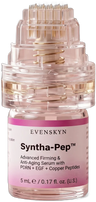
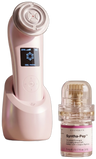
EvenSkyn MicroInfuser with Syntha-Pep PDRN serum
For an affordable, repeatable home routine using the same active families as clinic boosters, at a level that stays cosmetic.
How it worksA sterile head with 0.5 mm nominal needles, fixed at the head, clicks onto a sealed 5 mL single-use ampoule; the serum goes on as you stamp.
The serumBiosynthetic PDRN at 0.2 percent, sh-Oligopeptide-1, GHK-Cu, a four-form hyaluronic acid system, niacinamide, ergothioneine and Centella asiatica extract.
The routineOne session every two weeks in the evening, about 5 to 10 minutes; four sessions to a kit.
StatusA cosmetic device, not a medical device, and not FDA-cleared.
$179.98
Four complete treatments, about two months. 60-day money-back guarantee on unused treatments for US and Canada residents.
What it will not do: replace or equal Profhilo, SkinVive or any injection, reach where a clinician’s needle goes, change skin overnight, or treat any skin condition. Not for use in pregnancy or breastfeeding, with a history of keloid scarring, or within six months of oral isotretinoin.10
How to use micro-infusion at home, and who should not
Technique is most of the safety story. These steps follow our product and safety pages; always follow the instructions that come with your own device.
Start with clean, healthy skin, and pause retinoids, AHAs, BHAs and vitamin C for about 48 to 72 hours around a session.24
Use a fresh sterile head and a fresh sealed ampoule every session.10
Keep off the eyelids, the hollow under the eye and the lips.24
Afterwards, skip makeup, sweat, pools, saunas and hot showers that day and the next, and wear SPF 30 or higher every morning.24
Keep sessions two weeks apart, in the evening; ten days apart only after four to six sessions without irritation.10,24
Wait at least 48 hours before radiofrequency, and at least 24 hours before ultrasound, EMS, microcurrent or LED.24
Who should not use it, or should ask first
Do not use it during pregnancy or breastfeeding, with a personal or family history of keloid scarring, or within six months of oral isotretinoin.10
With a known fish or shellfish allergy, our duo page asks you not to use micro-infusion: the supplier letter covers the Soluble Collagen on the ingredient list but not the separate Collagen entry.22,25
If you take blood thinners, speak to a doctor first.10
Skip it after a peel, laser treatment or sunburn in the past seven days, and on skin that is broken, infected or inflamed.24
With rosacea, controlled eczema or psoriasis, melasma or a history of dark marks after inflammation, the safety page asks for an extended 24 to 48 hour patch test first.24
With known allergies, read the full ingredient list first. It includes bitter orange flower oil, an essential oil, and we hold no allergen testing on the finished formula.22,24
Stop and contact a healthcare provider if redness lasts more than 48 hours, swelling increases, or you see warmth, pus or fever.24
What to realistically expect, week by week
An honest timeline rather than a promise. Results vary, and none of this is a guaranteed outcome.
Fig. 2 | A two-week gap places the next session after the proliferative phase of the last. Phase timings are for skin wounds in general, and the phases overlap;26 channel closure comes from a review of microneedle studies, where the dark gold mark is one patch measured closed by about six hours and the light bar the reported range up to 72 hours.8 Session markers follow our kit’s instructions. Drawn by us; the alignment is our inference, not a measured result.
The first evening. A light pink flush for one to four hours is expected, and our safety page says most people see a hydrated look by the next morning.24 That is early hydration, not the result to judge.
The first weeks. Any change in the look of smoothness and evenness builds gradually, session by session. This is the window where a routine becomes a habit or gets abandoned.
Around 12 weeks. Judge here, with photos taken in the same light, not with daily mirror checks. Three months is also the average treatment length in the 2023 review of growth factor studies.20
Ongoing. Treat it as upkeep. The product page frames results as building over a course of consistent sessions, which is why the cost of continuing matters.10
Frequently asked questions
What is a skin booster?
An injection placed in the skin by a clinician to improve its quality, such as smoothness and hydration, rather than to add volume. Many are built on hyaluronic acid; newer ones use polynucleotides such as PDRN.
Can you get a skin booster at home?
Not the injection. At home, micro-infusion uses short needles to open temporary channels so a serum with similar active families passes the surface. It is a cosmetic routine, not an injectable treatment, and no home kit has been trialled against a clinic booster.
Is Profhilo available in the United States?
Not yet. Evolus, which took exclusive U.S. rights from IBSA in 2026, anticipates U.S. commercialization in 2030. That is the company’s forecast, not a regulatory decision. Profhilo is widely used in Europe.
What is a cheaper alternative to Profhilo?
In U.S. clinics, a hyaluronic acid booster on the market is SkinVive, used to smooth cheek skin. At home, the closest category is a micro-infusion routine with a hyaluronic acid and PDRN serum, priced per kit rather than per visit. Neither is Profhilo, and a home routine does not do what an injected gel does.
Do at-home skin boosters actually work?
They can help the look of skin, and delivery is the reason. In lab work, microneedle-treated skin let through far more copper peptide than intact skin, and in one small trial micro-spicules carrying EGF beat a plain EGF cream. That is not the depth or dose of an injection, and no home kit, ours included, has a published trial.
What is the difference between micro-infusion and microneedling?
Microneedling is mainly about the controlled micro-injury itself, which prompts the skin to repair. Micro-infusion pairs the channels with a serum delivered at the same time, so the goal is both the channel and what travels through it.
What are polynucleotides and PDRN?
Purified DNA fragments, conventionally from trout or salmon sperm. PDRN’s main action is described as engaging adenosine A2A receptors, a pathway tied to tissue repair. Most of the evidence is for injected PDRN, and a 2026 review judged topical forms less effective than injections.
Is biosynthetic PDRN the same as salmon PDRN?
Not proven to be. Most published PDRN research used PDRN extracted from fish. Biosynthetic PDRN, like ours, is made without fish, which some people prefer, but it should not be assumed to perform the same.
Does copper peptide GHK-Cu do anything?
In the lab, yes: it raised collagen output in fibroblast cultures, and a 2018 review lists increases in collagen, elastin and glycosaminoglycan synthesis. The problem is getting it into skin: in one lab study almost none crossed intact skin in nine hours, while microneedle-treated skin let it through.
How much do skin boosters cost?
Clinics price boosters per treatment and set their own prices, so ask for an all-in quote. Our kit is priced per kit: four sessions, about two months, so a session costs the kit price divided by four.
Is at-home micro-infusion safe?
It can be, used as directed: healthy skin only, a fresh sterile head each time, two weeks between sessions, and respect for the contraindications. It is not for pregnancy or breastfeeding, a history of keloid scarring, or the six months after oral isotretinoin, and people on blood thinners should speak to a doctor first.
How often should I do it?
Follow your device’s instructions. Ours is one session every two weeks in the evening, and every ten days only after four to six sessions without irritation.
Will it replace my skincare or my dermatologist?
No. Treat it as one delivery-focused step in a routine that still includes barrier care and daily sunscreen, and see a qualified professional for any medical or persistent skin concern.
The case against our own recommendation
No home kit, ours included, has a published trial against a clinic booster or against the same serum without needles. Our PDRN’s raw-material average sits below the published range for PDRN, and GHK-Cu and the EGF peptide sit near the end of our ingredient list.4,14,22 And we sell what we recommend.
What would change our view: a randomized split-face trial of a home kit against the same serum used without needles, measured at 12 weeks.
How we built this page. On 15 November 2026 we checked each study against its PubMed record or publisher page, and read our own product, ingredient, transparency, duo and safety pages, Evolus’s August 2026 results filing, AbbVie’s 2023 release on SkinVive and Grand View Research’s market outlook, reporting each only as far as we read it. This version replaces an earlier one at the same address. It updates Profhilo’s U.S. position, aligns the safety advice with our current product and safety pages (pregnancy and breastfeeding are now a firm no, and the fish or shellfish caution is back), removes our numeric self-score and two lines we could not confirm, drops four references we no longer rely on, and adds a checker, evidence grades and two figures.
Conflicts: we make the MicroInfuser and the Syntha-Pep serum named here. EvenSkyn is a Canadian company that makes at-home beauty devices. No clinician reviewed this version. General information, not medical advice: talk to a dermatologist about your own skin.
References
AbbVie (Allergan Aesthetics). Press release on SKINVIVE by JUVÉDERM, 15 May 2023: hyaluronic acid intradermal microdroplet injection to improve skin smoothness of the cheeks in adults over 21. Read 15 November 2026. news.abbvie.com
Evolus, Inc. Second quarter 2026 financial results, Form 8-K exhibit 99.1, 5 August 2026: exclusive U.S. licensing agreement with IBSA for Profhilo, anticipated U.S. commercialization in 2030. Read 15 November 2026. sec.gov
Li H, Low YSJ, Chong HP, Zin MT, Lee CY, Li B, Leolukman M, Kang L. Microneedle-mediated delivery of copper peptide through skin. Pharmaceutical Research. 2015;32(8):2678-2689. doi:10.1007/s11095-015-1652-z. PubMed 25690343. Abstract read.
Squadrito F, Bitto A, Irrera N, Pizzino G, Pallio G, Minutoli L, Altavilla D. Pharmacological activity and clinical use of PDRN. Frontiers in Pharmacology. 2017;8:224. doi:10.3389/fphar.2017.00224
Papakonstantinou E, Roth M, Karakiulakis G. Hyaluronic acid: a key molecule in skin aging. Dermato-Endocrinology. 2012;4(3):253-258. doi:10.4161/derm.21923. PubMed 23467280. Abstract read.
Maquart FX, Pickart L, Laurent M, Gillery P, Monboisse JC, Borel JP. Stimulation of collagen synthesis in fibroblast cultures by the tripeptide-copper complex glycyl-L-histidyl-L-lysine-Cu2+. FEBS Letters. 1988;238(2):343-346. doi:10.1016/0014-5793(88)80509-x. PubMed 3169264. Abstract read.
Coulman SA, Birchall JC, Alex A, Pearton M, Hofer B, O’Mahony C, Drexler W, Považay B. In vivo, in situ imaging of microneedle insertion into the skin of human volunteers using optical coherence tomography. Pharmaceutical Research. 2011;28(1):66-81. doi:10.1007/s11095-010-0167-x
Varani J, Dame MK, Rittie L, Fligiel SEG, Kang S, Fisher GJ, Voorhees JJ. Decreased collagen production in chronologically aged skin: roles of age-dependent alteration in fibroblast function and defective mechanical stimulation. American Journal of Pathology. 2006;168(6):1861-1868. doi:10.2353/ajpath.2006.051302. PubMed 16723701. Abstract read.
EvenSkyn. EvenSkyn MicroInfuser with Syntha-Pep PDRN serum, product page: specifications, schedule, regulatory status and source declarations. Read 15 November 2026. evenskyn.com
Grand View Research. Skin boosters market: press release and report outlook, including ingredient segments (hyaluronic acid, PDRN, PLLA and PDLLA, polycaprolactone, exosomes). Read 15 November 2026. grandviewresearch.com
Bos JD, Meinardi MMHM. The 500 Dalton rule for the skin penetration of chemical compounds and drugs. Experimental Dermatology. 2000;9(3):165-169. doi:10.1034/j.1600-0625.2000.009003165.x
Fisher Scientific. Invitrogen human EGF recombinant protein (supplier number BMS320), product description: a single chain of 53 amino acids with a molecular mass of 6,222 daltons. Read 15 November 2026. fishersci.com
EvenSkyn. Syntha-Pep Transparency Lab: composition, supplier source declarations and batch records. Read 15 November 2026. evenskyn.com
Pavicic T, Gauglitz GG, Lersch P, Schwach-Abdellaoui K, Malle B, Korting HC, Farwick M. Efficacy of cream-based novel formulations of hyaluronic acid of different molecular weights in anti-wrinkle treatment. Journal of Drugs in Dermatology. 2011;10(9):990-1000. PMID 22052267
Hostynek JJ, Dreher F, Maibach HI. Human skin penetration of a copper tripeptide in vitro as a function of skin layer. Inflammation Research. 2011;60(1):79-86. doi:10.1007/s00011-010-0238-9. PubMed 20721598. Abstract read.
Ha JM, Lim CA, Han K, Ha JC, Lee HE, Lee Y, Seo YJ, Kim CD, Lee JH. The effect of micro-spicule containing epidermal growth factor on periocular wrinkles. Annals of Dermatology. 2017;29(2):187-193. doi:10.5021/ad.2017.29.2.187. PubMed 28392646. Abstract read.
Arora G. Polynucleotides and polydeoxyribonucleotides in dermatology: a narrative review. Journal of Cutaneous and Aesthetic Surgery. 2026;19(1):17-28. doi:10.25259/JCAS_65_2025
Pickart L, Margolina A. Regenerative and protective actions of the GHK-Cu peptide in the light of the new gene data. International Journal of Molecular Sciences. 2018;19(7):1987. doi:10.3390/ijms19071987
Quinlan DJ, Ghanem AM, Hassan H. Topical growth factor preparations for facial skin rejuvenation: a systematic review. Journal of Cosmetic Dermatology. 2023;22(7):2023-2039. doi:10.1111/jocd.15644
Quinlan DJ, Ghanem AM, Hassan H. Topical growth factors and home-based microneedling for facial skin rejuvenation. Journal of Cosmetic Dermatology. 2022;21(8):3469-3478. doi:10.1111/jocd.14650
EvenSkyn. What is actually in Syntha-Pep: the full ingredient list as declared on the carton, the bitter orange flower oil and the collagen source declarations. Read 15 November 2026. evenskyn.com
US Food and Drug Administration. Microneedling devices: getting to the point on benefits, risks and safety. Consumer update, content current as of 15 October 2025. fda.gov
EvenSkyn. Micro-infusion contraindications and safety: who should not use an at-home device. Last updated 15 November 2026; read 15 November 2026. evenskyn.com
EvenSkyn. Lumo+ and MicroInfuser duo product page: box contents, sequence, regulatory status, guarantee and warranty. evenskyn.com. Read 15 November 2026.
Gonzalez ACO, Costa TF, Andrade ZA, Medrado ARAP. Wound healing - A literature review. Anais Brasileiros de Dermatologia. 2016;91:614-620. doi:10.1590/abd1806-4841.20164741
Nine brands, one shared depth ceiling, and a set of differences that sit in the hygiene design rather than the marketing. We compare Seranova, Qure, Glov and the EvenSkyn MicroInfuser on single-use...
No radiofrequency microneedling device is meant for home use, and the FDA says so in writing. What you can do at home instead, twelve products ranked on what each one publishes, and...
How to use PDRN at home, step by step: as a daily serum on intact skin, or through a sealed micro-infusion kit every two weeks, with the two-week schedule, what can go...
Deixar comentário
Os comentários precisam ser aprovados antes da publicação.




Deixar comentário
Os comentários precisam ser aprovados antes da publicação.
Este site é protegido por hCaptcha e a Política de privacidade e os Termos de serviço do hCaptcha se aplicam.