Best Derma Stamps of 2026: 14 Compared by What the Brand Publishes
Published
Derma stamp buying guide · 2026
A derma stamp is one of the simplest microneedling tools: a small flat head of needles you press straight down and lift. What separates one from another is the needles, the head and the hygiene, and the hygiene is what product pages say least about.
Quick answer. There is no single best derma stamp, because none of these has been tested against the others. Of the 14 we compared on 8 November 2026, the Banisher 3.0 publishes the most detail on its replaceable heads, Beautimate's 140-pin stamp is the cheapest adjustable stamp whose maker says to stay at 0.5 mm or below at home ($19.00), and Dr. Pen's Bio Needle 120 publishes the most of the scalp-only stamps. On your face at home, use 0.5 mm or shorter, press straight down without dragging, and keep off your eyelids, the under-eye hollow and the red of your lips. For thinning hair, the studies tested needling alongside minoxidil, so start with a dermatologist. Our own MicroInfuser is a sealed, single-use micro-infusion stamp rather than a reusable derma stamp, so it is not in the picks.
EvenSkyn Research Team · 18-min read · Published 8 November 2026 · Specs and prices read from each brand's own page on 8 November 2026 · 15 cited sources · Brand byline, not clinician reviewed
Key takeaways
The picks, by need
Most detail on replaceable heads, for the face: Banish Banisher 3.0. Replaceable 0.5 mm heads at $25.00 each in a pack of three, 3 to 4 full-face sessions a head, and a five-minute alcohol soak before each use. $130.00 one-time for the kit with serum and two heads. It does not publish a needle count, and Banish also sells a 0.25 mm head for under-eye lines and lips, areas we would not stamp at home.
Cheapest adjustable stamp with a stated home limit: Beautimate Adjustable Derma Stamp, 140 pins. $19.00. The dial runs from 0.25 to 3.0 mm, and Beautimate says to stay at 0.5 mm or below at home, replace it every 6 to 10 uses and clean it with 70% isopropyl alcohol before and after.
Fixed depth and a fresh head each session: HoMEso Micro Stamp. Mechanically limited to 0.5 mm, with 64- and 120-needle heads you replace after every use. Two heads come in the box, the product page offers no replacement heads, and the price is shown only in euros.
Most published of the scalp-only stamps: Dr. Pen Bio Needle 120. 120 stainless steel needles, reuse up to 15 times, a 5 to 10 minute soak in 70% alcohol. $29.00. Its page gives both a 0 to 2 mm dial and a 0 to 0.5 mm range, so check the setting every time.
4 of the 10 dry stamps dial to 2 mm or more, and a fifth is adjustable with no range published. Only Beautimate tells you to stay at 0.5 mm or below at home.
Only 1 of the 14 says its needles arrive sterilised, and it does not say how. None names a sterilisation method.
6 of the 10 dry stamps do not publish how many needles they have.
Where a brand publishes how long a reusable stamp or head lasts, it is 3 to 20 sessions, so the needles cost about $1.33 to $8.33 a session before any serum.
Specs and prices from each brand's own page, read 8 November 2026. Brand names identify products only. EvenSkyn makes the MicroInfuser, which is not in the picks. None of these products was tested on skin for this guide.
14derma stamps and hydra stamps compared, from each brand's own page
0 of 14say how their needles were sterilised before shipping; one says "sterilized" without saying how
3.0 mmthe deepest dial setting on two of these home stamps, six times the 0.5 mm we would use on a face
14 derma stamps, compared by what the brand publishes
We read each product page on 8 November 2026 and wrote down what it says about the needles, the head, how long it lasts, how to clean it and whether it arrives sterile. Where a page says nothing, the table says so rather than guessing. Ten are dry stamps, where you apply a serum separately; four are hydra stamps, which carry the serum in a chamber above the needles.
Swipe the table sideways to see every column.
Table 1. Dry derma stamps, from each brand's own product page, read 8 November 2026.
Stamp, and what it is sold for
Price, 8 Nov 2026
Needles
Needle length
Head
Replace after
Cleaning the brand gives
Sterile on arrival?
Banish Banisher 3.0 Face and scalp; Banish sells a 0.25 mm head for under-eye lines and lips, which we would not stamp at home, and a 1.0 mm head for body stretch marks
$130.00 one-time kit with Banish serum; replacement heads $75.00 for three
Not published; gold-plated titanium
0.5 mm heads in the kit; 0.25 and 1.0 mm heads sold separately
Replaceable; two 0.5 mm heads in the kit
Each head: 3 to 4 full-face, 8 partial-face or 1 scalp session in the page's table, and 4 full-face elsewhere on the page
70 to 90% isopropyl alcohol before each use; 5-minute soak in the cap
Every 10 to 12 uses or when blunt; its FAQ says every 6 to 8 weeks
Alcohol before use; the FAQ says a 70% isopropyl spray
Not stated
"Not published" means we looked and the page did not say. Prices are as shown on 8 November 2026, in the currency shown.
Hydra stamps: needles plus a refillable serum chamber
A hydra stamp screws a small glass chamber onto the needle head, so serum flows down to the skin as you press. You fill the chamber yourself and reuse it, so everything below about cleaning applies to the chamber too.
Swipe the table sideways to see every column.
Table 2. Hydra stamps, from each brand's own product page, read 8 November 2026.
Adjustable 0.25 to 1.5 mm; the brand says 0.5 mm or below at home
Glass, 10 mL, with a removable top for filling and cleaning
About every 6 to 10 uses
70% isopropyl alcohol before and after use
None of the four says its needles or chamber arrive sterile.
What the tables show
Depth is often yours to set, and the dials go deep. Dr. Pen's Derma Stamp and Beautimate's 140-pin stamp both dial to 3.0 mm, and Dr. Pen's page lists 1.5 mm for deep wrinkles and scars. Beautimate is the only maker of an adjustable stamp here that tells you to stay at 0.5 mm or below at home.
Sterile is rare. Follicle Booster describes its needles as sterilized, without saying how. HoMEso's heads are "hygienically packed". Every other page either says nothing or tells you to clean or sterilise the stamp yourself.
Replacement advice runs from every session to every 20. HoMEso replaces the head every time; Banish's table gives 3 to 4 full-face sessions a head; Nurse Jamie allows up to about 20 uses. Dr. Pen's stamp and hydra pages give a replacement line written for a roller.
Pages contradict themselves. Beautimate's Hydra Stamp specs say 24 stainless steel needles, its search description 25 and an image description 20 titanium; Dr. Pen's hydra pages give a 5 mL and an 8 mL chamber; the Bio Needle 120 page gives a 0 to 2 mm dial and a 0 to 0.5 mm range; rhute says 10 to 12 uses in one place and 6 to 8 weeks in another. Check the spec you care about before you buy.
Figure 1. What each stamp's own product page publishes, read 8 November 2026. A half dot means the page is unclear or contradicts itself on that point. Sources: the product pages linked in Tables 1 and 2.
What a derma stamp can and cannot do
Much of the trial evidence for microneedling is on acne scars, and nearly all of it comes from clinic treatments with longer needles. A 2021 review of 9 randomised trials called it well tolerated and effective for atrophic acne scars,[1] and a 2018 systematic review called it safe and effective while flagging weaknesses in the studies.[2] Home products are a different thing: the American Academy of Dermatology says products sold for at-home microneedling are not meant to puncture the skin and give less noticeable results than a dermatologist's treatment.[3] So treat a home stamp as a tool for the look of smoother skin and for helping a serum past the surface, not as a cheaper clinic session. For thinning hair, the research is about needling added to minoxidil, covered below.
How to choose a derma stamp: five checks
Pick the needle length first, and prefer one you cannot turn up by accident. In a 2025 ultrasound study of 45 women, facial skin measured about 1.46 mm at the forehead, 1.37 mm at the mid cheek and 0.57 mm at the upper eyelid.[4] A 0.5 mm needle is about a third of forehead skin on paper, and most of an eyelid. Home stamps for the face should stay at 0.5 mm or shorter. If you buy an adjustable one, set it before every session, because a dial that reaches 3.0 mm is clinic territory. Our microneedling depth chart shows the skin thickness at 23 sites on the face.
Look at the head, and how long it lasts. A stamp is reused, and its needles dull and can bend. Brands that publish a figure say 3 to 20 sessions for a reusable head or stamp. A replaceable head, like the Banisher's, lets you keep the handle and swap the needles.
Read what the brand says about sterility. A stamp that arrives sterile is not sterile on its tenth use. Soaking it in alcohol disinfects it, but alcohol is not used to sterilise medical instruments because it does not kill bacterial spores.[5] The FDA says re-using needle cartridges can cause or spread infection.[6] Never share a stamp.
Check the needle count and the material, but do not overrate them. More needles cover more skin with each press. Titanium, stainless steel and gold-plated needles are all sold for home use; we found no study comparing them in home stamps.
Work out the cost per session. Divide the price by the number of sessions the brand says the needles last. That is the needle cost; a dry stamp needs a separate serum, and anything you put on freshly needled skin should be made for it.
What a derma stamp costs per session
Derma stamps are cheap per session, because the same needles are used again and again. That reuse is also their weak spot: the needle cost drops as the needles get duller and the cleaning gets more important.
Our arithmetic from each brand's published price and use count, read 8 November 2026. Only stamps priced in US dollars with a published use count are shown, and Dr. Pen pages whose only use count is written for a roller are left out. A derma stamp's figure covers the needles only; you buy the serum separately.
Stamp or head
Price
The brand says it lasts
Needle cost per session
Banisher 3.0 replacement head
$25.00 a head ($75.00 for three)
3 to 4 full-face sessions
$6.25 to $8.33 a full-face session, head only
Beautimate Adjustable Derma Stamp, 140 pins
$19.00
6 to 10 uses
$1.90 to $3.17
Dr. Pen Bio Needle 120
$29.00
Up to 15 uses
$1.93 or more
Follicly Derma Stamp
$19.99
10 to 15 uses
$1.33 to $2.00
Nurse Jamie Beauty Stamp
$50.00
About 10 to 20 uses
$2.50 to $5.00
Beautimate Adjustable Hydra Stamp
$20.00
6 to 10 uses
$2.00 to $3.33, plus your serum
Beautimate Hydra Stamp, fixed 0.25 mm
$19.00
About 6 to 10 uses
$1.90 to $3.17, plus your serum
EvenSkyn MicroInfuser (ours, for comparison)
$179.98 for a kit
4 sessions, a new sterile head and a sealed serum ampoule each time
$45.00, serum included
Calculator
Your stamp, per session
Enter a price and a number of sessions.
This is the needle cost only. For comparison, a MicroInfuser session is $45.00, with a new sterile head and a sealed serum ampoule each time. Runs in your browser; nothing is stored.
Derma stamp needle length: what to use where
The skin under a stamp is not the same thickness everywhere. These are the median thicknesses from the 2025 ultrasound study, next to what we would do with a home stamp.[4] For clinic practice, the labeling the FDA reviewed for one clinic pen recommends 0.25 to 0.5 mm around, but not within, the orbital rim, which is a clinic depth, not a home one.[7]
Median skin thickness from Korzekwa and colleagues, Journal of Clinical Medicine, 2025 (45 women aged 22 to 73, 75 MHz ultrasound). The right-hand column is our guidance for home stamps, not a figure from the study.
Zone
Median skin thickness
With a home derma stamp
Forehead (centre)
1.46 mm
Up to 0.5 mm. The flattest zone, and the easiest to stamp evenly.
Mid cheek
1.37 mm
Up to 0.5 mm.
Chin
1.61 mm
Up to 0.5 mm.
Angle of the jaw
1.20 mm
Up to 0.5 mm.
Bridge of the nose
1.28 mm
Up to 0.5 mm, with light pressure. A small head fits here better than a roller.
Above the upper lip
1.62 mm
Up to 0.5 mm, stopping short of the lip line.
Upper lip, red part
1.06 mm
Never at home.
Lower eyelid
0.81 mm
Never at home, and nothing inside the orbital bone.
Upper eyelid
0.57 mm
Never. A 0.5 mm needle is 87% of that skin on paper.
One more thing: needle length is not how deep a needle goes. Skin gives way under the tips, and channels close once the needles come out. In a study on one volunteer, silicon research needles 0.28 mm tall, pressed into the forearm by finger, made holes about 0.18 mm deep.[8] Neither the 14 brands here nor EvenSkyn publishes a measured depth for a 0.5 mm home needle. Tips that barely break the surface are a different thing again: nano-needling, explained.
How to use a derma stamp on your face, step by step
Follow your own stamp's instructions first. This is the general shape of a safe home session, with the points where brands disagree flagged.
Check the length. 0.5 mm or shorter on the face. On an adjustable stamp, set the dial and look at it before you start.
Clean the stamp the way its maker says. Most pages we read say 70% isopropyl alcohol, from a quick spray to a 5 to 10 minute soak, then air dry. That disinfects the needles; it does not make them sterile.[5]
Start with clean, dry, bare skin. No makeup, and skip any area that is tanned, sunburned, infected or breaking out.[3]
Press straight down and lift straight up. Do not drag or twist the stamp; that is how needles tear skin. Move by about the width of the head each time so the presses sit side by side, and keep the pressure light. At 0.5 mm or less, expect pressure and a prickle rather than pain: a review of clinic practice notes that needles up to 0.5 mm long are essentially painless.[9]
Skip the no-go zones. Eyelids, the under-eye hollow, anything inside the orbital bone, the red of the lips, moles and raised scars.
Afterwards, keep it simple. Apply only what is made for freshly needled skin, and wait 24 hours before makeup, as the American Academy of Dermatology advises after microneedling.[3] Be careful with what goes on during and after: in a 2014 report of three women, facial granulomas followed microneedling with topical products,[10] and a 2024 review of 15 reported cases found topical vitamin C implicated in most of them.[11] Our guide to what to use after microneedling covers what to use and when.
Space your sessions. Brands disagree: Dr. Pen says once every 3 weeks at 0.5 mm, Banish once every 2 weeks for the Banisher 3.0, Nurse Jamie 1 to 2 times a week and Zenagen 2 to 3 times a week on the scalp, and clinics doing deeper work space sessions 2 to 4 weeks apart for acne scars.[3] Our own kit's rule is one session every 14 days. More often does not mean better results.
Replace the needles on time. Use the brand's figure, and sooner if the needles look bent or feel blunt.
Derma stamps for the scalp and beard: what the studies tested
For thinning hair, the evidence is specific and easy to misread. The American Academy of Dermatology says a few studies show microneedling can help stimulate hair growth, that other studies show it helping alongside another treatment, and that it is best to check with a dermatologist before you buy a device, because microneedling can worsen some conditions.[12]
A widely cited 2013 study from India randomised 100 men aged 20 to 35 with pattern hair loss. Both groups used 5% minoxidil twice a day. One group also had weekly microneedling in a hospital dermatology department, with a 1.5 mm roller run over the thinning areas until the scalp turned mildly red. After 12 weeks, hair counts rose by 91.4 on average in that group against 22.2 with minoxidil alone, and 82% against 4.5% rated their improvement above half.[13]
A 2025 review pooled 12 randomised trials with 631 patients and found that adding microneedling to minoxidil increased hair count and hair thickness, with mostly mild side effects. It also rated every trial as having some risk of bias, found that hair count results varied widely between trials, and noted that they used needles from 0.25 to 2.5 mm and schedules from twice a week to once every four weeks.[14]
Three things follow for a home stamp. The tested routines paired needling with minoxidil, so a stamp on its own is not what was tested. That 2013 trial used a 1.5 mm roller in hospital, and the AAD notes that hair-loss devices carry longer needles than skin devices.[12] And no trial tested any of the stamps in our table. The stamps sold for the scalp here run from 0.25 mm (Dr. Pen's hydra stamps) to dials that reach 2.0 or 3.0 mm, so ask a dermatologist which length and schedule suit your hair loss, and how to fit it around any minoxidil. A beard grows on facial skin, so we would treat it like the cheek: 0.5 mm or shorter.
How to clean a derma stamp, and when to replace it
Six of the ten dry stamps name an alcohol: 70% isopropyl, or 70 to 90% for the Banisher. The instructions run from a spray to a five-minute soak in the cap (Banish) to a 5 to 10 minute soak (Dr. Pen). Two pages say to sanitise without naming anything, and two say nothing at all.
Whatever the page says, three things hold. Alcohol disinfects but does not sterilise, because it does not kill bacterial spores.[5] A stamp is personal: never share it. And the needles wear, so follow the replacement figure, or replace sooner if a needle bends or the stamp starts to drag.
No brand we read publishes how fast its needles dull, and we found no study measuring wear on home stamp needles. The nearest evidence is about ordinary injection needles, not microneedles: under an electron microscope, tip deformation rose from 4.61% on unused needles to 29.2% after ten passes.[15] Treat that as a reason to respect the replacement figure, not as a measurement of your stamp.
Who should not use a derma stamp
The American Academy of Dermatology says microneedling is not for people who heal slowly or poorly, have or have had a keloid scar, have a weakened immune system, are being treated for skin cancer in the area, or are having radiation treatment. It also says to wait out a tan or sunburn, a skin infection or painful pimples, and to let at least a month pass after your last isotretinoin pill.[3]
The FDA says microneedling may not be suitable for people with bleeding or clotting disorders or on blood thinners, and that people with eczema or diabetes may want to avoid it. It lists cold sore flare-ups, infection and dark or light spots among the less common risks.[6] Our own contraindications page is stricter for our kit, including six months after isotretinoin.
Derma stamp, roller or pen?
The short version: a stamp goes straight in and out, one spot at a time; a roller enters and leaves at an angle as the drum turns; a pen drives its needles with a motor. We compare all four home formats on depth, sterility, serum and cost in microneedling pen vs stamp vs roller vs micro-infusion, and the at-home microneedling buyer's guide helps you pick a format before a brand.
Where our MicroInfuser fits
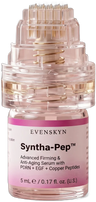
The MicroInfuser is a stamp too, built the other way round: a fixed 0.5 mm needle head that is sterile and single use, clicked onto a sealed 5 mL ampoule of Syntha-Pep, our biosynthetic PDRN serum. Nothing is reused or refilled, and the length cannot be changed. It costs far more per session than a derma stamp, and its instructions cover the face, not the scalp. One kit is four sessions, one every two weeks: $179.98, or $107.99 with code BLACK40 until 30 Nov.
A handheld microneedling tool with a small, flat head of fine needles that you press straight down into the skin or scalp and lift, one spot at a time. Home stamps come with a fixed needle length or a dial; the fixed-length stamps we read mostly use 0.25 to 0.5 mm, while some dials reach 3.0 mm.
What is the best derma stamp?
None of these has been tested against the others, so it depends on what you need. Of the 14 we compared on 8 November 2026, the Banisher 3.0 publishes the most detail on its replaceable heads ($130.00 kit, heads $25.00 each), Beautimate's 140-pin stamp is the cheapest adjustable stamp whose maker says to stay at 0.5 mm or below at home ($19.00), and Dr. Pen's Bio Needle 120 publishes the most of the scalp-only stamps ($29.00). Prices were read on each brand's page that day.
Does a derma stamp actually work?
Much of the trial evidence for microneedling is on acne scars, and nearly all of it comes from clinic treatments rather than home stamps. A 2021 review of 9 randomised trials called it well tolerated and effective for atrophic acne scars, and a 2018 systematic review called it safe and effective while noting weaknesses in the studies. We found no study testing a home derma stamp brand, and the American Academy of Dermatology says home products give less noticeable results than a dermatologist's treatment. For thinning hair, the evidence is for needling added to minoxidil.
What size derma stamp should I use on my face?
0.5 mm or shorter at home. In a 2025 ultrasound study, skin measured about 1.46 mm at the forehead, 1.37 mm at the mid cheek and 0.57 mm at the upper eyelid, so a 0.5 mm needle is about a third of forehead skin on paper. Longer needles are clinic territory, and the eyelids, the under-eye hollow and the red of the lips are off limits at home.
How often should you use a derma stamp?
Follow your stamp's maker and give your skin time to settle between sessions. Brand advice runs from once every 3 weeks at 0.5 mm (Dr. Pen) and once every 2 weeks (Banish) to 2 to 3 times a week (Zenagen, scalp), and up to every other day for Banish's 0.25 mm head. Clinics space deeper acne scar sessions 2 to 4 weeks apart. Our own kit is one session every 14 days.
What should I put on my skin after using a derma stamp?
Keep it to gentle products made for freshly needled skin. Our own kit's rule is to stop retinoids and exfoliating acids 48 hours before a session and wait 72 hours after, with shorter windows for vitamin C, and the American Academy of Dermatology says to wait 24 hours before makeup. Granulomas under the skin have been reported after microneedling with topical products, most often vitamin C. Our guide to what to use after microneedling covers what to use and when.
Can a derma stamp regrow hair?
The evidence is for needling added to minoxidil, not for a stamp alone. In a 2013 trial of 100 men, weekly 1.5 mm needling plus minoxidil raised hair counts by 91.4 against 22.2 with minoxidil alone after 12 weeks, and a 2025 review of 12 trials found the same direction with wide variation between studies. The American Academy of Dermatology suggests checking with a dermatologist before you buy a device.
Do dermatologists recommend derma stamps?
The American Academy of Dermatology says products sold for at-home microneedling are not meant to puncture the skin and give less noticeable results than a dermatologist's treatment. For hair loss, it says it is best to check with your dermatologist before you buy a device.
How long does a derma stamp last?
As long as its maker says, and no longer. On 8 November 2026 the figures ran from a single use (HoMEso's heads) and 3 to 4 full-face sessions a head (Banish) to 6 to 10 uses (Beautimate), 10 to 15 (Follicly), up to 15 (Dr. Pen's Bio Needle) and about 10 to 20 uses or 30 to 60 days (Nurse Jamie). Replace it sooner if a needle bends or it starts to drag.
How do you clean a derma stamp?
The way its maker says. Most pages we read use 70% isopropyl alcohol, from a spray to a 5 to 10 minute soak, then air drying. Alcohol disinfects but does not sterilise, because it does not kill bacterial spores, so never share a stamp and replace it on time.
Is a derma stamp better than a derma roller?
No study has compared them at home. A stamp goes straight in and out, one spot at a time, while the needles of a roller enter and leave at an angle as the drum turns, which is why our at-home microneedling guide prefers a stamp. The small head of a stamp also suits small areas. We compare the formats in microneedling pen vs stamp vs roller vs micro-infusion.
Can I use a derma stamp under my eyes?
Not on the eyelids or in the under-eye hollow. The lower eyelid measured 0.81 mm thick and the upper eyelid 0.57 mm in a 2025 ultrasound study, so even a 0.5 mm needle is most of that skin on paper. Stop at the orbital bone.
Does derma stamping hurt?
At 0.5 mm or less, expect pressure and a prickle rather than pain; a review of clinic practice notes that needles up to 0.5 mm long are essentially painless. If it hurts, the needles are too long for home use or you are pressing too hard.
Is a derma stamp the same as micro-infusion?
Not quite. A derma stamp makes the channels and you apply a serum separately. A hydra stamp adds a refillable serum chamber. A micro-infusion kit like our MicroInfuser pairs a sterile, single-use needle head with a sealed serum ampoule, so nothing is reused or refilled.
How we compared these products
We read each product's own page, and where it was a Shopify store its product data, on 8 November 2026, and recorded the price shown, the needle count, length and material, the head, the brand's replacement figure, its cleaning instructions, any sterility claim and the areas it is sold for. Key figures were read twice. Where a page contradicts itself, the table shows both figures. Where a brand does not publish a figure, the table says so rather than estimating one.
We started from the stamps that appear for derma stamp searches in the US and kept those with a brand page we could read. We left out a stamp sold only through a marketplace listing, and we left out sealed micro-infusion kits, which we compare in our micro-infusion system guide. Two of the 14 are sold from European stores (HoMEso in euros, rhute in pounds), so their prices are shown as listed.
We did not test these products on skin, run a panel or receive any of them for free, and we earn nothing from any brand named here. EvenSkyn makes the MicroInfuser, which is not in the picks. Prices change often in November, so check the live listing before you buy.
References
Sitohang IBS, Sirait SAP, Suryanegara J. Microneedling in the treatment of atrophic scars: a systematic review of randomised controlled trials. Int Wound J. 2021;18(5):577-585. PMID 33538106. doi:10.1111/iwj.13559
Ramaut L, Hoeksema H, Pirayesh A, Stillaert F, Monstrey S. Microneedling: where do we stand now? A systematic review of the literature. J Plast Reconstr Aesthet Surg. 2018;71(1):1-14. PMID 28690124. doi:10.1016/j.bjps.2017.06.006
American Academy of Dermatology. Microneedling can fade scars, uneven skin tone, and more. Last updated 17 July 2023. Read 8 November 2026. aad.org
Korzekwa S, Matusz K, Kukulski M, Wawrzaszek P, Górna N, Rosiński W, Włosiański J, Przystańska A. Quantitative analysis of the human face skin thickness: a high-frequency ultrasound study. J Clin Med. 2025;14(23):8401. doi:10.3390/jcm14238401
Centers for Disease Control and Prevention. Chemical Disinfectants, Guideline for Disinfection and Sterilization in Healthcare Facilities (2008). Last reviewed 28 November 2023. Read 8 November 2026. cdc.gov
U.S. Food and Drug Administration. Microneedling Devices: Getting to the Point on Benefits, Risks and Safety. Content current as of 15 October 2025. Read 8 November 2026. fda.gov
U.S. Food and Drug Administration. De Novo classification request DEN160029, SkinPen Precision System: decision summary, recommended treatment depths. Granted 1 March 2018. accessdata.fda.gov
Enfield J, O'Connell ML, Lawlor K, Jonathan E, O'Mahony C, Leahy M. In-vivo dynamic characterization of microneedle skin penetration using optical coherence tomography. J Biomed Opt. 2010;15(4):046001. doi:10.1117/1.3463002
Singh A, Yadav S. Microneedling: advances and widening horizons. Indian Dermatol Online J. 2016;7(4):244-254. doi:10.4103/2229-5178.185468
Soltani-Arabshahi R, Wong JW, Duffy KL, Powell DL. Facial allergic granulomatous reaction and systemic hypersensitivity associated with microneedle therapy for skin rejuvenation. JAMA Dermatol. 2014;150(1):68-72. PMID 24258303. doi:10.1001/jamadermatol.2013.6955
Friedmann DP, Mehta E, Verma KK, Harris R. Granulomatous reactions from microneedling: a systematic review of the literature. Dermatol Surg. 2025;51(3):263-266. Published online 25 November 2024. PMID 39584690. doi:10.1097/DSS.0000000000004450
American Academy of Dermatology. Hair loss: diagnosis and treatment. Last updated 13 December 2022. Read 8 November 2026. aad.org
Dhurat R, Sukesh M, Avhad G, Dandale A, Pal A, Pund P. A randomized evaluator blinded study of effect of microneedling in androgenetic alopecia: a pilot study. Int J Trichology. 2013;5(1):6-11. PMID 23960389. doi:10.4103/0974-7753.114700
Ahmed KMA, Kozaa YA, Abuawwad MT, et al. Evaluating the efficacy and safety of combined microneedling therapy versus topical minoxidil in androgenetic alopecia: a systematic review and meta-analysis. Arch Dermatol Res. 2025;317(1):528. PMID 40056230. doi:10.1007/s00403-025-04032-1
Akintilo L, Green JB, Kaufman J, et al. When to change needles during neuromodulator injections: an electron-microscopy investigation into needle tip deformation. J Cosmet Dermatol. 2025;24(1):e16506. PMID 39499618. doi:10.1111/jocd.16506
Editorial log: published 8 November 2026, with every product page read that day. We will re-read every product page by 8 February 2027 and date the changes here.
Nine at-home anti-aging devices across radiofrequency, EMS, microcurrent and light, read from their makers on 15 November 2026, with the evidence behind each technology graded. We make three of them and say...
GLP-1 face, also called Ozempic face, is the look of lost facial volume and looser skin after fast weight loss, and this guide covers why it happens, what clinic options do and...
Hinterlasse einen Kommentar
Alle Kommentare werden vor der Veröffentlichung geprüft.




Hinterlasse einen Kommentar
Alle Kommentare werden vor der Veröffentlichung geprüft.
Diese Website ist durch hCaptcha geschützt und es gelten die allgemeinen Geschäftsbedingungen und Datenschutzbestimmungen von hCaptcha.