
Medically Reviewed by Dr. Lisa Hartford, MD
Last updated: April 2026. Medically reviewed by Dr. Lisa Hartford, MD, Board-Certified Dermatologist and Chief Dermatology Advisor at EvenSkyn.
The short version
Most anti-aging device content is written for people in their fifties. If you are in your early-to-mid thirties or early forties and starting to notice fine lines, subtle loss of firmness, or a softer jawline than you had a few years ago, the advice usually does not fit. You do not need a clinical-grade RF device yet. You also should not wait ten years to start.
The clinical literature supports a concept called prejuvenation: consistent, gentle stimulation of collagen and facial muscle tone beginning in your thirties to slow the rate of age-related decline rather than reverse it after it compounds. Studies across the past decade show that people who start consistent stimulation protocols in their thirties tend to need less aggressive intervention in their fifties. The biology is straightforward. Collagen declines at roughly 1% per year from the late twenties. You cannot stop the decline, but you can slow it substantially by keeping fibroblast activity high, muscle tone strong, and cellular metabolism supported.
The device category for prejuvenation is different from the category for reversal. A 32-year-old and a 52-year-old need different tools. This guide explains the distinction, compares the at-home devices that make clinical sense for users in their thirties and early forties, and provides a protocol drawn from research rather than marketing.
What prejuvenation actually means and why the clinical community is converging on it
Prejuvenation is a clinical concept that has gained significant traction among dermatologists and aesthetic practitioners since roughly 2022. The framing is simple: intervene with gentle stimulation before visible aging becomes entrenched rather than waiting for significant laxity and then chasing reversal.
The biology supporting this is well-established. A 2025 narrative review in the Journal of Cosmetic Dermatology (Viscomi et al., PMC 12374573) documented that collagen synthesis begins its measurable decline in the late twenties. By the mid-thirties, most people have lost measurable dermal density even if visible changes have not yet appeared. By the mid-forties, the cumulative decline starts producing the fine lines, softening jawline, and loss of elasticity that people typically describe as "suddenly looking older."
The prejuvenation argument is that interrupting this compounding decline with regular, gentle stimulation produces meaningfully better outcomes at age 55 than waiting until 55 to act. A 2024 systematic analysis of 18 home facial rejuvenation device studies (PMC 10929553) found that consistent low-intensity protocols produced cumulative dermal improvement and that earlier-started protocols showed better long-term trajectories than delayed-intervention protocols. The 2014 Wunsch & Matuschka controlled trial on red light and near-infrared (PMC 3926176) documented measurable intradermal collagen density increase across an 8-week protocol in a general-population cohort not selected for severe laxity, suggesting the mechanism works preventively as well as restoratively.
Dr. Hartford puts it directly:
"A decade ago, I would tell a 32-year-old patient with no visible aging that she did not need to do anything yet. The clinical research has moved past that position. We now know that starting gentle, consistent stimulation in your thirties preserves collagen density and muscle tone in ways that are significantly harder to rebuild once lost. It is not about vanity at 32. It is about what your skin looks like at 52, and the evidence increasingly shows that what you do in your thirties compounds measurably. Prejuvenation is not a marketing term. It is the direction clinical dermatology has moved."— Dr. Lisa Hartford, MD, Board-Certified Dermatologist (Johns Hopkins; Mayo Clinic), Chief Dermatology Advisor at EvenSkyn
The practical question this raises is not whether to start, but what tools actually make sense for someone in their thirties or early forties who does not yet have significant laxity to reverse.
Why the device that is right for your mother is probably wrong for you
The single most common mistake in at-home anti-aging device purchases is buying the wrong category for where you actually are in the aging trajectory. A 32-year-old with early fine lines and no laxity who buys a high-intensity clinical-grade RF device like the Lumo+ will use more power than her skin needs, pay more than she needs to spend, and often end up treating less frequently than the prejuvenation research actually supports.
Meanwhile, a 55-year-old with visible jowling and significant laxity who buys a gentle ultrasonic toning device will get hydration and cleansing benefits but will not see the structural collagen rebuilding that serious laxity actually requires. She will conclude the device does not work, when in fact the device was never designed for her use case.
The right mental model is to match device intensity to biological stage.
The three stages of at-home anti-aging needs
Stage 1: Prejuvenation (late 20s to early 40s). Fine lines just starting, subtle texture changes, maybe some puffiness or dullness. The dermis is still relatively healthy. The goal is maintenance and prevention: keep fibroblasts active, support cellular metabolism, maintain muscle tone, enhance skincare absorption. The right tools are gentle, consistent, and designed for near-daily use. Ultrasound (for deep cellular stimulation and sonophoresis), microcurrent (for muscle tone), red and blue LED (for cellular support and blemish control), and sonic massage fit this stage. RF is unnecessary at this stage and often overpowered.
Stage 2: Early reversal (mid-40s to early 50s). Visible fine lines, some softening along the jawline, early laxity, perimenopausal changes if applicable. The dermis has started losing density measurably. The goal shifts from pure maintenance to gentle structural rebuilding alongside continued prevention. Multi-modal devices combining RF with EMS, LED, and ionisation become the appropriate category. The Lumo+ at this stage starts making sense because its 1 MHz bipolar RF actually rebuilds the collagen that has started declining.
Stage 3: Active reversal (mid-50s and beyond). Established laxity, visible jowling, deeper lines, significant volume loss in some cases. The goal is to reverse as much as is reversible at home and maintain what you have. Clinical-grade multi-modal devices like the Lumo+ become essential. Some users in this stage also benefit from combining home devices with periodic clinical treatment (Thermage, Ultherapy, Sofwave) for maximum effect.
The failure mode most consumer content enables is skipping Stage 1 entirely and telling everyone to buy Stage 2 or Stage 3 devices regardless of biological need. This is good for selling expensive devices. It is not good for matching tools to users.
The technology stack that makes sense for prejuvenation
For users in Stage 1, the clinical evidence converges on four specific modalities. Each addresses a different dimension of early-stage aging, and the combination covers what a well-designed prejuvenation protocol actually needs.
Ultrasound at home: the prejuvenation workhorse
Ultrasound at home operates differently from clinical HIFU systems and should be evaluated on its own terms rather than as a scaled-down version of Ultherapy. Clinical HIFU delivers focused acoustic energy at 4.5mm depth to reach the SMAS layer and produce dramatic single-session lifting. At-home ultrasound operates at much lower energy levels, which makes it inadequate for dramatic reversal but well-suited for something different: sustained cellular stimulation and sonophoresis.
Sonophoresis is the process by which ultrasound waves create temporary microscopic pathways in the stratum corneum, enhancing the absorption of topically applied actives. Research published in Advanced Drug Delivery Reviews and subsequent ultrasound physics literature has documented that low-frequency ultrasound can increase penetration of peptides, hyaluronic acid, and certain antioxidants into the dermis by measurable multiples compared to topical application alone.
The at-home ultrasound mechanism for prejuvenation users works through three effects operating simultaneously. The acoustic vibration stimulates fibroblasts gently without the thermal injury clinical HIFU produces. The enhanced penetration makes whatever serum you are already using meaningfully more effective. The increased blood flow and lymphatic drainage produces the tone and radiance improvement that users notice within a few sessions.
This is why at-home ultrasound makes more sense as a maintenance and prejuvenation tool than as a laxity-reversal tool. Users who buy at-home ultrasound expecting an Ultherapy-equivalent experience are misaligned on what the device does. Users who buy it understanding what it actually is tend to be highly satisfied.
Microcurrent and EMS for early-stage muscular tone
Muscular tone in the face follows the same use-it-or-lose-it pattern as muscular tone elsewhere in the body. A 2024 narrative review on microcurrent therapy (PMC 12357078) documented that consistent microcurrent application produces measurable improvements in facial contour, muscular tone, and visible firmness without the thermal or energy intensity required for structural collagen rebuilding. For users in their thirties and early forties, maintaining masseter, zygomaticus, and platysma tone through regular microcurrent or EMS sessions preserves the muscular support that dermal laxity eventually compounds against.
The difference between a 45-year-old who has used microcurrent 3 times per week for 15 years and a 45-year-old who has never used it is visible. The muscular foundation holds the skin more effectively, the jawline stays more defined, the cheekbones retain more structural support. This is prejuvenation at the muscular layer.
Red and blue LED photobiomodulation
LED at 623nm (red) penetrates to the dermis and is absorbed by mitochondria, specifically by cytochrome c oxidase, boosting ATP production and upregulating fibroblast activity. The 2014 Wunsch & Matuschka controlled trial referenced above documented measurable intradermal collagen density increases from consistent red light exposure. For prejuvenation users, this is the cellular-metabolism dimension that supports everything else in the protocol.
Blue LED at 465nm operates in the epidermis and has documented antibacterial properties, particularly against Cutibacterium acnes (previously Propionibacterium acnes). For users in their thirties who still experience occasional breakouts or blemish-prone skin, blue LED integration handles that concern in the same device that supports collagen and muscle work.
Sonic massage and thermal activation for everyday absorption and comfort
Sonic massage at audible frequencies combined with mild thermal activation enhances lymphatic drainage, reduces morning puffiness, and improves the absorption of whatever skincare you apply afterward. These are not dramatic mechanisms. They are the small, compounding daily benefits that make a device part of your actual routine rather than a dusty shelf investment.
The EvenSkyn Eclipse: why it was designed for exactly this user
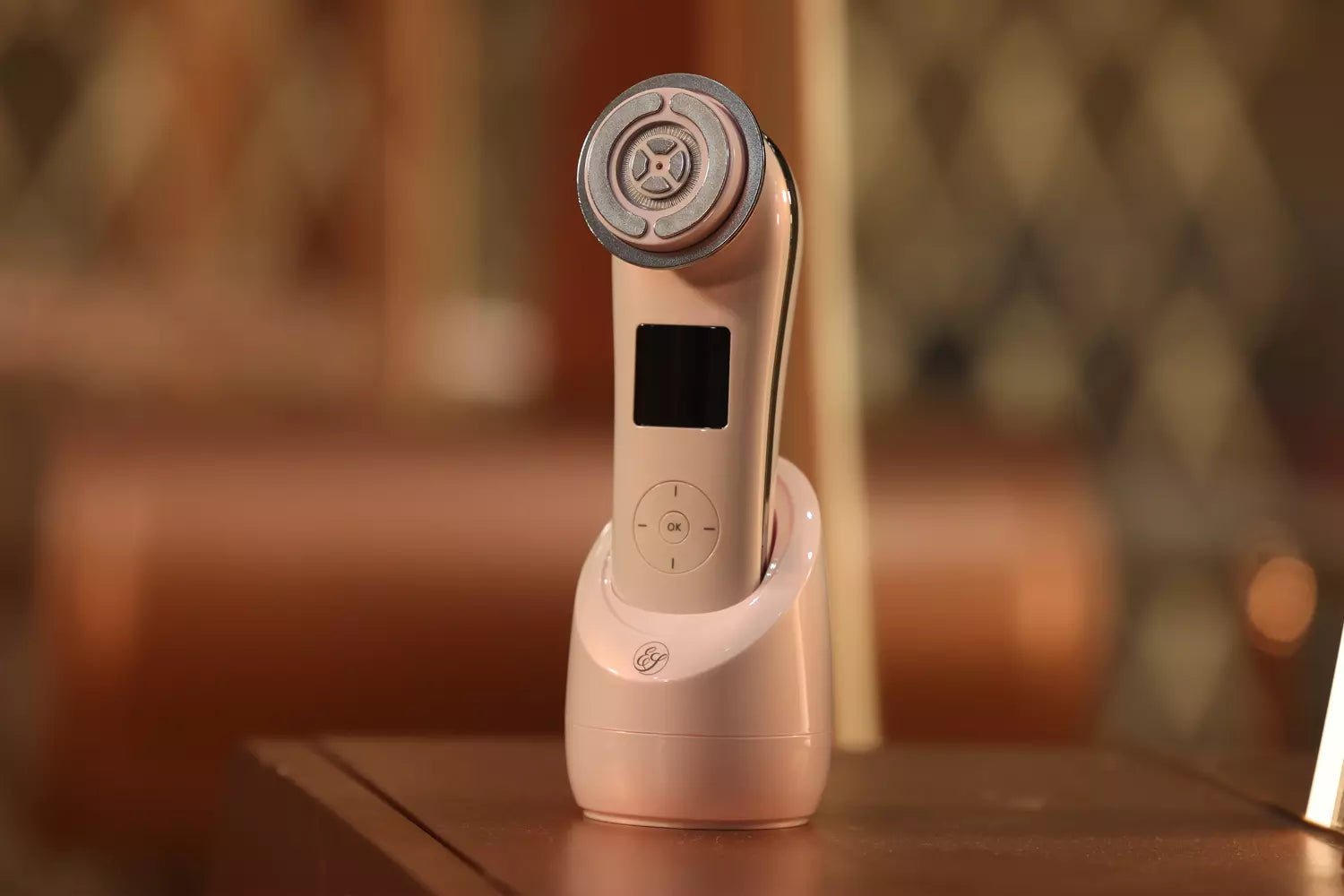
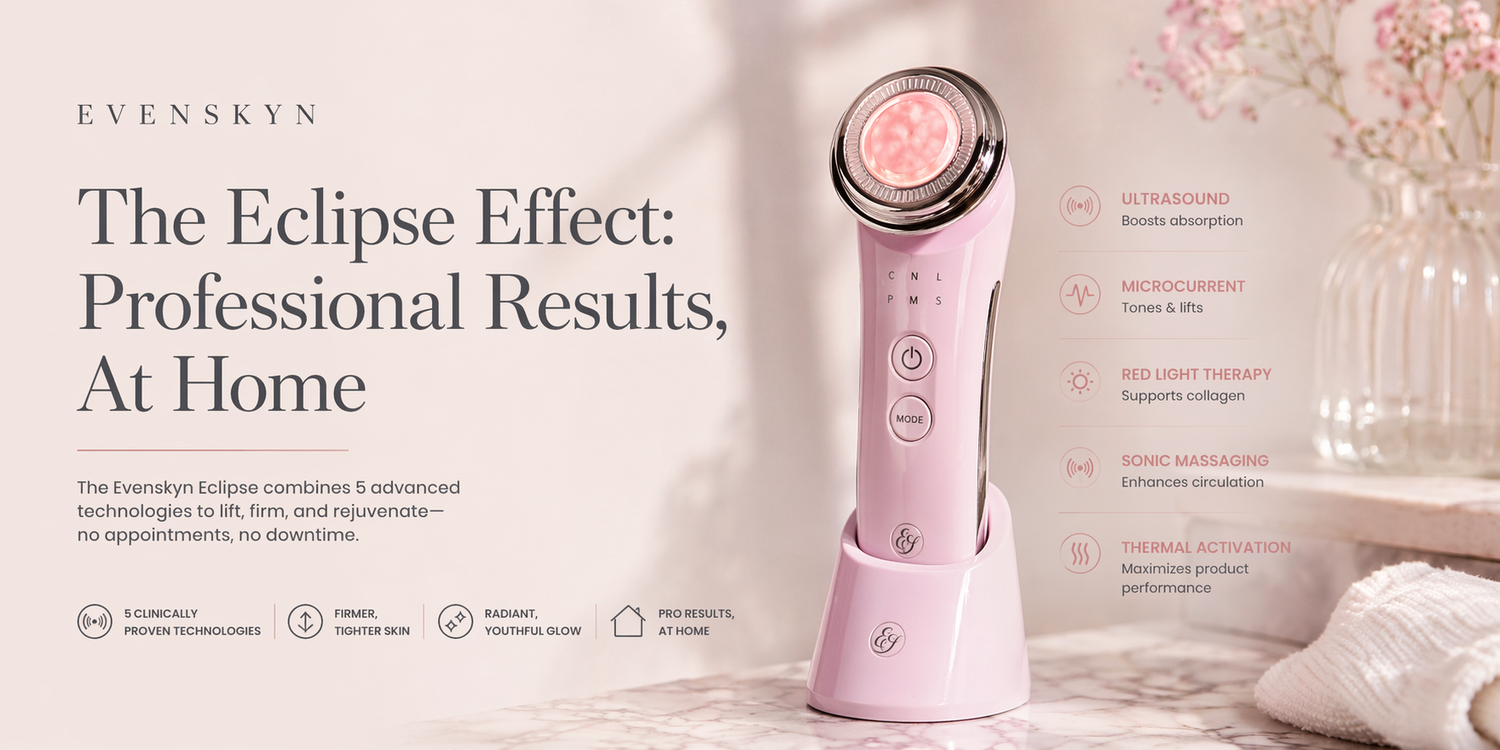
The EvenSkyn Eclipse is the Stage 1 device in our product line. It was engineered specifically for users in their thirties and early forties who need prejuvenation-appropriate technology rather than reversal-grade RF. The six modes cover the full prejuvenation stack in a single handset:
Cleansing mode uses ultrasonic vibration to loosen impurities, excess sebum, and dead skin cells from pore surfaces. This is deeper than cleanser-plus-hands alone and prepares the skin for the modes that follow.
Nourishment mode combines ultrasound with sonophoresis to enhance absorption of whatever water-based serum you apply. Peptide serums, hyaluronic acid, vitamin C serums, and niacinamide formulations all absorb measurably better after sonophoresis than applied topically alone. This is the mode that makes your existing skincare routine more effective.
Lifting mode applies microcurrent at calibrated intensity appropriate for daily use. Unlike the EMS output on the Lumo+, which is designed for active muscular restructuring, the Eclipse's lifting mode is tuned for maintenance and tone preservation. Three intensity levels let users start gently and progress as their skin acclimates.
Photorejuvenation mode delivers red LED at 623nm for dermal collagen support and blue LED at 465nm for blemish-prone areas. The dual-wavelength approach means a single device handles both the collagen-metabolism dimension and the breakout-management dimension many Stage 1 users still deal with.
Massaging mode uses sonic-frequency vibration for lymphatic drainage, puffiness reduction, and the kind of small-but-real morning improvements that drive consistent routine adherence. This is the mode most users report becoming genuinely attached to.
Soothing mode applies gentle thermal activation to support serum absorption and provide the calming finish that makes the device feel like a spa ritual rather than a medical treatment.
At $199 MSRP (currently at $199 regular, with regular promotional pricing below that), the Eclipse is priced at the point where a user in their thirties can afford it as a routine addition rather than a major financial decision. The price reflects what the category actually needs at Stage 1, not a downgrade from the Lumo+. These are different tools for different biological stages.
The comparative landscape for Stage 1 devices
For users evaluating at-home devices in the prejuvenation category specifically, here is how the Eclipse compares to the other devices competing for attention at this price point.
| Device | Technologies | Price (USD) | Primary use case | FDA-cleared |
|---|---|---|---|---|
| EvenSkyn Eclipse | Ultrasound + microcurrent + red LED + blue LED + sonic massage + thermal activation | $199 | Prejuvenation, everyday maintenance, enhanced absorption | Yes |
| FOREO BEAR Mini | Microcurrent only | $249 | Muscle toning only | Yes |
| FOREO LUNA 4 | Sonic cleansing + firming massage | $279 to $319 | Cleansing and light toning | Yes |
| NuFACE FIX | Microcurrent only (small targeted wand) | $149 | Targeted microcurrent for eyes and lips | Yes |
| Solawave 4-in-1 Wand | Red LED + microcurrent + thermal + vibration | $169 | Broad-spectrum maintenance | Yes |
| Project E Beauty Labelle | Ultrasound + ions | $75 | Ultrasound cleansing and absorption only | Yes |
| Mira-Skin Ultrasound | Ultrasound only, paired with proprietary serum | $349 | Ultrasound-enhanced product penetration | Yes |
| Dennis Gross LED Eye Mask | LED only (targeted) | $169 | Eye-area LED only | Yes |
The pattern that emerges: most Stage 1 devices do one thing. The Eclipse does six, at a price between FOREO BEAR Mini and FOREO LUNA 4, and covers more of the prejuvenation stack than any competitor in the same price bracket.
When to upgrade from Eclipse to Lumo+
Eclipse is the right device for prejuvenation. It is not the right device for every stage forever. Knowing when to upgrade matters, because using a Stage 1 device against Stage 3 biology produces disappointing results and wastes time.
The signals that you have moved past the Eclipse's best-fit use case and should consider upgrading to the Lumo+ are specific:
Visible laxity that does not respond to consistent Eclipse use. If you have been using the Eclipse 3 to 5 times per week for 12 weeks and jawline definition or under-eye firmness has not improved meaningfully, you may have progressed to a stage where RF-level stimulation is required.
Deep lines rather than fine lines. The Eclipse's modalities address fine lines and texture but do not deliver the dermal thermal stimulus required to remodel established deep wrinkles. When the nasolabial folds, marionette lines, or forehead lines are deep enough to hold makeup and remain visible without expression, the RF category is the appropriate tool.
Perimenopausal or menopausal changes. The 30% collagen loss in the first five years post-menopause (documented in Viscomi et al., 2025) is a structural challenge the Eclipse's gentle modalities were not designed to address. The Lumo+'s RF output at 1 MHz bipolar reaching 140°F / 60°C dermal temperature is calibrated for this kind of structural rebuilding.
Jawline softening that has become visible in photographs. A soft jawline that only you notice is Stage 1 territory. A jawline that has clearly changed in photos taken 2 or 3 years apart is Stage 2 or Stage 3 territory.
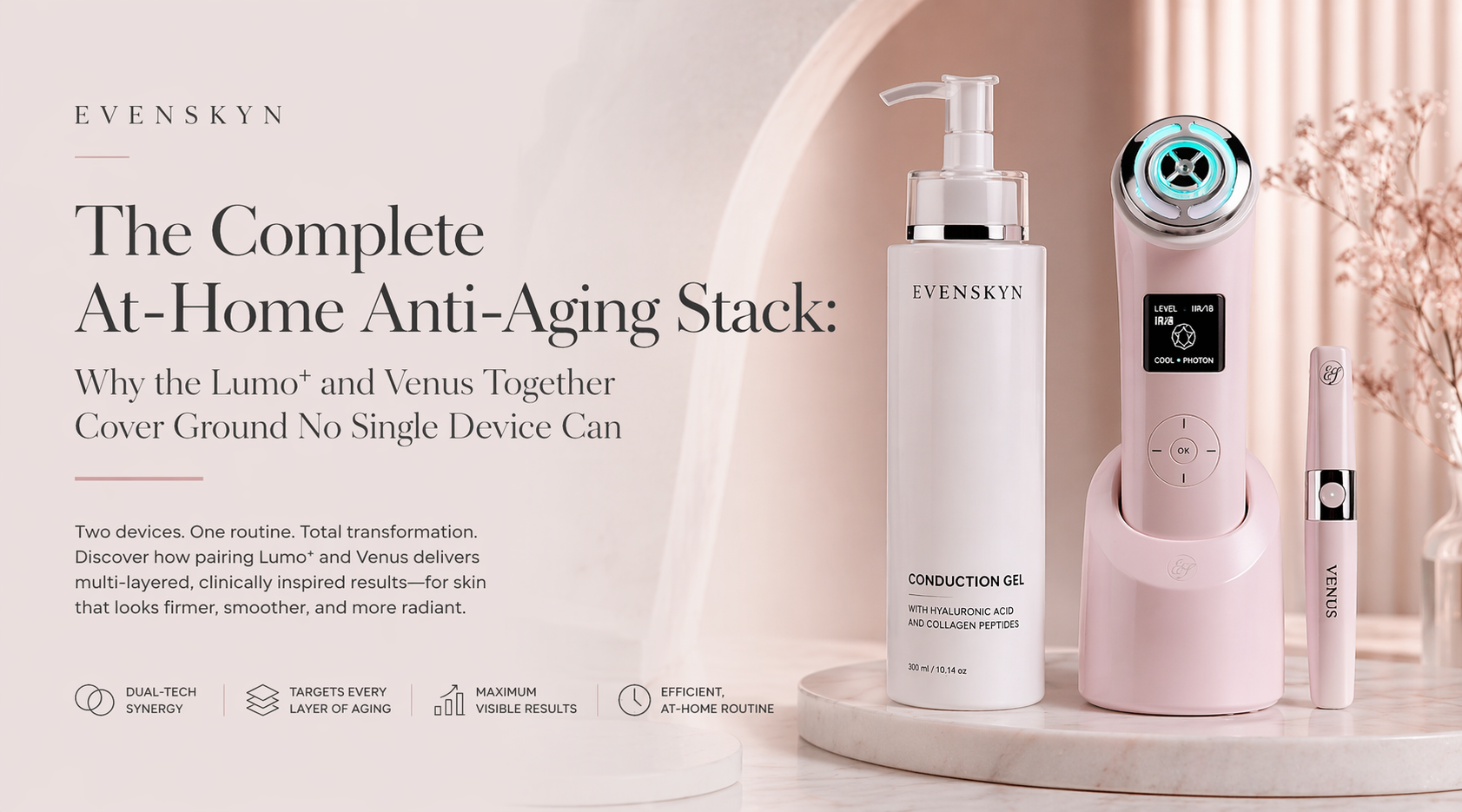
The upgrade is not a replacement. Many users run both devices in their routine after upgrading: Eclipse for daily maintenance, absorption, and cleansing, Lumo+ two to three times per week for structural collagen work. The Lumo+ and Eclipse together constitute a full-stack at-home anti-aging protocol that covers prevention, reversal, and everyday maintenance.
The 12-week Eclipse prejuvenation protocol
The research-supported approach for Stage 1 users is consistency over intensity. Fibroblasts respond better to regular gentle stimulation than to infrequent aggressive sessions, and the muscular tone benefits of microcurrent specifically require consistent application to compound.
Daily (5 to 7 minutes)
Cleansing mode on clean skin with water-based toner or plain water as the conductor. This replaces or enhances your normal cleanser routine. The ultrasonic vibration reaches into pore depth in a way manual cleansing cannot.
4 to 5 times per week (8 to 12 minutes)
Nourishment mode with your preferred water-based serum (peptides, hyaluronic acid, niacinamide, or vitamin C are all good choices). Apply serum, run the device in Nourishment mode, let it glide across the face in slow upward motions. Sonophoresis dramatically improves how much of the serum actually reaches where it is supposed to act.
Massaging mode immediately after Nourishment mode for lymphatic drainage. This is particularly valuable in the morning to reduce overnight puffiness and in the evening for relaxation.
3 times per week (10 to 15 minutes)
Lifting mode on the cheekbones, jawline, and under-eye zone (avoiding the immediate eye area, which requires an eye-specific device like the Venus). Use EvenSkyn Conduction Gel or a water-based alternative for proper coupling. Sweep upward along the natural contour lines for 2 to 3 minutes per zone.
2 to 3 times per week (10 to 15 minutes)
Photorejuvenation mode at the end of your session. Red LED at 623nm supports the dermal collagen work. If you have active blemishes or acne-prone zones, switch to blue LED during that portion of the session.
Once weekly (5 minutes)
Soothing mode with a day cream or non-water-based moisturizer. This is the comfort finish that caps a full-stack session.
Skincare support layer
Broad-spectrum SPF 30+ every morning without exception. UV exposure is the single largest accelerator of collagen decline, and no device can outpace unprotected daily UV damage.
Retinoid 2 to 3 evenings per week (not on the same nights as Photorejuvenation mode if the retinoid is strong). Retinoids and red light both stimulate fibroblast activity and collagen synthesis, through complementary mechanisms.
Peptide serum or hyaluronic acid serum as the Nourishment mode vehicle. Choose water-based formulations; oils and silicones reduce both ultrasound transmission and microcurrent conduction.
Frequently asked questions
Should I buy a skin tightening device in my thirties, or is it too early?
The clinical research increasingly supports early-start prejuvenation protocols. Collagen begins measurable decline in the late twenties, and consistent low-intensity stimulation from the early thirties produces meaningfully better outcomes at 50-plus than delayed intervention. The right device for your thirties is different from the right device for your fifties, however. Stage 1 devices like the EvenSkyn Eclipse provide the right intensity and technology stack for prejuvenation: ultrasound, microcurrent, red and blue LED, sonic massage, and thermal activation, all calibrated for gentle daily use. Stage 2 and 3 devices like the Lumo+ provide RF at intensities designed for structural rebuilding, which is overpowered for Stage 1 biology.
What is the difference between the EvenSkyn Eclipse and the Lumo+?
The Eclipse at $199 is designed for Stage 1 prejuvenation: users in their thirties and early forties who need gentle, consistent maintenance and have minor or early signs of aging. It combines ultrasound, microcurrent, red and blue LED, sonic massage, and thermal activation across six modes for everyday use. The Lumo+ at $499 is designed for Stage 2 and 3 users with more advanced aging signs who need structural collagen rebuilding. It delivers RF at 1 MHz bipolar reaching 140°F / 60°C dermal temperature, combined with EMS at approximately 3 mA, red and blue LED, and ionisation. The RF is the critical technological difference: Lumo+ rebuilds dermal collagen at a thermal intensity the Eclipse is not designed to deliver. Many users run both devices in their routine after reaching a stage where RF becomes appropriate: Eclipse daily for maintenance and absorption, Lumo+ two to three times weekly for structural work.
What is prejuvenation and is it scientifically supported?
Prejuvenation is the clinical practice of starting low-intensity anti-aging protocols before significant visible aging has occurred, rather than waiting for laxity and reversing it later. The biology supporting prejuvenation is well-established. Collagen declines at approximately 1% per year from the late twenties. Consistent gentle stimulation (microcurrent, red light, ultrasound, appropriate topicals) maintained over years preserves dermal density and muscular tone in ways that are significantly harder to rebuild once lost. The 2024 Clinical, Cosmetic and Investigational Dermatology systematic review of home facial rejuvenation devices documented that earlier-started protocols produce better long-term trajectories than delayed-intervention protocols. Aesthetic dermatology has converged on prejuvenation as a clinically supported approach, and the device category for this user group is different from the category designed for established laxity reversal.
Can I use the Eclipse if I already have some fine lines and early jawline softening?
Yes, this is exactly the user profile the Eclipse was designed for. Fine lines, subtle texture changes, early softening around the jawline and cheekbones, puffiness, and dullness are Stage 1 concerns that the Eclipse's six-mode technology stack addresses directly. Consistent use over 12 weeks produces measurable improvement in texture, tone, and early-stage firmness. If after 12 weeks of consistent use you are not seeing the maintenance benefits you expected, or if your concerns have progressed beyond Stage 1, upgrading to the Lumo+ is the appropriate next step. For most Stage 1 users, the Eclipse handles the prejuvenation mandate for years before Stage 2 becomes the appropriate category.
Does at-home ultrasound actually work, or is it too weak to do anything?
At-home ultrasound devices operate at much lower energy levels than clinical HIFU systems like Ultherapy or Sofwave. Evaluated as a scaled-down clinical HIFU, at-home ultrasound underperforms the clinical systems substantially. Evaluated for what it actually does, at-home ultrasound is effective at two things the clinical systems are not optimized for: sustained low-level fibroblast stimulation across consistent daily-to-weekly use, and sonophoresis (enhanced penetration of topically applied actives). For prejuvenation users, these two mechanisms are more valuable than the dramatic single-session lifting clinical HIFU provides. At-home ultrasound works well for Stage 1 users. It does not replace clinical HIFU for Stage 3 users, and anyone selling it as equivalent to Ultherapy is overselling.
How does the EvenSkyn Eclipse compare to the FOREO BEAR Mini?
The FOREO BEAR Mini at $249 is a microcurrent-only device. It does one thing (facial muscle toning) and does it well, but it is a single-modality tool. The Eclipse at $199 combines six modalities (ultrasound cleansing, sonophoresis, microcurrent lifting, red and blue LED photorejuvenation, sonic massage, and thermal activation) in one handset at a lower price point. For users whose only concern is muscle toning, the BEAR Mini is a focused solution. For users who want the full prejuvenation stack (cleansing, absorption enhancement, toning, collagen support, lymphatic drainage, and comfort) in one device, the Eclipse covers substantially more ground at a lower price.
How does the EvenSkyn Eclipse compare to the Solawave wand?
The Solawave 4-in-1 wand at $169 combines red LED, microcurrent, thermal activation, and vibration. The Eclipse at $199 adds ultrasound (for cleansing and sonophoresis) and blue LED (for blemish-prone zones), plus has more structured six-mode operation with three intensity levels per mode. The Eclipse and Solawave target similar use cases, with the Eclipse offering broader technology integration at a modestly higher price point. Both are reasonable Stage 1 devices. The Eclipse's ultrasound integration is the most significant differentiator for users whose routine includes serum absorption or who want to incorporate cleansing into the device protocol.
Is the Eclipse safe for all skin types and tones?
Yes. Ultrasound, microcurrent, and LED at the wavelengths and intensities the Eclipse uses are chromophore-independent, meaning they do not interact with melanin differently across skin tones. Safe for Fitzpatrick skin types I through VI. The Eclipse is also safe for sensitive and acne-prone skin, with three intensity levels allowing users to start gently and progress as comfort dictates.
How often should I use the Eclipse?
For prejuvenation protocols, the clinical research supports near-daily to daily use in short sessions rather than infrequent long sessions. Cleansing and Massaging modes are safe and beneficial for daily use. Nourishment mode is appropriate 4 to 5 times per week. Lifting mode is most effective at 3 times per week. Photorejuvenation mode at 2 to 3 times per week aligns with the clinical LED research. The Eclipse's protocol is deliberately lower-intensity and higher-frequency than RF protocols like the Lumo+'s 2 to 3 times weekly structure, because the prejuvenation mechanism rewards consistency over intensity.
Do I need conduction gel with the Eclipse?
For the Lifting, Photorejuvenation, and Massaging modes, a water-based conduction medium is strongly recommended. Without proper coupling, the microcurrent in Lifting mode produces uneven current density (the shocky or zappy sensation), the ultrasound components transmit less efficiently, and results are reduced. Purpose-formulated EvenSkyn Conduction Gel is designed to work with the full Eclipse technology stack. For Cleansing mode, use a water-based toner or plain water. For Nourishment mode, use your preferred water-based serum. For Soothing mode, a cream or moisturizer is appropriate since the thermal activation does not require conduction.
Can I use the Eclipse if I am in my late twenties and just noticing very early signs?
Yes, and the late twenties is arguably the ideal time to start a prejuvenation protocol. The research supports intervention beginning before visible aging compounds. Users in their late twenties typically have healthy fibroblast populations and strong muscular tone, which means the Eclipse's gentle stimulation maintains what is there rather than trying to rebuild what has declined. Starting at 28 produces better outcomes at 48 than starting at 38 does. The Eclipse's low-intensity profile is safe and appropriate for users in their late twenties.
Will I outgrow the Eclipse eventually?
Most users eventually transition from Stage 1 to Stage 2 as their biological stage progresses, typically sometime in their mid-to-late forties depending on individual factors including genetics, sun exposure history, menopausal stage if applicable, and lifestyle. When that transition happens, the appropriate action is to add the Lumo+ to the routine (not replace the Eclipse). The Eclipse continues to provide valuable daily maintenance, cleansing, absorption enhancement, and supportive LED work even after you have added RF-level intervention. The two devices are complementary in Stage 2 and Stage 3 protocols, not substitutes.
References
Prejuvenation and early intervention
- Viscomi et al. Managing Menopausal Skin Changes: A Narrative Review. Journal of Cosmetic Dermatology, 2025 (PMC 12374573)
- Development of Home Beauty Devices for Facial Rejuvenation: Establishment of Efficacy Evaluation System. Clinical, Cosmetic and Investigational Dermatology, 2024 (PMC 10929553)
Ultrasound and sonophoresis
- Ultrasound Physics and Instrumentation. StatPearls, NCBI Bookshelf, NBK570593
- Polat BE, Blankschtein D, Langer R. Low-frequency sonophoresis: application to the transdermal delivery of macromolecules and hydrophilic drugs. Expert Opinion on Drug Delivery 2010;7(12):1415-32.
- Haykal D, et al. A Systematic Review of High-Intensity Focused Ultrasound in Skin Tightening and Body Contouring. Aesthetic Surgery Journal, 2025 (PubMed 40184185)
Microcurrent therapy
LED photobiomodulation
RF for structural rebuilding (for Stage 2 and 3 context)
About the medical reviewer
Dr. Lisa Hartford, MD is the Chief Dermatology Advisor at EvenSkyn. She graduated with honors from Johns Hopkins University School of Medicine and completed her dermatology residency at the Mayo Clinic. Her career spans clinical dermatology, pharmaceutical dermatology research, and formulation work with luxury skincare brands. She joined EvenSkyn in 2020 and advises on device engineering, formulation decisions, and clinical claims across the product line.
This article is informational, not medical advice. EvenSkyn devices are FDA-cleared and Health Canada approved. Consult a healthcare professional before beginning any energy-based treatment if you have active implants, are pregnant, or have specific medical conditions. Individual results vary.


Leave a comment
All comments are moderated before being published.
This site is protected by hCaptcha and the hCaptcha Privacy Policy and Terms of Service apply.