EGF and growth factor serums · 2026
EGF earned its discoverer a share of a Nobel Prize. In a serum bottle the evidence is thinner, and the labels differ far more than the marketing suggests.
Quick answer. There is no single best EGF serum, because none of these has been tested against the others. Of the 9 growth factor serums we compared on 5 November 2026:
- Cheapest way to try one: The Ordinary GF 15% Solution ($15.50 USD for 30 mL).
- States its EGF amount: Klairs Midnight Blue Youth Activating Drop (10 ppm).
- Shortest ingredient list: Bioeffect EGF Serum (seven ingredients).
- Human-derived option: SkinMedica TNS Advanced+ ($295.00 USD list for 30 mL).
Expect a gradual change in the look of fine lines and texture at most. Our own MicroInfuser is not in the picks, because EGF is a minor ingredient in its serum.
EvenSkyn Research Team · 18-min read · First published April 2026, rebuilt 5 November 2026 · Prices and labels read from each brand's US page, or the named retailer, on 5 November 2026 · 10 cited sources · Brand byline, not clinician reviewed
Key takeaways
The picks, by need
-
Cheapest way to try one: The Ordinary GF 15% Solution. Three peptides the brand calls plant-based biomimetic EGF, TGF and IGF peptides sit 3rd to 5th of 12 ingredients, with no fragrance listed. $15.50 USD for 30 mL. The brand calls it a 15% "solution" of those peptides; the page does not say how much of that is the peptides themselves.
-
States its EGF amount: Klairs Midnight Blue Youth Activating Drop. Lists sh-Oligopeptide-1 (EGF) 3rd of 15 and sh-Polypeptide-1 (bFGF) 4th, and says the EGF is at 10 ppm. $30.00 USD for 20 mL at Wishtrend, the stockist Klairs names, where it showed at $25.50 USD on 5 November.
-
Shortest ingredient list: Bioeffect EGF Serum. Seven ingredients, with barley-grown EGF last of the seven, and no fragrance. It contains barley. $179.00 USD for 15 mL, the highest price per mL in this table.
-
Human-derived growth factors: SkinMedica TNS Advanced+ Serum. Human Fibroblast Conditioned Media is 3rd of 32 ingredients, with no fragrance. $295.00 USD list for 30 mL, and $236.00 USD on sale at Dermstore on 5 November.
-
States a growth factor complex figure: Allies of Skin Multi Peptides & GF Advanced Lifting Serum. Lists a "3% SH-OLIGOPEPTIDE-1 (Growth Factor) Complex" 2nd of 42, so the EGF itself is some smaller part of that 3%. No added fragrance or essential oils, per the brand. $188.00 USD for 1 fl oz.
-
Also prints an EGF figure: Medicube EGF NAD+ Firming Serum. Prints "2.5PPM" after SH-OLIGOPEPTIDE-1, 20th of 64 ingredients. $26.00 USD; the US page does not state the bottle size.
- At the sizes compared, price per mL runs from $0.52 USD (The Ordinary) to $11.93 USD (Bioeffect).
- 4 of the 9 print a growth factor figure, but only Klairs (10 ppm) and Medicube (2.5 ppm) give it as an amount of EGF itself.
- DRMTLGY lists plain Oligopeptide-1, -2 and -3 and Medik8 lists plain Oligopeptide-1, without the sh- prefix, and neither page says which ingredient is the growth factor.
- Only ZO lists fragrance.
- Our MicroInfuser is not ranked: sh-Oligopeptide-1 is 27th of 32 in its serum. More below.
Prices and labels from each brand's US page, or the named retailer, read 5 November 2026. Brand names identify products only.
53amino acids in EGF, the protein behind a share of the 1986 Nobel Prize[2] About 6,000daltons for EGF[4], against the roughly 500-dalton rule of thumb for passing intact skin[7] 33studies in the 2023 systematic review of topical growth factor products, 9 of them randomised[3] $0.52 to $11.93price per mL at the sizes compared, 5 November 2026
9 growth factor serums, compared by what the label says
We read each brand's US product page on 5 November 2026, or the named retailer where the brand page could not be read, and recorded the price, size, the growth factor ingredients as listed, any stated amount, where they sit on the ingredient list, and fragrance. The table is sorted by price per mL, lowest first. Where a brand does not publish a figure, it says not stated.
Swipe the table sideways to see every column.
Prices in US dollars as shown on 5 November 2026 (Wishtrend, used for Klairs, shows "$" with no currency code). Price per mL is our arithmetic at the regular price and the size shown (1 fl oz is about 29.6 mL); larger sizes can cost less per mL. Ingredient positions are counted from the ingredient list on the page named in each row. Brand statements are quoted as claims, not verified results.
| Product |
Format and size |
Price (USD) |
Price per mL |
Growth factor ingredient, as listed |
Amount, as the brand states it |
Place on the ingredient list |
Fragrance (parfum) or essential oil listed |
Worth knowing |
| The Ordinary GF 15% Solution |
Serum, 30 mL |
$15.50 USD |
$0.52 USD |
Nicotiana Benthamiana Hexapeptide-40 sh-Oligopeptide-1, Nicotiana Benthamiana Hexapeptide-40 sh-Polypeptide-76 and Nicotiana Benthamiana Octapeptide-30 sh-Oligopeptide-2, which the brand calls plant-based biomimetic EGF, TGF and IGF peptides |
“a 15% solution” of those peptides; the page gives no figure for the peptides themselves |
3rd to 5th of 12 |
None listed |
Vegan, per the brand. The brand says not to use it with direct acids or direct vitamin C. |
| Klairs Midnight Blue Youth Activating Drop |
Serum, 20 mL |
$30.00 USD (shown at $25.50 USD with a 15% badge) |
$1.50 USD |
sh-Oligopeptide-1 (EGF); sh-Polypeptide-1 (bFGF) |
“The EGF is prescribed to the max level of 10PPM” |
3rd and 4th of 15 |
None listed |
Read at Wishtrend, which Klairs' FAQ names as its stockist; Wishtrend shows "$" prices with no currency code and does not state US shipping. Walmart.com lists it at $29.50 USD. Klairs' FAQ says 10 ingredients; Wishtrend prints 15. |
| DRMTLGY Needle-less Growth Factor Serum |
Serum, 1 fl oz |
$69.00 USD (lower sale prices also shown, not labelled) |
$2.33 USD |
Oligopeptide-3, Oligopeptide-2, Oligopeptide-1, with no sh- prefix |
Not stated |
10th to 12th of 42 |
None listed |
The brand says it uses “5 bio-engineered growth factor peptides”, without naming them, and no human-derived ingredients. |
| Medik8 Liquid Peptides Advanced MP |
Serum, 30 mL |
$95.00 USD |
$3.17 USD |
Oligopeptide-1, with no sh- prefix |
Not stated for the growth factor; the brand states a 30% multi-peptide complex |
29th of 60 |
None listed; the brand says fragrance free |
Markets a “GF MiniProtein” without naming its ingredient. Certified by the Vegan Society, per the brand. |
| Allies of Skin Multi Peptides & GF Advanced Lifting Serum |
Serum, 1 fl oz |
$188.00 USD |
$6.36 USD |
“3% SH-OLIGOPEPTIDE-1 (Growth Factor) Complex” |
3% complex, not 3% EGF |
2nd of 42 (its complexes are listed first; water is 7th) |
None; the brand says no added fragrance or essential oils |
The brand says it can be used after microneedling and lasers; follow your clinic's aftercare. |
| ZO Skin Health Growth Factor Serum |
Serum, 30 mL |
$200.00 USD |
$6.67 USD |
sh-Oligopeptide-1, sh-Oligopeptide-2, sh-Polypeptide-1, sh-Polypeptide-11, sh-Polypeptide-9 |
Not stated |
35th to 39th of 44 |
Yes: Fragrance/Parfum, last of 44 |
The brand calls them “Plant- + Enzymatically-Derived”. The page says it is only available through clinical professionals; the same page also shows an Add to Bag button. |
| SkinMedica TNS Advanced+ Serum |
Dual-chamber serum, 30 mL |
$295.00 USD list ($236.00 USD on sale at Dermstore) |
$9.83 USD |
Human Fibroblast Conditioned Media |
Not stated |
3rd of 32 |
None; described as fragrance-free |
Human-derived, by its ingredient name. Two chambers, one combined ingredient list; also lists whey protein. Read at Dermstore, because SkinMedica's US site returned "Page Not Found" for every page we tried on 5 November. |
| Bioeffect EGF Serum |
Serum, 15 mL (30 mL also sold) |
$179.00 USD |
$11.93 USD |
EGF (Barley sh-Oligopeptide-1) |
Not stated |
7th of 7 |
None; the brand says fragrance-free |
Contains barley. The brand page shows $179 without tying it to a size; Dermstore lists 15 mL at $179.00 and 30 mL at $299.00 USD. |
| Medicube EGF NAD+ Firming Serum |
Serum, size not stated on the US page |
$26.00 USD |
Not calculated |
SH-OLIGOPEPTIDE-1; also Oligopeptide-3, -2 and -1, with no sh- prefix |
“2.5PPM” printed after SH-OLIGOPEPTIDE-1 |
20th of 64 (the others 61st to 63rd) |
None listed |
The brand suggests applying it before its Booster Pro X2 or Booster Mini devices. |
| EvenSkyn MicroInfuser kit, Syntha-Pep serum (ours, not ranked) |
4 sealed 5 mL ampoules plus 4 sterile, single-use 0.5 mm needle heads |
$179.98 |
Not comparable (a kit) |
sh-Oligopeptide-1 |
Not stated (PDRN is stated at 0.2%) |
27th of 32 |
Bitter orange flower oil (an essential oil), 21st of 32 |
A PDRN serum for one micro-infusion session every two weeks, not a daily growth factor serum. |
What the table shows
Four kinds of ingredient are sold as growth factors here. SkinMedica uses human cell culture fluid. Bioeffect, Klairs, ZO, Allies of Skin and Medicube list sh-Oligopeptide-1 or related sh- growth factors. The Ordinary's three ingredients carry sh- growth factor names with a plant prefix (Nicotiana Benthamiana), and the brand calls them plant-based biomimetic EGF, TGF and IGF peptides. DRMTLGY and Medik8 list peptides without the sh- prefix and do not say which one is the growth factor. Price does not follow what the label tells you: the two serums that state an amount of EGF itself, Klairs and Medicube, are among the cheapest here.
What EGF is, in plain terms
Epidermal growth factor (EGF) is a small protein of 53 amino acids that your own skin uses as a signal. When it binds its receptor on skin cells, it tells them to divide and move, which is part of how skin closes a wound[1]. Stanley Cohen isolated it in the early 1960s and shared the 1986 Nobel Prize in Physiology or Medicine for the discovery of growth factors[2].
In skincare, EGF is made in the lab rather than taken from people. On an ingredient list it usually appears as sh-Oligopeptide-1, the cosmetic name for human-identical EGF, sometimes as rh-Oligopeptide-1. Some brands grow it in barley plants, others in yeast or bacteria. A different group of serums uses conditioned media: the fluid human skin cells are grown in, which carries a mix of growth factors and other proteins. A third group uses short "mimetic" peptides designed to act like growth factors without being them. These are different ingredients, so the comparison table above names what each serum lists.
What the studies can and cannot tell you
The evidence for topical growth factors is real but modest, and most of it comes from small, short studies: 24 of the 33 studies in the main 2023 review were uncontrolled case series[3].
-
The main overview is a 2023 systematic review of topical growth factor products for facial skin: 33 studies, 9 of them randomised, about 1,180 people in total. It found modest improvements in the look of fine lines and texture, and noted that whether results last beyond six months is not known[3].
-
EGF on its own has limited controlled trial data. A 2021 systematic review of EGF in aesthetics and regenerative medicine said the published trials, many uncontrolled, were not enough evidence to establish efficacy, although its authors still reach a favourable conclusion about EGF for hard-to-heal wounds and aging skin[4].
-
A 2012 barley EGF study followed 29 women aged 39 to 75 who used Bioeffect EGF Serum twice a day for three months, alongside a cleanser and sunscreen, and reported better texture and fewer visible fine lines[5]. It was open-label, meaning everyone knew what they were using, with no comparison group.
-
After procedures, a placebo-controlled split-face study of 21 people found acne scars treated with fractional CO2 laser improved somewhat more on the side that also got EGF (27% against 21% at three months)[6]. That is a clinic laser setting, not daily skincare.
The honest summary: a growth factor serum can support the look of smoother skin over months, it is not a replacement for a retinoid or sunscreen, and no serum in this guide has been tested head to head against another.
The delivery problem, and why brands talk about needles
EGF is about 6,000 daltons[4]. A widely cited rule of thumb, set out by Bos and Meinardi in 2000, is that a compound generally needs to be under about 500 daltons to pass through intact skin[7]. So most EGF in a serum stays near the surface. That is why growth factors are often paired with needling in clinics, and why some brands say their serum can be used after microneedling.
Our rule is simple: only a serum made for open micro-channels, sealed and opened fresh for one session, should go through needles. A bottle you open and touch every day is not made for that job, whatever the active. Use bottled growth factor serums on intact skin.
How to read a growth factor label in 30 seconds
-
Find the growth factor by name. sh-Oligopeptide-1 or rh-Oligopeptide-1 means EGF. "Human Fibroblast Conditioned Media" or similar means a cell culture fluid with mixed growth factors. Oligopeptide-1, -2 or -3 printed without the sh- or rh- prefix may be a growth-factor-like peptide rather than EGF itself, so look for the brand to say which ingredient it means. If you cannot find any of these, ask the brand which ingredient is the growth factor before paying extra for one.
-
Check where it sits. Ingredients are listed in descending order down to 1%. EGF is used in tiny amounts, so a late position is normal; what matters is that the brand tells you what it is.
-
Look for a stated amount, and what it measures. A few brands state a figure. A percentage for a named "complex" or "solution" is not the amount of growth factor itself.
-
Check fragrance and essential oils if your skin is reactive.
-
Check the source if it matters to you. Human-derived conditioned media, plant-grown EGF and lab-made peptides are different choices, and the brand should say which it uses.
Is EGF safe? The cancer and hair loss questions
Two worries come up again and again, and both deserve a straight answer.
"EGF causes hair loss." This traces back to Bioclip, a wool-harvesting method made available to Australian farmers in 1998, in which sheep get a single injection of EGF that breaks the wool fibre, so the fleece can be lifted off by hand about a week later[10]. Earlier research gave sheep EGF by infusion and recorded thickened skin and wool follicle regression[8]. Those are whole-body doses in sheep, not a serum on a human face, and we found no study showing topical EGF serums cause hair loss in people.
"EGF causes cancer." EGF tells cells to divide, which is why the question is reasonable. A 2023 dermatology review reports no evidence that topical EGF preparations stimulate cancer cell growth[1], and we found no study showing that cosmetic EGF serums cause skin cancer. Because it does signal cell growth, our advice is plain: do not use a growth factor serum on or near an active or recent skin cancer, and ask your doctor first if you have a history of skin cancer.
Do not use it on or near an active or recent skin cancer. Skip it, or ask your doctor first, if you have a history of skin cancer, an active flare of psoriasis or eczema where you would apply it, or broken or infected skin, or if you are pregnant or breastfeeding (there is little safety data either way). As with any new active, patch test on the jaw for a few days first.
How to use a growth factor serum
-
When: once or twice a day on clean skin, after a toner or essence and before heavier creams, unless the brand says otherwise.
-
With retinol or vitamin C: we found no published clash, but follow each brand's directions; The Ordinary, for one, says not to use its GF 15% Solution with direct vitamin C or direct acids. If your skin is sensitive, use the growth factor serum in the morning and the retinoid at night, and introduce one new product at a time.
-
With acids: keep strong exfoliating acids to different nights so the routine stays comfortable.
-
How long: give it two to three months before judging, and photograph your skin in the same light at the start.
-
Daily sunscreen: keep it up; no serum on this list replaces it.
Who should buy which
-
On a budget, or new to growth factors: The Ordinary GF 15% Solution.
-
You want EGF itself, with a number: Klairs (10 ppm), or Medicube (2.5 ppm, size not stated).
-
You want the shortest ingredient list: Bioeffect (seven ingredients; it contains barley, and the brand suggests a three-day patch test for very sensitive skin).
-
You want human-derived growth factors: SkinMedica TNS Advanced+.
-
You would rather avoid human-derived ingredients: The Ordinary, Bioeffect, DRMTLGY and ZO describe theirs as plant-based, produced in barley, bio-engineered, or plant- and enzymatically-derived; DRMTLGY also says it uses no human-derived ingredients.
-
Avoiding fragrance: every serum in the comparison except ZO lists none. Our own Syntha-Pep lists bitter orange flower oil, an essential oil.
Growth factors and micro-infusion
Do not put your daily serum through a needling device. A bottle you open and touch every day is not made for open micro-channels. Adding EGF to needling is also less proven than it sounds: in a 2022 randomised, double-blind study of 28 people, acne scar scores did not change significantly with clinic microneedling, with or without EGF applied afterwards[9]. Anything applied through micro-channels should be made for that job and come sealed, for a single use. Our guide to what serum to use with microneedling goes through what to look for.
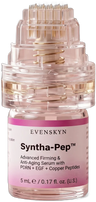
Where our kit fits. The EvenSkyn MicroInfuser pairs a gamma-sterilised, single-use 0.5 mm needle head with a factory-sealed, single-use 5 mL ampoule of Syntha-Pep, our serum, filled in a cleanroom under Good Manufacturing Practice. Syntha-Pep is a PDRN serum first: biosynthetic PDRN is the lead active at a published 0.2% (2,000 ppm), and Copper Tripeptide-1 and sh-Oligopeptide-1 (EGF) are listed 26th and 27th of its 32 ingredients (see the full Syntha-Pep ingredient list). It also lists bitter orange flower oil, an essential oil, 21st of 32. That is why it is not in the picks above: if EGF is the ingredient you want most, choose a growth factor serum from the table for daily use on intact skin; the MicroInfuser is for one session every two weeks. Syntha-Pep does contain sh-Oligopeptide-1, so the skin cancer cautions above apply to the kit too: do not use it on or near an active or recent skin cancer, and ask your doctor first if you have had skin cancer. The kit is also not suitable during pregnancy or breastfeeding; see who should not use micro-infusion.
Pause retinoids and exfoliating acids for 48 hours before a session and keep actives paused until 72 hours after it. See how to use the MicroInfuser for the full routine, and how at-home micro-infusion kits compare if you are choosing one.

Want to try micro-infusion? This is ours.
The EvenSkyn MicroInfuser kit holds four sterile, single-use 0.5 mm needle heads and four sealed 5 mL ampoules of Syntha-Pep, our biosynthetic PDRN serum at 2,000 ppm (0.2%), with sh-Oligopeptide-1 (EGF) and Copper Tripeptide-1 (GHK-Cu) further down the list. One kit is four sessions, one every two weeks. Today's price: $179.98, or $107.99 with code BLACK40 until 30 Nov.
See the MicroInfuser
EGF and growth factor serum questions
What is the best EGF serum?
It depends on the job, because none of these serums has been tested against the others. To try one cheaply, The Ordinary GF 15% Solution is $15.50 USD for 30 mL. For a stated EGF amount, Klairs Midnight Blue Youth Activating Drop says 10 ppm ($30.00 USD for 20 mL). For the shortest ingredient list, Bioeffect EGF Serum has seven ($179.00 USD for 15 mL). For human-derived growth factors, SkinMedica TNS Advanced+ is $295.00 USD list for 30 mL. Prices were read on 5 November 2026.
Is The Ordinary GF 15% Solution any good?
It is the cheapest growth factor serum we compared, at $15.50 USD for 30 mL on The Ordinary's US page on 5 November 2026, with a short list of 12 ingredients and no fragrance listed. Its growth factor ingredients are peptides the brand calls plant-based biomimetic EGF, TGF and IGF peptides, and the 15% describes a solution of those peptides; the page does not say how much of it is the peptides themselves. No study we found tests this product itself.
Is the Medicube EGF NAD+ serum good?
Its US page lists sh-Oligopeptide-1 20th of 64 ingredients with 2.5PPM printed right after it, and lists no fragrance. It was $26.00 USD on medicube.us on 5 November 2026. The page does not state the bottle size, so we could not work out a price per mL. Medicube suggests applying it before its Booster Pro X2 or Booster Mini devices. No study we found tests this product itself.
What does EGF do for skin?
EGF (epidermal growth factor) is a signalling protein that tells skin cells to divide and move, which is part of how skin repairs itself. In a serum, most EGF stays near the surface because it is a large molecule. Small studies report modest improvements in the look of fine lines and texture over a few months, but most were short and small, and many had no comparison group, so expect a gradual change at most.
Is EGF a peptide?
Not quite. EGF is a small protein of 53 amino acids. Its ingredient-list name, sh-Oligopeptide-1, is why it is often filed with peptides, but it is a growth factor rather than a short signal peptide like palmitoyl pentapeptide-4.
What is EGF called on an ingredient list?
Usually sh-Oligopeptide-1, sometimes rh-Oligopeptide-1. Serums based on human cell culture list conditioned media instead, for example Human Fibroblast Conditioned Media, which contains a mix of growth factors rather than EGF alone.
Does EGF serum actually work?
Modestly, on the evidence available. A 2023 systematic review of topical growth factor products found modest gains in the look of fine lines and texture across 33 studies, while a 2021 review of EGF alone found the trials too weak to establish efficacy. It is a reasonable supporting step, not a replacement for a retinoid or sunscreen.
Is EGF better than retinol?
No serum here has been tested against a retinoid. Retinoids have far more evidence behind them for the look of fine lines. If you tolerate a retinoid, it comes first, and a growth factor serum can sit alongside it, for example in the morning with the retinoid at night.
Can EGF in skincare cause cancer?
We found no study showing cosmetic EGF serums cause skin cancer, and a 2023 dermatology review reports no evidence that topical EGF preparations stimulate cancer cell growth. Because it does signal cells to divide, do not use it on or near an active or recent skin cancer, and ask your doctor first if you have had skin cancer.
Does EGF cause hair loss?
The worry comes from sheep: Bioclip, an Australian wool-harvesting method, uses a single injection of EGF to break the wool fibre so the fleece can be removed by hand. That is a whole-body dose in sheep. We found no study showing topical EGF serums cause hair loss in people.
How much EGF should a serum have?
There is no agreed effective amount for topical EGF. Some brands state a figure in ppm (parts per million); 10 ppm is 0.001%. A stated figure helps you compare brands that publish one, but no study has set a minimum dose for serums.
Human growth factors or plant-grown EGF: which is better?
We found no study comparing them head to head. Human-derived conditioned media carries a mix of growth factors; plant-grown or lab-made EGF is a single, defined protein. Some people prefer to avoid human-derived ingredients, so the table shows which type each serum uses.
Can I use an EGF serum after microneedling?
Not through the needles. Anything applied through open micro-channels should be made for that job and come sealed, for a single use, which a bottle you open every day is not. Use a bottled growth factor serum on intact skin, and follow your clinic's aftercare after a professional treatment.
How long does an EGF serum take to work?
In the 2023 systematic review, most products were used twice a day and treatment averaged about three months. Give a serum two to three months of daily use and compare photos taken in the same light before deciding.
Can I use EGF with vitamin C?
We found no published interaction between the two, but follow each brand's directions: The Ordinary says not to use its GF 15% Solution with direct vitamin C. Low-pH vitamin C serums can sting, so if your skin is sensitive, use them at different times of day.
Are Korean EGF serums any good?
Many K-beauty serums list sh-Oligopeptide-1. Judge them the same way as any other: find the growth factor on the list, check for a stated amount and fragrance, and compare price per mL.
Does the MicroInfuser contain EGF?
Yes, listed near the end. Syntha-Pep, the serum sealed in each MicroInfuser ampoule, lists sh-Oligopeptide-1 (EGF) 27th of its 32 ingredients, just after Copper Tripeptide-1. Its lead active is biosynthetic PDRN at 0.2% (2,000 ppm). A kit holds four sessions; the current price is on the product page.
How we compared these products
We read each product's US page, or the named retailer, on 5 November 2026 and recorded the price, size, the growth factor ingredients as listed, any stated amount, their place on the ingredient list, fragrance and essential oils, and the brand's own statements about source and use. SkinMedica's US site returned "Page Not Found" for every page we tried that day, so its row comes from Dermstore. Klairs' product page could not be read, so its row comes from Wishtrend, which Klairs' FAQ names as its stockist. Bioeffect's page shows one price beside two sizes, so we matched it to the 15 mL size using Dermstore's listing. Two products we looked at, Neocutis Bio Serum Firm and Biodroga EGF Serum, were sold out on their brand pages that day, so they are not in the table. Medicube's page showed a "Sold out" label beside an Add to Cart button, and its search results showed no sold-out label, so it stays in. Where a brand does not publish a figure, the table says not stated rather than estimating one.
We did not test these products on skin, run a panel, or receive any of them for free, and we earn nothing from any competitor mention. Brand names identify products only. EvenSkyn makes the MicroInfuser and Syntha-Pep, which are not in the picks and are marked as ours. Prices change often in November, so check the live listing before you buy.
Related reading: PDRN serums and creams compared the same way, PDRN, EGF and GHK-Cu in micro-infusion, and skin boosters at home.
References
- Shin SH, Koh YG, Lee WG, Seok J, Park KY. The use of epidermal growth factor in dermatological practice. Int Wound J. 2023;20(6):2414-2423. PMID 36584669. PMCID PMC10333026. doi:10.1111/iwj.14075
- Cohen S. Epidermal growth factor. Nobel Lecture, 8 December 1986. NobelPrize.org.
- Quinlan DJ, Ghanem AM, Hassan H. Topical growth factor preparations for facial skin rejuvenation: a systematic review. J Cosmet Dermatol. 2023. PMID 37222303. doi:10.1111/jocd.15644
- Miller-Kobisher B, Suárez-Vega DV, Velazco de Maldonado GJ. Epidermal growth factor in aesthetics and regenerative medicine: systematic review. J Cutan Aesthet Surg. 2021;14(2):137-146. doi:10.4103/JCAS.JCAS_25_20
- Schouest JM, Luu TK, Moy RL. Improved texture and appearance of human facial skin after daily topical application of barley produced, synthetic, human-like epidermal growth factor (EGF) serum. J Drugs Dermatol. 2012;11(5):613-620.
- Ratanapokasatit Y, Sirithanabadeekul P. The efficacy and safety of epidermal growth factor combined with fractional carbon dioxide laser for acne scar treatment: a split-face trial. J Clin Aesthet Dermatol. 2022;15(7):44-48. PMID 35942017.
- Bos JD, Meinardi MM. The 500 Dalton rule for the skin penetration of chemical compounds and drugs. Exp Dermatol. 2000;9(3):165-169. PMID 10839713. doi:10.1034/j.1600-0625.2000.009003165.x
- Moore GP, Panaretto BA, Carter NB. Epidermal hyperplasia and wool follicle regression in sheep infused with epidermal growth factor. J Invest Dermatol. 1985;84(3):172-175.
- Costa MA, Freire ES, Andrade MCV, Silva MR, Castañon MCMN, Raposo NRB. Microneedling and epidermal growth factor (EGF) as strategies for the acne scars treatment. Surg Cosmet Dermatol. 2022. doi:10.5935/scd1984-8773.2022140068
- Australian Wool Innovation. Biological harvesting. wool.com, read 5 November 2026. CSIRO. Bioclip biological wool harvesting. CSIROpedia, read 5 November 2026.




发表评论
所有评论在发布前都会经过审核。
此站点受 hCaptcha 保护,并且 hCaptcha 隐私政策和服务条款适用。