


Skin Quality · At-Home Regenerative Skincare
Injectable skin boosters are the fastest-moving idea in aesthetics. Here is what they actually do, what an at-home micro-infusion routine can and cannot copy, and how to choose without wasting money.
The short answer
Skin boosters are injectable treatments that improve skin quality rather than add volume. A clinician places hyaluronic acid, polynucleotides, or peptides into the skin to boost hydration, firmness, and glow. You cannot inject at home, and no at-home tool reaches the depth a clinician does. What you can do at home is micro-infusion: a small stamp of very short needles opens temporary microchannels so a serum of the same active families (hyaluronic acid, PDRN, growth factors, copper peptides) is delivered past the surface instead of sitting on top of it. It is a different, gentler, appearance-focused approach. It costs far less and fits your own bathroom, but it will not replicate an injectable booster.
Executive summary
"Skin booster" is a category, not one product. It covers hyaluronic acid bioremodelling (for example Profhilo), polynucleotide treatments (for example the Rejuran family), and micro-injected mesotherapy. All are placed in the skin by a clinician. Nominative use
The category is shifting from pure hydration toward regenerative actives: polynucleotides and PDRN, peptides, and exosomes. Those same active families now appear in at-home serums. Market reporting
The molecules have real biology. Hyaluronic acid governs skin water content, copper peptide GHK-Cu supports collagen and elastin synthesis, and PDRN engages a receptor tied to tissue repair. Papakonstantinou 2012; Pickart 2018; Squadrito 2017
The catch is delivery. Growth factors, copper peptides, and PDRN are large or water-loving molecules that penetrate intact skin poorly as a plain cream. Micro-delivery measurably improves how much gets in. Li 2015; MS-EGF study; Quinlan 2023
That delivery gap is the honest case for at-home micro-infusion: it is the home method that puts these actives past the surface. It is not, and should not be sold as, a substitute for an injectable booster. Our position
If you want the specific result an injectable delivers, see a qualified clinician. If you want an affordable, repeatable, appearance-level home routine using the same active families, an at-home micro-infusion kit is a reasonable pick. Our position
Estimated annual growth rate for the global skin booster market through 2030, depending on the analyst.
The molecular-weight ceiling often cited for a molecule to cross intact skin efficiently. Many actives sit above it.
Profhilo is not currently approved for injection in the United States, so U.S. searches for an alternative are common. A U.S. approval process was reported to be underway in 2026.
What a skin booster actually is
Start with the word, because it is doing a lot of quiet work. A booster is not a filler. A filler adds structure and volume: it lifts a cheek, sharpens a jaw, plumps a lip. A booster does something less obvious. It is placed into the skin to change the quality of the tissue: hydration, elasticity, smoothness, that hard-to-fake look of skin that holds water well.
Most boosters are built on hyaluronic acid. Hyaluronic acid is the molecule that lets young skin hold onto water, and a 2012 review in Dermato-Endocrinology described it as the key molecule in skin moisture, with a striking capacity to retain water. As skin ages, its hyaluronic acid content and its ability to make collagen both fall. A separate 2006 paper in the American Journal of Pathology documented reduced collagen production in chronically aged skin. Put those two together and you have the plain biology of why skin looks drier, thinner, and less springy over time.
Booster brands answer this in different ways, and the differences matter more than the marketing suggests. A quick, neutral map of the category:
| Approach | Representative names | What it is built on | The idea |
|---|---|---|---|
| HA bioremodelling | Profhilo, SkinVive | High concentration of hyaluronic acid | Hydrate and prompt the skin to firm through a spreading gel placed at set points. |
| Polynucleotides / PDRN | Rejuran family, "salmon DNA" boosters | Purified nucleotide fragments | Support the skin's own repair signalling rather than only adding water. |
| Mesotherapy cocktails | Various clinic blends | HA plus vitamins, amino acids, sometimes peptides | Micro-inject a nutrient blend across an area for glow and texture. |
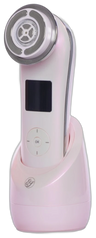
| At-home micro-infusion | EvenSkyn MicroInfuser (ours) | Serum of HA, PDRN, growth factor, copper peptide | Open temporary microchannels at home so a serum is delivered past the surface. Appearance-focused, not an injection. |
Brand names belong to their respective owners and appear here for comparison only. Availability, formulations, and pricing change; verify against each provider's current listing. This table describes categories, not clinical equivalence between them.
Notice the honest line in that last row. Everything above it happens in a clinic, with a needle held by a trained person, placed into the skin. The last row happens at home and stays much shallower. Same active families, very different depth and control. Holding that distinction in mind is the whole point of this guide.
"The key molecule involved in skin moisture is hyaluronic acid, which has a unique capacity for retaining water." Papakonstantinou, Roth & Karakiulakis, Dermato-Endocrinology, 2012
Why boosters exploded, and why the ingredients moved home
Two things happened at once. First, taste changed. A decade of very visible filler pushed a counter-reaction toward looking rested rather than reworked. Boosters fit that mood: subtle, quality-first, no obvious volume. Second, the science moved. The newest boosters lean on regenerative actives, polynucleotides and PDRN, peptides, and exosomes, rather than hyaluronic acid alone. Industry trackers describe exactly this shift toward collagen-stimulating, repair-signalling injectables, with especially fast adoption in Korea.
Here is the part that matters for anyone reading at home. Those same active families are now in over-the-counter serums. PDRN serums, copper peptide serums, growth factor serums, they are all on the shelf. Which raises the obvious question: if the molecule is in a bottle I can buy, why pay a clinic?
The answer is not marketing. It is skin. And it is worth understanding properly, because it is the one fact that tells you whether any at-home approach is worth your money.
The delivery problem: the fact that decides everything
Your skin's outer layer, the stratum corneum, is a barrier by design. It keeps water in and most things out. That is wonderful for survival and inconvenient for skincare, because many of the most interesting actives are exactly the molecules the barrier blocks best: large, or water-loving, or both.
Copper peptide GHK-Cu is a useful worked example. It has more than fifty years of research behind it. A 2018 review in the International Journal of Molecular Sciences catalogued its ability to increase collagen, elastin, and glycosaminoglycan synthesis and to support the function of dermal fibroblasts, the cells that build the skin's scaffolding. A foundational 1988 paper in FEBS Letters had already shown the copper tripeptide stimulating collagen synthesis in fibroblast cultures. The molecule is not in question. Getting enough of it to the right depth from a cream is.
This is where micro-delivery earns its place, and the evidence is specific rather than hand-waved. A 2015 study in Pharmaceutical Research tested microneedle-mediated delivery of copper peptide through skin and found that almost none of the peptide crossed intact skin, while a measurable amount passed through once microneedles had created the channels. Growth factors tell a similar story. In a controlled split-face study, a micro-spicule preparation carrying epidermal growth factor produced significantly greater gains in dermal density and depth than the same growth factor in a plain cream, with the researchers pointing to skin penetration as the limiting factor for topical delivery. A 2023 systematic review in the Journal of Cosmetic Dermatology concluded that topical growth-factor preparations do appear to help facial skin, though largely on the basis of investigator and participant assessments, while noting that the evidence still leans on uncontrolled studies and needs stronger trials.
The evidence chain, laid out honestly
-
Aging skin loses hyaluronic acid and makes less collagen, so it looks drier and less firm. (Papakonstantinou 2012; Varani 2006.)
-
Actives that can help, PDRN, copper peptides, growth factors, hyaluronic acid, have real supporting biology. (Squadrito 2017; Pickart 2018; Maquart 1988.)
-
But most of these molecules cross intact skin poorly as a plain cream. Delivery, not the molecule, is the bottleneck. (MS-EGF study; Quinlan 2023.)
-
Opening temporary microchannels measurably improves how much of these actives reach living skin. (Li 2015; microneedling plus growth-factor trial.)
-
Therefore a micro-infusion approach is a rational way to use these actives at home. It improves delivery versus a serum alone. It does not reach clinic depth, and the studies above are on their own preparations, not on any specific consumer kit. This is a mechanism, not a promise of a result.
That last caveat is not a hedge for legal comfort. It is the truth of the situation, and stating it is how you tell an honest guide from a sales page. Improving delivery is real and worth having. It is not the same as the depth, dose, and precision of a treatment a clinician injects.
Meet the actives, and what each one is really for
The regenerative boosters and the better at-home serums draw from the same short list of ingredients. Knowing what each one does, and where its evidence is strong versus still forming, is the difference between buying on the label and buying on the biology. Here is the honest read on the four that matter most.
Hyaluronic acid: the water molecule
This is the base of most boosters for a reason. Hyaluronic acid is the skin's own humectant, and the 2012 Dermato-Endocrinology review framed it as the key molecule controlling skin moisture, prized for how much water it holds relative to its size. Topically, it plumps the look of skin by drawing in water at the surface. Injected or infused deeper, its role is more structural. It is the least controversial ingredient in the category and the easiest to feel working, because hydration shows up fast. What hydration alone does not do is rebuild the deeper scaffolding, which is where the next three come in.
PDRN and polynucleotides: the repair signal
PDRN, short for polydeoxyribonucleotide, and the broader polynucleotide family are the actives driving the newest generation of boosters. The mechanism is genuinely interesting. A 2017 review in Frontiers in Pharmacology described PDRN as an agonist at the adenosine A2A receptor, a pathway tied to tissue repair, and noted that it also feeds nucleotides into the cell's salvage pathway, the recycling route cells use to rebuild. In plain terms, it is less a passive ingredient and more a signal that nudges repair activity.
Two honest caveats belong here. First, much of the strongest PDRN evidence comes from studies of a registered injectable drug, in clinical or animal settings, rather than over-the-counter serums, and some of that research is authored or funded by parties with a commercial interest in PDRN, so an at-home serum result should be read as appearance-level and not as equivalent to those studies. Second, source matters less than people think. Traditional PDRN is purified from salmon or trout; bioengineered PDRN is made by fermentation. The molecule works through the same biology, but the fermentation route avoids an animal-derived source and can be more consistent. We go deeper on that trade-off in our article on salmon versus bioengineered PDRN.
Copper peptide GHK-Cu: the scaffolding support
If PDRN is the newcomer, GHK-Cu is the veteran, with a research trail going back to the 1970s. The 2018 International Journal of Molecular Sciences review is the one to know: it documents GHK-Cu increasing collagen, elastin, and glycosaminoglycan synthesis and supporting dermal fibroblasts, the cells that build and maintain the skin's structure. The foundational 1988 FEBS Letters paper showed the copper tripeptide stimulating collagen synthesis in fibroblast cultures directly. This is a molecule aimed squarely at the firmness and resilience side of skin quality rather than surface hydration. Its one persistent problem is the one this whole guide keeps returning to: getting enough of it deep enough from a topical. Our dedicated guide to GHK-Cu copper peptides covers the fifty-year trail in full.
Epidermal growth factor: the messenger, with an asterisk
EGF, which appears on ingredient labels as sh-Oligopeptide-1, is a signalling protein involved in how skin cells proliferate and repair. Topical growth-factor serums are popular, and a 2023 systematic review in the Journal of Cosmetic Dermatology found that they do appear to help, though largely on the basis of investigator and participant assessments rather than large controlled trials. The asterisk is delivery, and it is a big one. EGF is a relatively large protein, and in a controlled split-face study a micro-spicule form of EGF produced significantly greater improvement in dermal density and depth than the same EGF in a plain cream, which the researchers attributed to better skin penetration. In other words, EGF is a strong example of an active whose value depends heavily on how it is delivered. Our article on EGF and micro-infusion goes further on this.
Step back and a pattern is obvious. Three of the four most interesting actives, PDRN, GHK-Cu, and EGF, share the same limitation as a topical: they are large or water-loving molecules that the skin barrier holds at the door. That shared limitation is the reason micro-infusion exists as a home format, and the reason the criteria below start with delivery.
How to judge any at-home skin booster
If you are weighing an at-home kit, or deciding between a kit and a clinic, these are the criteria that separate something useful from a gadget. Use them on us too.
Does it actually cross the barrier?
A serum alone mostly sits on top of skin. The reason micro-infusion exists is delivery. If a product promises peptide or PDRN results with no mechanism to get past the surface, be skeptical.
What is actually in the serum?
Look for named, meaningful actives at sensible levels, not a hero ingredient listed last. The interesting boosters combine hydration with repair-signalling actives rather than relying on one.
Is it honest about depth?
At-home tools use very short needles and reach the upper skin. Anything claiming clinic-depth or clinic-equal results at home is overselling. Shallow and consistent still helps; pretending otherwise does not.
Is it safe to run yourself?
Sterile single-use heads, clear contraindications, and an honest allergen list matter more than a long benefit list. A booster you use wrong is worse than one you skip.
What does it cost over a year?
Compare the true annual cost, device plus refills, against repeat clinic sessions plus maintenance. This is usually where an at-home routine makes its clearest case.
Does it tell you what it will not do?
The most trustworthy signal. A product willing to name its limits is usually being straight with you about its benefits too.
Red flags when shopping for an at-home booster
The at-home category attracts marketing that outruns the evidence. A few specific claims should make you slow down and read more carefully, because they usually signal a product hoping you will not ask the delivery question.
Treat these claims with suspicion
- "Clinic results at home" or "as good as an injectable." No at-home device reaches clinic depth. A product that claims equivalence is overstating what short needles can do.
- A hero active with no delivery mechanism. A PDRN or peptide serum with nothing to get it past the surface is mostly selling you a nice moisturiser at an active's price.
- Before-and-after images with no method or timeline. Dramatic photos with no detail on how many sessions, over how long, or under what lighting are decoration, not evidence.
- "Fragrance-free" that is not. Check the ingredient list. If a botanical oil is present, the honest phrase is "no added synthetic fragrance," not "fragrance-free."
- No named allergens or contraindications. A device that never tells you who should not use it is not being cautious on your behalf.
- Vague sourcing. "Advanced peptide complex" with no named actives at no stated levels is a label writing a cheque the formula may not cash.
None of this means at-home tools do not work. It means the trustworthy ones tend to be specific, honest about depth, and clear about who should skip them. Specificity is the tell.
At-home micro-infusion versus injectable boosters
This is the comparison most people actually want, framed neutrally. It is a comparison of categories, not a claim that one replaces the other.
| Injectable boosters (clinic) | At-home micro-infusion | |
|---|---|---|
| Who performs it | A trained clinician | You, at home |
| Depth reached | Into the dermis, precisely placed | Upper skin only, via short microchannels |
| Active dose | Controlled, concentrated | Lower; appearance-level |
| Typical goal | A measured change in skin quality | Support hydration and the look of firmness and glow |
| Cost pattern | Several hundred per session, repeated, plus maintenance | One-time device, then periodic serum refills |
| Downtime and oversight | Clinical setting, professional aftercare | Minimal, self-managed, needs correct technique |
| Best understood as | A medical aesthetic treatment | A cosmetic routine using the same active families |
Brand and treatment names belong to their owners and are referenced for comparison only. Costs are commonly reported ranges that vary by country, clinic, and product; verify locally. Depth and dose descriptions are general and not a statement of clinical equivalence.
Read that table as a fork, not a hierarchy. If your goal is the specific, measurable outcome an injectable delivers, the honest recommendation is a qualified clinician. If your goal is an affordable, repeatable, appearance-focused routine you can run for years using hyaluronic acid, PDRN, growth factor, and copper peptide, an at-home micro-infusion kit is a sensible way to do that. Different jobs.
"Is there an at-home Profhilo?" A straight answer
Short version: no, and it is worth being clear about why. Profhilo is a specific injectable product, placed by a clinician, and in the United States it is not currently approved for injection, which is a large reason people search for an alternative in the first place. A U.S. approval process was reported to be underway in 2026, so that status may change. If you want an in-clinic option that is FDA-approved in the U.S. today, SkinVive by Juvederm is the hyaluronic acid skin-quality injectable that holds that clearance. But nothing you buy for home use is Profhilo or an equal to it.
The useful version: if you cannot or would rather not have injectable bioremodelling, the closest home category is a micro-infusion routine that delivers hyaluronic acid and repair-signalling actives past the surface. It works on skin quality in the same broad spirit, hydration and the look of firmness, at a fraction of the cost and with no needle in a clinic. It will not bioremodel your dermis the way an injectable is designed to. Anyone telling you it will is selling, not informing.
What it costs, honestly
Cost is where an at-home routine tends to make its clearest, least emotional case, so it deserves real numbers rather than a vague "save money" claim. The figures below for clinic treatments are commonly reported ranges; they move a lot by city, clinic, and product, so treat them as a frame and verify locally.
| Route | Commonly reported cost pattern | Over a first year |
|---|---|---|
| Injectable booster course | Several hundred per session; an initial course of two sessions is typical, then maintenance every few months | Often four figures once maintenance is included |
| At-home micro-infusion (ours) | One-time kit, then periodic serum refills | $119.99 for the kit with four serum vials, a two-month supply (as listed September 2026), plus any further serum; no per-session clinic fee |
Clinic figures are commonly reported ranges and are not quotes; verify with providers near you. Our kit price is as listed on evenskyn.com in September 2026 and may change.
The point is not that cheaper is better. It is that the two routes have genuinely different cost shapes. Clinic boosters are a recurring cost tied to appointments. An at-home routine front-loads one device and then costs only refills. For appearance-level upkeep over years, that shape is friendlier to most budgets, which is the democratisation that made at-home devices a category in the first place.
A note on gifting
A skin-quality kit lands well as a milestone gift, a fortieth or fiftieth birthday, a "treat yourself" for a parent who has spent years treating everyone else. It reads as considered rather than generic, and unlike a clinic course it is something the person can keep and use on their own schedule.
One tactful caveat: frame it as a treat, not a fix. An anti-aging device given without being asked for can read as a comment on someone's face. Gift it to people who have said they are curious, and let it be a pleasure, not a hint.
The MicroInfuser Kit, scored
A scorecard, judged by the same criteria above. We keep two dimensions deliberately low, depth versus a clinic booster and speed of visible change, because that is the honest picture of what any at-home tool can do.
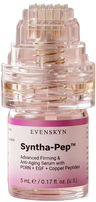
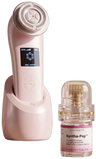
EvenSkyn MicroInfuser Kit with Syntha-Pep
A well-evidenced, affordable at-home delivery routine using the same active families as injectable boosters. Not a substitute for a clinic treatment, and not an instant fix. Overall is the average of the seven dimensions below.
PDRN, GHK-Cu, EGF, and hyaluronic acid each have real, cited literature behind them.
Opening microchannels measurably beats passive application for these molecules.
It reaches the upper skin only. It cannot match injectable depth, and does not try to.
A one-time device plus refills undercuts repeat clinic sessions and maintenance.
Runs on your own schedule with minimal downtime.
Regenerative actives work over weeks of consistency, not overnight.
Straightforward, but it needs correct technique, single-use heads, and respect for the contraindications.
Best for
- An affordable, repeatable, appearance-level routine using booster-family actives.
- Anyone who cannot or would rather not have injectable treatments.
- Home users happy to follow a technique and stay consistent for weeks.
Not the best fit for
- Anyone wanting the specific, measurable result an injectable delivers.
- People expecting an instant, dramatic change.
- Anyone who wants a product carrying a vegan attestation or a finished-formula allergen test, because EvenSkyn holds neither.
If you want our pick
The EvenSkyn MicroInfuser Kit with Syntha-Pep serum
Full disclosure, again: this is our product, and this section is where our commercial interest is most direct. Here is the straight version of what it is and what it is not, using the same criteria we asked you to judge everything else by.
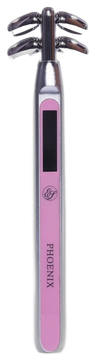
The kit pairs an at-home micro-infusion applicator with the Syntha-Pep serum. EvenSkyn formulates the serum around three named actives, each with the research discussed above: bioengineered PDRN, a growth factor (epidermal growth factor, which appears on ingredient labels as sh-Oligopeptide-1), and the copper peptide GHK-Cu, alongside hyaluronic acid. The design idea is the delivery logic of this whole guide: open temporary microchannels so those actives are delivered past the surface rather than resting on it. These are appearance-focused benefits, the look of firmer, smoother, better-hydrated skin, not medical claims.
What we think it does well
- Uses the delivery mechanism the evidence actually supports, rather than a serum alone.
- Combines hydration with three repair-signalling actives that each have real literature.
- Biosynthetic PDRN, recorded in supplier documentation as not derived from salmon, at a stated level.
- One-time device plus refills, a friendlier cost shape than repeat clinic visits.
- Cruelty-free, with no added synthetic fragrance.
What it will not do
- It is not an injectable and does not replace or equal Profhilo, Rejuran, or any clinic booster.
- It reaches the upper skin, not the deep dermis a clinician targets.
- Regenerative actives work gradually. This is a weeks-of-consistency routine, not an instant result.
- EvenSkyn makes no vegan claim for it, because no formula-level attestation is on file, and holds no allergen testing on the finished formula.
- It is not a treatment for any medical or skin condition. See a professional for those.
How to use micro-infusion at home, and who should not
Technique is most of the safety story with any at-home micro-infusion. The outline below is general good practice; always follow the instructions that come with your specific device.
-
Start clean and calm
Cleanse, and only work on healthy, intact skin. Skip any area that is broken, irritated, sunburned, or breaking out.
-
Patch test first
Test the serum on a small area and wait to rule out a reaction before treating the whole face, especially if your skin is reactive.
-
Use a fresh, single-use head
Sterility is the point. Use a new applicator head each time and never share the device.
-
Apply serum, then infuse gently
Work in sections with light, even passes as directed. More pressure is not more results; it is more irritation.
-
Support the skin afterward
Keep it simple for the rest of the day: gentle, barrier-supporting products, no strong acids or retinoids straight after, and sunscreen the next morning.
-
Space sessions sensibly
Follow the recommended frequency rather than doing more, more often. Skin needs recovery time between sessions to benefit.
Who should not use it, or should ask a professional first
- Anyone with a known allergy to a listed ingredient. Correction, 4 September 2026: this entry previously read fish or shellfish allergy, because the collagen was described as marine. Supplier documentation reviewed in August 2026 does not support that premise: it records the Soluble Collagen as produced by yeast fermentation rather than extracted from animal sources, and the PDRN as biosynthetic and not derived from salmon. Those declarations cover two ingredients, no allergen testing on the finished formula is held, and this is not a statement that the serum is safe with a fish or shellfish allergy.
- Anyone who is pregnant or breastfeeding, without first checking with a healthcare professional.
- Skin that is currently broken, infected, inflamed, sunburned, or actively breaking out.
- People with conditions affecting healing or clotting, keloid-prone skin, or active skin disease, without professional advice.
- Anyone using it as a treatment for a medical or skin condition. It is a cosmetic routine, not a therapy.
For product questions, EvenSkyn support is available Monday to Friday, 9 a.m. to 5 p.m. EST. For anything medical, speak to a qualified professional.
What to realistically expect, week by week
Managing expectations is part of getting a fair result, so here is an honest timeline rather than a promise. Skin renews on its own schedule, and regenerative actives work with that schedule, not around it. Individual results vary, and none of this is a guaranteed outcome.
-
First session to a few days
The most immediate change is usually hydration and a temporary glow, largely from the hyaluronic acid and from freshly infused skin holding water better. This is real but surface-level, and it is not the same as a structural change.
-
Two to four weeks
With consistent sessions at the recommended spacing, people often report skin feeling smoother and looking a little more even. This is the window where a routine either becomes a habit or gets abandoned, and consistency is what decides the outcome.
-
Six to twelve weeks
The actives aimed at firmness, the copper peptide and PDRN signalling, work over a longer horizon because collagen and matrix changes are slow by nature. Any change here is gradual and best judged by photos taken in the same light weeks apart, not by daily mirror checks.
-
Ongoing
Like most skin-quality upkeep, benefits depend on continuing. Stop, and skin gradually returns to its baseline. This is maintenance, not a one-time fix, which is exactly why the one-time-device-plus-refills cost shape matters.
If you want a dramatic, measured change on a fixed timeline, that expectation points toward a clinician, not an at-home device. If you want steady, appearance-level upkeep you can sustain, this is a reasonable way to get it.
Frequently asked questions
What is a skin booster?
A skin booster is an injectable treatment placed into the skin by a clinician to improve skin quality: hydration, elasticity, smoothness, and glow. Unlike a filler, it is not meant to add volume or reshape the face. Most boosters are based on hyaluronic acid, and newer ones add regenerative actives such as polynucleotides or PDRN.
Can you get a skin booster at home?
You cannot inject at home, and no home device reaches the depth a clinician does. What you can do at home is micro-infusion, which uses very short needles to open temporary microchannels so a serum of similar active families is delivered past the skin surface. It is a gentler, appearance-focused routine, not an injectable treatment.
Is there an at-home alternative to Profhilo?
Not a true equivalent. Profhilo is a specific injectable, placed by a clinician, and it is not approved for injection in the United States. The closest home category is a micro-infusion routine that delivers hyaluronic acid and repair-signalling actives into the upper skin. It supports skin quality in a similar spirit at a much lower cost, but it does not bioremodel the deeper skin the way an injectable is designed to.
Do at-home skin boosters actually work?
The honest answer is that they can help at the level of appearance, and the reason is delivery. Research shows that opening microchannels improves how much of actives like copper peptides and growth factors reach living skin compared with a plain cream. That is a real benefit. It is not the same as the depth, dose, and precision of an injectable, and individual results vary.
What is the difference between micro-infusion and microneedling?
Microneedling is mainly about the controlled micro-injury itself, which prompts the skin to repair. Micro-infusion uses the same idea of tiny channels but pairs them with a specific serum delivered at the same time, so the goal is both the channel and what travels through it. In practice, micro-infusion is microneedling with a delivery job attached.
What are polynucleotides and PDRN?
They are purified fragments of nucleotides, the building blocks of DNA, used because they appear to support the skin's own repair signalling. PDRN in particular has been characterised as engaging an adenosine receptor linked to tissue repair. Much of that evidence comes from injectable and clinical settings, so at-home serum results should be understood as appearance-level rather than the same as those studies.
Is bioengineered PDRN better than salmon-derived PDRN?
Bioengineered PDRN is made by fermentation rather than extracted from fish. The main practical differences people care about are consistency and suitability, for example avoiding an animal-derived source. The underlying molecule works through the same biology. We cover this in more detail in our dedicated article on salmon versus bioengineered PDRN.
Does copper peptide GHK-Cu do anything, or is it hype?
It has genuine research behind it, spanning decades, including work showing it can increase collagen, elastin, and glycosaminoglycan synthesis and support the cells that build the skin's scaffolding. The real-world limitation is getting enough of it deep enough from a topical, which is exactly why delivery method matters.
How much do skin boosters cost?
Injectable booster courses are commonly reported at several hundred per session, usually with an initial course of two sessions and then maintenance, which often reaches four figures over a first year. An at-home micro-infusion kit is a one-time device plus periodic serum refills, with no per-session clinic fee. Verify clinic pricing locally, as it varies widely.
Is at-home micro-infusion safe?
It can be, if you use healthy skin only, a fresh single-use head each time, patch test, and follow the recommended frequency. It is not suitable for broken, infected, or inflamed skin, for anyone with a known allergy to a listed ingredient, since no allergen testing on the finished formula is held, or during pregnancy or breastfeeding without professional advice.
How often should I do it?
Follow the frequency your specific device recommends rather than doing more. These actives work gradually and the skin needs recovery time between sessions, so consistency over weeks matters more than intensity in any single session.
Will it replace my other skincare or my dermatologist?
No. Think of it as one delivery-focused step within a routine, not a replacement for barrier care, sunscreen, or professional advice. For any medical or persistent skin concern, a qualified professional is the right call.
How we researched this, and how to read our claims
Every health and biology claim here is tied to a specific cited source, and each source was checked against its original publication rather than a summary. We separate two kinds of statement. Findings from peer-reviewed research are attributed to that research and describe the molecule or the mechanism, not our product. Statements about the EvenSkyn MicroInfuser and Syntha-Pep serum are our own manufacturer claims, are appearance-focused, and are labelled as ours.
We also flag where the evidence carries commercial ties, because that context matters. The main PDRN pharmacology review was written by researchers who have disclosed research funding from a PDRN manufacturer. The most-cited copper peptide reviews are by the scientist who discovered GHK-Cu and who develops copper-peptide products. Two of the growth-factor studies were open-label and industry-funded. None of that makes their findings wrong, but it is part of why this guide leans hardest on the more independent skin-penetration research, the studies that simply measure whether these molecules cross skin, when it makes the delivery argument. Where a clinic treatment is the better route, we say so. Product specifications should always be confirmed against the current product page before purchase. This guide is general information, not medical advice.
References
- Papakonstantinou E, Roth M, Karakiulakis G. Hyaluronic acid: a key molecule in skin aging. Dermato-Endocrinology. 2012;4(3):253 to 258. doi:10.4161/derm.21923. PMCID: PMC3583886.
- Varani J, Dame MK, Rittie L, et al. Decreased collagen production in chronically aged skin. American Journal of Pathology. 2006;168(6):1861 to 1868. PMCID: PMC1606623.
- Squadrito F, Bitto A, Irrera N, et al. Pharmacological activity and clinical use of PDRN. Frontiers in Pharmacology. 2017;8:224. doi:10.3389/fphar.2017.00224. PMCID: PMC5405115.
- Pickart L, Margolina A. Regenerative and protective actions of the GHK-Cu peptide in the light of the new gene data. International Journal of Molecular Sciences. 2018;19(7):1987. doi:10.3390/ijms19071987. PMID: 29986520. PMCID: PMC6073405.
- Pickart L, Vasquez-Soltero JM, Margolina A. GHK peptide as a natural modulator of multiple cellular pathways in skin regeneration. BioMed Research International. 2015;2015:648108. doi:10.1155/2015/648108. PMID: 26236730. PMCID: PMC4508379.
- Maquart FX, Pickart L, Laurent M, Gillery P, Monboisse JC, Borel JP. Stimulation of collagen synthesis in fibroblast cultures by the tripeptide-copper complex glycyl-L-histidyl-L-lysine-Cu2+. FEBS Letters. 1988;238(2):343 to 346.
- Li H, Low YSJ, Chong HP, et al. Microneedle-mediated delivery of copper peptide through skin. Pharmaceutical Research. 2015;32(8):2678 to 2689. doi:10.1007/s11095-015-1652-z. PMID: 25690343.
- Hostynek JJ, Dreher F, Maibach HI. Human skin penetration of a copper tripeptide in vitro as a function of skin layer. Inflammation Research. 2011 Jan;60(1):79 to 86.
- Quinlan DJ, Ghanem AM, Hassan H. Topical growth factor preparations for facial skin rejuvenation: a systematic review. J Cosmet Dermatol. 2023;22(7):2023 to 2039. doi:10.1111/jocd.15644. PMID: 37222303.
- Schouest JM, Luu TK, Moy RL. Improved texture and appearance of human facial skin after daily topical application of barley produced, synthetic, human-like epidermal growth factor serum. Journal of Drugs in Dermatology. 2012;11(5):613 to 620. PMID: 22527430.
- Ha J, et al. The effect of a micro-spicule containing epidermal growth factor on periocular wrinkles: a randomized controlled split-face study. Ann Dermatol. 2017;29(2):187 to 193. doi:10.5021/ad.2017.29.2.187. PMID: 28392646. PMCID: PMC5383744.
- An assessment of microneedling with topical growth factors for facial skin rejuvenation: a randomized controlled trial. J Clin Aesthet Dermatol. 2020;13(11):37 to 45. PMCID: PMC7716740.
- Draelos ZD. The effect of a combination of recombinant EGF cosmetic serum and a crosslinked hyaluronic acid serum as compared to a fibroblast-conditioned media serum on the appearance of aging skin. Journal of Drugs in Dermatology. 2016;15(6):738 to 741. PMID: 27272082.
Editorial log: Published July 2026. Updated September 2026 to add the listed kit price and remove pre-publication notes. 18 September 2026: updated the MicroInfuser price to $119.99 (list $189.99), $30.00 a treatment. Reviewed by the EvenSkyn Skin Science Desk. All 13 cited sources were verified against their original PubMed or publisher records at the time of writing. Regulatory and market figures were current as of July 2026; Profhilo's U.S. approval status in particular is changing, so check the current position before relying on it. Competitor and cost figures are from listings current at the time of writing and may have changed.


Leave a comment
All comments are moderated before being published.
This site is protected by hCaptcha and the hCaptcha Privacy Policy and Terms of Service apply.