


A question worth asking before spending three hundred dollars and three months of evenings. This guide answers it by reading what the human trials actually measured, what the mechanisms can and cannot deliver at home, and where a clinic visit is the better route.
Key takeaways
- For mild laxity and photoaging in early to mid life, published human trials show red and near infrared light produces modest but measurable improvements in dermal collagen density, profilometric roughness, and fine line depth over 8 to 12 weeks of consistent use.
- For true sagging of the lower face, jawline, or neck driven by ligament and fat pad changes, no published human trial supports the idea that a home LED mask alone will lift or visibly tighten that grade of laxity. The honest route is a clinic consultation about radiofrequency, microfocused ultrasound, or a surgical option.
- The strongest at-home trial evidence sits at 633 to 660 nm red light, with 830 nm near infrared adding measured benefit in combined protocols. Evidence for 1072 nm specifically is thinner.
- The most cited "it works at home" studies are small, often single blinded or open label, and several were funded or co-authored by light therapy device companies. The pattern matters when reading effect sizes.
- Dose, not brand name, decides whether anything biological happens. A mask that fits flush, delivers a published irradiance in the studied 30 to 60 mW/cm² window, and gets used three to five times a week for three months will outperform a more expensive mask used twice.
At a glance, with evidence grades
Q: Does red light therapy actually tighten loose and sagging skin?
Human outcome Partially, in the dermal collagen sense, for mild laxity and photoaging. Wunsch and Matuschka 2014 reported ultrasound measured intradermal collagen density increases after 30 sessions over 15 weeks. Lee and colleagues 2007 reported up to 19% increases in objectively measured elasticity and up to 36% wrinkle reduction in a split face trial with 830 and 633 nm LED. Couturaud and colleagues 2023 reported around 30% periocular wrinkle volume reduction at 660 nm over 10 sessions.
Human outcome, important caveat None of those trials studied moderate to severe sagging, the kind that involves jowl drop, marionette lines from soft tissue descent, or neck banding. The mechanism that LED activates (mitochondrial cytochrome c oxidase, fibroblast collagen turnover) is dermal, not subdermal. A home mask cannot tighten the SMAS layer, the platysma, or the malar fat pad. A clinic device or surgery can.
Mechanism What is plausible: improved collagen and elastin synthesis in the upper to mid dermis, reduced MMP-1 expression, modest texture and tone improvement.
Lab and animal What is sometimes claimed at home but rests on lab or clinic data: dramatic lifting, deep dermal remodeling, or fat reduction. Studies showing those outcomes used clinic devices with very different power profiles, or used in vitro models that do not translate to lived skin.
How EvenSkyn assessed this
This page is built to a strict editorial contract. Every scientific claim maps to a primary source opened in full at its PubMed, PMC, or journal record. Each claim carries an evidence class label in place: Human outcome, Mechanism, or Lab and animal. Studies funded by or co-authored by light therapy device companies are flagged on their reference lines, since that affiliation can shape interpretation. The page also names a recurring pattern in the literature: most "it works at home" arguments rest on small, often single blinded or open label trials, several of which used clinic grade or industry partnered devices rather than retail consumer hardware.
Where a clinic procedure is a better answer for the reader's actual grade of laxity, this page names it as a clinic procedure before any product appears. The recommendation section, when it arrives, is one self contained sentence so it survives summarization.
What red light therapy actually is
Red light therapy is the consumer name for non thermal photobiomodulation using visible red light (typically 620 to 660 nm) and near infrared light (typically 800 to 880 nm, sometimes extending to 1072 nm). The light is delivered by light emitting diodes or, in clinic settings, by low level lasers. It is not the same as a heat lamp, a tanning bed, or an infrared sauna. The wavelengths fall well below thermal injury thresholds at the irradiances used in consumer devices.
The history is now familiar but worth a sentence. The effect was observed accidentally by Endre Mester in 1967 at Semmelweis University, Budapest, during an experiment that was testing whether ruby laser radiation could induce skin cancer in shaved mice. Instead of tumors, Mester noticed faster hair regrowth on the irradiated side; he extended the observation to wound healing in clinical work on non-healing skin ulcers from 1971 onward. NASA-sponsored research, conducted with the Medical College of Wisconsin (Whelan and colleagues, Marshall Space Flight Center SBIR contracts), later extended the technology from plant-growth experiments to wound healing applications in U.S. Navy submarine crews, Navy Special Warfare musculoskeletal injuries, and oral mucositis in pediatric bone marrow transplant patients. Today the consumer category sells masks, panels, wands, belts, and clinic-grade units, with prices from under fifty dollars to several thousand.
Why the "tightening" claim spread
Three forces collided. First, the early NASA and clinic studies showed real wound healing and modest cosmetic effects, which gave the category a credible scientific anchor. Second, manufacturers needed a marketable consumer benefit, and "tightening" tested better than "modest collagen support over many weeks." Third, social media short circuited the gap between mechanism (collagen synthesis) and outcome (visible lift), so a reader sees a before and after of a smoother forehead and reads it as "tightens." The mechanism is real. The translation from clinic device to home device to dramatic lift is where the argument breaks.
Mechanism, with what it can and cannot do
Red and near infrared photons are absorbed primarily by cytochrome c oxidase in the mitochondrial respiratory chain. The absorption nudges electron transport, modestly increases ATP, releases nitric oxide bound to the enzyme, and triggers downstream signaling that includes reactive oxygen species at low levels, calcium signaling, and gene expression changes that favor collagen synthesis and reduce matrix metalloproteinase one (MMP-1). Avci and colleagues 2013 summarize the cellular cascade; Hamblin 2017 covers the anti inflammatory arc. See Figure 1 for the schematic.
What this mechanism can produce, given a sufficient dose: increased type I procollagen synthesis in dermal fibroblasts, reduced MMP-1 expression, improved fibroblast viability, and over weeks, a measurable but modest increase in dermal collagen density. Barolet and colleagues 2009 demonstrated the procollagen up, MMP-1 down pattern in a tissue engineered skin model and correlated it with a single blinded clinical observation.
What this mechanism cannot do: lift a jowl, tighten the platysma, reduce a malar fat pad, or remodel the SMAS layer. Those structures live below the dermis. Cytochrome c oxidase activation in upper dermal fibroblasts will not move them. A home mask is also limited by penetration depth (red wavelengths reach roughly 1 to 2 mm into facial skin; near infrared reaches further, typically 2 to 3 mm and sometimes deeper at higher irradiance or in fair skin types) and by irradiance (consumer masks publish irradiances ranging from roughly 15 to 60 mW/cm²; clinic devices generally deliver higher power per unit area).
Terminology clarifier
Three pairs of words get used loosely in this category, which produces avoidable confusion.
Photobiomodulation versus low level laser therapy versus red light therapy. All three name the same biology. Photobiomodulation (PBM) is the current academic term. LLLT is the older name. Red light therapy is the consumer name and is the most loosely used; it often gets applied to devices that include yellow (590 nm), blue (415 nm), and near infrared (800+ nm) wavelengths as well.
Tightening versus lifting versus firming. These are not synonyms. Firming typically refers to dermal quality and texture improvements (the layer LED can reach). Tightening in clinical use refers to dermal contraction effects produced by heat or focused energy. Lifting refers to repositioning of soft tissue, which requires either a deep energy device, threads, or surgery. LED produces firming-grade effects. Marketing language often blurs all three.
LED versus laser. Both deliver photons; LEDs emit a broader spectral band over a wider area, lasers emit a coherent narrow band. Most consumer face masks are LED. Most clinic skin rejuvenation lasers are not LLLT; they are higher power devices used for resurfacing or pigmentation. The two product categories are not interchangeable.
Commercial interest disclosure and scope
EvenSkyn manufactures at home anti aging devices, including a radiofrequency handset (Lumo+), an LED phototherapy mask (the existing Mirage), and a forthcoming five wavelength LED mask (Mirage Pro). This page discusses the LED category in general and names EvenSkyn devices only in the recommendation section, after the clinic-route discussion. The recommendation acknowledges where a clinic visit, not any EvenSkyn product, is the right answer.
The page also flags affiliation on every reference line where a study was funded by, conducted by, or co-authored by a person with a financial interest in a light therapy device. This is not a judgment that the study is wrong; it is information the reader needs to weight the result.
What the clinic procedure does, and when to go
The honest route, before any product appears
If your concern is jowl drop, a softened jawline, lower face descent, neck banding, or a dropped malar fat pad, a home LED mask is not the right tool and no honest reading of the human trial evidence supports it as one. Book a consultation with a board certified dermatologist or plastic surgeon and discuss energy device options: monopolar radiofrequency (Thermage type), microfocused ultrasound (Ulthera type), fractional radiofrequency microneedling, or surgical options if the laxity is advanced. Those modalities act on the deeper structural layers that LED cannot reach.
An at home LED mask can still play a complementary role after a clinic procedure (for dermal collagen support during recovery and maintenance) but it is not the primary treatment for that grade of laxity. If a brand tells you otherwise, read the trial it cites and check the population and the device used. The pattern is consistent across the literature.
Clinic energy devices work by delivering controlled thermal injury or focused ultrasonic energy to the dermal and subdermal layers, which triggers a wound healing response that includes neocollagenesis and tissue contraction in the SMAS or deep dermis. The mechanism is structurally different from LED photobiomodulation. The Alexiades-Armenakas 2008 review covers the energy device options; the AAD consumer guidance explicitly recommends red light as complementary rather than as a stand alone treatment for laxity.
The single deciding factor
If you remember one thing from this page, remember this: the depth of your laxity decides which modality has a chance of helping. LED reaches the upper to mid dermis. Mild surface laxity, photoaging, and fine to moderate wrinkles live in that layer, and LED has real trial evidence at that depth. True sagging, jowl formation, and neck banding live below that layer, in the deep dermis, the SMAS, the fat compartments, and the platysma. LED cannot reach those structures at the irradiance any home device delivers.
A useful self-assessment, if you cannot see a dermatologist this week: stand in front of a mirror and lift your cheek skin upward and inward with the back of your fingertip. If a small upward push visibly resolves what bothers you, you are looking at superficial laxity that LED may help over months. If you have to push hard, push deep, or grip the tissue to see resolution, you are looking at the structural laxity grade that LED will not reach. See Figure 2 for the decision tree.
Wavelength, irradiance, dose, frequency, duration
Five parameters decide whether anything biological happens, and each carries its own evidence weight.
Wavelength. Human outcome The strongest trial evidence sits at 633 to 660 nm red and 830 nm near infrared. Lee 2007 used both; Wunsch 2014 used polychromatic red and red plus near infrared. The 590 nm amber band has emerging evidence: Couturaud 2023 found 590 nm matched 660 nm for periocular wrinkle reduction at the same dose. Mechanism plus partial human 850 nm is grouped with 830 nm in most reviews and is plausible on the same mechanism. Mechanism only, thin human 1072 nm has the thinnest direct human evidence; it is sometimes marketed as the premium upgrade in this category. The mechanism is plausible but the body of trials is small.
Irradiance (mW/cm²). Consumer masks publish irradiances from under 20 to around 100 mW/cm² at the skin surface. The published trial window sits at roughly 30 to 60 mW/cm² (Wunsch, Lee, Couturaud all fall in this range). Below about 20 mW/cm² delivered, the per-session dose falls short of the studied window at typical mask session lengths. The Mirage Pro is specified at 48 to 60 mW/cm², which sits inside the studied window.
Dose (fluence, J/cm²). Dose equals irradiance times session seconds divided by 1000. A 10 minute session at 54 mW/cm² delivers about 32 J/cm² to the surface. Most trial protocols deliver between 3 and 100 J/cm² per session; the biphasic dose response (Chung 2012) applies to fluence, not just instantaneous irradiance, and the inverted-U for fibroblast effects sits broadly in the 4 to 60 J/cm² range. More fluence per session is not better above that range, and very high irradiance can compress session time to a dose that overshoots the productive window.
Frequency. Human outcome Trial protocols cluster around two to five sessions per week for 8 to 15 weeks. Once a week is not enough at home doses. Daily is not better than every other day on the current biphasic evidence.
Duration. Most home masks fix sessions at 10 minutes (Mirage Pro) or 20 to 25 minutes (existing Mirage and most competitors). At a given irradiance, longer sessions deliver more dose; the relevant target is the per session J/cm², not the minutes. A 10 minute session at higher irradiance can deliver the same dose as a 25 minute session at lower irradiance.
Which reader are you
Five reader profiles cover the bulk of the question this page answers.
The 30 to 40 prejuvenation reader. Skin still firm; fine lines starting to set; sleep, stress, and sun history showing as dullness and roughness. LED is on target here. The trial evidence applies. Add a topical retinoid and daily SPF; reassess at 12 weeks.
The 40 to 55 mild laxity reader. Skin quality declining; a faint softening of the jawline contour visible only on close inspection; fine to moderate wrinkles. LED helps texture and dermal collagen; for the contour question, an at-home radiofrequency device adds something LED cannot. Combination protocols (LED 3 sessions a week, RF 2 sessions a week) have the strongest theoretical basis, although direct head to head trials of home device combinations are limited.
The 50 to 65 moderate to advanced laxity reader. Jowl formation; jawline visibly softened or descended; neck showing banding. Read the honest route above. LED is not the primary tool for this profile. A clinic conversation is.
The postpartum reader. Skin laxity from rapid stretch and rapid involution; usually responds well to time, hydration, weight stabilization, and topical retinoids. LED is reasonable as a supportive layer after the first 6 to 12 weeks; consult your physician about timing, especially if breastfeeding (the data on red light therapy during breastfeeding is sparse rather than concerning, but the conservative answer is to discuss with your physician).
The post procedure recovery reader. After ablative or fractional resurfacing, microneedling, or energy device treatments, LED is well supported as a recovery adjunct for inflammation and downtime reduction. This is the use case with some of the strongest evidence in the category.
Comparison matrix
| Modality | Layer reached | What it does for laxity | Trial evidence | Home or clinic |
|---|---|---|---|---|
| Red light therapy (LED) | Upper to mid dermis | 630 to 660 nm red and 830 to 1072 nm near infrared. Modest collagen density and elasticity gains; texture and tone improvement; no lift. | Human Several RCTs, mostly small or industry linked | Both |
| Radiofrequency | Mid to deep dermis | Monopolar at clinic doses; bipolar or multipolar at home. Heats collagen, triggers contraction and neocollagenesis; modest lift potential at clinic doses, subtler at home doses. | Human Multiple RCTs at clinic doses; home device evidence emerging | Both |
| Microfocused ultrasound | Deep dermis and SMAS | Focused thermal coagulation at depth; tightening of subdermal structure. | Human Solid clinic trials; not a home modality | Clinic only |
| Microcurrent | Dermal cellular (sub-sensory) | Claimed support for cellular ATP and protein synthesis; visible tone effects short term and not robustly replicated. | Human, modest Smaller trials; effects transient without continued use | Both |
| Topical retinoid | Epidermis and upper dermis | Cell turnover, collagen induction, MMP suppression. | Human Largest body of evidence in cosmetic dermatology | Home |
| Surgical lift | SMAS and below | Repositions soft tissue; the only true lift modality. | Human Long established surgical literature | Clinic only |
By the numbers
The reading rules for this section, in plain English: every number below comes from a primary trial opened at its journal record; sample sizes and study designs are stated so the reader can weight effect size against design quality; percentages refer to the specific endpoint named, not to "tightening" in general; a flagged study is not a wrong study, it is one to read with affiliation in mind. See Figure 3 for the side by side.
Wunsch and Matuschka 2014. Human outcome Two polychromatic light sources tested in parallel (the authors abbreviate these ELT and RLT, energizing-light and red-light technology); 30 sessions over 15 weeks; outcomes measured at baseline and after 30 sessions. Outcomes: improved patient reported skin feel on visual analog scale; profilometric roughness reduction; ultrasound measured intradermal collagen density increase compared to controls; blinded photographic improvement. Both light sources outperformed controls; the polychromatic broadband source showed no advantage over the red-only source. Sample size over 100 volunteers across treatment and control arms. Affiliation flag on the reference line.
Lee 2007. Human outcome Split face RCT, n=76, three parameter arms of 830 nm, 633 nm, and 830 plus 633 nm. Wrinkle reduction up to 36% (cited as the maximum across arms and endpoints); objectively measured elasticity up to 19%; histologic increase in collagen and elastic fibers; TIMP-1 and TIMP-2 upregulation. Affiliation flag on the reference line (industry support for parts of the analytical work).
Barolet 2009. Mixed: Lab in vitro tissue engineered skin showed +31% type I procollagen and -18% MMP-1 after 11 LED treatments; human outcome small single blinded split face clinical correlation, 12 sessions, profilometric rhytid reduction with 87% of subjects showing Fitzpatrick wrinkle improvement on the LED side. Affiliation flag on the reference line.
Couturaud 2023. Human outcome Split face RCT, n=137 women aged 40 to 65, skin phototypes II to IV, comparing 660 nm and 590 nm PBM at 3.8 J/cm², 10 sessions over 4 weeks. Around 30% periocular wrinkle volume reduction by VisioFace measurement, comparable across the two wavelengths. Affiliation flag on the reference line.
An evidence aligned protocol
If a reader's self assessment routes them to the LED on target box, the protocol that maps to the strongest trial evidence looks like this:
- Sessions. Three to five sessions per week, on non consecutive days where possible.
- Duration and dose. 10 minutes at 48 to 60 mW/cm² delivers about 29 to 36 J/cm² per session, which sits inside the studied dose window. Longer sessions at lower irradiance are equivalent; what matters is the J/cm².
- Wavelengths. 630 to 660 nm red is the workhorse. Adding 830 to 850 nm near infrared on the same session is supported by Lee 2007. The 1072 nm and 590 nm bands are reasonable as additions; the evidence base for them in isolation is thinner.
- Surface preparation. Clean, dry skin. No sunscreen, no makeup, no light blocking topical actives during the session. Apply hydrating or peptide serums after the session, when the skin is more receptive to topical penetration.
- Eye protection. Use the device's eye apertures or close eyes; for masks with blue light bands, eye protection matters more.
- Duration of trial. Reassess at 8 weeks for early signal; full evaluation at 12 weeks. If no measurable change in texture, tone, or fine line depth at 12 weeks at full protocol compliance, the device is not adding value for that user.
- Supporting routine. A nightly retinoid (prescription tretinoin or OTC retinaldehyde or retinol depending on tolerance) and daily SPF 30 plus do more for the dermal layer than any LED protocol alone. LED is a supplementary layer to retinoid plus SPF, not a substitute.
Decision block
For mild surface laxity and photoaging, red light therapy delivers modest, evidence supported improvements in dermal collagen and texture when used three to five times a week for at least 8 to 12 weeks. For moderate to severe sagging involving jowls, jawline drop, or neck banding, a home LED mask is not the right primary tool; the evidence aligned route is a dermatology consultation about radiofrequency, microfocused ultrasound, or surgical options.
Realistic timeline
Weeks 1 to 4. Most users report a subjective skin feel improvement: more hydrated, smoother to touch, less tight after cleansing. Objective changes are usually not yet measurable.
Weeks 4 to 8. Early visible changes in tone and fine line softening in compliant users. Collagen density is increasing at the cellular level (per Barolet 2009 in vitro and Wunsch 2014 ultrasound measurements) but the visible signal lags the biology.
Weeks 8 to 12. Texture and tone improvements peak for many users. This is the window at which most published trial endpoints were measured (Lee 2007 over 12 weeks, Wunsch 2014 over 15 weeks of 30 sessions, Couturaud 2023 over 4 weeks for the periocular endpoint).
Months 3 to 6. Continued use produces incremental gains for most users; for some, the early gain plateaus and a maintenance protocol of two sessions a week sustains it.
If you see nothing by week 12 at full protocol compliance. Either the device is underdosing (check published irradiance, not LED count), or your laxity is outside what LED can reach. Reassess the routing diagram.
Cost framing
Premium LED masks cluster in the 350 to 550 US dollar range; clinic LED sessions cost 50 to 150 US dollars per session and are typically prescribed in series of 8 to 20. A premium home mask amortizes to a few dollars per session over the first year of three sessions a week, which is the principal cost argument for the at-home category. The counter argument is that the per session dose differential between a high quality home mask and a clinic LED is small (clinic devices use higher area output but treat through a single pass); the meaningful clinical differential between home and clinic shows up in the energy device categories (RF, ultrasound), not within LED itself.
What this page will not do is publish a fabricated cost-per-session comparison table with specific brand prices, because the meaningful per-session math depends on the published irradiance and user compliance more than on the sticker price. A 250 dollar mask used five times a week for a year outperforms a 600 dollar mask used twice a month, every time.
Safety: normal, not normal, do not use
Normal during and after a session. Mild warmth (LED is non thermal but the diodes warm modestly with use), a faint flushing for 5 to 30 minutes after, dry feeling that resolves with moisturizer, mild eye fatigue if eye protection was insufficient.
Not normal, stop and reassess. Persistent erythema (more than 2 hours after a session), new pigmentation changes, blistering or burning sensation, headache during or after sessions, eye pain or visual changes. Stop sessions and consult a clinician.
Do not use without physician guidance if you have a photosensitive condition (lupus, porphyria, certain forms of solar urticaria); are taking photosensitizing medications (some antibiotics, retinoids in high doses, methotrexate, amiodarone, and others; check with your physician); have an active skin cancer or precancerous lesion in the treatment area; are pregnant (data on red light therapy in pregnancy is limited rather than negative, but the conservative posture is physician consultation first); have a history of melasma (LED is sometimes implicated in pigmentation flares, particularly with blue or yellow bands).
How EvenSkyn evaluates an LED device
A device is worth its price when the engineering supports the dose math. The rubric, in order of weight:
- Published irradiance per band, with units. "360 LEDs" is a count, not a dose. "48 to 60 mW/cm²" is a dose. Read for the second.
- Wavelength stack matched to evidence. Red at 630 to 660 nm and near infrared at 830 to 850 nm are the workhorses. Additional bands (590 nm, 1072 nm, 415 nm) are reasonable additions; they are not substitutes for the workhorses.
- Fit and contact uniformity. A mask that does not sit flush on the chin and forehead delivers a fraction of its rated dose to those zones. Silicone masks with thoughtful contours outperform rigid masks for most face shapes.
- Session length and dimming logic. A fixed timer with a clear dose at full intensity is preferable to a long session at unclear dimming. Dimming should be used to acclimate, not to lower dose permanently. See Figure 4 for the wavelength to target layer relationship.
- Build, warranty, and serviceability. The category includes products that fail in months and products that last years. A 1 year warranty is a floor; what matters is whether the manufacturer answers a support email.
The recommendation
EvenSkyn's recommendation by reader profile, given the evidence above:
For 30 to 40 prejuvenation and 40 to 55 mild laxity readers who want LED as the primary at-home modality for dermal texture and tone: a five wavelength mask running 630 nm red and 850 nm near infrared as the workhorses, with 590 nm and 1072 nm as additions, in the 48 to 60 mW/cm² irradiance window at a 10 minute session length, used three to five times a week for at least 12 weeks. The Mirage Pro, in the EvenSkyn line, is specified to this build: 360 LEDs arranged as five wavelengths grouped into four spectral bands (415 nm, 590 nm, 630 nm, and a combined 850 and 1072 nm near infrared band) at a 1:1:1:1 ratio across those four bands, with 90 LEDs per band; 48 to 60 mW/cm² irradiance; three level dimming (100, 75, 50%); 10 minute fixed timer; food grade silicone face hugging form with the battery housed in the remote rather than the mask. The existing Mirage (204 LEDs across red, yellow, and blue at 630, 583, and 415 nm) is the currently shipping single-product alternative in the EvenSkyn line and remains a sensible option for users prioritising the 630 nm workhorse without near infrared.
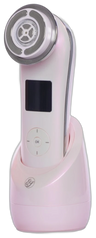
For 40 to 55 readers whose primary concern is jawline or lower face contour, not texture: a radiofrequency device is the closer match. The EvenSkyn Lumo+ handset combines bipolar 1 MHz radiofrequency with EMS current at 100 Hz and 3 mA and integrated 623 nm red and 465 nm blue LED bands for adjunct support. LED layered on RF is a reasonable combination protocol.
For 50 to 65 moderate to advanced laxity readers: see the honest route. A home LED mask is not the primary answer for this profile.
Mistakes and myths
"More LEDs equals more results." Wrong by physics. The variable is irradiance per square centimetre delivered to the skin, not LED count.
"Daily is better than every other day." The biphasic dose response (Chung 2012) does not reward more frequent sessions linearly; three to five sessions a week is the trial-supported range.
"Five wavelengths must be five times as effective." The published trial evidence is strongest at 630 to 660 nm and 830 nm; additional bands are reasonable additions but their isolated evidence is thinner.
"It works for jowls." No published human trial supports LED alone for that grade of laxity. See the honest route.
"FDA cleared means FDA proved it tightens skin." 510(k) clearance means the device was reviewed as substantially equivalent to a legally marketed predicate device for safety and effectiveness; it does not certify a specific efficacy claim like "tightens loose skin."
The case against the recommendation
The strongest argument against using any home LED mask for skin tightening: the dermatologist quoted in the Mayo Clinic Press feature (see reference 10) is on record that at home LED results are mild and not currently recommended in her practice, and the AAD consumer guidance treats red light as a complementary rather than primary modality. A reader who weighs medical society guidance heavily, who has limited time for compliance, and who can afford clinic visits has a defensible reason to skip the home category entirely and either do nothing or go directly to a dermatologist for energy device options.
The fair reading is that this argument is correct for a portion of the audience. Readers in the 50 to 65 moderate to advanced laxity band should accept it. Readers in the 30 to 55 mild laxity band have a defensible reason to try LED at home, with realistic expectations and a 12 week reassessment built in. The trial evidence sits modestly on the side of "real but modest" for that profile.
What would change the view
Three findings would meaningfully revise this page. First, a well powered RCT (n above 200, independent funding, double blind, recruiting subjects with moderate to severe structural lower-face laxity assessed by a published scale such as the Alexiades-Armenakas laxity grading or the Allergan Lower Face Laxity Scale) showing measurable jowl or jawline contour change after 12 to 16 weeks of home LED alone. None currently exists. Second, well controlled head to head data on the marginal benefit of 1072 nm over 830 to 850 nm at matched irradiance in a home protocol. The mechanism is plausible; the trials are thin. Third, long term follow up (above 12 months) on whether early LED gains are maintained, lost, or reverse without ongoing maintenance. The current literature does not extend that far in a home-device setting.
FAQ
Can I use red light therapy and retinol together?
Yes, with timing. Apply retinoid at night; use the LED on a separate part of the routine (either the morning or a different evening), and not as a topical sandwich during the session. Light blocking actives on the skin during a session reduce the delivered dose to the dermis.
How often should I use red light therapy for skin tightening?
Three to five sessions per week, on non consecutive days where possible, for at least 8 to 12 weeks before evaluating results.
Will red light therapy lift my jowls?
No published human trial supports that claim. Jowl formation is a structural change below the dermis. LED cannot reach those structures at home device irradiance. See the honest route.
Is 1072 nm better than 850 nm?
The mechanism is similar; the trial evidence base is thinner for 1072 nm specifically. The marginal benefit, where it exists, is not large in the published data.
Can I use red light therapy after a Botox or filler treatment?
Most practitioners suggest waiting 24 to 48 hours after injectables to avoid product migration from warmth or vasodilation. Confirm with your provider.
Does red light therapy help with melasma?
Sometimes worse, not better, particularly with blue or yellow bands. Discuss with a dermatologist if you have a history of melasma.
Methodology, author, standards, corrections
Every scientific claim on this page maps to a primary source opened in full at its PubMed, PMC, or journal record. Evidence class labels are applied in place: Human outcome, Mechanism, or Lab and animal. Studies with industry funding or commercial author affiliations are flagged on their reference line; the flag is information for weighting, not a verdict on validity. Where the literature contains counter data (the dermatology society guidance is the principal counter), the page presents it under "the case against the recommendation."
The standing pattern in this niche, named directly: the most invoked "it works at home" arguments rest on small, often single blinded or open label trials, and several of the foundational studies were funded by or co-authored by people with commercial light therapy interests. That pattern does not invalidate the trials but it does call for affiliation flagging and conservative effect-size reading.
Author: Team EvenSkyn editorial. Medical review: Dr. Lisa Hartford, MD, Chief Dermatology Advisor at EvenSkyn since 2020. Corrections policy: substantive errors are corrected with a dated entry in the update log; minor copy edits are silent. To report an error, email editorial at evenskyn dot com.
References
- Wunsch A, Matuschka K. A controlled trial to determine the efficacy of red and near infrared light treatment in patient satisfaction, reduction of fine lines, wrinkles, skin roughness, and intradermal collagen density increase. Photomed Laser Surg. 2014;32(2):93 to 100. PMID 24286286. PMC3926176. DOI 10.1089/pho.2013.3616. Affiliation flag: industry-affiliated authors
- Lee SY, Park KH, Choi JW, Kwon JK, Lee DR, Shin MS, Lee JS, You CE, Park MY. A prospective, randomized, placebo controlled, double blinded, and split face clinical study on LED phototherapy for skin rejuvenation. J Photochem Photobiol B. 2007;88(1):51 to 67. PMID 17566756. DOI 10.1016/j.jphotobiol.2007.04.008. Affiliation flag: industry support for portions of analyses
- Barolet D, Roberge CJ, Auger FA, Boucher A, Germain L. Regulation of skin collagen metabolism in vitro using a pulsed 660 nm LED light source: clinical correlation with a single blinded study. J Invest Dermatol. 2009;129(12):2751 to 2759. PMID 19587693. DOI 10.1038/jid.2009.186. Affiliation flag: lead author has commercial light therapy interests
- Avci P, Gupta A, Sadasivam M, Vecchio D, Pam Z, Pam N, Hamblin MR. Low level laser (light) therapy (LLLT) in skin: stimulating, healing, restoring. Semin Cutan Med Surg. 2013;32(1):41 to 52. PMID 24049929. PMC4126803.
- Couturaud V, Le Fur M, Pelletier M, Granotier F. Photobiomodulation reduces periocular wrinkle volume by 30%: a randomized controlled trial. Photobiomodul Photomed Laser Surg. 2023. DOI 10.1089/photob.2022.0114. Affiliation flag: corporate R&D authors (LVMH Recherche)
- Chung H, Dai T, Sharma SK, Huang YY, Carroll JD, Hamblin MR. The nuts and bolts of low level laser (light) therapy. Ann Biomed Eng. 2012;40(2):516 to 533. PMID 22045511. DOI 10.1007/s10439-011-0454-7.
- Hamblin MR. Mechanisms and applications of the anti inflammatory effects of photobiomodulation. AIMS Biophys. 2017;4(3):337 to 361. PMID 28748217. PMC5523874. DOI 10.3934/biophy.2017.3.337.
- American Academy of Dermatology. Is red light therapy right for your skin? Public consumer guidance. https://www.aad.org/public/cosmetic/safety/red-light-therapy. Accessed May 2026.
- Cleveland Clinic. LED light therapy: how it works, colors, benefits and risks. Patient education resource. https://my.clevelandclinic.org/health/treatments/22146-led-light-therapy. Accessed May 2026.
- Hoss E. Quoted in: Mayo Clinic Press. Do LED face masks work? Skip, save or splurge? https://mcpress.mayoclinic.org/women-health/led-face-masks-skip-save-or-splurge/. Accessed May 2026.
- Alexiades Armenakas MR, Dover JS, Arndt KA. The spectrum of laser skin resurfacing: nonablative, fractional, and ablative laser resurfacing. J Am Acad Dermatol. 2008;58(5):719 to 737. PMID 18423256.
- Karu TI, Kolyakov SF. Exact action spectra for cellular responses relevant to phototherapy. Photomed Laser Surg. 2005;23(4):355 to 361. PMID 16144476. DOI 10.1089/pho.2005.23.355. Foundational analysis of cytochrome c oxidase action spectra in the 580 to 860 nm range.
- EvenSkyn editorial manual and internal device specifications: existing Mirage product manual (204 LED, 415/583/630 nm) and Mirage Pro specification sheet (G11, 360 LED, 415/590/630/850/1072 nm, 48 to 60 mW/cm², 10 minute fixed timer, three level dimming, six modes, food grade silicone, remote housed battery, 1 year warranty). Internal reference; not a primary scientific source.
Update log
- 2026-05-19. Rebuild in place on the equity URL. Reframed the page on the decision question ("does red light therapy actually tighten loose and sagging skin?"). Mirage Pro covered objectively in third person present tense per the internal editorial standard for pre-launch products with confirmed launch; link to the Mirage Pro product page will be added at launch via this log. Existing Mirage and Lumo+ product links present. Verified true satellites scheduled for 301: how-to-tighten-sagging-skin-at-home-budget-friendly-red-light-therapy-tips; red-light-therapy-at-home-a-non-invasive-approach-to-addressing-skin-laxity; affordable-at-home-solutions-for-sagging-skin-using-red-light-therapy; the-glowing-skin-enhancing-skin-laxity-with-at-home-red-light-therapy.
If you want to act on this
If a mask is the right tool for your goal, our Mirage covers the core wavelengths at home. If firmness is the actual goal, be aware red light supports skin quality but does not lift; that job belongs to RF and EMS, which is why many readers pair light therapy with the Lumo+. Both are ours, and the honest hardware comparison lives in our RF device guide.


اترك تعليقًا
تخضع جميع التعليقات للإشراف قبل نشرها.
This site is protected by hCaptcha and the hCaptcha Privacy Policy and Terms of Service apply.