

Nano-Needling and Nano-Infusion, Explained
Nano-needling sits on almost every spa menu and in almost every at-home device listing, usually described in language borrowed from microneedling. The two are not the same treatment, and the difference decides whether you get a glow or a structural change.
Key takeaways
- Nano-needling is a delivery treatment, not a collagen treatment. Blunt cones loosen the skin's outer barrier so serum absorbs better. That is the mechanism, and it is a real one.
- The collagen marketing does not survive the arithmetic. Facial epidermis measures roughly 66 to 123 micrometres in published histometric work. Cartridges rated 0.15 to 0.25 mm are quoting 150 to 250 micrometres, more than the full thickness of facial epidermis. That rating and the phrase "does not penetrate the dermis" cannot both describe the same quantity.
- Rated depth is tip length, not achieved penetration. Blunt cones tent and compress skin instead of piercing it, so real penetration is a fraction of the number on the box. That is why some sources say 0.25 mm and others say no penetration at all, and why both can be defensible.
- The evidence base is thin. Microneedling has systematic reviews behind it. We found no published trial of a nano pen as sold to consumers. The closest is a 2025 half-face study, mostly by L'Oréal researchers, in which a serum did better with a nanochip tapping tool than without it over 8 weeks. Treat any precise absorption percentage as unsourced until a study is named.
- What it costs. Six US med spas we checked charge $149 to $269 for a nano facial. Four home pens cost about $70 to $395, plus about $1.40 to $5.50 per use in tips.
- Buy it for the right reason. Same-day radiance, better absorption, no downtime, kind to sensitive skin. Not for wrinkles, laxity or scarring, which are dermal problems.
The short version
Nano-needling, also sold as nano-infusion, uses a cartridge of silicon or steel cones rather than needles. Those cones act on the stratum corneum and upper epidermis, creating temporary channels that let skincare absorb better. The channels close quickly, there is essentially no downtime, and the treatment suits sensitive skin.
What it does not do is reach the dermis. That matters because the collagen response everyone wants from needling depends on a controlled wound in the dermis triggering a repair cascade. A treatment that stops above that layer cannot start that cascade. So nano-needling is best understood as an absorption and radiance treatment, not a collagen treatment, whatever the marketing around it says.
What nano-needling actually is
Nano-needling is a treatment performed with a pen-style device fitted with a nano cartridge instead of a needle cartridge. The cartridge tip holds a dense cluster of cones or pyramids, usually mono-crystalline silicon, sometimes stainless steel. Product pages often spell it "silicone", which is a soft rubber; mono-crystalline silicon is a hard crystal, the material computer chips are made from, and some brands use both spellings on different pages. Either way, the tips are blunt relative to a needle. Pressed against skin at speed, they separate cells in the outermost layer rather than piercing through it.
The result is a field of very shallow, very short-lived channels in the stratum corneum, the dense outer barrier whose entire biological job is keeping things out. Serum applied during or immediately after the pass travels into those channels instead of sitting on top of the barrier. That is the whole mechanism, and it is a real one. Absorption through intact skin is genuinely poor, so temporarily loosening the barrier does change how much of a product gets anywhere.
Nano-infusion is the same treatment under a different name, with the emphasis placed on the serum rather than the tip. If a menu offers a nano facial, a nano-infusion facial or nano-needling, you are looking at variations of one procedure.
How deep does it actually go? The arithmetic nobody runs
Depth decides everything about this treatment and it is the specification reported least consistently. Across device manufacturers, clinic pages and training material, three incompatible accounts circulate: that the tips do not penetrate skin at all, that they reach roughly 0.15 mm, and that they reach around 0.25 mm.
Set those against measured anatomy and the problem is plain. In a histometric study of 180 participants, facial epidermal thickness ran from about 66 to 121 micrometres in women and about 79 to 123 micrometres in men, over a facial dermis measuring well past a thousand micrometres. A 2022 systematic review and meta-analysis in the Journal of the European Academy of Dermatology and Venereology compiled epidermal reference values across 37 skin areas and lands in comparable territory. The stratum corneum, the layer nano is usually said to act on, is repeatedly reported at roughly 10 to 20 micrometres.
Now convert the marketing into the same units. A cartridge rated 0.15 mm is quoting 150 micrometres. One rated 0.25 mm is quoting 250. Facial epidermis is roughly 66 to 123 micrometres deep. Taken at face value, those rated depths would carry a tip clean through the epidermis and into the dermis, which is exactly what the same product pages insist does not happen.
Figure 1. The rated nano depth (orange, dashed) crosses the dermal junction on paper. The achieved effect (red) sits in the outer epidermis, because blunt cones compress skin rather than pierce it. The micro-infusion and microneedling lines are rated needle lengths too, not measured depth in skin.
The resolution is not that someone is lying. The rated figure and the achieved figure are two different measurements. A cartridge specification describes how far the tips protrude from the housing. A blunt silicon cone pressed against skin does not travel that distance into tissue, because skin is elastic and deforms around a blunt object rather than parting for a sharp one. The tip tents the surface, separates cells in the outermost layers, and stops well short of its own rated length. A sharp needle of identical rated length behaves nothing like it, which is why depth ratings transfer badly between the two categories. A small 2017 split-face study in the Journal of Cosmetic and Laser Therapy points the same way: in 16 people, 0.5 mm nanochip tips caused less water loss and redness than straight microneedles of the same length, and the skin recovered faster. At 0.25 mm, water loss did not differ significantly between the two.
Carry that distinction into any treatment room or product page. It also explains how nano can be described as reaching a quarter of a millimetre on one page and as not penetrating skin on another. Both are defensible. They are answering different questions, and almost nobody says which.
| Figure you will see | In micrometres | What it actually refers to | How to treat it |
|---|---|---|---|
| Stratum corneum thickness | About 10 to 20 | Measured anatomy, the barrier layer nano acts on | Reliable, widely reported |
| Facial epidermal thickness | About 66 to 123 | Measured anatomy, the floor of the epidermis on the face | Reliable, from histometric study |
| Nano cartridge "0.15 mm" | 150 | Tip protrusion length, not depth reached in skin | A hardware spec. Do not read it as penetration |
| Nano cartridge "0.25 mm" | 250 | Tip protrusion on some product pages | Same. Exceeds facial epidermal thickness on paper only |
| "Does not penetrate the skin" | not applicable | A description of achieved effect | Compatible with the rows above once rated and achieved are separated |
The claim worth auditing. Several pages selling nano cartridges describe the mechanism correctly, saying it works above the dermis and does not cause the micro-injury microneedling relies on, then list boosted collagen production as a benefit further down the same page. Both cannot be true, because the fibroblasts that build collagen sit below the junction the same page says the device never crosses. Where you see both, trust the mechanism description. It is the part the seller has no incentive to understate.
What nano-needling does, and what it does not do
Splitting this into two lists is worth the space, because the honest version of nano is still a good treatment. It is simply good for different reasons than the marketing suggests.
What it does
- Improves absorption of whatever is applied during the treatment. This is the primary and best supported effect. It is also why the serum used matters as much as the device.
- Mildly exfoliates the surface, which is a large part of the immediate brightness people notice.
- Delivers a short-term glow and a smoother-feeling surface, typically visible the same day. This is why it is popular before events.
- Suits skin that cannot tolerate more aggressive treatment, including sensitive or reactive skin, because it does not create an open wound.
- Requires no recovery time, so makeup and normal routine resume quickly.
What it does not do
- It does not induce collagen in the way microneedling does. Collagen induction depends on controlled injury in the dermis provoking a repair response. Reviews of microneedling describe exactly that sequence, with microwounds prompting growth factor release and collagen production. A treatment that stays above the dermis does not initiate it.
- It does not soften deep wrinkles or meaningfully change laxity on its own, because both are structural and structure lives in the dermis. Any change there follows the serum it delivers.
- It does not resurface scarring. Atrophic acne scarring needs remodelling, not absorption.
- It does not produce lasting change on its own. The channels close quickly, and the effects follow the products, so results fade between sessions in a way that structural change does not.
There is one more honest limitation, and it is about evidence rather than mechanism. Microneedling has a substantial published literature, including systematic reviews and safety analyses. Nano-needling has very little of its own, and we found no published trial of a nano pen as sold to consumers.
The closest is a 2025 study in the International Journal of Cosmetic Science. Sixty women in China used an anti-aging serum for 8 weeks, with a nanochip tapping tool on one side of the face only. The chip side showed a significantly greater reduction in the look of wrinkles, with better scores for nasolabial fold smoothness and firmness, and the chip did not harm the skin's outer barrier. Two cautions. Ten of its 13 authors list L'Oréal affiliations and two list Suzhou Nanomed Microelectronics, so it is industry research on one device. And it tested the chip together with a serum, so it supports better delivery, not a chip that builds collagen by itself.
Most of what else circulates consists of manufacturer descriptions and clinic marketing, including absorption-multiplier figures presented without a source. Treat any precise percentage you see attached to nano absorption as unverified unless a study is named.
Nano-needling vs microneedling vs micro-infusion
Think of the three as rungs on a ladder. Picking the right one is most of the decision, because depth determines mechanism, mechanism determines what kind of result is available, and no amount of technique moves a treatment up a rung.
The practical way to choose is to work backwards from the result you want rather than forwards from the treatment you have heard of.
| If your goal is | The honest match | Why |
|---|---|---|
| Glow before an event, with no recovery time | Nano | Immediate surface effect, nothing to recover from |
| Getting more out of a serum you already trust | Nano or micro-infusion | Both improve delivery. Micro-infusion delivers deeper. |
| Gradual change in the look of fine lines and firmness at home | Micro-infusion, alongside a retinoid and sunscreen | Delivers a serum made for micro-channels through real channels, a step beyond nano. Expect gradual, serum-led change; a retinoid and daily sunscreen have far more evidence for the look of fine lines |
| Sensitive or reactive skin, or a first treatment ever | Nano | No open wound, lowest risk entry point |
| Textured skin, scarring, significant laxity | Clinic microneedling or another clinical option | Needs depth and professional oversight that home tools do not provide |
If the middle rung is where you land, our guide to choosing a micro-infusion system covers what separates those devices, including depth, sterility and real cost per session.
What a nano facial involves
A nano facial follows a predictable sequence, and knowing it makes it easier to judge whether a provider is doing the treatment properly.
- Cleansing and preparation. Thorough removal of makeup, oil and sunscreen. Some providers include a gentle exfoliation step first.
- Serum selection. This is the step that determines your result, because the treatment is a delivery mechanism. A hydrating, peptide or antioxidant serum is typical. Ask what is being used and what is in it.
- The nano pass. The device moves across the face in sections, usually with light pressure, often several passes per area. Most people describe a vibration or tickling sensation rather than pain.
- Layering and finishing. Additional serum, often a mask, then moisturiser and sunscreen.
Sessions typically run 30 to 60 minutes including preparation. Skin often looks flushed for a short period and settles quickly. The main thing to expect is an immediate improvement in how skin looks and feels, and that it is a treatment you repeat rather than complete.
What to ask before you book
Five questions, each with a right kind of answer. A provider who handles all five comfortably is running the treatment properly.
- What depth is the cartridge? You want a number in millimetres, or a clear statement that the tips do not penetrate. You do not want "optimal" or "clinical grade".
- What serum are you using, and can I see the ingredients? The serum is the treatment. A provider who cannot tell you what is going into your skin is not one to let disrupt your barrier.
- Is the cartridge new and opened in front of me? The correct answer is yes, every time, with no elaboration needed.
- What are you expecting this to change, and by when? Hydration, brightness and texture within days is the honest answer. Firmness, deep lines or scarring is not.
- What licence do you hold and what does it permit? A straightforward question that a properly licensed practitioner answers without hesitation.
Can estheticians perform nano-needling?
Whether an esthetician can perform nano-needling has a real answer, and it varies by jurisdiction, which is precisely why it gets asked so often and answered so vaguely. The general principle across most regulatory frameworks is that a procedure which does not penetrate living skin sits within an esthetician's scope, while one that does may be restricted to medical or nursing professionals or require direct supervision.
That is exactly why the depth ambiguity above is more than a technicality. A device described as not penetrating the skin sits comfortably in one regulatory category. The same device described as reaching a quarter of a millimetre may not. Rules differ between states, provinces and countries, and they change.
Practical guidance rather than a legal answer, because we are not qualified to give one: ask your provider what licence they hold and what their state or provincial board permits, and check your own regulator's published scope-of-practice guidance directly rather than relying on a spa's description. If you are a practitioner, your licensing board is the only source worth acting on.
Nano pens, cartridges and at-home use
Home nano pens and cartridges are widely sold, and the honest assessment is that this is one of the lower-risk at-home device categories precisely because the mechanism is shallow. The nearest equivalent for the eye area is the single-use patch, and we cover applying dissolving under-eye patches in a separate guide. The hardware is worth understanding before you buy, because the cartridge does the work and the pen is mostly a motor.
A nano pen is a handheld motorised device that oscillates a detachable tip against the skin. The tips come in two broad forms: silicon chips, a dense grid of tiny cones or pyramids, and stainless steel cones, which some brands coat with a thin layer of silicon. Neither is a needle. Most are sold as single-use cartridges that click into the pen body, though one pen in the table below rates each tip for up to five treatments. Many pens accept both nano cartridges and true microneedling cartridges, which is a genuine hazard worth naming: the cartridges look similar in the box, and fitting the wrong one turns a no-downtime treatment into a needling session you did not plan. Check the packaging every time rather than the pen.
Four at-home nano pens, compared by cost per use
We read US list prices on each brand's or retailer's page on 5 November 2026, and they will change. Cost per use is the tip price divided by the uses the maker allows. The pen is a one-off cost.
| Pen | Pen price | Tips and cost per use | Tip and depth, in the seller's words | Maker's suggested use |
|---|---|---|---|---|
| Deminuage QuickPore NanoPen Prime | $69.99, device only | Daily NanoChips, one use each: 5 for $15.99 ($3.20 each) or 60 for $129.99 ($2.17 each) | "hard high-purity silicon"; no depth stated | "Use 5 times weekly" |
| Dr. Pen Ultima A6S, nano cartridge box | $249, with 2 nano cartridges | Nano Pin cartridges, single use, sterile pack: 10 for $55 ($5.50 each) | stainless steel "tipped with a thin layer of silicon"; "only penetrate the stratum corneum" | Not stated |
| Art of Skin Care Nano Infusion Pen | $295 | Tips, a fresh one for each full-face treatment: 5 for $20 ($4.00 each) | "Mono-crystalline silicon" (pen page), "silicone" (refill page); "at a .25mm depth" (refill page), "does not pierce the skin" (guide) | "up to three times per week" |
| The Light Salon Boost | $345 at Bluemercury, $395 at Dermstore (2 tips included) | 10 tips for $70 (Bluemercury) or $136 (Dermstore), each rated for up to 5 treatments: $1.40 or $2.72 per use | "Fine nano-scale tips", material not named; no depth stated | "Once weekly on full face" |
Two things stand out. Frequency moves the real cost more than tip price: at five uses a week, Deminuage's cheapest chips come to about $47 a month, against about $6 a month for a weekly Light Salon routine with Bluemercury tips. And two makers suggest using their pens far more often than the once every one to two weeks most providers work to, so we would start at the provider cadence and see how your skin responds.
Two of the four also make claims this guide would not: Deminuage says its pen will "Make serums 20x more effective", and Dr. Pen says its nano cartridges help "stimulate more collagen production between microneedling sessions". Neither page cites a study.
For comparison, our MicroInfuser is not a nano pen. It uses real 0.5 mm needles in sterile, single-use heads, with a sealed ampoule of serum for each session, one session every two weeks. A four-session kit costs $179.98, or $107.99 with code BLACK40 until 30 Nov.
If you want real needles rather than nano tips, see how to pick a home microneedling tool, from stamps to pens.
Beyond hardware, there is a short list of things worth getting right.
- Never stretch a tip past the maker's limit. Most are single use. Where a maker allows more, stop there, and never share one: a tip that has touched skin and serum is not clean, however it looks.
- The serum is the product. If the treatment is a delivery mechanism, a delivery mechanism paired with a thin serum delivers very little. Avoid driving in anything with fragrance, high-strength essential oils, or strong actives such as retinoids and acids during a pass.
- A number or a plain statement. Ask for a tip length in millimetres or a clear statement of what the tips reach, the same test as for a clinic. Only one of the four pens above prints a figure, which is itself worth knowing.
- Clean skin, clean hands, clean device. Shallow does not mean sterile technique stops mattering.
- Expect maintenance, not transformation. Home nano use is a routine enhancer. If your goal is structural, this is the wrong tool and no frequency of use converts it into the right one.
How often, and what to expect over time
Frequency guidance for nano is looser than for needling, because there is no wound to heal. Most providers work in a range of roughly once every one to two weeks, and some go weekly during an initial period. Daily use is a bad idea despite the low risk, because the stratum corneum is a barrier you want functioning and repeatedly disrupting it invites sensitivity and dehydration.
On results, set expectations at the mechanism. Hydration, brightness and surface smoothness appear quickly, often the same day, and are the reliable outcomes. Anything cumulative you notice over months is likelier to be the compounding effect of consistently better-absorbed skincare than a structural change in the skin itself. That is a genuine benefit and it is worth paying for. It is simply not the same benefit as collagen induction.
This is also why before and after photographs in this category deserve scepticism. Same-day photographs after a nano treatment capture hydration and exfoliation under fresh product, frequently with different lighting and often with makeup. That is a real effect and a poor evidence base.
What nano-needling costs, and how to judge the price
Pricing varies by city, provider and whether nano is sold on its own or bundled into a facial. As a reference point, we read the published prices of six US med spas on 5 November 2026: a nano facial cost $149 to $269 a session.
| Med spa | City | Treatment, as listed | Price | Length |
|---|---|---|---|---|
| Willow Medspa | Portage, MI | Nano Infusion Facial | $149, or $89 added to another facial | 50 min |
| Rejuvience Med Spa | Scottsdale, AZ | Nano Infusion Facial, with a growth factor serum | $150 | Not stated |
| Reflection Theory Med Spa | Lathrup Village, MI | Nano Infusion Facial | $200 | Not stated |
| Kerry Spindler Bespoke Aesthetics | Winthrop, MA | NanoNeedling, face or face and neck | $200 to $250 | 55 min |
| House of Aesthetics Med Spa | Huntington Beach, CA | Nano Infusion Facial | $249 | 90 min |
| Idan Med Spa | San Francisco, CA | Nano Infusion Facial | $269 | 60 min |
Six clinics are a sample, not a survey, and your market may differ. What travels better than any single number is a way of judging whether a price is reasonable.
Work out the per-session cost and then ask what share of it is the serum. Because nano is a delivery mechanism, a session using a basic hydrating serum and a session using a well-formulated professional one are different products at the same nominal price. Then multiply by the cadence a provider recommends, because this is a repeat treatment rather than a course you finish, and the annual figure is the honest comparison. Set that against a home device, where the pen is a one-off cost and tips plus serum recur: the four home pens above cost about $70 to $395, and their tips $1.40 to $5.50 per use.
For the needled version, our microneedling cost guide lists 2026 clinic prices per session, each with its source.
The comparison people most often want is nano against a deeper treatment, and here the arithmetic is less useful than the mechanism. A cheaper treatment that cannot produce the outcome you want is not better value, it is a different purchase. Decide which rung of the ladder matches your goal first, then compare prices within that rung.
Who nano suits, and who should look elsewhere
Nano is a good fit if
- You want a same-day glow with no recovery time.
- Your skin is sensitive, reactive, or new to any kind of device treatment.
- Your concerns are surface level: dullness, dehydration, rough texture, general radiance.
- You already own serums you rate and want more out of them.
Look at something else if
- You want change in the look of fine lines, firmness or laxity. Those are dermal, and nano does not reach the dermis. A retinoid and daily sunscreen have far more evidence behind them for the look of fine lines, micro-infusion is the next rung up for delivery, and a clinic is the rung for remodelling.
- You are treating scarring or significant textural damage. That is clinical work.
- You have an active infection, cold sore, or inflamed breakout in the area. Wait, regardless of how gentle the treatment is.
- You want a treatment that keeps working between sessions. Nano largely does not.
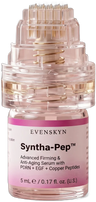
For the middle case, where you want a serum delivered through real channels at home and will follow single-use rules, micro-infusion is the category built for it. Ours is the EvenSkyn MicroInfuser: each kit holds four sterile, single-use 0.5 mm needle heads and four sealed 5 mL ampoules of Syntha-Pep, our PDRN serum, for one session every two weeks. Today's price: $179.98, or $107.99 with code BLACK40 until 30 Nov. We would rather you understood the difference than bought the wrong rung of the ladder from anyone, including us.
Frequently asked questions
What is nano-needling?
Nano-needling is a treatment using a pen-style device fitted with a cartridge of very fine silicon or steel cones rather than needles. The cones act on the stratum corneum and upper epidermis, creating temporary channels that improve how well skincare absorbs. It delivers surface brightness and hydration with essentially no downtime, and it is also sold as nano-infusion or a nano facial.
Is nano-needling the same as microneedling?
No. Microneedling uses metal needles set deep enough to reach the dermis and create controlled micro-injuries, which is what triggers the collagen response. Nano-needling uses blunt cones that stay above the dermis and work by loosening the outer barrier for better product absorption. They look similar in the treatment room and they do different things to different layers of skin.
Does nano-needling work?
It works for what it mechanically does, which is improve absorption of the products applied during the treatment and deliver an immediate surface glow through mild exfoliation and hydration. It does not work as a collagen treatment, because collagen induction requires reaching the dermis and nano-needling does not. Judge it as a radiance and delivery treatment and it performs well.
How deep does nano-needling go?
Published figures vary and do not agree with each other. Some sources describe no true penetration at all, others cite roughly 0.15 mm, and some device pages state around 0.25 mm. The key point is that a rated figure describes tip protrusion rather than depth achieved in skin, because blunt cones compress and tent tissue instead of piercing it. Ask the provider or seller for the specific cartridge rating, and read it as a hardware specification rather than a penetration depth.
Does nano-needling build collagen?
Not in the way microneedling does. Collagen induction depends on controlled injury within the dermis provoking a wound-healing response, and nano-needling stops above that layer. Some pages selling nano cartridges describe the shallow mechanism correctly and still claim boosted collagen further down the page. Where you see both claims together, the mechanism description is the reliable one.
What is nano-infusion?
Nano-infusion is another name for nano-needling, with the emphasis placed on the serum being delivered rather than on the tip doing the delivering. The procedure is the same: shallow channels in the outer skin, product driven into them, no dermal penetration. Spa menus use nano-infusion, nano-infusion facial and nano facial fairly interchangeably.
Does nano-needling hurt?
Most people describe a vibrating or tickling sensation rather than pain, since the tips are blunt and do not pierce living tissue. Some warmth or mild flushing during and shortly after the pass is normal. Sharp or stinging pain is not expected and usually means too much pressure, a damaged cartridge, or a serum that does not suit disrupted skin.
How often can you do nano-needling?
Most providers work in a range of roughly once every one to two weeks, sometimes weekly for an initial period. Daily use is not advisable even though the risk is low, because the stratum corneum is a barrier worth keeping intact and repeated disruption invites sensitivity and dehydration. Space sessions further apart if skin starts feeling tight or reactive.
Can you wear makeup after nano-needling?
Generally yes, and often the same day, which is one of the treatment's main practical advantages over needling. Many providers still suggest waiting a few hours to let the channels close and the applied serum settle. If your skin is flushed or feels sensitive, leaving it bare until the following morning is the more comfortable choice.
Is nano-needling worth it?
It is worth it if you are buying the right outcome. As an absorption and radiance treatment with no downtime it delivers reliably, particularly before events and for sensitive skin that cannot tolerate more aggressive options. It is not worth it as a route to firmer skin or softer deep lines, because the mechanism does not reach the layer where those changes happen.
What is the difference between nano-infusion and micro-infusion?
Nano-infusion uses blunt silicon or steel cones on the outer barrier, so the serum stays in the outer skin and no wound is made. Micro-infusion uses real fine needles of a short fixed length, commonly 0.2 mm to 0.5 mm, which open micro-channels and deliver serum through them in the same pass. Nano is gentler and more superficial; micro-infusion delivers deeper, which is why its needles should be sterile and single-use, and its serum sealed, single-use and made for that use. If that second description is what you are after, our criteria guide to micro-infusion systems sets out what separates them.
Can estheticians do nano-needling?
In most jurisdictions a procedure that does not penetrate living skin falls within an esthetician's scope, while one that does may be restricted to medical professionals or require supervision. Because depth claims for nano vary between sources, so does where a given device sits. Rules differ by state, province and country and they change, so check your regulator's published scope-of-practice guidance rather than relying on a spa's description.
How long do nano-needling results last?
The immediate glow typically holds for several days to about a week, tracking the hydration and exfoliation rather than any structural change. Because the channels close quickly and the benefit follows the products applied, results fade between sessions in a way that collagen-driven change does not. Consistent repetition is what maintains the effect.
Is nano-needling safe for sensitive skin?
It is one of the gentler device treatments available, and sensitive or reactive skin is among the groups it suits best, because no open wound is created. The usual cautions still apply: avoid treatment over active infection, cold sores or inflamed breakouts, and be careful about what is being driven in, since disrupted barriers make irritating ingredients more irritating. Patch testing a new serum first is sensible.
What serum should be used with nano-needling?
Hydrating, peptide-rich and barrier-supporting formulas suit the treatment well, since the whole benefit depends on what gets driven into the channels. Avoid retinoids, acids, high-strength vitamin C, added fragrance and concentrated essential oils during a pass, because a temporarily disrupted barrier makes irritants considerably more irritating. Ask any provider what they are applying and what is in it.
Are nano-needling before and after photos reliable?
Treat them cautiously. Same-day photographs capture hydration, exfoliation and freshly applied product, frequently under different lighting and often with makeup, all of which flatter the result without demonstrating a lasting change. Genuine evidence would require consistent lighting, bare skin and a gap of weeks. The absence of that standard across the category is itself worth noticing.
Can you do nano-needling between microneedling sessions?
Often yes, and it is a common pairing, but the timing matters more than the compatibility. Skin should be fully recovered from the needling session first, with no residual redness, sensitivity or flaking. Ask the practitioner who performed the deeper treatment, since they know what was done and how your skin responded.
Is nano-needling good for acne scars?
Not meaningfully. Atrophic acne scarring is a structural problem in the dermis and improving it requires remodelling at that depth, which nano-needling does not reach. It may improve overall radiance and how skin looks generally, which can soften the visual impression, but the scars themselves are unchanged. Scarring is a conversation for a dermatologist.
What are nano needles?
Nano needles are not needles in the usual sense. They are dense clusters of very small cones or pyramids, usually mono-crystalline silicon (often written as silicone on product pages) and sometimes stainless steel, mounted in a cartridge that fits a pen-style device and is usually sold for single use. They are blunt relative to a microneedling needle and act on the outermost skin layer rather than piercing into the dermis, which is what separates the two treatments.
Are nano-infusion cartridges single-use?
Usually. Dr. Pen, Art of Skin Care and Deminuage sell their nano tips for one use, and Dr. Pen's come in a sterile pack. The exception we found is The Light Salon Boost, whose tips are rated for up to five full-face treatments. Follow the maker's limit, never share a cartridge, and in a clinic expect a new one opened in front of you.
How much does nano-needling cost?
At six US med spas whose prices we read on 5 November 2026, a nano-infusion or nano-needling facial cost $149 to $269 a session. At home, the four pens we compared cost about $70 to $395, plus roughly $1.40 to $5.50 per use in tips. Because this is a repeat treatment, multiply by how often you would do it, and ask a clinic what serum is included, since that is where much of the value sits.
Do at-home nano devices work as well as professional treatments?
The mechanism is the same, so a home device can produce the same category of effect, but professional treatments generally use better cartridges, more consistent technique and stronger professional-grade serums. Since nano is a delivery mechanism, the serum difference accounts for much of the gap. Home nano is best understood as routine maintenance rather than a replacement for a professional session.
Where this leaves you
If you came here deciding whether nano-needling is your treatment, the answer turns on one question: do you want better absorption, or do you want structural change? Nano delivers the first honestly and cheaply, with no downtime, and it is the right call for radiance, sensitive skin and pre-event glow.
If it is the second, nano cannot get there, because the tissue that produces collagen sits below where it reaches. Structural change is clinic territory. In between sits micro-infusion: real channels for a sealed, single-use serum at home, a delivery step rather than a remodelling one. We make one, the EvenSkyn MicroInfuser, and we would rather you compared it against the criteria in our buyer's guide than took our word for it.
About this guide
Who wrote this and what our interest is. This guide was written by the EvenSkyn Research Team. EvenSkyn is a Canadian at-home beauty-device company that designs and manufactures anti-aging devices including the Lumo+ (radiofrequency, EMS and light therapy), the Phoenix microcurrent bar, the Venus eye device, the MicroInfuser, and the MatureSmile LED whitening kit. We do not sell a nano-needling device, and we do sell a micro-infusion system, which is the adjacent category one rung up the ladder described above. Our conclusion that nano and micro-infusion do different things is therefore convenient for us, which is exactly why we have grounded it in mechanism and depth rather than opinion, and why we say plainly that nano is the better choice for several goals our own product does not serve.
How we built it. Skin anatomy figures come from the histometric study and the systematic review listed below. Statements about microneedling mechanism come from the dermatology literature there. We searched for peer-reviewed research on cosmetic nano-needling specifically and did not find a body of it: most searches surface work on nanoparticle carriers and microneedle arrays, which are separate technologies sharing a prefix. A repeat search on 5 November 2026 found three small controlled studies of nanochip devices on the face, from 2017, 2021 and 2025, and one uncontrolled one. None tested a nano pen as sold to consumers, and we read their abstracts rather than the full papers; the two most relevant are listed below. Home pen and clinic prices were read from each seller's or clinic's US page on 5 November 2026 and will change. The text therefore draws a hard line between measured anatomy, which is well established, and manufacturer descriptions of nano hardware, which are not clinical evidence. Two sources we had originally shortlisted were dropped because we could not confirm them to that standard. We have not repeated the absorption-multiplier percentages circulating in this category, because we could not trace them to a study. No before-and-after photographs appear here.
Cosmetic use. Nothing here is medical advice, and nothing here is legal or regulatory advice on scope of practice. Speak to a qualified healthcare provider about your own skin, and to your licensing board about what you may perform.
References
- Iriarte C, Awosika O, Rengifo-Pardo M, Ehrlich A. Review of applications of microneedling in dermatology. Clinical, Cosmetic and Investigational Dermatology. 2017;10:289-298. PMID 28848356. DOI 10.2147/CCID.S142450.
- Hou A, Cohen B, Haimovic A, Elbuluk N. Microneedling: A Comprehensive Review. Dermatologic Surgery. 2017;43(3):321-339. PMID 27755171. DOI 10.1097/DSS.0000000000000924.
- Alster TS, Graham PM. Microneedling: A Review and Practical Guide. Dermatologic Surgery. 2018;44(3):397-404. PMID 28796657.
- Lintzeri DA, Karimian N, Blume-Peytavi U, Kottner J. Epidermal thickness in healthy humans: a systematic review and meta-analysis. Journal of the European Academy of Dermatology and Venereology. 2022;36(8):1191-1200. DOI 10.1111/jdv.18123.
- Oltulu P, Tekecik M, Taflioglu Tekecik Z, Kilinc F, Ince B. Measurement of Epidermis, Dermis, and Total Skin Thicknesses from Six Different Face Regions. Selcuk Medical Journal. 2022;38(4):210-215.
- Microneedling. StatPearls. StatPearls Publishing, NCBI Bookshelf NBK459344.
- Ye C, Lu C, Flament F, et al. A non-invasive way to enhance cosmetic efficacy by associating a cosmetic serum with a nanochip tapping. International Journal of Cosmetic Science. 2025;47(5):780-792. PMID 40223555. DOI 10.1111/ics.13056.
- Tao YL, Jameel AAB, Miao Y, et al. The self-recovery of facial skin barrier and erythema after nanochip treatment. Journal of Cosmetic and Laser Therapy. 2017;19(7):427-433. PMID 28657367. DOI 10.1080/14764172.2017.1341984.
Keep reading
- Best micro-infusion system 2026: how to choose, the criteria that separate at-home systems.
- Micro-infusion: what it is and how it works, the full mechanism explainer for the next rung up.
- Contraindications and safety, who should avoid needle-based treatment entirely.