


Explainer
At-Home Skin Tightening in 2026: What Actually Works, Ranked by Clinical Evidence
Clinical-evidence guide to at-home skin tightening in 2026. RF, microcurrent, LED, and HIFU compared. Real specs, 12-week protocol, honest device picks.
Zaprojektowano w Kanadzie
VIP early accessBlack FridayThe weekend is hereBlack FridayLast callCyber Monday40% off sitewide, applied for you at checkout.Shop the saleDarmowa dostawa do USA i Kanady60 dni gwarancji zwrotu pieniędzyPoradniki i pomoc po angielsku
Buying guide
Nine at-home anti-aging devices across radiofrequency, EMS, microcurrent and light, read from their makers on 15 November 2026, with the evidence behind each technology graded. We make three of them and say so.
Published by EVENSKYN, which makes and sells at-home beauty devices.

An evidence guide, 21 sources checked, updated 15 November 2026
Which at-home anti-aging device is worth buying in 2026? It depends on what you want to change. Here are nine devices across radiofrequency, EMS, microcurrent and light, read from their makers on 15 November, with the evidence behind each technology graded plainly.

At a glance
For a softening jawline: radiofrequency, the technology aimed at laxity. Its best home trial improved wrinkles and skin thickness over 12 weeks.1
For fine lines: radiofrequency, or red and near-infrared light, each with a randomized trial behind it.1,2
For the eye area: a device built for it. Our full-face handset, the Lumo+, is never used inside the eye socket.3,4
For puffiness and upkeep: a microcurrent roller used most days, for upkeep rather than a lift.5
Key takeaways
01Home devices work through three routes: heat (radiofrequency), electrical current (EMS or microcurrent) and light (LED). No single route covers everything.
02The best published evidence is thin: one randomized trial of a home RF device in 33 women, and one of facial EMS in 108. A 2024 review of 18 studies called the evidence for home devices insufficient.1,6,7
03Microcurrent and EMS are different classes of current. Our Phoenix runs at about 15 µA; the Lumo+ EMS mode at 3 to 15 mA, 200 to 1,000 times more (Fig. 1).3,5
04FDA clearance means the FDA accepted a device as substantially equivalent to one already legally on the market; it is not approval. Our Lumo+ is a cosmetic device and is not FDA-cleared.8,9
05The claim that microcurrent boosts cell energy traces to a 1982 laboratory study of rat skin, not to trials on faces or devices.10
06Whatever you buy, photograph your face in the same light and judge it at 12 weeks, the length of the trials behind these claims.1,6
Skin ages on several fronts at once: the support in the deeper layer thins and loosens, facial muscles lose tone, and sun and time leave lines and uneven color. Home devices aim at these with three kinds of energy. Grouping them this way is our framing, not a medical classification, but it explains why one device rarely does everything.
Radiofrequency (RF) devices pass a current between electrodes on the skin, and the skin’s resistance turns it into gentle heat. The heat is the point: it is the mechanism aimed at laxity. The best home evidence is a randomized split-face trial in which 33 women aged 35 to 60 used a home RF device on one side of the face and an anti-aging cosmetic on the other for 12 weeks; 32 finished, and the RF side showed significantly better wrinkles, radiance, color and skin thickness.1
Home devices are deliberately gentle. Our Lumo+ uses bipolar radiofrequency at 1 MHz: after a brief sensor-controlled warm-up, it holds the skin at a steady 40 to 42°C for the rest of the session.3 An earlier version of this page quoted a much higher temperature and a depth in millimeters; neither is in the device’s current specifications, so both are gone.
Electrical muscle stimulation (EMS) uses currents strong enough to make facial muscles contract. In a randomized controlled trial of 108 healthy women, 12 weeks of facial EMS, 20 minutes a day on five days a week, increased the thickness of a cheek muscle by 18.6 percent on average, with no increase in an untreated control group; at least 80 percent of users reported improved firmness, tone and lift, against under 5 percent of controls.6
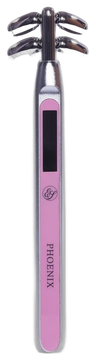
Microcurrent is a different thing: a current so low you usually cannot feel it. Our Phoenix delivers about 15 µA through its rollers, below what most people can sense.5 The claim that microcurrent raises cell energy traces to a 1982 laboratory study in which direct currents of 10 to 1,000 µA increased ATP in rat skin.10 That is a real finding about tissue in a lab, not a trial of faces or devices. Fig. 1 puts the two classes of current on one scale.

LED devices shine set wavelengths onto the skin with no heat to speak of. In a randomized, double-blind, split-face trial of 76 people with a sham-light arm, red (633 nm), near-infrared (830 nm) and the two combined all reduced measured wrinkles from baseline, by up to 36 percent, after eight sessions over four weeks.2 In a controlled trial of 136 people, broadband light did no better than red light alone, so more colors did not mean better results there.13 Both trials used professional light systems rather than home masks, and the studies of home LED devices are small.7
Our inference, not a tested method
Inference: because these act through different routes, heat, muscle contraction and light, a routine that uses more than one could cover more ground than any single device.
Untested hypothesis: a combined routine of radiofrequency, EMS and light improves the look of firmness and lines more at 12 weeks than any one of them alone.
What would prove it wrong: a randomized trial comparing the combined routine with each single technology and finding no added benefit. No such trial exists that we could find, so treat combination claims, ours included, as unproven.
Here is what each device uses, how often its maker says to use it, its price on the maker’s US page, and the FDA wording on that page. Three are ours. We left out devices whose maker pages we could not read today, and we did not test any of these devices for this guide.
| Device | What it uses | How often, per the maker | Price | FDA wording on the maker’s page |
|---|---|---|---|---|
|
Lumo+ EvenSkyn (ours) |
Bipolar RF at 1 MHz holding 40 to 42°C; EMS at 3 to 15 mA; red (623 nm) and blue (465 nm) light; ion cleansing and iontophoresis modes3 | Five-minute sessions, two to three times a week3 | $179.98 | None: a cosmetic device, not FDA-cleared9 |
|
Skin RF CurrentBody |
Radiofrequency14 | Five minutes per area14 | 448.99 USD14 | “FDA cleared”14 |
|
Venus EvenSkyn (ours) |
Fractional RF holding 42°C, red or blue light, sonic massage and ion-assisted absorption; eye area only4 | Not stated on the product page | $179.98 | None claimed4 |
|
TRINITY+ Starter Kit NuFACE |
Microcurrent with three frequencies and intensities; a Boost Button adds up to 25 percent more power11 | “Minutes a day”11 | 395.00 USD11 | “FDA-cleared”11 |
|
HALO ZIIP |
Microcurrent and nanocurrent12 | Three to five times a week, up to six on a short plan; treatments of 2 to 10 minutes12 | 399.99 USD12 | None on the page we read12 |
|
Phoenix EvenSkyn (ours) |
Solar-powered microcurrent of about 15 µA through four rollers5 | Near-daily; up to 15 minutes per area and 45 a day5 | $179.98 | None claimed5 |
|
4-in-1 Skincare Wand Solawave |
Red light, galvanic current, warmth and facial massage15 | Three minutes per area, 12 a day, three to five times a week, for at least eight weeks15 | 169.00 USD15 | “FDA-cleared”15 |
|
Booster Pro Medicube |
Booster, MC, Air Shot and Derma Shot modes, with sonic vibration and LED16 | Most modes one to three times a day; Air Shot two to three times a week16 | 230.00 USD16 | None on the page we read16 |
|
Contour Face Omnilux |
LED mask, 633 and 830 nm17 | Ten minutes, three to five times a week17 | 395.00 USD17 | FDA-cleared17 |
Other makers’ prices are the list prices on their US pages on 15 November 2026 and may have changed since; ours load live. Device names are trademarks of their owners, used here for identification and comparison only.
Four readings of that table. First, current is labelled loosely: the Solawave wand lists galvanic current rather than microcurrent, and two microcurrent makers do not state their output on the pages we read. Second, price does not track evidence; the technologies with controlled trials behind them, radiofrequency and red and near-infrared light, sit at several price points.1,2 Third, FDA clearance is a regulatory route built on equivalence to a device already on the market; it does not tell you how much a device will change your skin, and several makers here state it while ours does not.8 Fourth, the Lumo+ puts radiofrequency, EMS and light in one handset. That is a statement about what it contains, not proof that combining them works better.
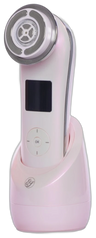
EvenSkyn Lumo+ (ours). Radiofrequency, EMS and red and blue light in one handset, plus an ion cleansing mode and an iontophoresis mode for water-based products, in five-minute sessions two to three times a week. Its page aims it at the look of fine lines, a softening jawline and loose skin on the neck, and says it is suitable for all skin types and tones. It is never used inside the eye socket.3 It is a cosmetic device, not FDA-cleared.9
CurrentBody Skin RF. Radiofrequency, five minutes per area, at 448.99 USD on the day we read it, with FDA clearance stated on its page.14 If FDA clearance matters to you in a radiofrequency device, it is the one in our table that states it.
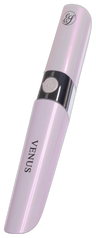
EvenSkyn Venus (ours). Built for the skin around the eyes, which its page says is too thin for full-power radiofrequency. It runs fractional radiofrequency with the head held at 42°C, pairs it with red or blue light, sonic massage and ion-assisted absorption of an eye cream, and is used over the upper and lower lids. Its page is plain about the limit: it cannot correct true ptosis, a muscle condition that needs a clinician.4
NuFACE TRINITY+. Microcurrent with three frequencies and intensities and a Boost Button, at 395.00 USD, with FDA clearance stated on its page. It does not state its output on the page we read.11
ZIIP HALO. Microcurrent and nanocurrent, in treatments of 2 to 10 minutes plus a built-in four-minute facial, three to five times a week, at 399.99 USD.12
EvenSkyn Phoenix (ours). A solar-powered roller bar at about 15 µA, for near-daily use over a water-based gel or serum. Its own page says it maintains and refreshes, and will not lift established sagging; that needs radiofrequency or clinical treatment.5
Omnilux Contour Face. A red and near-infrared mask at 633 and 830 nm, the same two wavelengths as the 76-person trial above, used ten minutes three to five times a week.2,17 Our guide to LED face masks compares masks from eight brands.
Solawave 4-in-1 Skincare Wand. Red light with galvanic current, warmth and massage, three minutes per area, at 169.00 USD. The lowest list price here; its maker asks for three to five sessions a week for at least eight weeks.15
Medicube Booster Pro. A daily skincare tool with Booster, MC, Air Shot and Derma Shot modes, sonic vibration and LED, at 230.00 USD. Most modes are used one to three times a day, and Air Shot two to three times a week.16
Our Mirage LED mask uses 630, 583 and 415 nm, not near-infrared as an earlier version of this page said. It is sold out, so it is not in our picks.18
We suggest one device that matches your main concern, used consistently, and a second only for a different job. Our sets pair the Lumo+ with the Venus for the eye area, the Phoenix for daily upkeep, or both.19
| Set | What it adds to the Lumo+ | Price today |
|---|---|---|
| Lumo+ and Phoenix | The Phoenix roller, for near-daily upkeep between radiofrequency sessions | $179.98 |
| Lumo+ and Venus | The eye area, which the Lumo+ keeps away from | $179.98 |
| Lumo+, Venus and Phoenix | Both of the above | $179.98 |
For scale against the clinic: RealSelf’s average reported cost for Morpheus8, a clinic radiofrequency microneedling treatment, is $1,870, from 123 reviews that list a price.20 Clinic microneedling carries the energy into the skin through needles, a different procedure from a home handset; our guide to Morpheus8 and the home alternative explains the difference. A home device is a one-off cost plus a water-based gel,3,5 and the trials behind these technologies ran for 12 weeks of regular use.1,6
Find your starting point
Pick your main concern and how much time you will give it. The suggestion draws only on the makers’ pages and the trials in this guide.
Your starting point appears here once you answer both.
The suggestions follow the evidence grades below and the schedules on the makers’ pages.1,2,3,4,5,6,10,12,15,17
A 2024 review gathered 18 clinical studies of home beauty devices for the face and concluded that the evidence is insufficient: most studies were small, short, at most 12 weeks, and not randomized. In the microcurrent category it found one randomized trial, and that trial used an EMS device.7 Here is the best evidence we found for each technology, graded.
| Technology | Best evidence we found | Grade | What it does not show |
|---|---|---|---|
| Radiofrequency at home | Randomized split-face trial, 33 women, 12 weeks, against an anti-aging cosmetic: better wrinkles, radiance, color and thickness1 | Moderate | Not our device; compared with a cosmetic, not with sham treatment |
| EMS | Randomized trial, 108 women, 12 weeks: cheek muscle 18.6 percent thicker; at least 80 percent reported improved firmness, tone and lift6 | Moderate | A different device from ours; untreated control, not sham |
| Red and near-infrared light | Randomized split-face trial with a sham-light arm, 76 people: measured wrinkles down by up to 36 percent from baseline; broadband no better than red in 136 people2,13 | Moderate | Professional light systems, not home masks; home LED studies are small7 |
| Sub-sensory microcurrent | ATP rose in rat skin at 10 to 1,000 µA in a laboratory study10 | Mechanistic | No randomized trial of a home microcurrent device in the 2024 review; its one trial in that category tested EMS7 |
| Combined routines | No trial found | Untested | Whether combining technologies adds anything |
How we grade: Moderate means at least one randomized controlled trial in people; Mechanistic means laboratory or animal work only; Untested means nothing published that we could find.
Every device here carries its own cautions, so read the manual before the first session. On our own pages:
If you have had Botox, filler or a chemical peel recently, our timing guide for home devices after injectables and peels covers how long to wait.
How we would decide
A softening jawline and little time? Radiofrequency in short sessions two to three times a week: the Lumo+, or the CurrentBody Skin RF.1,3,14
Fine lines most of all? Radiofrequency, or a red and near-infrared mask kept to its schedule.1,2
Eyelids and crow’s feet? A device made for the eye area, such as the Venus.4
Puffiness and upkeep? A microcurrent roller most days, as maintenance rather than a lift.5
Hoping for a facelift? No home device does that. A consultation with a dermatologist or surgeon is the honest next step.

Our pick for firming, and yes, we make it
For the look of a softening jawline, loose skin on the neck and fine lines, in five-minute sessions.
$179.98
What it will not do: match a clinic treatment, replace a facelift, treat the eye area (that is the Venus), or show results without a routine kept for months. With a pacemaker or a heart condition, ask your doctor first.3,9,21
It depends on what you want to change. For a softening jawline and firmness, a radiofrequency device such as our Lumo+ or the CurrentBody Skin RF. For fine lines, radiofrequency or a red and near-infrared LED mask. For the eye area, a device made for it, such as our Venus. For puffiness and upkeep, a microcurrent roller used most days. We make the Lumo+, Venus and Phoenix.
Radiofrequency and red and near-infrared light have the strongest controlled trials for the look of wrinkles. A home RF device beat an anti-aging cosmetic over 12 weeks in a randomized split-face trial, and red and near-infrared light reduced measured wrinkles by up to 36 percent from baseline in a 76-person trial with a sham-light arm. The evidence for microcurrent comes mostly from laboratory work.
No. A home handset warms the skin from its surface, while clinic radiofrequency microneedling such as Morpheus8 carries the energy into the skin through needles. RealSelf’s average reported cost for Morpheus8 is $1,870. At home, expect gradual change in the look of mild laxity over months, not a lift of established sagging.
They use different technologies. The NuFACE TRINITY+ is a microcurrent device, FDA-cleared, at 395.00 USD on the day we read it. The Lumo+ combines radiofrequency, EMS and light; it is a cosmetic device and not FDA-cleared. For firming, radiofrequency is the mechanism aimed at laxity. For microcurrent, the NuFACE or our Phoenix.
The evidence is thin. The cell-energy claim comes from a 1982 laboratory study of rat skin, and a 2024 review of home devices found only one randomized trial in the microcurrent category, which tested an EMS device. Treat a sub-sensory microcurrent device as gentle maintenance, not a lift.
Strength. Microcurrent is measured in microamps and usually cannot be felt; our Phoenix runs at about 15 µA. EMS is measured in milliamps and makes muscles contract; the Lumo+ EMS mode runs at 3 to 15 mA, 200 to 1,000 times more. The 108-woman trial that thickened a cheek muscle used EMS.
Not with our full-face handset: the Lumo+ is never used inside the eye socket, and you should check your own device’s manual. For the eyelids and the skin around them, use a device built for that area, such as our Venus, which runs fractional radiofrequency at 42°C with an eye cream.
Plan on 12 weeks, the length of the radiofrequency and EMS trials behind these claims. Some makers ask for at least eight weeks. Photograph your face in the same light at the start, then look again at 12 weeks rather than day by day.
No. A device cleared through the FDA’s 510(k) route was accepted as substantially equivalent to one already legally on the market; that is clearance, not approval. Our Lumo+ is a cosmetic device and is not FDA-cleared.
Of the devices we read, the Medicube Booster Pro lists an MC mode alongside LED and sonic vibration, and the Solawave wand pairs red light with galvanic current rather than microcurrent. Our own light handset, the Lumo+, pairs its LED with radiofrequency and EMS.
Start with the one device that matches your main concern and keep to its schedule. Add a second only for a different job, such as the eye area or daily upkeep. No trial has tested combined routines against single devices.
Our Lumo+ and Phoenix pages say they suit all skin types and tones, used as directed. Each device has its own cautions; ours include pacemakers and heart conditions, pregnancy, broken or inflamed skin and recent facial surgery. Read the manual first.
The case against our own recommendation
No trial has tested our devices, and no trial has tested a combined routine against single devices. Four devices in our table state FDA clearance and, on 15 November, cost less than the Lumo+, which is not FDA-cleared.9,11,14,15,17 And we sell what we recommend.
What would change our view: a randomized trial of the Lumo+ against a matched skincare routine, or of a combined routine against single technologies, measured at 12 weeks.
How we built this page. On 15 November 2026 we read the makers’ US product pages for every device in the comparison, our own product, set and safety pages, the FDA’s 510(k) page and RealSelf’s Morpheus8 cost page, and checked each study against its publisher or PubMed record, reporting it only as far as we read it. This version replaces an earlier one at the same address. It corrects the journal and the findings of the home radiofrequency trial, drops temperature and depth claims for the Lumo+ that we could not support, corrects the Mirage wavelengths, removes competitor prices and claims we could not read today, a cell-energy percentage and a manufacturing-history claim, and adds the evidence grades.
Conflicts: we make the Lumo+, Venus, Phoenix and Mirage named here. EvenSkyn is a Canadian company that makes at-home beauty devices. No clinician reviewed this version. General information, not medical advice: talk to a dermatologist about your own skin.
Face and neck
Explainer
Clinical-evidence guide to at-home skin tightening in 2026. RF, microcurrent, LED, and HIFU compared. Real specs, 12-week protocol, honest device picks.
Explainer
GLP-1 face, also called Ozempic face, is the look of lost facial volume and looser skin after fast weight loss, and this guide covers why it happens, what clinic options do and...
Buying guide
RF vs red light vs microcurrent for at-home skin concerns: what each technology does, who it suits, and how to pick the right device for your skin.


Zostaw komentarz
Wszystkie komentarze są moderowane przed opublikowaniem.
Ta strona jest chroniona przez hCaptcha i obowiązują na niej Polityka prywatności i Warunki korzystania z usługi serwisu hCaptcha.