Microcurrent vs EMS at Home: What Each One Actually Does, and Which Your Face Needs
Two technologies sold as one. A dermatologist draws the line where the physiology draws it, sources every figure, names the contraindications, and corrects EvenSkyn’s own loose labeling.
EvenSkyn Skin Science, Device Decoders
By Dr. Lisa Hartford, MD, board-certified dermatologist, Chief Dermatology Advisor at EvenSkyn. Last clinically reviewed May 17, 2026. 9022 words, 36 minute read, 22 verified primary references. Methodology, disclosures, and a dated update log sit at the end.
Two technologies are sold as if they were one. They are not close. One you can barely feel. The other contracts muscle hard enough that a single unaccustomed session drove a young athlete's creatine kinase to 240,000. Here is the honest separation, every figure traced to a primary source, who should skip both, and the place where my own employer has labeled this loosely.
Key takeaways
Different stimuli, not synonyms. Microcurrent runs at sub-sensory microamperage and is proposed to act on cells. EMS runs at motor level and contracts muscle. Shoppers know the first word, so marketing uses it for both.
The 500 percent ATP line is a distortion. It traces to a 1982 rat-skin bath study whose abstract contains no such number.
The 21 percent wrinkle line is weak. Thirty women, no control group, regional journal.
The cleanest cosmetic NMES trial is small and industry-adjacent. One hundred eight women, twelve weeks, blinded ultrasound, an author tied to the field.
EMS carries the stricter safety story. The FDA position is blunt: no device is cleared for weight loss or sculpted abs, and appearance will not change without diet and exercise.
Disclosed bias. EvenSkyn sells both kinds of device and has used microcurrent loosely for what is mechanistically EMS on the Lumo and Eclipse. I corrected that below rather than around it.
Table of contents
At a glance
Most readers want the conclusions before the 9,000 words of argument. Fair. Here they are, compressed, with everything sourced further down for anyone who wants to check my work rather than trust my face.
Question
Short answer
Are microcurrent and EMS the same?
No. Microcurrent is sub-sensory and proposed to act at the cell level. EMS recruits motor units and visibly contracts muscle.
Which has stronger facial evidence?
Neither is strong. EMS has the clearer physiology. The one controlled cosmetic NMES trial is small and industry-adjacent. Microcurrent facial data is smaller and largely uncontrolled.
Will I feel it?
EMS, yes, more so with a conductive gel. True sub-sensory microcurrent, usually not.
Who must skip EMS?
Anyone with a cardiac demand pacemaker, and stimulation must avoid the carotid sinus, neck, mouth, chest, and head. Pregnancy, epilepsy, and active cancer are physician calls.
Does either replace a clinic?
No. Both are maintenance tier. The FDA states EMS will not transform appearance without diet and exercise.
What the evidence supports, and where it does not
You deserve the verdict before the defense, because hiding the answer behind the argument is one of the small dishonesties that makes device content untrustworthy, so here it is in three buckets.
Supported
Motor-level electrical stimulation produces an involuntary muscle contraction. Nobody disputes that. The recruitment order differs from voluntary effort in ways Maffiuletti documented in 2010, and that difference is the entire reason a stimulated contraction feels mechanical and fatigues on its own schedule.2 Electrical stimulation also helps chronic wounds close. A 2020 Cochrane review on pressure ulcers supports it,9 and a separate systematic review and meta-analysis pooling 17 randomized trials across 740 patients lands in a similar place.10 One caveat travels with that evidence and I will keep repeating it: most of the wound work used high-voltage pulsed current, not the microamp range a home microcurrent wand delivers, and effect-size analyses in that field have excluded microcurrent specifically.11
Plausible but thin
Sub-sensory microcurrent changing how facial skin looks is mechanistically plausible and evidentially thin. The most-quoted facial figure in the whole category came from 30 women with no control arm in a regional journal.8 A combined microcurrent and radiofrequency home device produced a measurable eyebrow lift, 1.338 cm of brow-to-hairline change, in a placebo-controlled trial of 50 people, which is a better design and also not a pure microcurrent result.7 Plausible is the honest word. Proven is not.
Not supported
The claim that microcurrent raises cellular ATP by 500 percent in a living human face. The originating experiment bathed excised rat skin in 1982 and reported no such percentage anywhere in its abstract.1 The claim that EMS slims, burns fat, or builds visible abdominal definition. The FDA has said for decades that no device is cleared for that and that EMS calorie burn is marginal.15 The claim that any home unit equals a clinic energy device. Physics says otherwise, and I will not pretend otherwise to move a unit.
How I assessed this
Twenty-two primary records. Each one read rather than skimmed from a press release, and each one checked against PubMed, PubMed Central, the journal of record, or the issuing agency. Where a study was funded or run by a device maker, I flagged it in the text and in the list, not just one of the two. Where a famous number came from a weak design, I traced it to the design and told you what the design was. I held two questions apart that the category works hard to blur. Does sub-sensory microcurrent do anything to skin. Does motor-level EMS do something different to muscle. Separate questions, separate answers, and any article that answers them as a single question is selling a word, not a result.
One more rule governed the read, and it is worth stating because it changes which sentences you should trust on this page. Every efficacy study with a manufacturer fingerprint is flagged where it is used, not only in a reference list nobody scrolls to. Omatsu ran on a proprietary device technology, so it is labeled a device-technology study in the body.5 Kavanagh, the cleanest controlled cosmetic trial, carries an author embedded in the aesthetic-device field, stated where the study is cited.22 Alam's positive facial-exercise result came from a regimen a co-author owned, noted at the point of claim.4 Disclosing the conflict next to the number, rather than in a footnote, is the difference between a citation and a sales aid, and it is the standard this page asks of competitors and therefore owes you itself.
A clinic story that motivates this
A patient came in last spring, frustrated, holding a device she genuinely loved. Her face looked exactly as it had six months earlier. She had been told the device was microcurrent. When she demonstrated it, she ran it across slightly damp skin and flinched at a rhythmic pull along the jaw. That flinch is the tell. Sub-sensory microcurrent, run as designed, does not produce a pull you brace against. What she was holding was a low-grade muscle stimulator doing muscle-stimulator work under a softer name, and she had used it correctly the entire time. She had not abused her skin. She had been sold a vocabulary, and the vocabulary set an expectation the hardware was never built to meet. That conversation, repeated maybe a dozen times a year in my chair, is most of why this page exists.
Quick answers
What is microcurrent? A current low enough that you usually feel nothing, proposed to nudge cellular processes rather than to contract muscle.
What is EMS? A current strong enough to depolarize motor neurons and create a visible, palpable contraction, the same stimulation family physiotherapists use on paralyzed facial muscles.
Which is in my device? Wet the contacts. A clear rhythmic pull means EMS, whatever the box says.
Does feeling it mean it works? No. Feeling it means the circuit is live. Efficacy is a separate question answered by trials.
Disclosed bias and scope
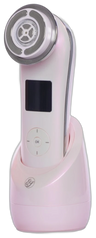
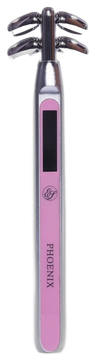
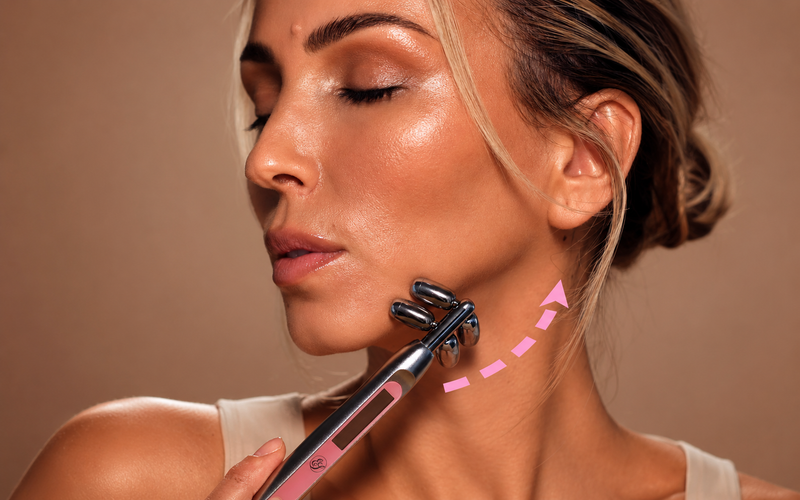
I am Chief Dermatology Advisor at EvenSkyn, a Canadian at-home device brand. EvenSkyn sells microcurrent and EMS devices. I have a commercial interest in you finding this page useful and trusting it, and pretending otherwise would be the first dishonest sentence in an article about honesty. Here is the part most brand pages bury in a footer, moved up where it belongs. EvenSkyn has used microcurrent and EMS interchangeably in its own marketing, because the gentler word is searched far more often. On the Lumo and the Eclipse, the muscle channel is EMS. The 2026 Lumo presents that channel as a massaging mode, and the same device also carries radiofrequency plus red and blue light. The Eclipse pairs the same EMS channel with ultrasound in place of radiofrequency, plus the same light wavelengths. The Phoenix is the only true microcurrent device in the line, solar powered and deliberately faint, and most people do not feel it even with gel. Letting that loose labeling stand here would make this article guilty of the exact move it criticizes in competitors. So the line gets drawn where the physiology draws it, and the recommendation later is built on that line rather than on the marketing.
A practical aside, since people ask me this holding the box. If you own an EvenSkyn Lumo, including the Lumo Plus or the 2026 model, those are the same device, and its muscle channel is EMS presented as a massaging mode alongside radiofrequency and light. The Eclipse swaps radiofrequency for ultrasound and keeps the same EMS channel. The Phoenix is the solar-powered microcurrent device, the faint one, and the field test holds: wet skin, low setting, and a clear rhythmic pull means you are holding an EMS device whatever the listing called it, while feeling almost nothing on the Phoenix is the Phoenix working as designed rather than failing. How these sit against the wider field is in our best microcurrent facial device guide.
Figure 1. One axis, two operating ranges. The friendly word covers the left band. The device you can feel is operating in the right band, and wetting the contacts slides you rightward.
Mechanism, in plain terms
Begin with how a muscle normally moves. When you smile on purpose, your nervous system recruits small motor units first and larger ones as more force is needed, rotating the load so the muscle does not fatigue all at once. Physiologically, that orderly small-to-large recruitment with rotating load is the body being economical with its own hardware, sparing fibers in turn so a sustained expression never exhausts the whole muscle at once, which is the baseline an external field cannot reproduce. Electrical stimulation does not respect that order. It fires the fibers where the external field is strongest, and it fires them synchronously, which is precisely why a stimulated contraction feels mechanical rather than fluid and tires the muscle on a different schedule than voluntary effort, a contrast Maffiuletti spelled out in detail and which has practical consequences for anyone holding one of these wands.2
Maffiuletti made a second point that matters more to a shopper than to a sports scientist. The field does not isolate one clean effect. A device sitting near the motor threshold is doing motor things even if the marketing copy says cellular, because there is no wall between a sensory tingle, a motor twitch, and a strong contraction, only a gradient, and the label on the box does not control where on that gradient your wet skin actually sits.2 Wetting the contacts lowers the skin's resistance and slides you measurably up that gradient toward the motor band, which is plain electrical physics rather than a matter of interpretation or brand preference, and it is also why the same dial feels like two different devices dry versus wet.
Now the microcurrent side. Cellular action is the proposed mechanism, and Cheng 1982 is the citation everyone leans on for it. That experiment took excised rat skin, bathed it, ran direct currents from 10 to 1000 microamps through it, and reported changes in ATP generation, protein synthesis, and membrane transport.1 Mechanistically the findings are real within their narrow frame, a bath, a rodent, and a defined microamp range, yet that frame is precisely what the marketing drops when it carries the result onto a human face decades older than any tissue Cheng ever measured. They are also a dish, a rodent, and a current range, not a measurement of a living 50-year-old human face, and the famous 500 percent figure stamped on serum cartons and device pages appears nowhere in the abstract. A real result was inflated downstream into a number it never produced. That is the clearest case of citation laundering in the category, and the provenance diagram below shows the chain.
The threshold ladder, and why the dial matters
Stimulation does not have two settings, it has a ladder, and the cosmetic vocabulary pretends the ladder has one rung. Stimulation climbs in rungs. Below perception sits the sub-sensory range, where true microcurrent is supposed to live. Raise the output and you cross a sensory threshold, a tingle. Raise it again and you cross the motor threshold, a twitch, then a sustained contraction. Push further and you reach a noxious range nobody markets. Maffiuletti's central methodological point is that the same applied current sits at different rungs depending on tissue, hydration, electrode size, and placement, so identical numbers on two boxes do not guarantee identical effects on two faces.2 Pulse duration, frequency, and duty cycle each shift where the working point lands, which is why a device that discloses none of those parameters has effectively disclosed nothing about what it does. Wet skin lowers impedance and slides the working point upward. That single variable, free and under your control, changes a device's behavior more than most of the features on the marketing page.
Synchronous recruitment is the other half. Voluntary effort spares fibers in turn. Voluntary effort rotates motor units to delay fatigue, while an external field fires whatever it reaches at once, repeatedly, with no rotation, which loads individual fibers harder than a comparable voluntary contraction would.2 That mechanism is benign at gentle facial settings. The same mechanism, at high whole-body intensity in an unaccustomed user, is the documented route to muscle-fiber injury and the creatine kinase spikes in the safety literature.13 One physiological fact, read at two intensities, explains both the modest facial effect and the rare serious harm.
Figure 2. The provenance of a number worth distrusting. A real in-vitro finding, a marketing percentage, and an inflation step nobody sources.
How microcurrent entered the face
A short history clears up why the marketing sounds the way it does. Cheng 1982 was an orthopaedic and surgical-research paper about wound and flap viability, run on excised rat skin in a bath, measuring ATP, protein synthesis, and membrane transport across a current range from 10 to 1000 microamps.1 Aesthetics borrowed it later. Nothing in that paper studied a face, a wrinkle, or a person, and the leap from a rodent flap to a glowing wand was made by copywriters, not by Cheng. Maffiuletti, working from the muscle side three decades on, then formalized why electrical recruitment behaves unlike voluntary effort, which is the half of the story the cosmetic pitch tends to skip.2 Two separate literatures, a surgical one and a sports-physiology one, got fused into a single beauty claim. Knowing that seam exists is most of what protects you at the checkout.
Regulation followed a different track again. Powered muscle stimulators sit under 21 CFR 890.5850, a device class with a prescription tier and an over-the-counter tier, and the FDA has held a consistent public line that no such device is cleared for weight loss or girth reduction and that appearance will not change without diet and exercise.1516 Microcurrent at true sub-sensory levels generally sits in a lower-intensity bracket. The category you are shopping is therefore three histories wearing one marketing coat: a surgical wound study, a muscle-physiology framework, and a regulatory file that says less than the ads imply.
Comparison matrix
Dimension
Microcurrent
EMS
What it does not do
Sensation
Usually none at true levels
Felt pull, stronger with gel or water
Neither proves efficacy by feel
Proposed target
Cellular processes
Motor units, muscle
Neither rebuilds dermal collagen overnight
Cleanest evidence
Small, mostly uncontrolled facial studies
Clear physiology; one small controlled cosmetic trial; palsy trials
Neither equals a clinic energy device
Main risk
Low; skin irritation
Contraindications; rare rhabdomyolysis at high intensity
Microcurrent does not carry the EMS contraindication list
Regulatory
Lower-intensity stimulator class
Powered muscle stimulator, 21 CFR 890.5850
Clearance is not proof of a cosmetic claim
EvenSkyn device
Phoenix, solar, faint
Lumo highest intensity, Eclipse mid
Phoenix is not a substitute for an EMS goal
By the numbers, read honestly
Numbers persuade, which is exactly why they earn scrutiny rather than applause. Here is each figure the category leans on, with its design and its funding attached so you can weight it yourself.
The 21 percent wrinkle figure
Saniee 2012, Journal of Jahrom University of Medical Sciences. Thirty women. No control group. Thirty sessions. Blinded photo grading reported roughly an 18 to 21 percent forehead change, the higher value a month after the last session.8 Methodologically you should read that figure as directional only, the kind of pilot signal that tells a researcher whether a properly controlled trial is worth funding, never the kind of result that earns the clinically proven language a marketing page will inevitably wrap around it. An uncontrolled before-and-after study of 30 people in a regional journal is a pilot signal that tells you whether a real trial is worth running, not a clinically proven badge. As a tell about sourcing hygiene, a widely shared write-up that repeats this figure prints the wrong author names for the very study it depends on, which means the people citing it never opened it.
The cleanest controlled facial NMES trial
Kavanagh 2012, Journal of Cosmetic Dermatology, is the closest thing to good cosmetic evidence and it deserves both its credit and its asterisks. One hundred eight healthy women, mean age 43.7, randomized to 12 weeks of a facial NMES device at 20 minutes a day, five days a week, against a no-intervention control, with assessor-blinded ultrasound of zygomaticus major thickness as an objective endpoint.22 Mean muscle thickness increased versus control. That is a real design with a real measurement. It is also partially blinded rather than fully, the control did nothing rather than using a sham, and a co-author is a dermatologist deeply tied to the aesthetic-device field, so the affiliation belongs in your reading. Good for this space is not the same as definitive anywhere else.
The facial-exercise comparator
Alam 2018, JAMA Dermatology, matters because it is the honest comparator for the muscle-toning idea. Twenty-seven enrolled, sixteen completed, a 20-week home regimen, and assessors reported fuller upper and lower cheeks with a perceived-age drop near three years.4 Pilot scale, tiny sample, and a co-author owned the exercise program tested, which I weight accordingly. Worth sitting with as a device shopper: the intervention that produced that result was free movement, not a powered tool you pay for.
The EMS facial trial
Omatsu 2024, Journal of Cosmetic Dermatology, ran an 8-week split-face controlled trial of high-frequency facial NMES in 24 women aged 30 to 59 at a university hospital and reported significant improvement in elasticity and wrinkle degree on the treated side at p below 0.05.5 Comparatively this is a better design than most of what circulates in the category, a controlled split-face structure with objective endpoints, though the proprietary device technology and the manufacturer proximity remain part of an honest reading rather than a footnote you are meant to skip. Hardware in that trial used a proprietary manufacturer technology branded CERTEC operating between 40 and 190 kHz, so this is a device-technology study whose affiliation context is part of the honest read, stated here and flagged again in the reference list rather than left for you to dig out.
What facial EMS is actually proven for
This is the literature the friendly marketing borrows from without saying so. The clean clinical trials of electrical stimulation on facial muscle are about Bell palsy, the sudden facial-nerve paralysis. Marotta 2020 randomized 20 patients with unrecovered palsy to NMES with shortwave diathermy plus supervised exercise against supervised exercise alone, scored on the Sunnybrook facial grading system, and reported gains in the stimulated group.19 Tuncay 2015 randomized 60 Bell palsy patients to electrical stimulation added to conventional therapy or therapy alone, again finding the added stimulation helped recovery on facial-function scoring.20 Di Pietro 2023 added selective electrical muscle stimulation to physical therapy and tracked outcomes immediately and at six months, contributing to a literature that still does not fully agree with itself.21 Sample sizes of 20 and 60 are small, the comparators differ, and the conclusions are mixed rather than unanimous, which is exactly why honest reporting calls this promising in palsy and silent on cosmetic aging. Restoring movement to a paralyzed muscle and firming a healthy aging one are different clinical problems with different evidence, and only the first has these trials behind it. When a brand says studied for facial muscles, this is frequently the shelf it is reaching for, and the distance between treating paralysis and tightening a jawline is the distance you are paying to have blurred.
The systematic-review reality check
Consulin 2023, an integrative review in Fisioterapia e Pesquisa, set out to evaluate NMES for facial aging and, after searching nine databases, found only two studies that met its criteria, which it then graded on the PEDro scale.6 Two qualifying studies, after nine databases were searched, which is the entire controlled foundation an honest reader is standing on when a brand says the science supports facial muscle stimulation for aging. Cohen 2022, a broader systematic review of home dermatology devices in Archives of Dermatological Research, reaches the same temperature: home devices occupy a maintenance tier where safety is generally acceptable and efficacy is modest and unevenly evidenced.3 When the review layer is that thin, confident transformation claims are not coming from the data.
Worth stating precisely what Cohen 2022 concluded, since it is the broadest lens here. After systematically reviewing home dermatologic devices for both safety and efficacy, the authors placed this whole category in a maintenance tier: adverse effects are generally mild and manageable, efficacy signals exist but are uneven, study quality is inconsistent, and the gap between marketing and evidence is a recurring theme rather than an exception.3 Consulin 2023 is narrower and starker. Nine databases searched, explicit inclusion criteria applied, and only two studies survived to be graded on the PEDro scale, a methodological-quality instrument, which tells you the controlled cosmetic NMES foundation is two studies deep, not the deep bench the adjectives imply.6 The strongest single design in the microcurrent column, the eyebrow-lift work, was double-blind and placebo-controlled across 50 participants and reported a 1.338 cm brow-to-hairline change, which is a genuinely better study and still a combined microcurrent-plus-radiofrequency device rather than microcurrent in isolation, so it cannot carry a pure-microcurrent claim no matter how often it is cited as if it could.7
The wound-healing borrow
Microcurrent marketing often points at the wound-healing literature to argue the current does real biological work. The Cochrane pressure-ulcer review and the 17-trial meta-analysis are genuine.910 Current type is the catch buried under that borrowed evidence. The strongest wound effects came from high-voltage pulsed current, and effect-size work in that field excluded microcurrent specifically.11 Biologically the effect is real for some currents and unproven for the faint microamp one in your hand. It is not automatically your faint facial microamp device, and the jump from one to the other is rhetorical, not demonstrated.
The safety numbers
High-intensity EMS is not theoretically risky, it is documented in print. Kästner 2015 reported two professional soccer players hospitalized after electromyostimulation training, one of whom hit a maximal creatine kinase of 240,000 U/L after a single session.13 A 2025 case report and review describes a 36-year-old whose one 25-minute high-intensity whole-body EMS session produced a creatine kinase of 19,534.12 Kemmler 2015 documented very high creatine kinase after exertional whole-body application.14 Manudhane 2020, analyzing the FDA adverse-event database for esthetic-marketed powered muscle stimulators, found 36 adverse events over a decade.17 Gentle home use rarely produces outcomes like these, which is exactly why chasing intensity is the wrong instinct.
What the wound-healing evidence actually says
This deserves its own section because it is the most-borrowed and least-read body of work in the category. Electrical stimulation does help certain chronic wounds close. Arora and colleagues, in a 2020 Cochrane review, assessed electrical stimulation for pressure ulcers and found supportive evidence within the limits Cochrane is careful to state.9 A separate systematic review and meta-analysis pooled 17 randomized trials across 740 patients and reached a broadly consistent conclusion on closure.10 A mechanistic review covering roughly 30 articles, a dozen of them randomized, describes plausible pathways, galvanotaxis and the endogenous wound battery among them.11 Strong-sounding so far. Now the part the serum box omits.
Current type decides whether any of that transfers. The largest wound effects in that literature came from high-voltage pulsed current, a stimulus quite unlike a faint cosmetic microamp wand, and effect-size analyses in the field have excluded microcurrent studies specifically when pooling outcomes.11 A pressure ulcer is also an open wound with a disrupted electrical gradient, a physiologically different target from intact, aging facial skin. The address is wrong. Borrowing a closure result from a sacral ulcer to imply forehead rejuvenation is a category jump nobody in those papers made. The biology is real. Its address is not your face, and the rhetorical move that relocates it there is the thing to notice.
Grading each parameter on its own evidence
A device is a stack of separate choices rather than one undifferentiated thing, and each choice carries its own evidence, so the honest move is to grade waveform, current type, frequency, intensity, and conductive medium individually instead of swallowing the marketing as a single bundled promise that hides the weak links inside the strong ones.
Current type
This is the parameter that decides everything else. Sub-sensory microcurrent and motor-level EMS are different stimuli with different literatures, and the wound-healing data that gets borrowed mostly used neither, it used high-voltage pulsed current.11 Grade: the single most load-bearing spec, and the one most often obscured.
Waveform and frequency
Frequency shapes what muscle does under stimulation, and the cosmetic trials that exist used specific ranges, Omatsu's device operating between 40 and 190 kHz, for example.5 Most consumer pages do not disclose their actual waveform or microamperage at all. Grade: evidence is parameter-specific, so an undisclosed waveform is an ungradable claim.
Intensity
Intensity is where benefit and risk both live. Too low to feel, on a true microcurrent device, is the design intent, not a malfunction. Too high, chased aggressively, is the exact path the rhabdomyolysis cases traveled.1213 Grade: more is not better, and the safe answer is comfortable, not maximal.
Conductive medium
A water-based gel is not an upsell, it is the circuit. Dry skin starves the current, and a wet contact is also the honest field test for whether an EMS unit is doing anything. Grade: the cheapest variable with the largest effect on whether the device works at all.
Session length and cadence
Disciplined schedules underpinned every trial that reported anything at all, Kavanagh's 20 minutes a day five days a week across 12 weeks being the cleanest worked example.22 Adherence, the boring variable, is the one most correlated with the small results that do exist. Grade: protocol fidelity matters more than peak intensity.
Which problem you actually have
Matching the tool to the layer is the whole game, and most disappointment traces to a mismatch nobody named out loud at the point of sale.
If your concern is laxity that tracks with lost muscle tone, that is the EMS lane, with modest and honest expectations. If your concern is surface texture and you want a low-effort, low-risk adjunct, microcurrent is plausible, and a lift is not on the menu, because a lift is a muscle and structure question and microcurrent is not operating in that room. If your concern is deep structural descent, jowling driven by bone and ligament and deep fat change, neither home tool is your answer, and a clinician who tells you otherwise to close a sale has failed you. Sorting honestly is unglamorous and rarely flattering to a checkout page.
Picture the face as four stacked layers, since the layer your concern lives in decides whether any device can reach it. Skin sits on top, then a fat compartment, then muscle, then bone and ligament beneath. Microcurrent, at true sub-sensory levels, is a skin-and-surface proposition at most, and the evidence is thin even there. EMS addresses the muscle layer, which is why its honest use case is tone rather than texture, and why its evidence base is muscle trials and palsy rehabilitation rather than dermatology. Neither tool touches bone, deep fat redistribution, or ligamentous descent, the structural drivers behind a heavy lower face in the fifties and sixties, and that ceiling is anatomical, not a matter of trying harder or buying the higher setting. Match the layer first. Match your concern to its layer before anything else. The device question only becomes answerable after that. It is also the variable that decides whether you are satisfied in three months or quietly disappointed.
Figure 3. A sorting tool, not a sales funnel. Any EMS contraindication overrides the tree and sends you to a physician first.
An evidence-aligned use protocol
This mirrors how the better trials actually ran sessions, stripped of the parts a home user cannot reproduce.
Clean the skin first. Apply a water-based conductive medium, because dry skin starves the current and because a wet contact is also how you confirm an EMS unit is doing anything at all. For EMS, work in zones rather than dragging continuously, begin at the lowest setting, raise the intensity only until the contraction is clear and comfortable, and keep sessions short and spaced exactly as the device instructs rather than as your impatience suggests, which is roughly the disciplined cadence the Kavanagh protocol used to get its small measured effect.22 For microcurrent, the design temperament is the opposite, longer and gentler, and feeling nothing is the expected experience rather than a fault. Stop either device if redness lasts past about an hour, if anything stings or burns, or if a muscle feels strained. More is not better. More is how the case reports happened.
Copy the protocol. Mirror the trials rather than your intuition. Kavanagh's protocol, the cleanest controlled cosmetic schedule on record, ran 20 minutes a day, five days a week, for 12 weeks, with a fixed routine and no escalation toward discomfort.22 Omatsu's split-face design ran eight weeks with the untreated side as the internal control, which is a useful private experiment you can imitate informally by treating one side first and watching honestly for a difference you did not expect to see.5 Two practical rules fall out of that. Consistency beats intensity. Every positive result in this literature came from adherence to a modest schedule rather than from a stronger setting. And a personal control beats a mirror memory, because the human eye is a generous and unreliable witness to its own face, which is why the trials used ultrasound and blinded graders instead of asking subjects whether they felt improved.
Neither home tool; a clinic route is the honest one
A realistic timeline
Weeks 1 to 2. Nothing visible. You may notice a short-lived reduction in puffiness right after a session that fades within hours, which is fluid movement, not remodeling, and worth enjoying without overreading. Weeks 4 to 8. This is the window where the small trials report measurable change in the people who keep showing up, and adherence, the variable nobody markets, is doing most of the work in that sentence. Months 3 and beyond. You have reached the ceiling of what maintenance-tier home stimulation realistically holds, a ceiling that is real and low at the same time. Stop using it and the effect detrains the way an untrained muscle does, because nothing structural was rebuilt, only a state maintained. None of that argues for skipping it. All of it argues for expecting the right size of result.
Safety: normal, not normal, do not use
Normal. A mild tingling on EMS, brief redness that settles, a faintly tired-muscle feeling afterward. Not normal. Pain, a burn, redness lasting well past an hour, and the pattern that should send you to a clinician quickly, dark urine, severe muscle pain, or marked weakness after an aggressive session, which is the rhabdomyolysis picture documented after single high-intensity whole-body EMS sessions with creatine kinase readings into the tens and even hundreds of thousands.1213
Do not use EMS at all, following the contraindications the FDA requires on powered muscle stimulator labeling, if you have a cardiac demand pacemaker.16 Stimulation should not be applied over the carotid sinus nerves. It should not be applied over the neck or mouth, where severe spasm of the laryngeal and pharyngeal muscles can be strong enough to close the airway. It should not be applied across the chest, where current near the heart may provoke arrhythmias, nor transcerebrally, nor over swollen, infected, or inflamed areas, nor over or near cancerous lesions.16 Pregnancy, epilepsy, and active heart disease are avoid-or-physician categories where a clinician decides before you do. The FDA consumer page also records real-world reports of shocks, burns, bruising, skin irritation, pain, and interference with implanted pacemakers and defibrillators.15 That list is not a brand being cautious for liability. That list is the entry price of a technology that genuinely moves muscle.
Numbers can mislead. A word on the laboratory number, because it is easy to wave at and worth understanding. Creatine kinase rises whenever muscle fibers are damaged, and ordinary hard exercise can raise it modestly. The values in the EMS case literature are not modest. A single unaccustomed whole-body session drove one young athlete to 240,000 U/L, orders of magnitude above a normal range, and a separate single 25-minute session produced 19,534.1312 At those magnitudes the clinical concern is rhabdomyolysis, where breakdown products can stress the kidneys, which is why the warning sign to act on is the combination of severe diffuse muscle pain, weakness, and dark urine after an aggressive session, not a faint next-day soreness from a gentle facial pass. Gentle facial use is not what put those people in hospital. A novice chasing maximum intensity on a large muscle mass is, and the gap between those two behaviors is the whole safety message.
The regulatory picture, plainly
Clearance language does heavy lifting in this category, so here is what the words actually mean. Powered muscle stimulators are regulated under 21 CFR 890.5850, with a prescription pathway and an over-the-counter pathway, and the FDA guidance for these devices specifies the contraindication and warning text manufacturers must carry.16 A 510(k) clearance, the route most home devices take, is a demonstration that a device is substantially equivalent to one already on the market. Clearance is not premarket approval, and it is not a finding that a cosmetic promise on the carton is true. Those are different regulatory facts that marketing routinely blends into one reassuring badge.
Real-world signal exists too. Manudhane and colleagues examined the FDA adverse-event database for esthetic-marketed powered muscle stimulators and catalogued 36 adverse events across roughly a decade, a low absolute count that still documents burns, pain, and device malfunction in cosmetic use rather than rehabilitation use.17 The FDA consumer page, separately, records shocks, burns, bruising, skin irritation, and interference with implanted pacemakers and defibrillators, and states plainly that EMS will not give the appearance results the ads suggest without diet and exercise.15 None of that bans home use. All of it argues for reading the box with the regulatory vocabulary decoded rather than absorbed.
How to read a claim the way I do
You do not need a dermatology degree to pressure-test this category. You need six habits, each aimed at a specific marketing move you will actually meet.
First, the clinically proven move. Ask which study and read the design, because a 30-person before-and-after with no control group is a pilot wearing a lab coat.8 Second, the percentage move. Find the original record and check whether the number is even in it, because the 500 percent ATP line and the 21 percent wrinkle line both shrink on contact with their sources and one propagation chain garbles the authors.18 Third, the synonym move. When microcurrent and EMS are used interchangeably, vocabulary is doing the work the evidence cannot, and you have my own employer's prior copy as a worked example. Fourth, the perception-panel move. When the result is subjects rating how they feel about their skin rather than a blinded measurement, label it perception and weight it accordingly. Fifth, the five-minute-facelift move. A facelift is surgery, a temporary depuffing is fluid, and equating them is a category error sold as a benefit. Sixth, the clearance move. FDA clearance is a substantial-equivalence pathway showing similarity to an existing device, not proof the cosmetic promise on the box is true, and a high ingredient concentration on a label is an input, not an outcome, which several competitors in this exact space sell as if it were the result.
Run those six habits on a real page and watch what happens. A product says clinically proven to lift, cites a 21 percent figure, calls itself microcurrent, shows before-and-afters from a satisfaction survey, promises a five-minute facelift, and wears an FDA-cleared badge. Habit one finds an uncontrolled 30-person study.8 Habit two finds the percentage came from that same weak design and is sometimes miscited to the wrong authors.8 Habit three finds the device is operating at a felt intensity, so the word microcurrent is doing public-relations work. Habit four reclassifies the before-and-afters as perception data. Habit five identifies the facelift line as a category error, since fluid depuffing and surgery are not the same event. Habit six decodes the badge as substantial equivalence, not proof.16 Six habits, one page. The confident claim has quietly become a maintenance-tier maybe. That is the entire skill, and you now have it.
My disclosed recommendation
Here the disclosure earns its place, because a recommendation that never excludes anything is not a recommendation, it is an advertisement. If you have weak muscle tone and no contraindications, the higher-intensity EMS option in the EvenSkyn line, the Lumo, is the honest match, and what you should expect is maintenance-grade firmness with consistent use rather than transformation, because the evidence does not support promising transformation. If your changes are earlier and you retain some tone, the Eclipse sits a step down in intensity and is the more proportionate choice. The Phoenix is microcurrent only, faint by design, and I will not tell you it does what EMS does, because the physiology says it does not, so it earns its place only as a gentle daily ritual for someone with clear eyes about the size of the payoff. If you have any EMS contraindication, the correct EvenSkyn recommendation for you is none of the EMS devices and a conversation with your physician, and a brand unwilling to put that sentence in writing is a brand to trust less on the others.
Bundles tempt people. On bundling, one honest rule. A second device earns its place only if it addresses a different layer, not the same one with a new label. Pairing a true microcurrent maintenance tool with an EMS device is mechanistically coherent, since one is a gentle surface ritual and the other a muscle-tone intervention. Pairing two devices that both claim the muscle layer is paying twice for one mechanism. The exclusion matters as much as the recommendation. If your goal is texture, the EMS device is the wrong buy. If your goal is tone and you have a contraindication, both EMS devices are the wrong buy. A recommendation that cannot say the words wrong buy is advertising in a lab coat, and you have now read several of those words from someone paid by the brand, which is the point.
Common mistakes, myths, and the honest cost comparison
Recurring mistakes in this category are tediously consistent year after year. Running a device on dry skin and concluding it is useless. Chasing intensity until it hurts, the road every rhabdomyolysis case traveled.13 Reading a felt buzz as proof of microcurrent, when feeling it is the sign you are in EMS territory. Expecting a home unit to match a clinic device built at energies and depths a consumer product is engineered specifically not to reach. Four more mistakes recur in my chair. Skipping the gel. Quitting at week two. Reading sensation as proof. Comparing a home wand to a clinic laser and feeling cheated by physics. On myths, microcurrent does not erase wrinkles, EMS does not melt fat, and neither builds collagen on the timeline a 30-second video implied. On cost, consistent home stimulation is cheaper per session than a clinic and weaker per session, both true at once, and the highest-return input for long-term skin aging is absent from this entire article by design, since it is daily sun protection, which outperforms every device discussed here at a fraction of the price.
Lifestyle inputs that outrank either device
A device pillar that refuses to say this would be dishonest by omission, so I will say it plainly. The interventions with the strongest evidence for how facial skin ages over decades are not electrical at all. Photoprotection is first by a wide margin, since ultraviolet exposure drives the majority of visible photoaging, and a daily broad-spectrum habit outperforms any home stimulation device discussed on this page at a fraction of the cost. Tobacco cessation is next, because smoking accelerates dermal collagen loss in a way no microamp can offset. Sleep, glycemic control, and a tolerated retinoid each have a deeper evidence base for skin aging than microcurrent or EMS. None of that makes a device worthless. All of it sets the device in its correct place, which is a small optional accelerator bolted onto inputs that matter more, and a clinician who sells you the wand while skipping this paragraph has inverted the priority order for you.
Cost versus clinic, without the spin
Money matters too. Money deserves the same honesty as mechanism. A home device is a fixed upfront cost amortized across many short sessions, which makes it cheap per use and also weak per use, both true at once, with no clinician calibrating intensity or catching a contraindication you did not know you had. A clinic energy device is expensive per visit and operates at depths and energies a consumer product is engineered specifically not to reach, so you are paying for a different category of effect, not a discount on the same one. Neither is a swindle and neither is a shortcut. The honest framing is a ladder: free lifestyle inputs at the base with the strongest evidence, a maintenance-tier home device as an optional middle rung for the right person, and clinic procedures as a separate and pricier tier for structural change a wand cannot deliver. Buying the middle rung while skipping the base is the common and expensive mistake, since the device cannot outwork sun damage you are still accumulating daily.
The case against my own recommendation
Let me argue the other side properly rather than as a rhetorical courtesy. The facial evidence for both modalities is thin enough that a careful dermatologist could reasonably tell you to buy no device at all, put the money toward a good sunscreen and a retinoid, and lose nothing measurable in your skin across a year. Free facial exercise, not a powered tool, produced the single most interesting positive result in the comparator literature.4 The one clean controlled cosmetic NMES trial was partially blinded, controlled against nothing rather than a sham, and carries an industry-adjacent author.22 If you are device-skeptical, the data does not corner you into a purchase, including a purchase from us. I think a well-matched EMS unit is a defensible maintenance choice for the right person with the right expectations and no contraindications. I do not think the evidence lets me call it necessary, and anyone who calls it necessary is ahead of the data. Sit with that before you spend.
Now the harder version. Push the skeptical case harder and it gets sharper. The one controlled cosmetic NMES trial used a no-intervention control rather than a sham, so part of its effect could be attention, routine, or the simple act of touching and assessing the face daily.22 The microcurrent facial figure rests on an uncontrolled design where regression to the mean and photographic conditions can manufacture a percentage on their own.8 The split-face EMS study reduces some of that risk by design, yet it ran eight weeks in 24 people with a proprietary device, which is a starting point rather than a settled answer.5 A reasonable reader can look at that stack and decide the rational purchase is none of it. I will not argue them out of that, because the evidence does not let me. My position is narrower than the marketing wants and I am stating its width on purpose: a well-matched EMS device is a defensible maintenance choice for a specific person, and nobody on the planet has the data to call it necessary.
What would change this verdict
This page carries a logged commitment to its own falsifiability, because a verdict that cannot be wrong is not a verdict. A large, independent, sham-controlled facial trial of sub-sensory microcurrent with objective measurement, ideally histology, would move microcurrent from plausible to supported or bury it, and either result gets written in. A blinded head-to-head of facial EMS against facial exercise would settle the toning question Kavanagh and Alam only gesture at.224 A shift in the FDA position on home EMS cosmetic claims would change the safety and marketing framing here directly.15 If any of those land, the update log at the foot of this page is where the change gets dated and explained, not quietly edited away.
Worth being concrete about what would actually move me, since vague falsifiability is no falsifiability. For microcurrent: a trial of at least 100 participants, sham-controlled, double-blind, 12 weeks or longer, with a blinded objective endpoint such as profilometry or histology rather than self-rated satisfaction, isolating microcurrent from any radiofrequency or light co-treatment. Reproduce a clinically meaningful skin change under those conditions and microcurrent moves from plausible to supported in my hands, in writing, with the date attached. For EMS cosmetic use: a blinded trial comparing facial EMS against an active comparator, ideally structured facial exercise given how well Alam's free intervention performed, with assessor-blinded muscle imaging.422 Beat exercise under blinding and the recommendation strengthens. Fail to, and the honest verdict tightens toward saving your money. A regulatory shift in the FDA position on home EMS cosmetic claims would change the framing here independently of either trial.15
FAQ
Is microcurrent the same as EMS?
No. Microcurrent is sub-sensory and proposed to act at the cell level. EMS is motor-level and contracts muscle. Different stimuli with different evidence.
Why do brands use the words interchangeably?
Because microcurrent is the more searched, friendlier term. EvenSkyn has done this too, which is why the bias section corrects it instead of repeating it.
Will I feel a true microcurrent device?
Usually not. The Phoenix, for instance, stays faint even with gel. A clear pull means EMS.
Does microcurrent boost ATP by 500 percent?
That figure is absent from the 1982 source, which measured rat skin in a bath. It was inflated downstream.
Is the 21 percent wrinkle number reliable?
It comes from 30 women with no control group in a regional journal. Treat it as directional.
Is there any controlled facial trial worth knowing?
Kavanagh 2012, 108 women, 12 weeks, blinded ultrasound of a cheek muscle. Real design, partial blinding, industry-adjacent author.
Can EMS slim my face or sculpt muscle for the look?
The FDA states no EMS device is cleared for weight loss or girth reduction and that appearance will not change without diet and exercise.
What is facial EMS actually proven to do?
The clean trials treat Bell palsy, the facial-nerve paralysis, in small mixed-result studies. That is restoring movement, not cosmetic tightening.
Who must not use EMS?
People with a cardiac demand pacemaker, and stimulation must avoid the carotid sinus, neck, mouth, chest, and head. Pregnancy, epilepsy, and heart disease are physician categories.
Can EMS cause real harm?
Rarely, at high intensity. A single unaccustomed session has driven creatine kinase to 240,000 U/L in a documented case.
Does either replace a clinic device?
No. Both are maintenance tier. Clinic energy devices operate at depths home units are built not to reach.
How long until I see anything?
If anything, 4 to 8 weeks of consistent use, and it fades when you stop because nothing structural was rebuilt.
What is the highest-return free thing for my skin?
Daily sun protection. It outperforms every device discussed here for long-term aging, at a fraction of the cost.
Does the wound-healing research prove microcurrent works on my face?
No. The strong wound effects used high-voltage pulsed current on open wounds, and microcurrent was excluded from the effect-size pooling. A sacral ulcer is not aging facial skin.
What does FDA cleared actually mean here?
It means substantially equivalent to an existing device under 21 CFR 890.5850. It is not approval and not proof the cosmetic claim is true.
Is the Bell palsy evidence relevant to anti-aging?
Only loosely. Those trials restore movement to paralyzed muscle in small mixed-result studies. Firming a healthy aging face is a different problem with no comparable trials.
What single habit beats both devices for long-term skin?
Daily broad-spectrum photoprotection, by a wide margin, followed by not smoking. Devices are accelerators bolted onto those, not replacements.
Methodology, disclosures, and review
Sources were located by primary search and verified to PubMed, PubMed Central, the journal of record, or the issuing agency, and identifiers were never taken from memory or from another paper's reference list, because that is a known route to inheriting somebody else's mistake. Industry funding and weak study designs are flagged in the body and in the reference list rather than left for the reader to discover. EvenSkyn manufactures devices discussed here, a commercial relationship disclosed at the top of the article and again here, not buried in a footer. This page is reviewed by Dr. Lisa Hartford, MD, board-certified dermatologist, in the role of Chief Dermatology Advisor at EvenSkyn, and no further biographical specifics are asserted, because none were independently supplied and inventing them would breach the standard this article asks competitors to meet.
Related reading
This pillar is the evidence and decision hub for at-home electrical stimulation. The companion how-to on using microcurrent devices safely sits beneath it as a satellite and links back here as its parent. Three sibling pillars sit beside it rather than competing with it: the at-home micro-infusion guide for delivery-based approaches, the radiofrequency device guide for the energy-based lane, and the LED face mask guide for photobiomodulation, each cross-linked so a reader and a search engine can see how the pieces relate. This pillar is the canonical evidence and decision hub for at-home electrical stimulation, the satellite how-to points up to it as its parent, and the three sibling pillars sit beside it on adjacent modalities rather than competing for the same query, which keeps the internal structure legible to both a person navigating the topic and a crawler mapping it.
References
Cheng N, Van Hoof H, Bockx E, Hoogmartens MJ, Mulier JC, De Dijcker FJ, Sansen WM, De Loecker W. The effects of electric currents on ATP generation, protein synthesis, and membrane transport of rat skin. Clin Orthop Relat Res. 1982;(171):264-272. PMID 7140077. In-vitro rat skin; no industry funding.
Maffiuletti NA. Physiological and methodological considerations for the use of neuromuscular electrical stimulation. Eur J Appl Physiol. 2010;110(2):223-234. PMID 20473619.
Cohen M, Austin E, Masub N, Kurtti A, George C, Jagdeo J. Home-based devices in dermatology: a systematic review of safety and efficacy. Arch Dermatol Res. 2022;314(3):239-246. PMID 33938981. PMCID PMC8918178. No conflict declared.
Alam M, Walter AJ, Geisler A, Roongpisuthipong W, Sikorski G, Tung R, Poon E. Association of Facial Exercise With the Appearance of Aging. JAMA Dermatol. 2018;154(3):365-367. PMID 29299598. PMCID PMC5885810. Pilot; a co-author owns the tested regimen.
Omatsu J, Yamashita T, Mori T, et al. Neuromuscular electrical stimulation for facial wrinkles and sagging: the 8-week prospective, split-face, controlled trial in Asians. J Cosmet Dermatol. 2024. PMID 38992992. DOI 10.1111/jocd.16403. Device-technology study; proprietary CERTEC technology, 40 to 190 kHz.
Consulin Consolmagno D, et al. Neuromuscular Electrical Stimulation in Facial Aging: an Integrative Literature Review. Fisioter Pesqui. 2023;30:e21008423en. DOI 10.1590/1809-2950/e21008423en. Only two studies met inclusion criteria.
Home eyebrow-lift double-blind placebo-controlled RCT, combined microcurrent with radiofrequency, N=50; brow-to-hairline reduction 1.338 cm. PMID 26963615. Combined modality, not pure microcurrent.
Saniee F, Ghaffarian Shirazi HR, Khademi Kalantari K, Yazdanpanah P, Rezasoltani A, Dabiri N. The effect of microcurrents on facial wrinkles. J Jahrom Univ Med Sci. 2012;10(2):9-16. DOI 10.29252/jmj.10.2.9. Uncontrolled before-and-after, n=30.
Arora M, Harvey LA, Glinsky JV, et al. Electrical stimulation for treating pressure ulcers. Cochrane Database Syst Rev. 2020;1(1):CD012196. DOI 10.1002/14651858.CD012196.pub2.
Effectiveness and safety of electrical stimulation for treating pressure ulcers: a systematic review and meta-analysis. PMID 35244315. 17 RCTs, 740 patients.
Electrical Stimulation to Enhance Wound Healing. PMCID PMC8293212. Predominantly pulsed current, not microcurrent.
Electromyostimulation-Induced Rhabdomyolysis: A Case Report and Comprehensive Literature Review. Cureus. 2025. PMCID PMC12635786. Single 25-minute session; CK 19,534.
Kastner A, Braun M, Meyer T. Two cases of rhabdomyolysis after training with electromyostimulation by 2 young male professional soccer players. Clin J Sport Med. 2015;25(6):e71-e73. PMID 25353720. DOI 10.1097/JSM.0000000000000153. Single session, CK peak 240,000 U/L.
Kemmler W, Teschler M, Bebenek M, von Stengel S. Very high creatine kinase concentration after exertional whole-body electromyostimulation. Wien Med Wochenschr. 2015;165(21-22):427-435. DOI 10.1007/s10354-015-0394-1.
FDA. Electronic Muscle Stimulators, consumer information page. Reports of shocks, burns, irritation, pain, and pacemaker or defibrillator interference; no clearance for weight loss.
FDA. Guidance Document for Powered Muscle Stimulator 510(k)s. 21 CFR 890.5850. Contraindications quoted verbatim in the safety section.
Manudhane AP, Wang S, Ezaldein HH, Scott JF. Powered muscle stimulators: an investigation into newly FDA 510(k) approved devices marketed for muscle toning and esthetic benefit. J Dermatolog Treat. 2020;31(2):200-203. PMID 30799667. DOI 10.1080/09546634.2019.1587148. 36 adverse events over a decade.
The Influence of Facial Muscle Training on the Facial Soft Tissue Profile: A Brief Review. Cosmetics. 2019;6(3):50.
Marotta N, Demeco A, Inzitari MT, Caruso MG, Ammendolia A. Neuromuscular electrical stimulation and shortwave diathermy in unrecovered Bell palsy: a randomized controlled study. Medicine (Baltimore). 2020;99(8):e19152. PMID 32080092. PMCID PMC7034718. RCT, n=20.
Tuncay F, Borman P, Taser B, Unlu I, Samim E. Role of electrical stimulation added to conventional therapy in patients with idiopathic facial (Bell) palsy. Am J Phys Med Rehabil. 2015;94(3):222-228. PMID 25171666. RCT, n=60.
Di Pietro A, Cameron M, Campana V, et al. Efficacy of adding selective electrical muscle stimulation to usual physical therapy for Bell palsy: immediate and six-month outcomes. Eur J Transl Myol. 2023. PMID 37877154. PMCID PMC10811644. DOI 10.4081/ejtm.2023.11630.
Kavanagh S, Newell J, Hennessy MJ, Sadick NS. Use of a neuromuscular electrical stimulation device for facial muscle toning: a randomized, controlled trial. J Cosmet Dermatol. 2012;11(4):261-266. DOI 10.1111/jocd.12007. n=108, 12 weeks, blinded ultrasound endpoint; partially blinded, no-intervention control, industry-adjacent author.
Update log
May 17, 2026, Edition 1.0. First publication. Twenty-two citations verified to primary records. EvenSkyn microcurrent and EMS labeling corrected in the disclosed-bias section. FDA powered-muscle-stimulator contraindications quoted verbatim. Kavanagh 2012 controlled trial and Bell palsy literature added. Falsifiability conditions logged for future revision.
If you want to act on this
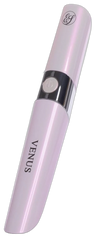
For microcurrent and EMS at home we make two options: the Phoenix bar ($119.99) for facial massage-style microcurrent, and the Lumo+ when you want EMS combined with radiofrequency in one handset. Effects are session-dependent and fade if you stop; that is true of every device in this category.
"Microcurrent" has quietly become a shelf category, not a spec, and several popular devices are really running EMS. Here is how to tell what you are buying, what the clinical evidence supports,...
How EMS works for glute and body toning, what the research supports, realistic expectations, and how to use electrical muscle stimulation sessions at home.
هل يبدو وجهك منتفخًا وباهتًا؟ ربما لديك سائل لمفي يدور تحت بشرتك. اقرأ وتعلم كيفية تعزيز التصريف اللمفي وإزالة سموم الجلد باستخدام العلاج بالتيار الكهربائي الدقيق.





اترك تعليقًا
تخضع جميع التعليقات للإشراف قبل نشرها.
This site is protected by hCaptcha and the hCaptcha Privacy Policy and Terms of Service apply.