
Medically Reviewed by Dr. Lisa Hartford, MD
A practical guide to brightening a mature smile without the sensitivity. Reviewed against current ADA guidance and peer-reviewed research on how teeth age.
Last updated: April 2026 · By: The EvenSkyn Research Team
Quick answer
Teeth whitening is safe for most adults over 50, but the drugstore kit that worked on a 30-year-old mouth usually causes more sensitivity than results on mature enamel. The reason is straightforward. Enamel thins with age and the dentin underneath it gets yellower and denser, so standard bleaching concentrations penetrate faster than older teeth can comfortably handle. What works instead: a lower-concentration formula (ADA-safe OTC products use up to 3.5% hydrogen peroxide, or roughly 10% carbamide peroxide), shorter sessions in the 10–20 minute range, LED acceleration at around 465 nm, and a formula that includes desensitizers like potassium nitrate and enamel support like fluoride. Expect two to four shades of improvement over one to two weeks, not the "instantly Hollywood white" most kits advertise.
Most whitening advice online is written for someone in their twenties, with a pen and a thirty-minute break. That advice doesn't hold up well on a fifty-five-year-old mouth that has seen three decades of coffee, two crowns, and a touch of gum recession.
This guide is the version written for the other reader. We'll cover what actually happens to teeth after 50, why the kits on the pharmacy shelf often backfire on mature enamel, the five things to look for in a whitening product if your teeth have started zinging, and how the main at-home options stack up against each other — including honestly naming the ones worth trying.
A note before we start: if you haven't had a dental cleaning in the last year or you've got an untreated cavity or active gum disease, fix that first. Whitening on top of an unstable mouth tends to end badly. Once you're cleared, the rest of this is yours.
Why teeth yellow after 50 (it's mostly not stains)
The change you're seeing in the mirror isn't the same yellowing you noticed at 35. There are three things happening underneath the surface, and only one of them is staining.
Enamel is getting thinner. Enamel doesn't regrow. Every chew, every brush, every acidic drink scrapes off microscopic amounts of it, and it compounds over decades. A 2022 study in the Journal of the Mechanical Behavior of Biomedical Materials looking at enamel across three age groups found measurable decreases in both hardness and reduced modulus with age, along with shifts in the mineral structure itself. Thinner enamel is more translucent, which means the color underneath shows through more clearly.
Dentin is getting yellower, and there's more of it. The layer under your enamel keeps laying down new tissue throughout your life — it's called secondary dentin, and it starts kicking in around age 35. Secondary dentin is denser, less permeable, and darker than the original. So your enamel is thinning and the layer showing through it is getting yellower and opaquer at the same time. You can see why brushing harder doesn't fix this.
Decades of staining have migrated deeper. Coffee, tea, red wine, tobacco, curry, soy sauce, beets, and certain antibiotics all leave pigments that bond with enamel initially and, over years, creep into the dentinal tubules. A systematic review published in 2024 found that the yellow-blue axis (the b* value in color science) shifts noticeably toward yellow in adults over 45 compared to under-30s. One pilot study in the Journal of Indian Prosthodontic Society noted a significant jump in tooth darkness specifically after age 50.
Add in receding gums (which expose more root surface, which stains easily), reduced saliva (saliva is one of the biggest things protecting enamel), and the handful of medications that alter tooth color from the inside out, and you're looking at a genuinely different whitening job than you were twenty years ago.
Why drugstore whitening kits often fail on mature teeth
Most at-home whitening products on the shelf today were formulated in the late '90s and early 2000s. The research backing them was done largely on younger teeth. Look at the packaging and you'll see the same four problems, repeated across nearly every brand.
The peroxide concentration is calibrated for thick enamel. The ADA's guidance for over-the-counter whitening products is a maximum of 3.5% hydrogen peroxide. Plenty of kits push higher than that, or use carbamide peroxide at concentrations of 22–35% (which breaks down to roughly 7–12% hydrogen peroxide equivalent). On younger teeth, that strength is fine. On enamel that's thinned over fifty years, the same chemistry reaches the nerve faster. That's the "zinging" pain people describe.
Session lengths are too long for mature enamel. Forty-five and sixty-minute dwell times were designed for resistant young teeth. On older teeth, the whitening effect plateaus well before the session ends. Everything after that point is just accumulating irritation with no extra shade benefit.
One-size trays don't respect receding gums. This is the underrated issue. Generic boil-and-bite trays were molded to average gum lines from a younger population. If your gums have receded even slightly, the tray edge sits below the enamel margin and holds gel against exposed dentin or gum tissue. Dentin is porous. Gums burn. This is why so many people over 50 get sensitivity even when the peroxide concentration is reasonable.
The formulas skip enamel support. A smart whitening gel includes potassium nitrate to calm nerve response, sodium fluoride to help remineralize enamel, and sometimes calcium phosphate or calcium glycerophosphate to reinforce the tooth surface. Most drugstore kits are peroxide plus flavoring. That's it. For a 28-year-old mouth, that's probably fine. For a 58-year-old mouth, the missing ingredients matter.
One practical note: the ADA Seal of Acceptance is a voluntary program, and it flags products that have been tested for safety and effectiveness. The catch is that the Seal currently only covers toothpastes and whitening strips, not LED kits or gel trays. So "no ADA Seal" on an LED kit doesn't mean it's bad. It means there's no Seal category for that format yet. Use concentration, session length, and the rest of the checklist below as your actual filters.
What to look for in whitening after 50: the five-point checklist
Before comparing products, here's the checklist. Anything you're considering should clear all five.
- Peroxide concentration in the gentle range. Hydrogen peroxide at 3.5% or less (the ADA OTC threshold), or carbamide peroxide around 10–16%. If the label doesn't tell you, that's a red flag on its own.
- Short sessions: 10–20 minutes, not 45–60. If a product needs an hour to work, the chemistry is either too weak or too strong. There's no reason a well-formulated gel needs that long.
- LED acceleration, specifically in the blue range around 465 nm. Blue light speeds up the breakdown of peroxide, which lets you get comparable results in less time. Bonus if the kit adds a red light mode, which has been associated with reduced gum inflammation during treatment.
- Desensitizers and enamel support built into the gel. Look for potassium nitrate, sodium fluoride, or calcium glycerophosphate. These aren't marketing. They're what separates gels formulated for sensitive mature teeth from gels formulated for anyone.
- A delivery system that keeps gel on teeth, not on gums. Pen applicators or well-designed mouthpieces beat flat generic trays and over-large strips when you've got any gum recession.
Anything that passes all five is a reasonable candidate. Anything that fails two or more, skip.
Comparison: the at-home whitening options, honestly ranked
Here's how the main categories stack up for someone over 50. Prices are approximate U.S. averages as of early 2026.
| Option | Typical price | Peroxide strength | Session length | Sensitivity risk for mature teeth | Best for |
|---|---|---|---|---|---|
| In-office professional (dentist chair, one visit) | $400–$1,200 | 25–40% HP (with gum protection) | 30–90 min | Moderate-high short-term, lower long-term | Big events, heavy intrinsic staining, people with complex dental work |
| Dentist-prescribed take-home trays (custom-molded) | $200–$500 | 10–16% carbamide (~3.5–5.5% HP equivalent) | 30–60 min daily, 2–4 weeks | Low-moderate | Sensitive teeth with meaningful discoloration, when budget allows |
| LED kits built for mature / sensitive teeth (e.g., MatureSmile, Snow Sensitive line) | $90–$300 | Low-to-mid, typically ≤10% carbamide equivalent | 10–20 min | Low when formula is right | Adults 40+ wanting professional-style results at home without the price |
| Drugstore LED kits (Colgate Optic White Pro, generic Amazon kits) | $40–$100 | Varies widely; often 10%+ HP | 10–30 min | Moderate-high on thin enamel | Younger teeth or occasional touch-up; not ideal after 50 |
| Whitening strips for sensitive teeth (Crest 3D Whitestrips Sensitive) | $25–$60 | ~6% HP | 30 min daily, 2 weeks | Low-moderate | Budget-friendly maintenance, mild surface staining |
| Whitening toothpaste (Sensodyne Clinical White, Colgate Optic White) | $7–$15 | Non-bleaching or trace peroxide | Daily use | Very low | Maintaining results, not creating them |
| Peroxide-free PAP kits (MySweetSmile, some Hismile) | $30–$70 | 0% peroxide (PAP chemistry) | Varies | Very low | People who've reacted badly to any peroxide; results are gentler/slower |
| Charcoal, baking soda, oil pulling | <$15 | N/A | N/A | Abrasion risk for charcoal; low for others | Honestly, skip charcoal if your enamel is already thin |
A few things worth naming directly:
Crest 3D Whitestrips Sensitive is a genuinely reasonable starting point if your budget is tight and your discoloration is mild. They don't do much for deep intrinsic yellowing, but they don't hurt either, and the sensitive formulation is notably more tolerable than the standard one.
Snow's product line is more expensive and the marketing is heavier than the science warrants, but their sensitive-teeth option works for many people in their fifties.
MySweetSmile and other PAP-based (phthalimidoperoxycaproic acid) options are peroxide-free, which is real, not a gimmick. They're gentler but slower. If you've had bad experiences with any peroxide product at any concentration, PAP is worth trying before you give up on whitening entirely.
At-home LED kits designed specifically for mature teeth are the newest category, and the most honest thing to say about them is that the formulation matters more than the brand. A mature-teeth-specific kit with poor formula chemistry is no better than a drugstore one. A mature-teeth-specific kit with the full checklist above is meaningfully better than anything you'll find on a CVS shelf.
Teeth whitening for sensitive teeth after 50
If you've had a bad whitening experience before, this section is the most important part of the article.
Sensitivity during whitening is almost always caused by peroxide reaching the dentinal tubules (the tiny channels that run from enamel down to the nerve) faster than the tooth can buffer. That happens for three reasons on mature teeth: enamel is thinner, gum recession has exposed dentin at the root, and the peroxide concentration is higher than your mouth can handle.
There are five things you can do about it, and they stack.
First, spend two weeks before you start whitening brushing with a potassium-nitrate-based toothpaste. Sensodyne Pronamel or Sensodyne Clinical White both work. Potassium nitrate calms the nerve response over time; it's not instant, but it makes a real difference by the time you start the kit.
Second, pick a whitening gel that already contains potassium nitrate. This is a dealbreaker for mature teeth. If the ingredient list doesn't include it, you're relying entirely on your pre-treatment prep.
Third, don't brush with cold water for the first few days of active whitening. Room temperature. Small thing, big difference.
Fourth, skip citrus, tomato, wine, and soda for 24 hours after each session. Your enamel is briefly more permeable right after peroxide exposure, and acidic foods in that window cause more sensitivity than they usually would.
Fifth, listen to the signal. If you feel a zing during a session, stop. Rinse, wait 48 hours, come back at a shorter duration. "Pushing through" sensitivity is the fastest way to end up unable to drink iced water for a week.
Hydrogen peroxide vs carbamide peroxide: what the labels actually mean
Quick translation, because most kits don't explain this.
Carbamide peroxide breaks down into hydrogen peroxide and urea once it hits your mouth. The conversion ratio is roughly 1:3 — meaning 10% carbamide peroxide delivers about 3.5% hydrogen peroxide. So a kit advertising "22% carbamide peroxide" is comparable to one with "7.5% hydrogen peroxide," and a kit with "10% carbamide peroxide" sits right at the ADA's OTC safety guideline.
For mature teeth specifically, carbamide peroxide has a small advantage: it releases more slowly, which means a gentler overall exposure curve for the same total whitening effect. That's why most dentist-prescribed take-home trays use carbamide rather than straight hydrogen peroxide.
The practical takeaway: when you see a peroxide number on a kit, do the math. If it's carbamide, divide by 3 for the hydrogen peroxide equivalent. Anything in the 6–10% carbamide range (≈2–3.5% HP equivalent) is the safe zone for mature enamel. Anything 20%+ is drugstore strength that wasn't designed with your teeth in mind.
If you have crowns, veneers, bonding, or visible fillings
Restorations don't whiten. The ADA is explicit about this — only natural tooth structure responds to bleaching agents. If you've got a crown on a front tooth, it will stay exactly the color it was the day the crown was placed, while your natural teeth around it get lighter.
Three practical paths:
If the restoration is visible when you smile, most cosmetic dentists recommend whitening your natural teeth first, letting the color stabilize for about two weeks (shade rebounds slightly in the days after treatment), and then replacing the crown or veneer to match the new shade. Not cheap, but it's the only way to get an even result.
If budget is tight and replacement isn't on the table, aim for conservative whitening. A two-shade improvement that still blends with your existing restoration looks better than a four-shade improvement that makes the restoration stand out.
If most of your front teeth are restored, whitening might genuinely not be the right investment. A professional cleaning and a maintenance toothpaste can recover a lot of the brightness without the risk of creating a mismatch.
Talk to your dentist before spending money on a kit if you're unsure. Fifteen minutes of their time will save you from a bad outcome.
A realistic timeline: what to expect week by week
This is where most whitening content oversells. Here's the real arc on mature teeth.
Week one. Surface stains come off first. You'll see a noticeable but subtle shift — usually about a shade, shade and a half. Photos catch it better than the mirror. This is also the week most sensitivity appears, if it's going to.
Week two. Now you're reaching the dentin-level color, which is the real intrinsic yellowing. Another shade or so. People who haven't seen you for a while will mention something.
Weeks three to four. For most people over 50, you've hit the ceiling your enamel allows. Continuing to whiten past this point isn't getting you whiter teeth, it's just wearing on your enamel. Stop.
Ongoing. Maintenance is the part most people skip and then wonder why they're back at the starting line six months later. Once a week with the kit, or a whitening toothpaste daily, plus straws for coffee and rinsing after tea. Do that, and results typically hold 6–12 months before you want another short active cycle.
Daily habits that actually protect whitening results
You don't need to eliminate everything that stains teeth. You need to reduce contact time and give your enamel time to recover between insults.
Drink coffee and tea through a straw when you can. It looks ridiculous and it works.
Rinse with water after anything pigmented. Doesn't have to be elaborate. A sip of water after your morning coffee removes most of what would otherwise settle in.
Don't brush immediately after acidic foods or drinks. Wait 30 minutes. Your enamel is briefly softer after acid exposure, and brushing during that window can scrub off more than it cleans.
Floss. Receded gums create more surface area for stains to grip, and the spaces between teeth are the fastest to re-yellow if you skip flossing.
Twice-yearly professional cleanings. Genuinely nothing you do at home removes tartar the way a hygienist does, and tartar is a stain magnet.
Our take: what we'd actually recommend
We make a whitening kit, so take this with appropriate salt. But the five-point checklist above is how we'd evaluate any product in this space, including our own.
If you've got the budget and the discoloration is significant, an in-office session with your dentist, followed by maintenance at home, is the fastest path. Dentist take-home trays are the next step down and a real sweet spot for most people.
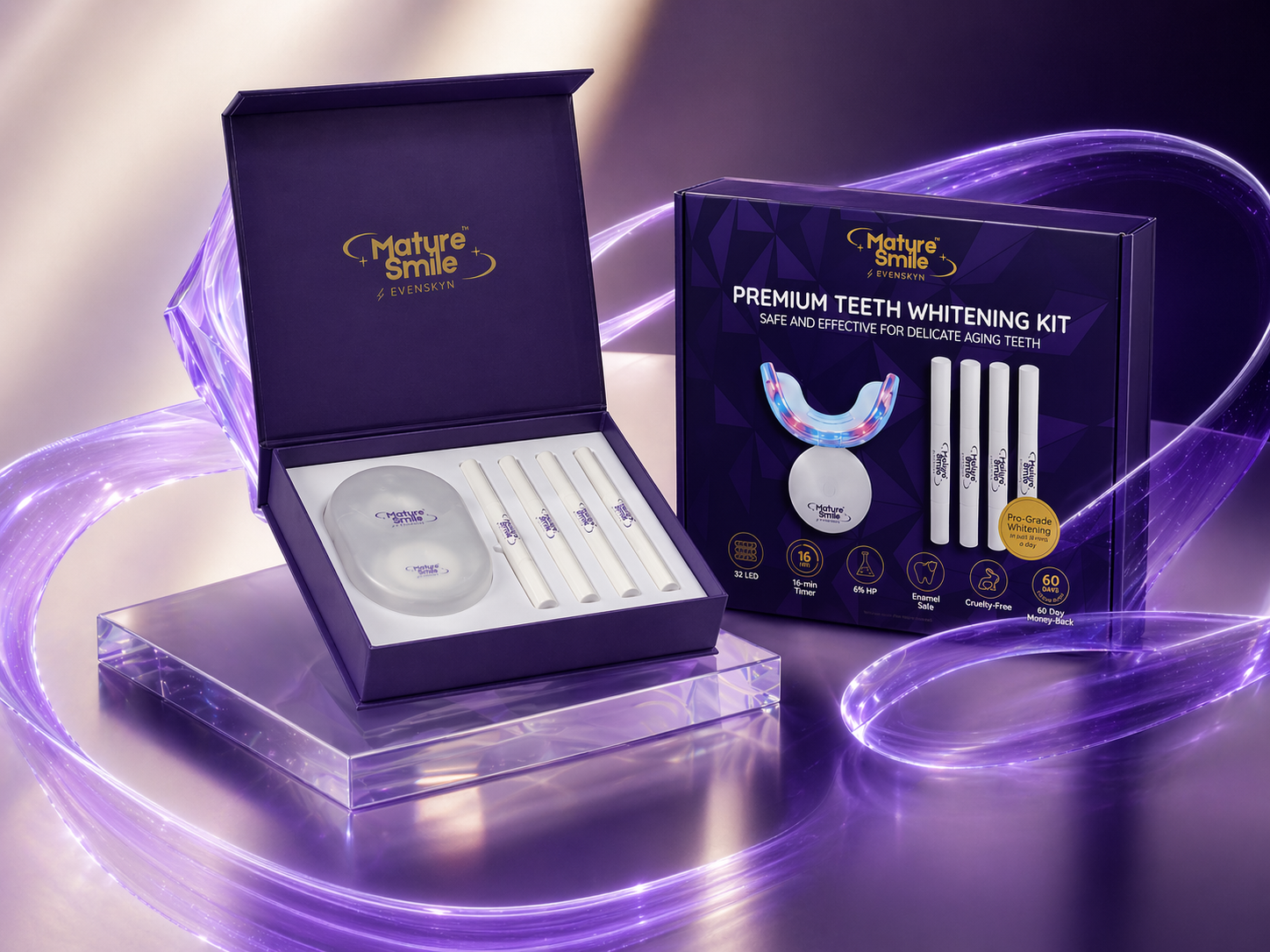
For an at-home-only solution, the options that clear the full checklist (gentle peroxide, short sessions, LED acceleration, desensitizer ingredients, gum-respecting delivery) are what we'd use. MatureSmile is the one we built, specifically because we couldn't find another that checked all five boxes for adults over 40. It uses a carbamide peroxide gel in the lower end of the effective range, pairs it with a combined blue-and-red LED mouthpiece for 16-minute sessions, and includes potassium nitrate, sodium fluoride, and calcium glycerophosphate in the formula. The precision-pen applicator keeps gel off receding gum lines. That's the honest reason it exists.
If you're on a tight budget and don't want to spend in our range, Crest 3D Whitestrips Sensitive is the reasonable drugstore pick. It won't do as much on intrinsic staining, but it won't hurt you either.
Frequently asked questions
Is teeth whitening safe after 50? For most adults with healthy teeth and gums, yes. The ADA considers hydrogen peroxide up to 3.5% safe for over-the-counter use. The main risks on mature teeth are sensitivity from overly strong formulations and gum irritation from ill-fitting trays. Choose a product that matches the five-point checklist above and see your dentist first if you've got untreated dental issues.
Why do my teeth hurt every time I try to whiten them? Three likely reasons: the peroxide concentration is too high for your enamel, the session is too long, or the gel is contacting your gums. Drop to a gentler formula (≤10% carbamide or ≤3.5% HP), cut sessions to 10–20 minutes, and switch to a pen applicator or better-fitting mouthpiece.
Can I whiten my teeth if I have crowns or veneers? You can whiten your natural teeth, but restorations won't change color. Plan to either match your whitening to the existing restoration shade or replace the restoration after treatment to match your new shade.
How white can teeth realistically get after 50? Two to four shades of improvement is the typical range for at-home whitening on mature teeth. The absolute ceiling is lower than for younger teeth because thinned enamel lets more dentin color show through no matter how much you bleach. Aiming for a natural, healthy brightness looks better than aiming for Hollywood white on a mature face.
Does LED actually do anything, or is it a gimmick? Blue LED at around 465 nm does accelerate the breakdown of peroxide — that's chemistry, not marketing. The catch is that LED alone, without a well-formulated gel, does very little. LED plus the right gel meaningfully shortens dwell time, which reduces sensitivity.
How long do whitening results last after 50? With light maintenance (once a week with your kit, or a whitening toothpaste daily) and reasonable habits around coffee and wine, six to twelve months before you'd want a short active cycle again. Without maintenance, three to six months.
Is carbamide peroxide better than hydrogen peroxide for mature teeth? Generally yes. Carbamide breaks down more slowly, which gives a gentler release curve for the same total effect. That's why most dentist-prescribed take-home kits use carbamide. The total peroxide exposure ends up comparable, but it's spread out more gently.
Should I whiten my teeth if I'm going through menopause? No direct contraindication. Some women notice increased tooth sensitivity or dry mouth during menopause, both of which can make whitening more uncomfortable. If that's you, give yourself extra pre-treatment desensitizing time (two to three weeks of Sensodyne before starting) and consider shorter sessions than the kit's defaults.
Do whitening strips work on older teeth? The sensitive-formula versions can help with surface stains. They don't do much for intrinsic age-related yellowing, because the strip shape doesn't conform well to the enamel surface and the peroxide is typically weaker. As a maintenance tool after a stronger treatment, they work fine.
References
- American Dental Association. Oral Health Topics: Whitening. ada.org/resources/ada-library/oral-health-topics/whitening
- Gibson et al. (2022). Contributions to enamel durability with aging. Journal of the Mechanical Behavior of Biomedical Materials. sciencedirect.com
- Alshamrani AA et al. (2016). Differences in tooth shade value according to age, gender and skin color. Journal of Indian Prosthodontic Society. ncbi.nlm.nih.gov/pmc/articles/PMC4762302
- Luque-Martinez et al. (2024). Dental color measurement to estimate age in adults: a systematic review and meta-analysis. Forensic Science, Medicine and Pathology. link.springer.com
- American Dental Association News. Experts weigh in on teeth whitening. adanews.ada.org
This article is general education. It's not a substitute for personalized dental advice, and it's not an endorsement of any specific clinical decision. If you've got questions about your specific situation — especially if you have existing restorations, gum disease, or a history of significant tooth sensitivity — your dentist is the right first call.
Written by the EvenSkyn Research Team. We develop and manufacture at-home beauty and oral care devices, including the MatureSmile LED whitening kit referenced above. Our editorial standard is to present honest tradeoffs across the category, name competitor products where relevant, and disclose our own product's role clearly when it appears. Corrections welcome at editorial@evenskyn.com.


اترك تعليقًا
تخضع جميع التعليقات للإشراف قبل نشرها.
This site is protected by hCaptcha and the hCaptcha Privacy Policy and Terms of Service apply.