





Micro-Infusion: What It Is and How It Works
A stamp, a set of very short needles, and a sealed dose of serum. The idea is simple. The reason it exists at all is a size problem that ordinary skincare cannot solve.
Micro-infusion is a treatment that stamps very fine, depth-limited needles into the skin while simultaneously delivering serum through the channels they create. It sits between plain topical skincare and in-clinic microneedling. The needles are short, typically around 0.5 mm for at-home systems, and the serum travels with them rather than being applied before or after. That pairing is the entire point: many of the most interesting skincare actives are far too large to cross intact skin on their own, so creating a temporary pathway is what lets them reach the upper dermal layers at all.
Who publishes this. EvenSkyn makes a micro-infusion system, so treat this as our own guide rather than a neutral survey. We have tried to be specific about what micro-infusion does not do, including the limits of our own device.
- It is a delivery method, not an ingredient. The needles solve a transport problem. What you actually get depends on the serum they carry.
- Depth is the safety story. A mechanically fixed 0.5 mm cannot be overridden by pressing harder, which is the mistake home users most often make.
- Skin blocks large molecules on purpose. Above roughly 500 daltons, absorption through intact stratum corneum drops sharply. Micro-channels are the workaround.
- Sealed beats refillable. Any system that asks you to pour serum into an open chamber has introduced a contamination path that a sealed ampoule does not have.
- Single use means single use. Home sterilising cannot reproduce factory gamma sterilisation, and reused tips are blunter as well as riskier.
- Results are a months story, not a weeks story. Hydration shows in days. Firming is a six to eight week horizon, with meaningful change across eight to twelve sessions.
- The contraindications are real. Active acne, keloid history, recent isotretinoin and blood thinners are genuine stop signs, not legal boilerplate.
What is micro-infusion?
Micro-infusion is a stamping treatment that combines two mechanisms in one pass: controlled micro-channel creation and simultaneous serum delivery. A sterile head holding dozens of very short needles is tapped across the face, and serum flows from an attached reservoir through those same needles as they work. Unlike a derma roller, nothing drags across the skin. Unlike a microneedling pen, the depth is fixed rather than dialled in by the user.
The word gets written three ways, micro-infusion, micro infusion, and microinfusion, and they all refer to the same thing. You will also see the underlying mechanism called microchanneling, and the device format described as a microneedling stamp or a microstamp. In clinics the principle is sometimes applied with professional systems at greater depth. At home it is performed with a sealed stamp at a shallow, mechanically limited depth, which is why an at-home microneedling system and a home micro-infusion kit are often the same category of product with different labels on the box.
Micro-infusion also gets grouped with skin booster treatments, and the overlap is real: both aim to place hydrating and regenerative ingredients below the surface rather than on it. The difference is route. Clinic skin boosters are injected. Micro-infusion opens temporary channels and lets the serum follow them.
The distinction that matters most is not the brand or the price. It is whether the serum path is sealed, whether the depth can be exceeded by pressing harder, and whether the needle head is genuinely single use. Those three things separate a controlled cosmetic treatment from an improvised one.
How does micro-infusion actually work?
Micro-infusion works by solving a delivery problem rather than by being more aggressive than other treatments. Two things happen during a session. The needles create temporary channels that bypass the outer barrier, and the mechanical action itself prompts the skin's normal repair response. That second part has a formal name in dermatology, collagen induction therapy, and it is the same principle that underpins microneedling: a controlled, deliberately small injury signals the skin to rebuild. The serum then travels into those channels rather than sitting on top of them, and the channels close over the hours that follow.
So a micro-infusion facial is really two treatments running at once. One is collagen induction therapy, which is slow and structural. The other is assisted delivery, which is immediate and depends entirely on what is in the ampoule. Most of the confusion about whether micro-infusion works comes from people judging the slow half on the fast half's timeline.
Depth is what separates a sensible at-home treatment from a risky one. At 0.5 mm the needles reach the upper papillary dermis. That is deep enough to bypass the barrier and shallow enough that most people feel a tapping sensation rather than pain, with a light flush that typically settles within one to four hours. On our own EvenSkyn MicroInfuser the depth is locked mechanically at the head rather than set by the user, so pressing harder changes nothing except how much you irritate your skin. Any home system worth buying should work the same way, whoever makes it.
Why does molecule size decide what a serum can do?
Skin is very good at keeping things out, and it discriminates largely by size. The widely cited 500 dalton rule holds that compounds heavier than roughly 500 daltons show a sharp drop in absorption across intact stratum corneum, and that larger molecules mostly do not cross the corneal layer at all. Plenty of prized skincare actives sit far above that line, which means a serum applied to the surface is doing most of its work on the surface.
PDRN is the clearest example. Its fragments run from roughly 50 to 1,500 kilodaltons, which is 50,000 to 1,500,000 daltons. That is around one hundred times the threshold at the small end and closer to three thousand times at the large end. No formulation trick makes a molecule that size behave like a small one. A pathway does.
Micro-infusion vs microneedling: what is the difference?
Micro-infusion and microneedling share a mechanism but differ in delivery and control. Microneedling creates channels and leaves serum application as a separate step, usually afterwards, once the channels have already begun closing. Micro-infusion delivers the serum through the needles during the same pass. The other major difference is depth control: micro-infusion systems built for home use fix the depth at the head, while pens and rollers vary with user pressure or a dial.
| Micro-infusion | Derma roller | Microneedling pen | |
|---|---|---|---|
| Depth control | Fixed at the head | Varies with pressure | User sets it |
| Serum delivery | Through the needles, same pass | Separate step | Separate step |
| Motion | Tap and lift | Rolling drag | Motorised stamping |
| Main risk | Stamping compromised skin | Tearing from drag | Depth set incorrectly |
| Built for | Home use | Home use | Clinical settings |
| Session length | 5 to 10 minutes | 10 to 15 minutes | 15 to 20 minutes |
Microstamp or micropen: which is more invasive?
A microstamp presses straight down and lifts straight off, at one fixed depth, which makes it the less invasive of the two by design. A micropen oscillates a cartridge at a depth the operator dials in, often well beyond 0.5 mm, and it is the depth setting rather than the motor that determines how invasive the session is. In a clinic that adjustability is the point. At home it is the main way people injure themselves, which is why stamps rather than pens are what reputable brands sell for unsupervised use.
Technique: why the overlap rule decides your result
Coverage is the difference between a session that treats your whole face and one that treats most of it. Each stamp should overlap the previous one by roughly half, so that about 50 percent of every new stamp lands on skin already treated and half lands on new territory. Stamp edge to edge with no overlap and you leave thin untreated strips between every set of channels.
What should you look for in a micro-infusion system?
Choosing a micro-infusion system comes down to four checks, and price is not one of them. Because the treatment breaks the skin barrier, the things that matter are the ones governing safety and sterility: how the depth is controlled, whether the serum ever meets open air, whether the needle head is genuinely single use, and what is actually in the serum. Each of the four checks below is unpacked further, with a scored comparison across the systems on the market, in our guide to choosing the best micro-infusion system.
Is the depth mechanically fixed?
A locked depth means pressing harder cannot push the needles further. This is the single most important safety feature in an at-home device, because pressure is the variable users get wrong. A dial that can be set to 1.5 mm at home is a clinical tool without clinical supervision.
Is the serum path sealed?
Systems that require pouring serum into an open chamber introduce a contamination path. A sealed ampoule that connects directly to the needle head means the serum never touches air, fingers or a refillable reservoir before it goes into freshly opened channels. This is the architecture we chose for the EvenSkyn MicroInfuser, and the trade-off is worth stating plainly: a sealed system costs more per session than refilling a chamber yourself, because you are buying a fresh sterile ampoule every time rather than decanting from a bottle. What you get for that is a serum path with no exposure points in it.
Is the needle head single use, and sterilised how?
Needle heads should be individually sealed and discarded after one session. Home sterilisation cannot reproduce factory gamma sterilisation, and reused tips are both blunter and a genuine infection risk. Blunt needles do not glide, they tear.
What is in the serum, and where is it sourced?
The serum is half the treatment. Look for actives that genuinely benefit from channel delivery, and for a brand that will tell you where its ingredients come from. Sourcing matters for allergen reasons as much as ethical ones, particularly with marine-derived ingredients. See exactly what is in ours on the Syntha-Pep ingredients page.
What should you expect, and when?
Micro-infusion delivers two kinds of change on two very different clocks. Surface hydration and a fresher look arrive quickly, within a day or two, because that is a water and barrier story. Anything that depends on collagen remodelling is slow, because collagen remodelling is slow. Setting the right expectation at the start is the difference between someone who stays consistent and someone who quits at week three.
| Window | What is happening | What to do |
|---|---|---|
| Session day | Channels open, serum absorbing, light flush | Pat in the remaining serum. No washing, no makeup, no sweating, no hot water. |
| 24 to 72 hours | Barrier temporarily more permeable and more reactive | Gentle cleanser, fragrance-free moisturiser, SPF 30 or higher every morning. No acids, retinoids or vitamin C. |
| Days 4 to 14 | Normal barrier function returning | Reintroduce actives gradually. Resume other devices after at least 24 hours. |
| Weeks 6 to 8 | Earliest point collagen-driven change tends to show | Keep the fortnightly cadence. Judge nothing before this point. |
| Months 4 to 6 | Cumulative change across eight to twelve sessions | Assess honestly against where you started, not against a filter. |
Cadence, wait times and timeline figures are drawn from the MicroInfuser User Manual, Edition 1 (2026). Other systems may specify different intervals, so follow the manual that came with your device.
The EvenSkyn MicroInfuser
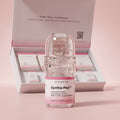
An at-home micro-infusion kit built around a sealed ampoule-to-needle-head design. Each session uses one fresh 5 mL Syntha-Pep ampoule and one fresh sterile head, at a mechanically fixed 0.5 mm depth, on a once-every-two-weeks schedule.
- Biosynthetic PDRN, not derived from salmon
- sh-Oligopeptide-1, a bioengineered peptide sequence-identical to human EGF
- Copper Tripeptide-1, hyaluronic acid at four molecular weights, niacinamide, Centella Asiatica and ergothioneine
- 24-karat gold-plated needles, single use, individually sealed
What it will not do. It will not reproduce the results of in-clinic treatments performed at greater depth. It will not work on a fortnight's timeline: initial firming is a six to eight week story and meaningful change accumulates across eight to twelve sessions. It is not suitable on raised or keloid scars, and it will only partially address deeper or mature stretch marks at this depth.
See the MicroInfuser kit EvenSkyn makes no vegan claim, because no formula-level attestation is on file. Supplier documentation reviewed in August 2026 records the PDRN (Sodium DNA) as biosynthetic and not derived from salmon, and the Soluble Collagen as produced by yeast fermentation rather than extracted from animal sources. Those declarations cover those two ingredients only. The full ingredient declaration is published in the Syntha-Pep Transparency Lab. Read the contraindications below before ordering.Who should not use micro-infusion?
Micro-infusion breaks the skin barrier, so the contraindications are real rather than precautionary boilerplate. Our micro-infusion safety and contraindications guide covers this eligibility list in full. Anyone in the categories below should not use an at-home micro-infusion device, and several of these warrant a conversation with a doctor rather than a judgement call at the bathroom mirror. If you are unsure where you sit, ask a dermatologist before your first session.
Do not use if any of these apply
- Active, cystic or inflammatory acne in the treatment area, or any open lesion.
- Raised scars, keloid or hypertrophic, or a personal or family history of keloid scarring. Stamping these can worsen their appearance.
- Oral isotretinoin within the past six months. An absolute contraindication.
- Broken, sunburned or compromised skin, or an eczema, psoriasis or dermatitis flare.
- An active skin infection in the treatment area, including cold sores.
- Prescribed blood thinners or anticoagulants, until your prescribing physician clears you.
- Pregnancy or breastfeeding, unless your physician confirms otherwise.
- A known allergy to gold, stainless steel or any ingredient in the serum.
- A recent chemical peel, laser treatment or significant sunburn, or skin still visibly red, peeling or tender.
People with deeper skin tones, roughly Fitzpatrick IV to VI, and anyone with a history of post-inflammatory hyperpigmentation should perform an extended patch test 24 to 48 hours before a first full-face session and watch closely for early pigmentation change.
Micro-infusion: 26 questions, answered
These are the questions people actually search before and after buying a micro-infusion system, grouped so you can find yours. Answers reflect the EvenSkyn MicroInfuser User Manual, Edition 1 (2026), and general practice for at-home micro-infusion. If your device came with a different manual, follow that one.
1. What is micro-infusion in skincare?
Micro-infusion is a stamping treatment that creates very short, depth-limited channels in the skin while delivering serum through those same channels in one pass. It sits between topical skincare and in-clinic microneedling. At home it is normally performed at a fixed depth of around 0.5 mm with a single-use sterile head.
2. What is a micro-infusion treatment?
A micro-infusion treatment is a single session, typically five to ten minutes, in which a sealed serum ampoule is connected to a sterile needle head and stamped across the face in sections. The serum flows through the needles as they work. Afterwards any remaining serum is patted into the face and neck.
3. Does micro-infusion actually work?
Micro-infusion reliably does one thing: it gets larger molecules past a barrier that would otherwise block them. That part is mechanical and well understood. What you get beyond improved delivery depends entirely on the serum, your skin and your consistency. Hydration effects show within days. Collagen-driven change takes months and is more modest than clinic treatments performed at greater depth.
4. Do at-home micro-infusion systems really work, or only clinic ones?
Both work by the same mechanism, but not to the same degree. Home systems are deliberately depth-limited, usually around 0.5 mm, because that is the depth at which the treatment stays safe without professional supervision. Clinic treatments go deeper and produce more dramatic change. An honest expectation for a home device is gradual improvement in the look of texture and firmness, not a clinical result.
5. Does micro-infusion work on wrinkles?
Micro-infusion can soften the look of fine lines over months of consistent use, through a combination of controlled micro-injury prompting the skin's repair response and improved delivery of firming actives. Deeper static wrinkles and folds respond far less at a 0.5 mm home depth. Expression lines caused by muscle movement are not what this treatment addresses.
6. Is a micro-infusion facial the same as microchanneling?
They describe the same underlying mechanism from different angles. Microchanneling is the name for creating temporary pathways through the skin barrier. A micro-infusion facial is a session that does that while delivering serum through those pathways at the same time. If a treatment menu lists microchanneling, expect the same principle, though clinic depth and serum will differ from a home system.
7. What is the difference between micro-infusion and microneedling?
Both create micro-channels. Micro-infusion delivers serum through the needles during the same pass and fixes the depth at the head, while microneedling treats serum application as a separate step and typically leaves depth to the user or the practitioner. Micro-infusion is a tap-and-lift motion. Rollers drag, which is where tearing risk comes from.
8. Is micro-infusion safe?
At a mechanically fixed shallow depth, with a single-use sterile head and a sealed serum path, micro-infusion is designed to be safe for home use. The risks come from the variables: reused needle heads, open serum chambers, stamping over active acne, and treating skin that is broken or inflamed. Nearly every reported problem traces to one of those four.
9. Can you use micro-infusion if you take blood thinners?
Not without speaking to your prescribing physician first. Anticoagulants including warfarin, clopidogrel, apixaban, rivaroxaban and daily aspirin therapy raise the risk of bruising, prolonged pinpoint bleeding and slower recovery, even at 0.5 mm. Your doctor knows your dosage and your reason for taking it, and that decision belongs with them rather than with a product page.
10. Is micro-infusion safe during pregnancy?
Pause it. The standard guidance is to stop micro-infusion during pregnancy and breastfeeding until a physician confirms it is appropriate to resume. Hormonal shifts change how skin reacts to stimulation, and several common serum ingredients have not been studied specifically for use in pregnancy. Ask your obstetrician or dermatologist rather than relying on a label.
11. Does micro-infusion hurt?
Most people describe a gentle tapping sensation with slight warmth, particularly across the cheeks and forehead, rather than pain. At a fixed 0.5 mm depth there should be no dragging, scratching or sharp sensation. If you feel any of those, you are pressing too hard, which does not improve results and does increase irritation.
12. Is bleeding normal after micro-infusion?
Mild pinpoint bleeding is uncommon at a 0.5 mm fixed depth and most users never see it. A few tiny spots simply indicate the needles reached the upper papillary dermis, and are not a cause for concern. Rinse with cool water and apply a fragrance-free barrier cream. Anything beyond a few pinpoints suggests too much pressure.
13. Can micro-infusion cause breakouts?
It can, and the cause is almost always hygiene or timing rather than the treatment itself. Sweat, unwashed hands, an unsanitised surface, or stamping over skin that was already congested will all introduce bacteria into freshly opened channels. Avoid the gym and hot yoga for 24 hours, sleep on a fresh pillowcase, and never stamp over an active breakout.
14. Is micro-infusion safe for darker skin tones?
It can be used, but with more caution than most marketing admits. People with Fitzpatrick IV to VI skin and anyone with a history of post-inflammatory hyperpigmentation face a genuine risk of pigmentation change from controlled micro-injury. Perform an extended patch test 24 to 48 hours beforehand, use lighter pressure, protect rigorously with SPF, and consider speaking to a dermatologist first.
15. How do you use a micro-infusion kit?
Cleanse thoroughly and dry the skin, sanitise your hands and surface, connect a fresh ampoule to a fresh sterile head, then rest the assembled device needle-down for one to two minutes so serum reaches the tips. Stamp in sections with light taps and roughly 50 percent overlap, then pat any remaining serum into the face and neck. The sequence above follows our own EvenSkyn MicroInfuser manual, and most sealed at-home systems work the same way, but check the instructions that came with yours before the first session.
16. How often should you do micro-infusion?
Once every two weeks is the standard cadence for at-home systems. More frequent stamping does not improve collagen induction at this depth and can compromise barrier function. Users whose skin has tolerated the first four to six sessions without irritation sometimes shorten the interval to ten days, returning to fortnightly at the first sign of redness or dryness.
17. Do the needles inject the serum into the skin?
No, and this is a common misunderstanding. The needles do not push serum in the way a syringe does. They create temporary channels, and the serum is then drawn into the upper dermal layers through those openings far more efficiently than topical application allows. There is no pressure-injection mechanism involved.
18. Can you reuse a micro-infusion needle head?
No. Needle heads are single use only. Home sterilising cannot reproduce the gamma sterilisation used in manufacturing, so reuse raises infection risk substantially. Reused tips are also blunted, and a blunt needle tears rather than penetrates cleanly. Discard the head and the ampoule together after every session.
19. What should you avoid after a micro-infusion session?
For the first 24 hours avoid washing your face, makeup, sweating, saunas, steam rooms, pools, hot tubs and hot showers. Across 24 to 72 hours avoid retinoids, vitamin C, AHAs, BHAs, benzoyl peroxide, added fragrance and high-strength essential oils. Apply broad-spectrum SPF 30 or higher every morning, because UV on freshly treated skin is the leading cause of post-treatment pigmentation.
20. Can you use micro-infusion with retinol or vitamin C?
Yes, but not close to a session. Stop retinoids, AHAs and BHAs 48 hours before and resume 72 hours after. Stop vitamin C and physical exfoliants 24 hours before and resume 48 hours after. Hyaluronic acid is the exception and can be used the same day, since it hydrates without irritating freshly treated skin.
21. Can you use other devices on the same day?
Before, yes. After, wait. Radiofrequency, ultrasound and microcurrent devices used earlier the same day warm the tissue and increase circulation, which primes the skin. After a session, wait a minimum of 24 hours before resuming any of them, because heat, vibration or electrical stimulation on freshly treated skin can amplify redness and prolong recovery.
22. Can you use micro-infusion around the eyes?
Not directly. The eyelids, the immediate under-eye hollow and any tissue inside the orbital bone should be avoided entirely, because the skin there is too thin for direct micro-infusion. Residual serum can be patted gently along the orbital bone with clean fingertips instead, which is the safe way to treat that area. For a dedicated approach to the eye area, see our guide to under-eye patch application.
23. Can you use micro-infusion on the neck and chest?
Yes, with more caution than the face. Skin on the neck and chest is thinner and more prone to post-inflammatory hyperpigmentation, so use lighter pressure, reduce each zone's sweep count, and extend the interval between treatments to three weeks for those areas. The backs of the hands generally tolerate treatment at standard pressure.
24. Does micro-infusion help acne scars?
For atrophic acne scars, meaning the depressed or pitted kind, the appearance can soften gradually with consistent use, and one to two extra passes over those areas is reasonable when the skin is fully calm and not actively breaking out. Raised, keloid and hypertrophic scars are the opposite case: stamping those can worsen them and should be avoided entirely.
25. Does micro-infusion help with uneven tone and dark spots?
It can support the look of a more even tone, though most of that work comes from the serum rather than the needles. Brightening actives such as niacinamide benefit from improved delivery. It is not a melasma treatment, and anyone with melasma or a hyperpigmentation history should patch test and speak to a clinician before starting.
26. How long do micro-infusion results last?
Hydration and glow effects fade within days to weeks once you stop, because they depend on repeated sessions. Collagen-driven change persists longer, since remodelled tissue does not simply revert, though it will gradually be lost to normal ageing. Results are maintained by keeping the fortnightly cadence rather than by finishing a course.
Read next
- How to choose the best micro-infusion system
- What is PDRN in skincare, and what does the evidence actually show
- The complete guide to at-home micro-infusion devices
- Micro-infusion vs microneedling vs dermarolling
- Micro-infusion before and after: what is realistic in 12 weeks
- Is at-home micro-infusion safe?
Last reviewed 29 July 2026 by the EvenSkyn Skin Science Desk. Specifications, cadence, wait times and contraindications are drawn from the EvenSkyn MicroInfuser User Manual, Edition 1 (2026). The 500 dalton penetration threshold is from Bos and Meinardi, Experimental Dermatology, 2000. EvenSkyn products are cosmetic and are not intended to diagnose, treat, cure or prevent any disease. Consult a dermatologist if you are unsure whether micro-infusion suits your skin.

