

Qure Reviews, Read Properly: What Qure Publishes, What Third Parties Show, and Where the Numbers Disagree
Competitor review, written by a competitor
Qure is the most recommended at-home micro-infusion system on the internet right now. Google’s AI Overview calls it the best overall, the biggest affiliate listicle in the category ranks it first, and its shopping panel carries thousands of ratings. Before you buy one, here is what Qure’s own page states, where its published figures contradict each other, what three separate rating sources actually show, and how the system compares with the EvenSkyn MicroInfuser on specifications.
The short version
Qure makes a competent, well-marketed 0.5 mm micro-infusion system with two targeted serums, disposable heads and a clearly stated treatment cadence. On the hardware there is very little separating it from the EvenSkyn MicroInfuser or from Seranova. Depth is the same, needle material is the same, single-use heads are the same, and the recommended frequency is the same across all three.
Three things are worth knowing before you buy. Qure’s page states two different money-back windows, 90 days and 30 days, at the same time. Its headline efficacy figure and the study it cites describe two different measurements and the page does not reconcile them. And its three public rating figures, first-party, Trustpilot and Google, are 4.8, 4.5 and 4.4 across very different review counts.
None of that makes Qure a bad product. It makes it a heavily marketed one, which is a different thing, and it is worth being able to tell those apart when the entire first page of Google is recommending it to you.
What Qure is
Qure Skincare sells an at-home micro-infusion device: a handle, a disposable needle head and a serum ampoule. You stamp rather than roll, the needles create temporary channels in the outer skin, and the serum travels through them. It is the same treatment category as the EvenSkyn MicroInfuser, Seranova, Glov and AMIRO.
Qure’s distinguishing choice is that it splits its formula in two. Instead of one serum meant to do everything, you pick a Serum for Dark Spots or a Serum for Wrinkles. That is a genuinely reasonable design decision and it is the thing we would point to if asked what Qure does better than the rest of the category.
What Qure states about its own product, read on 23 August 2026
| Attribute | What Qure’s page states |
|---|---|
| Needle depth | 0.5 mm |
| Needle material | 24K gold-plated |
| Needle count | Not stated |
| Needle head | Disposable. “New needle heads provide sharp, straight needles for every treatment” |
| Sterilisation | “EO-sterilized (ethylene oxide)” |
| Serums | Serum for Dark Spots and Serum for Wrinkles, sold separately |
| Dark Spots actives | Tranexamic acid, niacinamide, panthenol. Concentrations not stated |
| Wrinkles actives | Beta-glucan, sodium hyaluronate, niacinamide, panthenol. Concentrations not stated |
| Frequency | “Every 2 weeks for best results” |
| Price seen | $119.00 for a Micro-Infusion 1 Month Bundle (Brightening) on qureskincare.com. Google’s shopping panel showed $169.00 against $357 the same day |
| Treatments per bundle | Not stated |
| Guarantee | “90-Day Money-Back Guarantee” and “30-Day Money-Back Guarantee” both appear |
| Efficacy claim | “93% noticed results the next day after their first treatment” |
| Study cited | “Based on results after 6 treatments in a user study of 30 participants aged 25-65” |
| Professional claim | “50+ Board Certified Dermatologists recommend Qure to their patients” |
| First-party rating | “4.8/5 Rated by 10k+ Customers”, with 4,588 reviews shown on one bundle |
Three places where Qure’s published numbers disagree with each other
These are not accusations. They are what a careful reader finds on one page in one sitting, and each one is checkable by opening the page yourself.
1. Two money-back windows on one page
A 90-Day Money-Back Guarantee and a 30-Day Money-Back Guarantee both appear. Sixty days separate those promises. This is a very common pattern when a promotional banner and a standing policy live on the same template, and it is usually resolved in the buyer’s favour, but it is not resolved on the page. Get the applicable window confirmed in writing before you order.
2. The efficacy figure and the study describe different things
Qure states that 93% noticed results the next day after their first treatment. Qure separately attributes its results to a study measuring outcomes after six treatments, in 30 participants aged 25 to 65. A next-day observation after one session and an assessment after six sessions are not the same measurement, and the page does not explain which produced the 93%.
The deeper point is about what a next-day change can be. Any micro-channelling treatment leaves skin briefly plumper and better hydrated, and that is visible in a mirror the following morning. It is a real effect. It is also a temporary one, and it is not evidence of the structural change these products are usually bought for. We apply the same standard to ourselves: our own testing is company-sponsored, unpublished and not peer-reviewed, and we say so wherever we cite it.
3. Three rating sources, three different numbers
| Source | Rating | Count | Read on |
|---|---|---|---|
| Qure’s own site | 4.8 / 5 | “10k+ customers”, 4,588 reviews on one bundle | 23 Aug 2026 |
| Trustpilot profile for qureskincare.com, as displayed in Google’s results | 4.5 / 5 | about 1,588 reviews | 23 Aug 2026 |
| Google shopping panel | 4.4 / 5 | about 1,300 ratings | 23 Aug 2026 |
A first-party number sitting above third-party numbers is normal and not by itself suspicious. Brands collect reviews from every buyer; independent platforms collect from people motivated enough to go elsewhere and write one. What is worth taking from this is simply that no single figure here is the truth, and 4.8 from 10,000 is doing more marketing work than 4.4 from 1,300.
The claim we could not check
“50+ Board Certified Dermatologists recommend Qure to their patients.” We looked for names, institutions, credentials or any disclosure of whether those clinicians were compensated, and found none published. The claim may be entirely accurate. It is not currently verifiable, and an unverifiable endorsement is not a reason to choose a product over another one.
We hold ourselves to the same line. EvenSkyn works with a Chief Dermatology Advisor and we name that role and that relationship rather than implying a broader consensus we cannot evidence.
Qure's comparison article, fact-checked
On 31 August 2026 we read Qure's own comparison article, titled "Qure vs Seranova vs Glov: Full Comparison", attributed to "Our Editorial Team" with no publication date shown. It compares three kits and does not mention EvenSkyn. Because it has become one of the most visible comparison pages in the category, we checked its factual claims the way we check everything else on this page: against primary sources, with the same standard applied to ourselves.
The FDA sentence, checked against the FDA's page
The article states: "The FDA notes that devices with shorter, blunter needles used mainly to support serum absorption or the look of skin generally aren't classified as medical devices."
The FDA's microneedling devices page, read in full on 30 August 2026, states the conditions differently: "Generally, microneedling products that do not penetrate into the living skin layers (epidermis and dermis) and claim only to do the following would not be devices: Facilitate exfoliation of the skin (that is, disruption or removal of the stratum corneum); Improve the appearance of skin; Give skin a smoother look and feel; Give skin a luminous look." The same page states: "Microneedling devices are not approved for delivery of cosmetics, topical medications (for example, creams, ointments, gels), vitamin solutions, drugs, or blood products (for example, platelet-rich plasma (PRP)) into the skin."
Two differences matter. First, the FDA's non-device conditions are that a product does not penetrate living skin and claims only appearance-level effects. Supporting serum absorption is not among the listed claims, and the FDA separately states that microneedling devices are not approved to deliver cosmetics into the skin. Second, applied to the products the article compares, kits with sharp 0.5 mm needles that carry a serum into living skin, the sentence would leave a reader with the impression that the category generally sits outside device classification. Under the FDA's own wording, a sharp 0.5 mm kit penetrates living skin, and that reading covers Qure's kit, Seranova's, Glov's and ours alike. We say exactly this about our own product on our device-category reference, which quotes and links every source used here.
The claims that check out
The article states Glov's needle depth as 0.25 mm. That matches Glov's main product page as read on 31 August 2026, and it is fair to note that the ground moved under everyone here: Glov's own pages stated 0.5 mm in July 2026. The article's Qure specifications, 0.5 mm depth, 24K gold plating, EO sterilisation and an every-two-weeks cadence, match Qure's own product page read the same day. Its description of Seranova's serum matches Seranova's current ingredient marketing.
A wording worth reading twice
The article says the Qure system is "backed by an independent 31-subject clinical evaluation across all Fitzpatrick skin types". Qure's product page describes that evaluation as an "independent clinical evaluation of dermatologic safety-in-use". A safety-in-use evaluation examines tolerance, not results, so "backed by" is carrying more weight in that sentence than the evaluation it points to. Qure's separate efficacy figure and study description are examined earlier on this page.
What the article does not contain
No prices appear for any of the three kits, and the comparison covers three brands in a category of at least ten. For every brand's published facts in one dated table, see the micro-infusion disclosure ledger.
Qure and the EvenSkyn MicroInfuser, spec by spec
Read the ties first. On most of what actually happens to your skin, these two products are the same, and any comparison that hides that is selling you something.
| Specification | Qure | EvenSkyn MicroInfuser | Who wins |
|---|---|---|---|
| Needle depth | 0.5 mm | 0.5 mm, mechanically locked so pressing harder cannot drive them deeper | EvenSkyn, narrowly, for stating the lock |
| Needle material | 24K gold-plated | 24 karat gold-plated | Tie |
| Head reuse | Disposable, new head each treatment | Single use, new head each treatment | Tie |
| Sterilisation stated | Ethylene oxide | Individually gamma-sterilised | Tie, both disclose, which most of the category does not |
| Serum path | Ampoule and chamber | Sealed ampoule connecting directly to the head, no transfer step | EvenSkyn |
| Serum actives | Tranexamic acid or beta-glucan, plus niacinamide, sodium hyaluronate, panthenol | Biosynthetic PDRN at 2,000 ppm, Copper Tripeptide-1, sh-Oligopeptide-1 | EvenSkyn |
| Targeted formulas | Two, dark spots or wrinkles, chosen at purchase | One combined formula | Qure |
| Concentrations published | No | Yes, PDRN stated at 2,000 ppm, which is 0.2% | EvenSkyn |
| Entry price | $119.00 for a 1 Month Bundle | $119.99 for the kit | Qure, by under a dollar at today’s price |
| Treatments stated | Not stated | 4 sealed ampoules, sold as a 2 month supply | EvenSkyn |
| Cost per treatment | Not published. Two sessions a month at their own cadence would imply about $59.50, our inference not their figure | $30.00, published | EvenSkyn |
| Frequency | Every 2 weeks | Every 2 weeks | Tie |
| Money-back window | 90 days and 30 days both stated | 60 days, one number | EvenSkyn, for being unambiguous. Qure if the 90 applies to you |
| Public review volume | Thousands, across three sources | Far fewer, and we do not publish a rating on the product page | Qure, clearly |
| Availability today | Shipping | Shipping | Tie |
That is five ties, three lines where Qure is the better buy and seven where we would argue ours is. We are not going to pretend the review-volume line is a small one. If social proof is what you buy on, Qure has thousands of public reviews and we do not, and no amount of specification detail changes that.
The one difference that actually matters
Strip out everything both brands share and one substantive difference is left: what goes through the channel.
Qure’s published formulas are built on tranexamic acid, beta-glucan, niacinamide, sodium hyaluronate and panthenol. Those are good, well-evidenced topical ingredients. They are also, tranexamic acid aside, ingredients that work reasonably well applied normally, because they are small enough to get where they need to go without help.
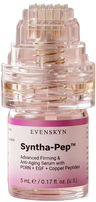
The EvenSkyn Syntha-Pep ampoule is built around biosynthetic PDRN at 2,000 ppm, with Copper Tripeptide-1 and sh-Oligopeptide-1. PDRN is a large molecule and its targets sit below the outer layer of skin, which is precisely the case for delivering it through a channel rather than spreading it on top. We have written a page on exactly that question, including what nobody has measured, and we recommend reading it before you take our word for it.
So the honest framing is not that one device is better made. It is that a micro-infusion device earns its price when it delivers something that could not get there otherwise. That is the question to put to any brand in this category, including us.
Who should pick which
Pick Qure if:
- You want the lowest cost of entry into the category.
- Your concern is specifically dark spots and you want a formula built around tranexamic acid.
- Large public review volume is how you decide, and you want to read a thousand strangers before you buy.
- You want the option to switch formulas between wrinkle and pigment concerns over time.
Pick the EvenSkyn MicroInfuser if:
- You want the device to deliver something you could not simply apply topically, which is the entire argument for owning one.
- You want the actives and the concentration published rather than listed without numbers.
- You want a sealed serum path with no pour or transfer step.
- You want one unambiguous returns window rather than two numbers on one page.
- You want a published cost per treatment you can check against the kit price.
Pick neither if: you have active acne, an eczema or rosacea flare, have taken isotretinoin recently, are pregnant, or scar easily. That advice applies to every product named on this page including ours, and it is covered properly on our safety page.
Where we stand
We are not going to end a page about a competitor by telling you the competitor is bad. Qure makes a real product, states its needle depth consistently, uses disposable heads, names its sterilisation method and publishes a cadence. Most of this category does less than that.
What we would ask you to do is separate the marketing from the specification. Qure is winning the recommendation layer right now, and a first page of Google that agrees with itself is not the same as evidence. Read both ingredient lists, including ours in declaration order, decide whether you want the device to deliver something you cannot apply another way, and buy on that.
Frequently asked questions
Is Qure Skincare a legitimate company?
Yes. Qure sells a real product from a real storefront, ships internationally, operates country domains for Germany and France, and carries a public Trustpilot profile with roughly 1,588 reviews. Nothing on this page suggests otherwise. The questions worth asking about Qure are about its published claims, not its existence.
Does Qure micro-infusion actually work?
Qure publishes one study to support that: 30 participants aged 25 to 65, results measured after six treatments. That is a small, company-run study and we could not find it published in a peer-reviewed journal. It is evidence, and it is the weakest grade of evidence. What is better established across the category is that a 0.5 mm needle creates temporary channels in the outer skin, and that anything you deliver through them meets less resistance than it would sitting on the surface. Qure’s needle depth is the same 0.5 mm as ours and as Seranova’s, so on the mechanism itself there is nothing separating these products.
How much does Qure micro-infusion cost?
Qure’s own page lists a Micro-Infusion 1 Month Bundle at $119.00 on 23 August 2026. Google’s shopping panel showed a Qure micro-infusion listing at $169.00 against a $357 compare-at price on the same day, so the figure depends on which bundle and which surface you land on. Qure’s page does not state how many treatments are in the 1 Month Bundle. At Qure’s own recommended frequency of every two weeks, a month implies two sessions, which would work out near $59.50 each, but that is our inference from their frequency guidance and not a number Qure publishes.
What is Qure’s needle depth?
0.5 mm, and Qure states it consistently. Their page describes 24K gold-plated needles at 0.5 mm. That matches the EvenSkyn MicroInfuser and Seranova’s headline figure. Depth is not where these products differ.
Are the Qure needle heads reusable?
No. Qure describes disposable heads and states that new heads provide sharp, straight needles for every treatment. That is the correct design for this category and it matches ours.
How are Qure needle heads sterilised?
Qure states EO sterilisation, meaning ethylene oxide. The EvenSkyn MicroInfuser heads are individually gamma-sterilised. Both are recognised methods for single-use devices. Ethylene oxide is a chemical process and requires an aeration step afterwards to bring residual levels down; gamma irradiation is a physical process and leaves no chemical residue. Neither method is a problem in itself, and the notable thing is that both brands name their method at all, which most of this category does not.
What is in the Qure serums?
Qure sells two: a Serum for Dark Spots, listing tranexamic acid, niacinamide and panthenol, and a Serum for Wrinkles, listing beta-glucan, sodium hyaluronate, niacinamide and panthenol. Concentrations are not published. Those are sensible, well-understood ingredients. They are also, with the exception of tranexamic acid, ingredients you can already buy in a topical serum.
Does Qure contain PDRN?
No. Neither published Qure formula lists PDRN, and neither lists a copper peptide or a growth factor. This is the clearest formulation difference in the category. The EvenSkyn Syntha-Pep ampoule is built around biosynthetic PDRN at 2,000 ppm with Copper Tripeptide-1 and sh-Oligopeptide-1, a figure taken from the formulation and safety summary we publish. Whether that matters to you depends on whether you want the device to deliver ingredients you cannot easily apply another way, or ingredients you can.
How often should you use Qure?
Every two weeks, which is what Qure’s own page recommends. That is the same cadence we recommend for the MicroInfuser, and the same one Seranova publishes. Nobody in this category is arguing about frequency.
What is Qure’s return policy, 30 days or 90 days?
Their page states both. We read a 90-Day Money-Back Guarantee and a 30-Day Money-Back Guarantee on the same page on 23 August 2026, alongside a reference to hassle-free returns. We are not calling that dishonest, and it is the kind of thing that happens when a promotion and a standing policy live on one template. It does mean you should get the applicable window in writing before you buy, because the difference between those two numbers is two months of your money.
What does “50+ board certified dermatologists recommend Qure” actually mean?
We could not establish that. Qure states it on its page. No names, credentials, institutions or disclosure of whether those dermatologists were compensated appear alongside the claim, and we could not find a public list. It may be entirely accurate. It is not currently checkable, and a claim you cannot check should not be the reason you buy something.
Is the “93% noticed results the next day” claim reliable?
Treat it carefully. Qure states that 93% noticed results the next day after their first treatment, and separately attributes its numbers to results after six treatments in a study of 30 participants aged 25 to 65. Those two framings do not describe the same measurement, and the page does not reconcile them. Beyond that, a next-day change after any micro-channelling treatment is most plausibly hydration and mild local swelling, which is real and visible and also temporary. It is not the same thing as a structural change, and no at-home device in this category should be sold as though it were.
What do Qure’s ratings actually say?
Three sources give three different numbers, and all three are worth knowing. Qure’s own page states 4.8 out of 5 from more than 10,000 customers, with 4,588 reviews shown on one bundle. Trustpilot’s public rating for qureskincare.com, as shown in Google’s search results on 23 August 2026, was 4.5 from about 1,588 reviews. Google’s own shopping panel showed 4.4 from about 1,300 ratings the same day. First-party review counts are usually higher than third-party ones because they collect from every buyer rather than from people motivated to go and write somewhere else. The pattern here is normal. The spread is worth seeing before you treat any single figure as the truth.
Qure or Seranova, which is better?
On the specifications both publish, they are close to identical: 0.5 mm, 24 karat gold-plated needles, disposable heads, every two weeks. The real differences are the serums and the buying experience. Qure splits its formula in two so you choose between dark spots and wrinkles; Seranova sells one combined formula. We have written a separate page on Seranova and we reach the same conclusion there: depth is not the deciding factor in this category, and anyone telling you it is has not read all three brands’ pages.
Qure or the EvenSkyn MicroInfuser, what is the actual difference?
Three things, and only three. First, the serum: ours is built around PDRN with a copper peptide and a growth factor, theirs is not. Second, the serum path: ours is a sealed single-use ampoule that connects directly to the needle head with no transfer step. Third, the price and what it buys: Qure’s entry bundle is under a dollar cheaper up front at today’s price, ours is $119.99 for four sealed treatments, which is $30.00 each. Everything else, depth, needle material, single-use heads, cadence, is the same. If cost of entry is the deciding factor, Qure wins that line. If what goes through the channel is the deciding factor, we would argue ours does.
Is Qure FDA approved?
No at-home micro-infusion device in this category is FDA approved, and that includes ours. FDA approval is a specific pathway that applies to high-risk medical devices. Cosmetic devices of this kind are not approved, and any brand in this category using the word approved is using the wrong word. If a claim about regulatory status matters to your purchase, ask the brand for a clearance number and the product code it sits under, and treat a refusal as an answer.
Related reading
- Best micro-infusion system: every at-home kit compared
- Seranova reviews, read properly
- Glov Beauty reviews, read properly
- Micro-infusion safety and contraindications
- Does topical PDRN get into skin?
- What is actually in Syntha-Pep
Sources, with the date each was read
- Qure Skincare, Micro-Infusion product page, qureskincare.com/pages/microinfusion. Source for price, needle depth and material, disposable heads, ethylene oxide sterilisation, both serum ingredient lists, the two money-back windows, the every-two-weeks cadence, the 93% claim, the 30-participant study description, the dermatologist claim and the first-party rating.
- Trustpilot profile for qureskincare.com, rating and review count as displayed in Google search results on 23 August 2026.
- Qure Skincare, "Qure vs Seranova vs Glov: Full Comparison", qureskincare.com/blogs/all/qure-vs-seranova-vs-glov, read 31 August 2026. Source for every claim attributed to Qure's comparison article above.
- FDA, Microneedling Devices page, fda.gov/medical-devices/aesthetic-cosmetic-devices/microneedling-devices, read in full 30 August 2026. Source for the FDA quotations in the fact-check section.
- Google shopping panel for Qure micro-infusion, price, compare-at price, rating and rating count as displayed on 23 August 2026.
- Google United States search results for “best micro infusion system” and “qure vs seranova micro infusion”, including the AI Overview and its cited sources, captured 23 August 2026.
- EvenSkyn MicroInfuser product page and micro-infusion safety page, evenskyn.com, for every EvenSkyn figure quoted above.
Prices, ratings and published claims change. Every figure above is stamped with the date we read it. If you are reading this much later, open the sources and check.