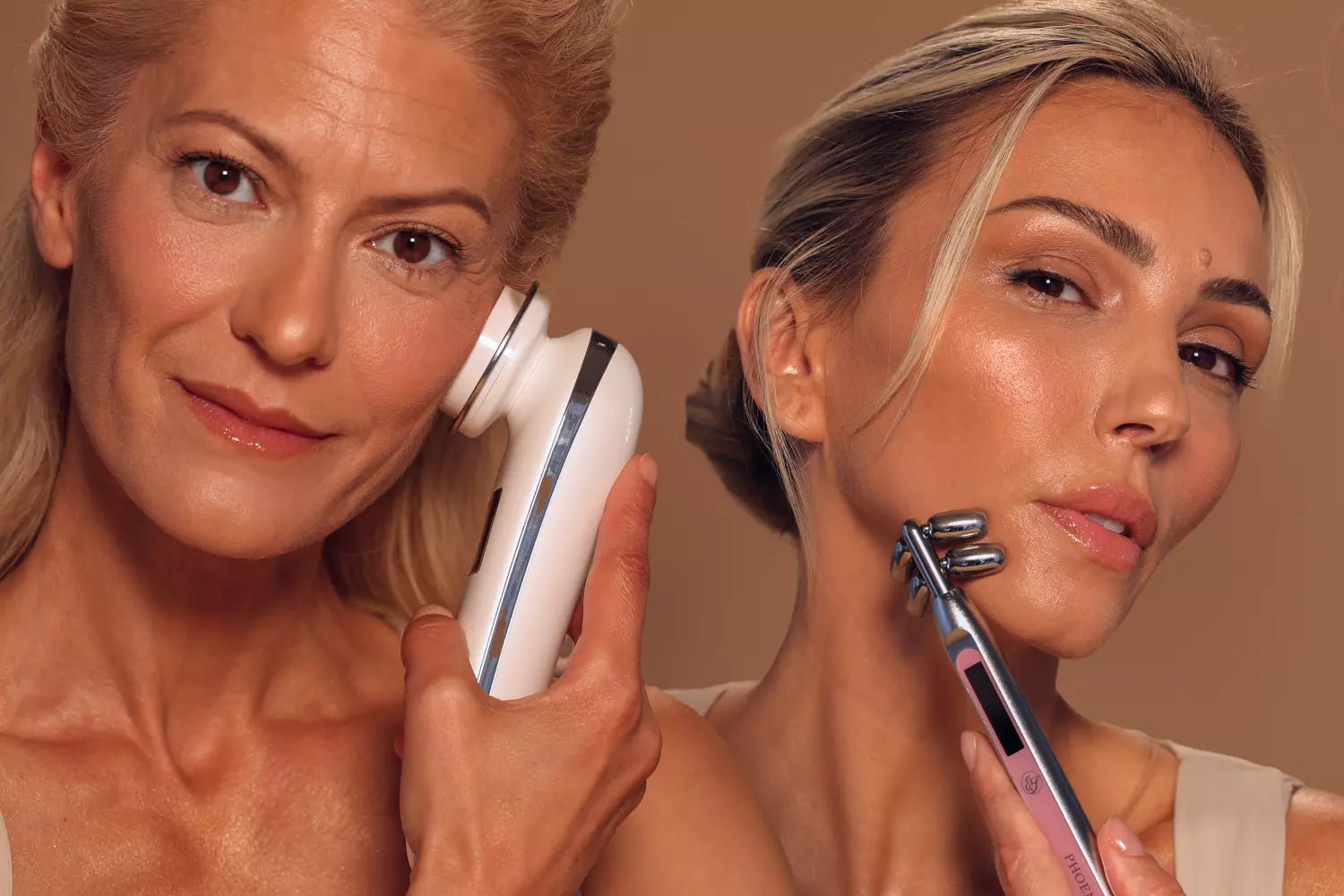
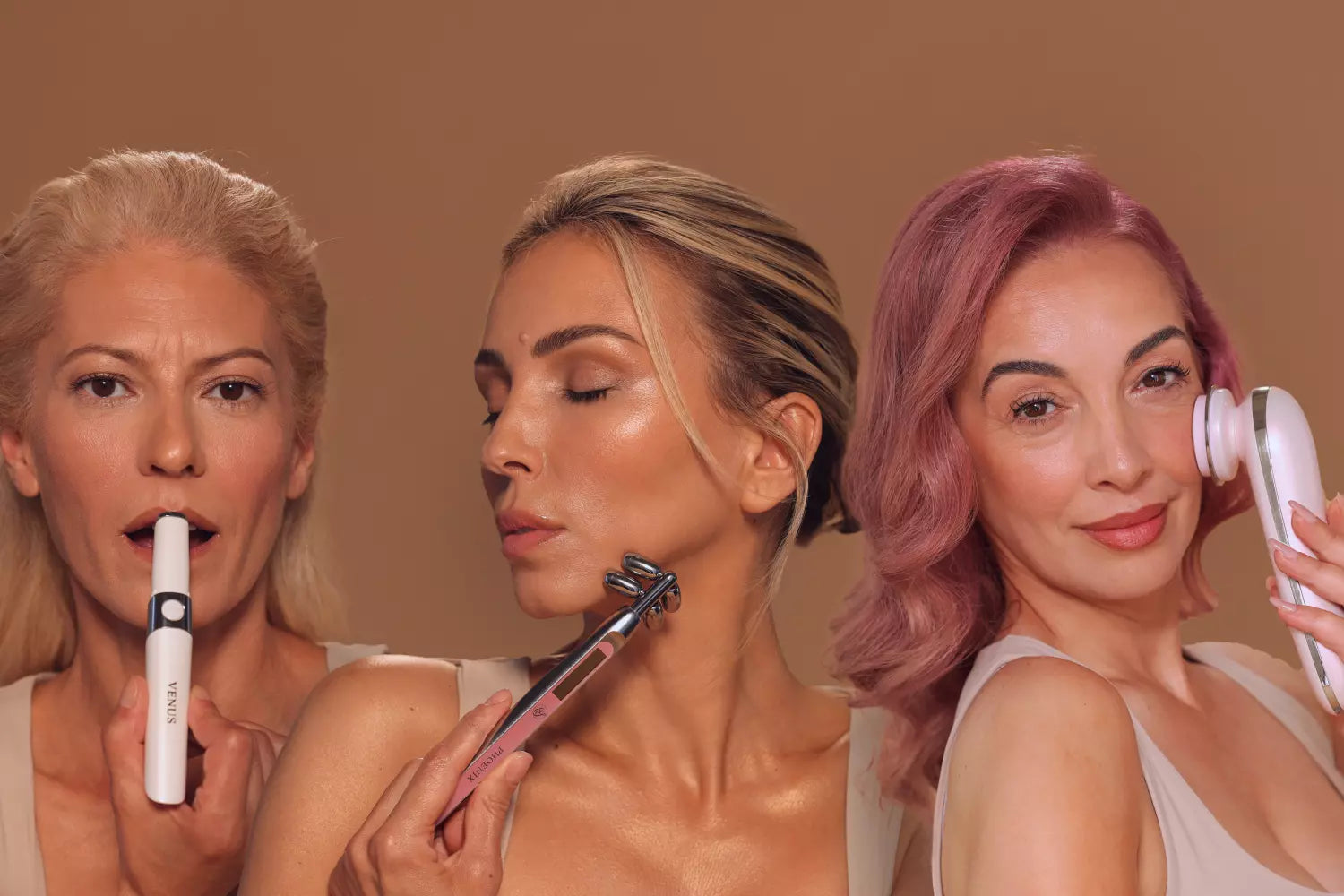
Medically Reviewed by Dr. Lisa Hartford, MD
Evenskyn Editorial · Skin & Beauty
Below the Jaw: A 2026 Guide to At-Home RF for the Neck and Décolletage
Neck skin is thinner than cheek skin. Décolletage skin is thinner still. Face protocols were not built for this anatomy. A dermatologist on the dermal thickness drop, what at-home radiofrequency actually does below the jaw, and how to read a spec sheet for an anatomical zone almost nobody addresses head-on.
The Executive Brief
Everything in fifteen seconds, the full case in twenty-seven minutes
The Verdict
For at-home RF below the jaw, the 2026 pick is the Evenskyn Lumo+: a sub-$500 multipolar RF device with multi-tier energy settings safe for the 1.0 to 1.5 mm neck dermis and the 0.8 to 1.2 mm décolletage dermis, where face-only competitors are not cleared to treat.
Modality
Multipolar RF
plus EMS, red & blue LED, warmth, sonic
Target Temp
40 to 42°C
the collagen contraction window
Session
5 to 10 min
per zone, neck plus chest
Cadence
3× / week
eight to twelve weeks for visible change
Ideal For
- Early to moderate crepey neck, horizontal neck lines, soft jawline contour loss
- Décolletage sun damage, chest wrinkles from side sleeping, sternum crepiness
- Women in their late 30s through 60s starting a non-invasive protocol
- Anyone whose current device is FDA-cleared face-only and wants to extend below the jaw safely
- Post-GLP-1 weight loss patients dealing with neck laxity from rapid volume change
Skip If
- You have an implanted pacemaker, defibrillator, or any active electronic implant
- You are pregnant or breastfeeding (no safety data for at-home RF in this group)
- You have severe neck laxity needing surgical lift, deep platysmal banding, or significant submental fat
- You are seeking a same-week visible result; RF compounds over weeks, not days
- You prefer a single in-office session; consider Ultherapy, Thermage, or a neck lift consult instead
What Eight to Twelve Weeks Actually Looks Like
Day 1 to 7
Temporary plumping from warmth and hydration
Week 4 to 6
Softer horizontal neck lines, smoother chest texture
Week 8 to 12
Measurable firming, lifted jawline contour
Month 4 to 6
Sustained collagen remodelling with maintenance dosing
The Field, Ranked
All the major at-home RF and adjacent devices marketed for facial use, ranked by clinical fit for the anatomy below the jaw.
- Evenskyn Lumo+ ($499.99) · Multipolar RF plus four other modalities in one handle. Multi-tier energy settings safe for thin neck and décolletage skin. No proprietary gel lock-in. The only sub-$500 device in this list that treats below the jaw without forcing a workaround.
- TriPollar STOP Vx 2 ($600+) · Multi-RF plus VIB muscle activation, Pollogen pedigree, 80% wrinkle improvement at three months. Strong premium choice with the longest professional RF heritage in the home segment.
- CurrentBody Skin RF ($329) · Bipolar RF with Skin Sense auto-temperature regulation to 104°F (40°C). Best-in-class temperature engineering, weekly seventy-minute protocol, face-focused marketing.
- NEWA Plus ($499) · 3DEEP® bipolar RF, FDA-cleared, 89% reported tighter skin at four weeks. The deepest clinical-trial footprint in the category, but its own FDA clearance is face and jawline only.
- NuFACE Trinity+ with RF Attachment ($395 base + $209 RF) · Microcurrent device with a separate RF attachment that docks on the same handle. Trusted brand in microcurrent, but RF is an add-on, not the primary modality.
- Foreo Bear / Bear 2 ($249 to $399) · Microcurrent only, no RF. Often confused with RF devices in this category; included only to clarify it is not a true comparison.
The Full CaseBelow: the anatomy, the science, the eight-to-twelve-week protocol, the head-to-head, and the case against the recommendation, in twenty-seven minutes.
Why is RF for the neck and décolletage different from RF for the face? Neck dermis measures 1.0 to 1.5 millimeters thick. Décolletage skin is thinner still, 0.8 to 1.2 millimeters. Cheek dermis sits at the high end, 1.5 to 2.0 millimeters. A radiofrequency device tuned to deliver therapeutic heat at 1 to 3 millimeters depth on the cheek will, on the neck and chest, either over-penetrate into subcutaneous fat or under-stimulate the thinner dermal layer. Protocol, energy setting, and contact time all change.
Does at-home RF work on the neck? Yes, with the right device and an eight-to-twelve-week protocol. A 2025 systematic review of fifteen clinical studies (1,230 participants) found RF improved skin firmness in 52.9% to 100% of patients across treated zones.[3] The Evenskyn Lumo+ is the 2026 pick for at-home RF below the jaw: multipolar configuration, multi-tier energy that adapts to thinner skin, no other sub-$500 device engineered to treat this anatomy without a workaround.
- Title and masthead
- Byline and reading time
- The Executive Brief
- The Quick Answer and how to read this article
- The dermal thickness drop
- Four ways the neck and décolletage age
- Why face rules do not apply below the jaw
- How RF actually works on thin dermis
- A note from Dr. Kimji
- The Lumo+ in sensory detail
- The deciding factor: dosing, not power
- Four readers, four protocols
- The comparison set, scored by anatomy
- Six numbers that govern the protocol
- The weekly cycle, Monday through Sunday
- The recommendation
- Week-by-week realistic results
- The five-question pre-purchase audit
- When to skip the protocol entirely
- When to consider in-office instead
- What an actual eight-week cycle feels like
- Three mistakes, three myths
- The case against this recommendation
- What would change this view
- Ten questions
- About Dr. Ismail Kimji
- Editorial disclosure
- Updates log
- References
The Pillar · Part One
The Science
Anatomy, mechanism, and the single editorial premise that organizes everything that follows. Why face protocols fail below the jaw, and what a radiofrequency device must engineer for in order to treat the thinner skin between the jawline and the sternum.
Chapter I · The ScienceThe dermal thickness drop, in one paragraph
A pinch of cheek skin, a pinch from below the jaw, a pinch from above the sternum. Three different fingers. Three different millimetres. The reason at-home protocols designed for the cheek go quietly wrong elsewhere.
Hold a pinch of cheek skin between two fingers. Then hold a pinch of skin from the side of the neck, just below the jaw. Then hold a pinch from the décolletage, just above the sternum. The three feel different. They are different. Cheek dermis averages 1.5 to 2.0 millimeters thick. Below the jaw, that thins to 1.0 to 1.5 millimeters. On the décolletage, it thins further still, 0.8 to 1.2 millimeters.[1] Call this the dermal thickness drop; and it is the reason an RF protocol that works on the cheek can fail or, in the wrong hands, harm the anatomy below the jaw.
At-home RF devices deliver controlled electromagnetic heat into the dermis, raising tissue temperature to 40 to 42 degrees Celsius long enough to trigger immediate collagen contraction and a longer-term fibroblast response that lays down new collagen and elastin.[2] Energy peak depth is set by device geometry, electrode configuration, and power output. A bipolar device spaced for cheek treatment, applied to the thinner neck dermis, dumps the same energy into a smaller tissue volume. Two failure modes follow. First, over-heating: erythema lasting beyond twenty-four hours, blistering in worst cases, post-inflammatory hyperpigmentation in deeper skin tones. Second, paradoxical under-stimulation: energy passing through thin dermis into subcutaneous fat, heating fat rather than the collagen-producing layer.
A device tuned for the cheek is not a device for the neck. Marketing copy will treat them as the same anatomy. The dermis disagrees.
Chapter I · continuedFour ways the neck and décolletage age, and which ones at-home RF can address
Intrinsic collagen loss. Photoaging on the chest. Muscle and fat redistribution below the jaw. The postural creases of modern life. Four mechanisms, only some of which a thermal device can address.
The four mechanisms, plainly stated
Intrinsic Aging
Collagen and elastin loss
After thirty, the human dermis loses about one percent of its collagen per year. Almost every anti-aging treatment claims to address this mechanism. RF is well-suited to it: the 40 to 42 degree heat target triggers a stress response in fibroblasts that lays down new collagen over weeks.[3] On the neck and chest, where baseline collagen density is already lower than on the cheek, this remodelling response is what at-home RF delivers.
Photoaging
Cumulative UV on the décolletage
Chest, sternum, and upper breast skin receive years of UV exposure the face escapes through sunglasses, hats, and SPF. Result: mottled pigmentation, solar elastosis (yellowed, leathery texture), and crosshatched wrinkles worsened by side sleeping.[4] RF addresses the texture and laxity component. RF won't touch the pigment. For pigment: daily SPF 50 and, where appropriate, low-energy IPL.
Muscle & Fat Redistribution
The contour below the mandible
Below the jaw, contour is governed not just by skin but by the platysma muscle and the submental fat pad. Platysmal slackening produces vertical banding. A descending submental fat pad produces the jowl and double-chin contour. RF addresses the skin component. RF cannot reach the muscle or fat pad in any useful way. For platysmal banding: Botox or surgical platysmaplasty. For submental fat: deoxycholic acid (Kybella) or liposuction.[5]
Postural & Habitual
"Tech neck" and modern horizontal lines
Horizontal neck lines combine chronic head-down posture, photoaging, and intrinsic aging. RF softens the dermal component over weeks. RF will not touch the muscular contribution. Pairing RF with consistent ergonomics, a supportive pillow, and Botox into the platysmal lines (in moderate cases) gives a more complete result.
RF addresses the skin. Botox addresses the muscle. Surgery addresses the structure. The mechanisms of neck aging do not respond to a single instrument.
Chapter I · continuedWhy face protocols fail below the jaw
Thermal arrival is faster. Energy peak depth lands wrong. Muscular substrate is different. Three reasons a cheek protocol becomes an unreliable instrument the moment it crosses the jawline.
Default at-home RF protocols were designed for cheek skin. Energy setting, contact time, and cadence were all tuned to it. Apply the same protocol to the neck and three things change.
Thermal Arrival
The neck heats faster than the cheek
With less tissue mass to heat above the electrode, the neck reaches the 40 to 42 degree window faster than the cheek. A device that needs four minutes on the cheek may hit therapeutic temperature on the neck in two and a half. Holding the cheek dwell on neck skin pushes tissue into the over-heated range where erythema lingers and, in deeper skin tones, post-inflammatory hyperpigmentation becomes a risk.
Energy Peak Depth
The same wattage lands in the wrong layer
A bipolar electrode pair spaced for cheek penetration delivers most of its energy around 1.5 millimeters below the surface. On cheek dermis at 1.5 to 2.0 millimeters, that peak lands inside the dermis. On décolletage dermis at 0.8 to 1.2 millimeters, the same peak lands below the dermis, in subcutaneous fat. Heating fat does not generate collagen.
Muscular Substrate
The platysma sits just below the dermis
The neck has the platysma, a broad, thin sheet of muscle that lies just below the dermis. The cheek has no analogous superficial muscle in the treated zones. Microcurrent settings paired with RF, calibrated for cheek anatomy, can deliver more sensation than expected on platysmal tissue without producing more benefit.
Which is why face-only devices like NEWA explicitly restrict their FDA clearance to the face and jawline. Not a marketing limitation. A physics limitation. A device cleared for the cheek has not been clinically tested below the orbital bone.[6] An at-home RF device meant to safely treat the neck needs either lower power per square centimeter, longer interelectrode spacing, multi-tier energy settings, or some combination of the three.
Chapter I · continuedHow RF actually heats thin dermis
Non-ionizing energy, oscillating molecules, controlled friction, measured heat. The three engineering choices that decide whether a device belongs on the neck.
Radiofrequency in the at-home category operates between about 0.45 megahertz (NEWA's 3DEEP system) and 6.78 megahertz (Lumo+ and several others). These are non-ionizing electromagnetic frequencies, far below the frequencies that affect cellular DNA. Mechanism is purely thermal. An alternating electric field oscillates charged particles and water molecules in the dermis at the applied wave frequency. Molecular motion produces friction. Friction produces heat. Where the heat peaks depends on electrode geometry, not on the frequency itself.[2] A more recent overview of monopolar, bipolar, and multipolar RF systems by Zhang and colleagues confirms this geometry-depth relationship across at-home and clinical configurations.[13]
For at-home neck and décolletage treatment, three engineering choices govern whether a device is suited to the anatomy.
Electrode Configuration
Monopolar, bipolar, or multipolar
Monopolar RF (clinical Thermage) uses one electrode plus a grounding pad and delivers the deepest penetration. At-home devices avoid monopolar configurations; uncontrolled depth is unsafe. Bipolar RF (NEWA, CurrentBody) uses two adjacent electrodes; depth equals roughly half the interelectrode spacing. Multipolar RF (Lumo+, TriPollar) uses three or more electrodes firing in sequenced pairs, distributing energy across a wider area with shallower per-pair penetration. For thin skin, multipolar configurations distribute heat load more evenly, reducing local hotspots.[7] Fractional RF, between standard bipolar and microneedling-based RF, adds a further depth-control dimension characterized in the cosmetic literature.[17]
Power & Time-Temperature
The collagen window is 40 to 42 degrees
Collagen contraction requires tissue to reach 40 to 42 degrees Celsius held for two to three minutes per zone. Above 45 degrees risks denaturation; below 40 degrees produces warmth without effect. The relevant metric is not peak power but time-at-temperature. A well-engineered device measures skin temperature continuously and modulates output to hold the 40 to 42 window. CurrentBody's Skin Sense and the Lumo+ multi-tier energy system both do this; budget devices typically do not. A 2025 randomized study in Lasers in Surgery and Medicine demonstrated that a novel monopolar RF device, properly time-temperature controlled, was noninferior to clinical RF for skin tightening.[12]
Conductive Gel
The coupling medium that makes RF safe
Air conducts radiofrequency poorly. Skin without a coupling medium sparks, arcs, or transfers energy unevenly. Every credible at-home RF device requires gel applied to the treatment area. The gel ensures continuous electrical contact, provides a thin water layer that distributes energy across a wider skin patch, and provides glide for the curved anatomy of the neck. Branded gels (Evenskyn's Conduction Gel, CurrentBody's, NEWA's Lift Activator, TriPollar's Preparation Gel) differ in formulation but share these functions. Most devices work with any glycerin-based RF-rated gel; some require proprietary formulas for safety override reasons.
For the neck specifically, glide matters more than for the face. Contour is convex, skin moves with breathing and swallowing, and the device needs to traverse a longer path. Gel viscosity, more than gel brand, is the practical variable.
- Radiofrequency (RF)
- Non-ionizing electromagnetic energy that heats dermal tissue to trigger collagen contraction and remodelling. Operates at 0.45 to 6.78 MHz in at-home devices.
- Dermis
- The collagen and elastin-bearing layer of skin beneath the epidermis. Cheek dermis: 1.5 to 2.0 mm thick. Neck: 1.0 to 1.5 mm. Décolletage: 0.8 to 1.2 mm.
- Monopolar / Bipolar / Multipolar RF
- Electrode configurations. Monopolar (clinical Thermage) uses a grounding pad. Bipolar (NEWA, CurrentBody) uses two electrodes. Multipolar (Lumo+, TriPollar) uses three or more in sequenced pairs.
- Fibroblast
- The dermal cell that produces collagen and elastin. Heat at 40 to 42°C triggers a fibroblast response that lays down new collagen over weeks.
- Décolletage
- The chest and upper sternum, from the collarbone to the top of the breast. Skin here is the thinnest of the three zones treated in this protocol.
- Platysma
- The broad superficial muscle of the neck, just below the dermis. Slackens with age, producing vertical neck bands. Treated by Botox, not RF.
Chapter I · continuedA note from Dr. Ismail Kimji
The clinical reviewer for this article speaks directly to readers, before any protocol is recommended.
In dermatology practice, the patients who ask me about at-home RF for the neck and décolletage are almost never asking the question they think they are asking. They are asking, in the language of the consultation room, whether a device can give them back the contour they had at thirty-five. Often it cannot, not at the level imagined. What at-home RF can do, over an eight-to-twelve-week protocol, is soften horizontal neck lines, improve dermal texture and elasticity, reduce crepiness, and delay the next decade of laxity by a measurable amount. It will not replace a clinical Thermage cycle. It will not lift a platysmal band. It will not dissolve a submental fat pad. Knowing what it will and will not do is more useful than any device specification.
Dr. Ismail Kimji, MD, FRCPC · Doctor in Residence, Evenskyn
Chapter I · continuedThe Lumo+, in sensory detail
Weight, warmth, the faint metallic taste at the back of the mouth, the ritual that becomes habit by the third week. What the recommended device actually feels like in the hand.
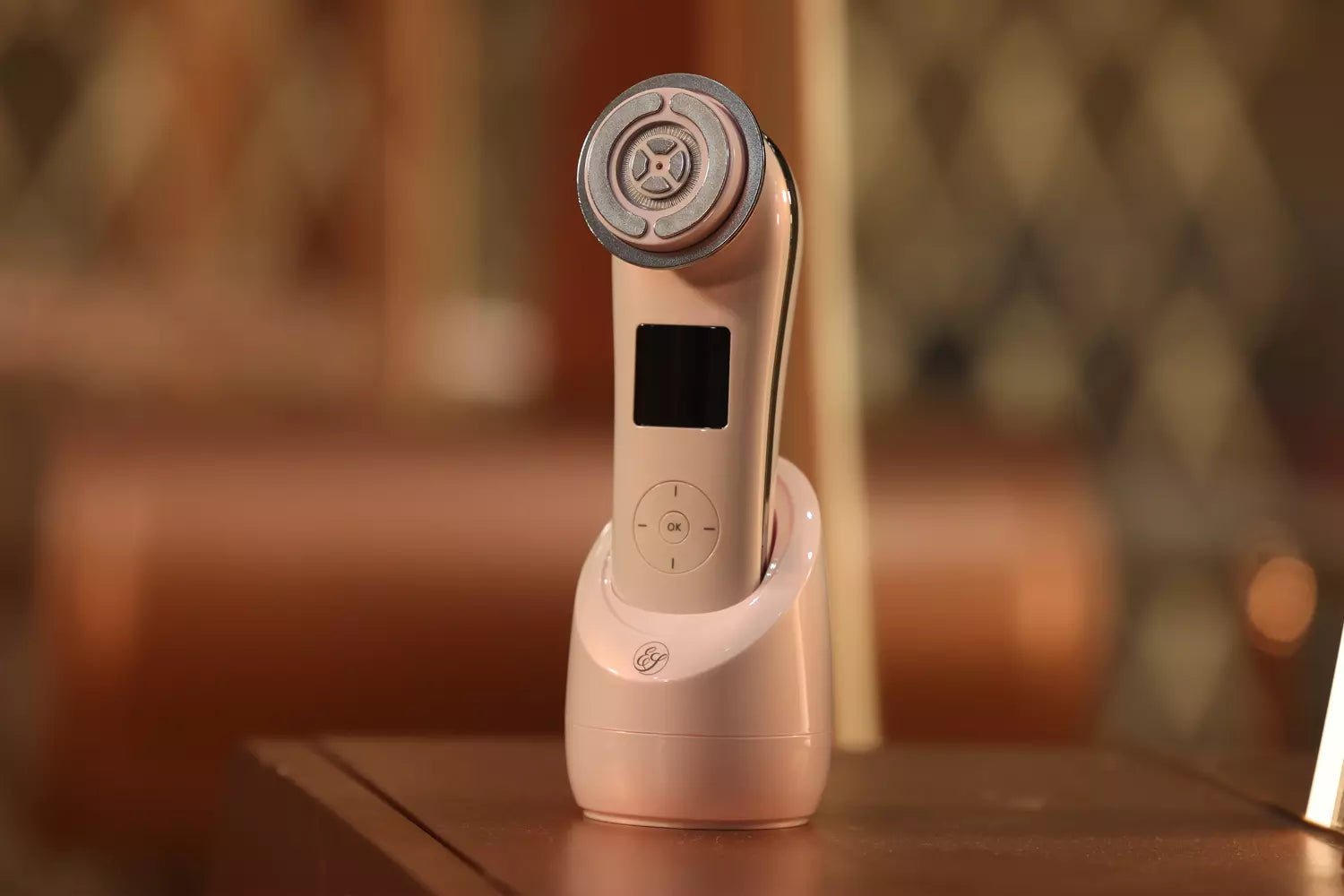
The Lumo+ is a handheld device about the length of a deck of cards, weighted with a slight forward balance toward the electrode head. Out of the box it feels heavier than it looks. This is not a $40 vibration toy. Metal of the electrode array catches the overhead light. A contoured matte plastic handle holds a single power button at the thumb position and an LED ring that displays the active mode and energy level.
Treatment takes about ten minutes for neck and décolletage combined. The first time through is the strange one. Cleanse the skin, apply a generous layer of conductive gel across neck and chest (more than the face requires), bring the device to the skin. The electrode array is cool against skin for the first three or four seconds. Warmth begins around the seventh second; within a minute the temperature stabilizes into something registering as "warm bath" rather than "hot stone." Not painful. Not even uncomfortable. A faint metallic taste sometimes registers at the back of the mouth on the lower neck (the trigeminal nerve picking up the field), fading after five or six sessions as the brain stops attending to it.
By the third week, the ritual stops feeling like a ritual and starts feeling like an evening habit, sandwiched between cleansing and moisturizer. Skin after a session has a faint flush that fades within twenty minutes. No peeling, no scabbing, no downtime. Next morning, skin looks slightly plumper, which is hydration, not collagen, but is encouraging in the early weeks before the slower changes accumulate. By week six or seven, the change is visible in the bathroom mirror under direct lighting. Not dramatic. Definite.
Chapter I · continuedThe deciding factor: dosing, not power
A single organizing principle for at-home RF below the jaw, stated plainly. More weeks, not more watts.
A single organizing principle: dosing beats power. A higher-output device used incorrectly will not outperform a lower-output device used correctly. Fibroblast response is a cumulative dose curve, not an instantaneous one. Eight to twelve weeks of consistent three-weekly sessions at the right temperature, held for the right dwell, with the right gel, produces more visible firming than two weeks of aggressive overuse.
People who report disappointing at-home RF results either stopped at week four, before the dose accumulated, or escalated the energy when they should have escalated consistency. The dermal thickness drop, again, is the reason. Below the jaw, margin for error on energy is smaller. The right move when results feel slow is more weeks, not more watts.
The shorthand: three sessions a week, eight to twelve weeks, no exceptions for the doubt window in weeks two and three. Conservative by design. Below the jaw, the dermis has less margin for the kind of error that aggressive dosing produces.
The Pillar · Part Two
The Protocol
Four reader profiles, a six-device comparison scored against the anatomy below the jaw, six numbers that govern dosing, and a Monday-through-Sunday cycle. Eight to twelve weeks, three sessions a week, one specific energy tier.
Chapter II · The ProtocolFour readers, four protocols
The right protocol depends on what you are starting with. Find the profile closest to yours below.
Early signs, before anything is established
First horizontal neck lines after a long flight or a few short nights. Jawline "starting to soften." Crosshatched sternum lines from side sleeping. Not yet considering anything clinical.
ProtocolThree Lumo+ sessions weekly for eight weeks, then twice-weekly maintenance. Daily SPF 50 on neck and chest. Weekly Mirage Pro for décolletage pigment. Revisit a clinical consult at age fifty.
Established laxity that shows up in photographs
Crepiness visible without a mirror, in casual photos. Jawline shifted enough you part your hair differently. Mottled chest pigmentation gained over the last five years. Side-sleeping wrinkles no longer erase by morning. Already considering Botox, filler, or Ultherapy.
ProtocolThree Lumo+ sessions weekly for twelve weeks, then twice-weekly maintenance. Weekly Phoenix microcurrent for jowls. Consider a dermatologist consult about whether one in-office Ultherapy or RF microneedling session would complement the at-home work, not replace it.
Twenty to forty pounds of weight loss in six to eighteen months
Semaglutide or tirzepatide produced visible facial and submental volume loss alongside its intended effects. Skin under the jaw has gone from contoured to slack. Some clinicians call this "Ozempic neck," and it behaves differently than age-only laxity.
ProtocolThree Lumo+ sessions weekly for twelve weeks while weight stabilizes. Protein intake of 1.2 to 1.6 g/kg to support fibroblast activity. For moderate cases, a consult on modest cheek and chin filler can lift the lower face by repositioning overlying tissue.[8]
Six to twenty-four months past a clinical procedure
Completed a Thermage cycle, an Ultherapy session, RF microneedling, or a thread lift. Want to extend and maintain the result. Not seeking new effect, just keeping the curve flatter for longer.
ProtocolTwo Lumo+ sessions weekly, indefinitely. Skip the eight-week loading phase; the clinical loading dose is already in. Phoenix microcurrent twice weekly if the clinical procedure addressed laxity but not contour.
Chapter II · continuedThe comparison set, scored by anatomy
Six devices, three anatomical zones, one variable that matters more than price or marketing. Where the at-home RF category fits the anatomy below the jaw, and where it does not.
Most editorial comparison tables score devices on facial efficacy and price, mentioning the neck and décolletage in a single line under "additional treatment areas." The table below is scored differently. The right-hand column, "Below-the-jaw fit," is the one that matters.
| Device | Modality | Power · depth | Cadence | Price | Below-the-jaw fit |
|---|---|---|---|---|---|
| Evenskyn Lumo+ | Multipolar RF + EMS + red & blue LED + warmth + sonic | 6.78 MHz, multi-tier, ~1 to 3 mm, auto temp | 3× weekly, 10 min | $499.99 | High. Multi-tier energy is calibrated for 1.0 to 1.5 mm neck and 0.8 to 1.2 mm chest dermis. |
| NEWA Plus (Endymed) | 3DEEP® bipolar RF only | 0.45 MHz, bipolar, face-tuned | 3× weekly for 4 wk, then 2× | ~$499 | Limited. FDA clearance is face and jawline only. Brand directs users not to treat below the orbital bone. Honest physics. |
| CurrentBody Skin RF | Bipolar RF only | Auto temp to 40°C (Skin Sense), face-tuned | 1× weekly, 70 min full face | $329 | Limited. Single energy setting calibrated for cheek anatomy. Works on the neck with face-tuned dwell time risks. |
| TriPollar STOP Vx 2 (Pollogen) | Multi-RF + VIB muscle activation | ~1 MHz, multi-electrode, two power levels | 2 to 3× weekly for 6 to 8 wk | $600+ | Moderate. Two-level power allows down-titration for thinner skin. Premium build, clinical pedigree. Proprietary gel required. |
| NuFACE Trinity+ · RF Attachment | Microcurrent base + separate RF dock-on | Single RF setting, face-marketed | 5 min, 5× weekly | $395 + $209 RF | Low. RF dock-on is a face-marketed accessory, not designed for neck as primary zone. |
| Foreo Bear / Bear 2 | Microcurrent only | ~200 to 335 µA, no RF | 2 min daily | $249 to $399 | Not applicable. Microcurrent only. Listed only to clarify the category boundary. |
| Solawave Wand | Red light + microcurrent + warmth | Resistive heating, not RF | 5 min daily | $169 | Not applicable. Warmth is resistive (heated metal head), not radiofrequency. |
Two observations from the table. First, NEWA's face-only stance is a feature, not a bug; the editorial credit it deserves is for stating that physics plainly. Second, the multi-tier energy on the Lumo+ is what changes the dose curve across anatomical zones. A device that adapts to cheek, neck, and chest in one ten-minute session is the engineering position that defines the category opening. For deeper background on configuration choice and clinical outcomes, the Lolis and Goldberg review in Dermatologic Surgery is the most-referenced overview of RF in cosmetic dermatology.[18]
The "Below-the-jaw fit" rating in this table reflects three inputs: the device's published FDA clearance language for anatomical zones; the electrode configuration relative to the 1.0 to 1.5 mm neck dermis target depth; and the presence or absence of a lower energy tier calibrated for thinner skin. Cost figures are 2026 manufacturer-listed retail. Where a device offers a face-tuned single-tier energy setting, the rating is "limited" rather than "high," regardless of how positive the clinical results on facial skin may be.
Chapter II · continuedSix numbers that govern the protocol
Strip the marketing copy and the at-home RF protocol reduces to six measurements. Learn these and most device questions answer themselves.
Neck Dermis Floor
The lower bound of dermal thickness on the lateral neck. Below this depth, RF energy enters subcutaneous fat, which is the wrong target for collagen remodelling.
Collagen Window
The minimum tissue temperature at which dermal collagen begins to contract and at which fibroblasts initiate a neocollagenesis response. Below this, the device is producing warmth without therapeutic effect.
Per-Zone Dwell
The session time per anatomical zone on the neck or décolletage at the correct energy level. Less than three minutes will not accumulate enough time-at-temperature. More than seven risks erythema.
Weekly Cadence
Three sessions per week for the first eight to twelve weeks. Spacing matters; sessions on consecutive days do not produce more benefit and may interfere with the rest-and-remodel phase of the fibroblast response.
Loading Phase
The window in which visible firming becomes measurable on the neck and chest. Most users see softening of horizontal lines by week four to six and overall firming by week eight to twelve.
Peak Remodelling
The week at which new collagen production peaks following a consistent loading phase, per the dermatological literature on RF-induced neocollagenesis. After this, maintenance dosing of two sessions per week sustains the result.[9]
Chapter II · continuedThe weekly cycle, Monday through Sunday
Three RF sessions. One LED. One microcurrent. One non-negotiable rest day. The Monday-through-Sunday rhythm that produces the dose curve in the clinical literature.
For Reader A and B profiles in §12, during the eight-to-twelve-week loading phase. Adjustments for Reader C and D follow at the end.
Monday evening · Lumo+ RF, neck and décolletage
Cleanse neck and chest. Apply conductive gel generously across the treatment area. Set Lumo+ to the lower energy tier. Treat each zone for five minutes in slow, overlapping circles. Wipe gel, apply hyaluronic serum, then moisturizer. Total time: ten minutes.
Tuesday evening · Mirage Pro LED, décolletage focus
Cleanse and pat dry. Position the Mirage Pro over décolletage and upper chest. Fifteen-minute red and near-infrared session. LED is non-thermal and can be paired with any topical, including retinoid, the same evening.
Wednesday evening · Lumo+ RF, neck and décolletage
Repeat the Monday protocol. By the third or fourth Wednesday, post-session flush is less noticeable as the skin's vascular response acclimates.
Thursday evening · Phoenix microcurrent, jawline contour
Cleanse, apply conductive gel along jawline and submental area. Five minutes of Phoenix microcurrent at the recommended level, sweeping upward and outward from chin to ear. Addresses muscle tone in the lower face that compounds the visible neck result.
Friday evening · Lumo+ RF, neck and décolletage
Third RF session of the week. Same protocol as Monday and Wednesday.
Saturday · Rest day, no devices
Collagen remodelling runs in the twenty-four to seventy-two hours after thermal stress. The rest day is when the dermis does the work the device asks of it. Skipping does not accelerate results.
Sunday evening · Optional Mirage Pro on the chest
Optional second LED session for significant chest photoaging. Skip if décolletage is in good condition.
Adjustments by reader profile
Reader A (early signs): Eight weeks, then twice-weekly RF maintenance. Keep LED weekly. Drop microcurrent unless jowls remain a concern.
Reader B (established laxity): Twelve weeks before dropping to maintenance. Consider adding Sunday Phoenix during loading for additional lower-face support.
Reader C (GLP-1 weight loss): Twelve weeks. Hold off on microcurrent intensification until weight has been stable for at least three months.
Reader D (post-clinical maintenance): Two RF sessions weekly, no loading phase. Skip LED unless décolletage was part of the clinical procedure.
Chapter II · continuedThe recommendation
After the comparison, the six numbers, and the weekly cycle, the editorial answer.
For the anatomy below the jaw, the 2026 recommendation is the Evenskyn Lumo+. The only sub-$500 device with multi-tier energy calibrated for both face and the thinner dermis of the neck (1.0 to 1.5 mm) and décolletage (0.8 to 1.2 mm). Multipolar RF alongside EMS microcurrent, red and blue LED, gentle warming, and sonic vibration in a single ten-minute session. No proprietary gel lock-in.
For a more complete below-the-jaw stack, the Complete Care Set pairs the Lumo+ with the Mirage Pro LED mask and the Venus eye device. Every Evenskyn device ships with a twelve-month limited warranty, a sixty-day money-back guarantee, and free shipping to US and Canada. Conceded: NEWA's clinical trial footprint on facial RF is the deepest in the category; TriPollar's Multi-RF engineering on the STOP Vx 2 is premium; CurrentBody's Skin Sense temperature regulation is excellent engineering. The case for the Lumo+ below the jaw is anatomical fit and modality breadth at the price, not a claim that no competitor offers anything.
Chapter II · continuedWeek by week, what to actually expect
From the strange first session to the established result. Where the curve flattens, where it accelerates, and the doubt window in which most protocols are abandoned too early.
Week 1
The ritual is new
First two or three sessions feel unfamiliar. Temporary flush after each fades within twenty minutes. Skin looks slightly plumper next morning, which is hydration response, not yet collagen.
Week 2 to 3
The doubt window
Sessions become routine. No visible change yet on the neck or chest. Serum absorption improves for some. This is where people quit a protocol. Almost always.
Week 4 to 6
First noticeable changes
Horizontal neck lines look softer under overhead lighting. Chest skin feels smoother to the touch. Jawline contour is unchanged; neck dermis is changing faster than structural anatomy. A 2022 split-face RCT of home-use RF (thirty-three women, ages thirty-five to sixty) reported significant improvements in wrinkles, elasticity, thickness, and hydration in this same window.[15]
Week 7 to 9
Compounding becomes visible
Photographs in similar lighting versus baseline show measurable firming. Jawline contour softens, less from dermal change and more from the cumulative microcurrent effect on underlying muscle.
Week 10 to 12
The loading phase peaks
Visible result is established. Friends and partners begin to notice, often without being able to name what changed. The dose curve doing its work.
Month 4 to 6
Maintenance phase
On twice-weekly cadence, the result holds and continues to refine. Fibroblast response peaks at twelve weeks but new collagen deposition continues for months with consistent stimulus.
What does not happen. Skin will not become tighter than the underlying structure. Submental fat is not reduced. Platysmal bands are not eliminated. Loose neck skin from significant weight loss is improved but not corrected. Readers expecting more should plan a dermatology or facial plastic surgery consult.
A brain that has watched a face for decades is the last to register slow change. The camera registers it first.
The Pillar · Part Three
The Decision
A five-question audit before any device commitment. When to skip the at-home category entirely. The six in-office procedures worth knowing about by name. And what eight weeks of consistent use actually feels like, written without the marketing.
Chapter III · DecisionThe five-question pre-purchase audit
Work through these five questions before any device commitment. A "no" on any one is worth pausing for; two or more may mean the at-home category is not the right starting point at all.
Will you commit to three sessions a week for eight to twelve weeks?
Consistency through the loading phase is the single biggest predictor of an at-home RF protocol succeeding or failing. Fibroblast response is a dose curve, not a switch. Three sessions a week for ten weeks is the threshold below which results often disappoint. If an evening schedule cannot hold that, consider a single in-office RF session every six to twelve months instead.
Do you have any of the absolute contraindications?
An implanted pacemaker, defibrillator, or any active electronic implant is absolute. So is pregnancy and breastfeeding (no safety data). So is recent (within four weeks) high-dose oral isotretinoin. Active eczema, psoriasis, or dermatitis in the treatment zone, recent injectable filler within two weeks, and any keloid history are relative contraindications worth discussing with a dermatologist before starting.
Is your primary concern within RF's actual treatment range?
RF on the neck and décolletage addresses dermal laxity, fine and moderate wrinkles, crepiness, and overall skin texture. It does not address platysmal banding, submental fat, severe weight-loss-related skin redundancy, or deeply set vertical neck lines from chronic muscle pull. For those, a clinical consult is the more productive first move.
Can you afford the full cost, not just the device?
The device is the largest line item but not the only one. Conductive gel runs $20 to $50 per year. Daily SPF 50 on neck and chest is non-negotiable. Stacking modalities (RF + LED + microcurrent) raises the bundle cost. The math still favors at-home versus clinical, but at-home is not free.
Are you willing to read the eight-week mark for what it is?
If results are not visible at week eight, the answer is usually more weeks, not a different device. Commit to the twelve-week mark before changing course. A device returned at week six is a device returned before the protocol completed its loading phase.
Chapter III · continuedWhen to skip the protocol entirely
Five situations in which the recommendation is to skip the at-home category and consider a different first step.
Severe laxity from significant weight loss
Skin redundancy following a fifty-pound-plus weight loss, especially rapid, is outside the range at-home RF can correct. Fibroblast response can support existing dermal scaffolding but cannot reduce skin surface area. A facial plastic surgery consult about a neck lift is the more productive first conversation.
Any implanted electronic device
No exceptions. The risk-benefit math does not work even in moderate use, and most at-home RF devices state this contraindication explicitly. Clinical risk is interference with the implant, not the device damaging tissue.
Pigmentation, not laxity, is the concern
Mottled chest pigmentation from cumulative sun exposure is a different mechanism. RF won't touch it. The at-home category for pigment is LED (Mirage Pro covers this) plus daily SPF 50. For pronounced cases, a clinical IPL series is the next step.
Within two weeks of a filler appointment
RF heat can affect hyaluronic acid fillers placed in the previous two weeks. Schedule RF before filler or wait two weeks after, and confirm the interaction with the injector. For Botox, timing is less constrained; some clinical literature suggests waiting at least seventy-two hours after Botox before applying RF heat in the treated zone.[10]
One in-office session per year is preferred over a daily ritual
Reasonable preference. A single Thermage cycle on the neck delivers a higher-intensity dose in one visit. The at-home protocol is for those whose lifestyle accommodates a weekly ritual; otherwise the clinical route is the better fit.
Chapter III · continuedWhen to consider in-office instead
Six clinical procedures worth knowing by name, by cost, and by recovery. The at-home protocol and the in-office procedures are not competitors so much as different points on the dose-intensity curve.
Ultherapy
A focused-ultrasound treatment, not RF, that delivers controlled thermal energy to deeper dermal and SMAS layers than at-home devices reach. A single session on neck and décolletage produces measurable lift over three to six months. Compared to twelve weeks of at-home RF, Ultherapy delivers a higher peak dose in one visit; at-home RF delivers a lower-intensity cumulative dose. The two are compatible and often paired.[11] A 2025 paper in Clinical, Cosmetic and Investigational Dermatology reported additive efficacy for RF combined with focused ultrasound.[16]
Thermage
Monopolar RF in a clinical setting. Energy reaches deeper subcutaneous layers that bipolar at-home devices cannot. A single cycle on face plus neck develops over two to six months. For severe established laxity, Thermage outperforms at-home RF measurably. For mild to moderate laxity, the at-home protocol can produce comparable visible result at a fraction of the cost.
Profound RF
RF combined with insulated microneedling, delivering thermal energy directly into the deeper dermis. More aggressive than Thermage, with five-to-seven days of erythema and swelling, but stronger results on established laxity.
RF Microneedling (Morpheus8)
Sits between Profound RF and standard at-home RF in intensity. A clinical Morpheus8 series of three sessions is the standard. True at-home microneedling at depth comparable to clinical Morpheus8 is not achievable safely. The CurrentBody RF Microneedling system uses gentler micro-channels, a different intensity tier than the clinical equivalent. SkinPen is a professional-grade microneedling system not classified as RF microneedling; it stays in clinical hands only. The FDA's October 2025 safety communication on RF microneedling devices reinforced the distinction.[14]
Botox into the platysma (Nefertiti lift)
Addresses platysmal banding by relaxing the vertical neck muscles. Does not treat dermal laxity; the right tool for the muscular component of neck aging. For visible platysmal banding, this pairs well with at-home RF: Botox addresses the muscle, RF addresses the dermis.
Neck lift surgery
Cervicoplasty, platysmaplasty, or full deep-plane neck lift. Highest intensity and cost, with meaningful recovery. For severe laxity beyond what non-invasive options can address, this is the answer. At-home RF is then a maintenance tool post-surgery, not a replacement for it.
For most readers in their late thirties through fifties starting a first non-invasive protocol, the at-home Lumo+ route delivers a defensible result at a defensible price. For more advanced anatomy, the clinical options above are not failures of the at-home category. Different tools for different problems.
Chapter III · continuedWhat a real eight-week cycle feels like
Eight weeks, four phases, told without the marketing. The first strange days, the doubt window, the first visible change in photographs, the settle.
First two weeks are the strangest. The ritual is new, the warmth is new, the metallic taste at the back of the mouth during the lower-neck portion is new. By the end of week two, none of this is remarkable; the device is just an evening implement next to the toothbrush. Skin is not visibly different yet. Morning plumping is hydration response.
Weeks three and four are the doubt window. Nothing new is happening on the surface. The temptation is to escalate the energy or add a fourth weekly session. The protocol's answer is no, on both counts. Stay with the dose. Let the dermis do its work.
Week five or six is the first visible change. Not in the mirror first thing in the morning. The change is visible in photographs. A side-angle photograph of the neck in even lighting, compared to one from before the protocol began, will show measurably softer horizontal lines and smoother chest texture. A brain that has watched your own face for decades is the last to register slow change; the camera registers it first.
Weeks seven and eight are when the result settles. Jawline contour is firmer, less from any single mechanism and more from the cumulative effect of the dermis, the microcurrent on the lower face, and lighting that flatters firmer skin. Partners or friends who do not know you are running a protocol notice without being able to name what changed. The reasonable interpretation is that the loading phase has done its work, and the move from here is twice-weekly maintenance and a long-term view.
The Pillar · Part Four
The Critique
Three mistakes that quietly sabotage a protocol. Three myths that persist anyway. The strongest cases for not buying the recommended device. And the four developments that would change this view in the next edition.
Chapter IV · CritiqueThree mistakes, three myths
The errors are practical. The myths are aspirational. Both shorten the half-life of any protocol they touch.
Three mistakes to avoid
Too little gel on the neck
Face protocols teach economy with conductive gel; neck protocols need the opposite. Curved anatomy, longer treatment path, thinner skin. Reapply mid-session if the device drags. Dry-skin drag is the most common cause of post-session erythema lasting beyond twenty minutes.
Morning treatment before sun exposure
Post-RF skin is briefly more photo-reactive for the first twelve to twenty-four hours. Morning sessions followed by daytime sun exposure raise the risk of post-inflammatory pigmentation. Evening sessions followed by sleep are the default. If a morning session is unavoidable, aggressive SPF 50 is mandatory.
Pairing RF with retinoid the same night
RF heat briefly sensitizes the dermis. Strong retinoids applied the same evening can produce more irritation than expected. Save retinoid for non-RF nights, or apply it forty-five minutes after the post-session moisturizer once the skin has fully calmed.
Three myths to retire
Stronger power equals faster results
The collagen-contraction window is 40 to 42 degrees Celsius. Above that, you damage the dermis. Below it, you produce warmth without effect. A higher peak output is not "stronger" in any way the body cares about; it is less forgiving of overuse.
Results plateau and reverse if you stop
Collagen laid down during a loading phase does not vanish if you stop. It ages at the normal one-percent-per-year rate. What you lose is the ongoing maintenance dose. Result holds; further accumulation stops.
At-home RF is a weaker clinical RF
Partially true, partially misleading. Peak intensity per session is lower at home. Cumulative dose over twelve weeks of three-weekly sessions is competitive with a single clinical session for mild-to-moderate anatomy. For severe laxity, home is no substitute.
Chapter IV · continuedThe case against this recommendation
Four scenarios in which the Lumo+ is not the right device, and a defensible alternative for each.
Case One · The Single-Modality Buyer
If your only goal is RF and depth-engineering matters more than breadth
A dedicated single-modality device with deeper RF-specific engineering may serve you better. NEWA Plus carries the deepest clinical-trial footprint in the home RF category and is engineered to do one thing very well, even if its FDA clearance is face-only. CurrentBody Skin RF has the best temperature-regulation engineering. A dedicated RF device plus separate LED and microcurrent tools may give more granular control at higher total cost.
Case Two · The Premium Buyer
If your budget accommodates the $600+ band and you value clinical heritage
TriPollar STOP Vx 2 at the $600+ band delivers Multi-RF engineering, VIB muscle activation, and Lumenis professional pedigree. If clinical heritage matters more than modality breadth, this is a defensible choice.
Case Three · Skip At-Home Entirely
If your schedule favors one concentrated session over a weekly ritual
A single Ultherapy or Thermage session on the neck delivers a higher peak dose in ninety minutes than twelve weeks of at-home RF. For readers whose schedule cannot accommodate three weekly sessions and who can write a single $3,000 check, the clinical route is more efficient on a time basis. The at-home protocol rewards a sustained ritual, not a concentrated treatment.
Case Four · Wait and See
If you are under thirty-five with no visible signs of laxity yet
The recommendation is to wait. SPF and a peptide serum are higher-yield investments at that age. At-home RF, like any anti-aging technology, has a window of best return; below thirty-five, marginal benefit per dollar is small.
The case for the Lumo+, plainly: for readers in their late thirties through sixties with mild-to-moderate neck and décolletage laxity, wanting a single device that handles multiple zones at a defensible price, with the lifestyle to commit three evenings a week, the multi-modality engineering and multi-tier energy settings make it the best 2026 fit. For readers outside that profile, one of the alternatives above may serve better.
Chapter IV · continuedWhat would change this view
Four developments between now and the next edition that would force a re-write of the recommendation above.
NEWA expanded its FDA clearance to neck and décolletage
The 3DEEP system has the deepest clinical evidence base in the category. Anatomical clearance is the limit, not the engineering. With supporting data, the field would tighten.
CurrentBody released a multi-tier energy Skin RF for thinner skin
Their temperature engineering is excellent; only the single-tier energy limits anatomical fit. A calibrated multi-tier version would change the head-to-head.
A randomized trial showed bipolar vs multipolar differs by neck
Current literature is dominated by face-zone trials. Peer-reviewed evidence of different fibroblast response by configuration on the neck specifically would re-weight the comparison.
At-home RF microneedling reached clinical-grade safety
A device with safe controlled-depth needles plus adjustable energy delivering clinical-grade results would displace the entire non-invasive at-home RF category. As of May 2026, no such device exists for safe consumer use without supervision.
Chapter IV · continuedTen questions
The questions readers actually ask, answered without softening.
Can I use the same RF device on my face and my neck?
Yes, if the device has multi-tier energy settings calibrated for thinner skin and if the manufacturer explicitly clears the neck as a treatment zone. The Lumo+ does both. Single-energy face-only devices like NEWA do neither.
Is at-home RF safe during pregnancy?
No. No clinical safety data exists for at-home RF during pregnancy or breastfeeding. Standard practice is to defer until after weaning. The contraindication reflects absence of evidence, not demonstrated harm.
How long does the Lumo+ battery last per session?
About ninety minutes of continuous use on a full charge. A ten-minute neck and décolletage session leaves substantial reserve. Full charge in about two hours via USB-C.
Can I use my regular moisturizer as the conductive medium?
No. Moisturizers do not conduct radiofrequency properly and may cause uneven heating or device errors. A dedicated conductive gel is required. The Evenskyn Conduction Gel is formulated for the device; any glycerin-based RF-rated gel works.
Will my pacemaker prevent me from using this device?
Yes. Any implanted active electronic device (pacemaker, defibrillator, neurostimulator, insulin pump) is an absolute contraindication. The risk is electromagnetic interference with the implant. No exceptions.
How does this protocol interact with Botox in my forehead or face?
RF on the neck and décolletage has no interaction with Botox in the face. If Botox is placed in the platysmal bands themselves, wait seventy-two hours before treating that zone with RF, and confirm timing with the injector.
Does at-home RF help "turkey neck"?
Partially. The "turkey neck" appearance combines skin laxity, platysmal muscle slackening, and submental fat. At-home RF addresses the skin laxity component, which can produce visible improvement on mild-to-moderate cases. RF can't reach the muscle or the fat pad in any useful way. For pronounced cases, a clinical consult about Botox into the platysma or a neck lift is the more direct path.
What about RF for body areas like the abdomen or arms?
The Lumo+ is engineered and cleared for face, jawline, neck, and décolletage. Same principles apply to larger body zones, but device geometry and energy delivery were not optimized for body contouring. For body RF, dedicated body devices or in-office procedures are more appropriate.
Will I see results faster if I use the device daily?
No. Fibroblast remodelling operates on a twenty-four to seventy-two hour cycle; sessions spaced too close together interrupt rather than accelerate the response. Three weekly sessions, spaced with at least one rest day between, produces the dose curve in the literature.
How long until results disappear if I stop maintenance?
Collagen built during the loading phase does not disappear. It ages at the normal rate of about one percent loss per year. A result built over twelve weeks remains visible for six to twelve months after the protocol stops, gradually returning toward baseline over two years if no maintenance resumes.
The Pillar · Part Five
The Reference
A reviewer who signed off on the clinical claims. Editorial disclosures behind the recommendation. The updates log, the standards by which this article is maintained, and the eighteen citations that anchor every number you have just read.
Chapter V · ReferenceAbout Dr. Ismail Kimji
Board-certified dermatologist. Royal College fellow. The clinical reviewer behind every claim in this article.
Dr. Ismail Kimji, MD, FRCPC is a board-certified dermatologist (Royal College of Physicians and Surgeons of Canada) and the Doctor in Residence at Evenskyn. He completed his medical training at one of Canada's leading academic medical centers and his dermatology residency in a Royal College-accredited program before serving in clinical practice with a focus on cosmetic dermatology, anti-aging device evaluation, and patient-led non-invasive protocols. He reviews Evenskyn editorial content for clinical accuracy, contraindication completeness, and tone of evidence. His clinical interests include consumer-grade dermatological device safety and efficacy, editorial transparency in the cosmetic device industry, and integration of at-home and in-office protocols across patient lifecycles.
For credential verification, contact support@evenskyn.com.
Chapter V · continuedEditorial disclosure
The conflict of interest, the competitor strengths conceded by name, the editorial standards that govern this article.
Published by Evenskyn, the manufacturer of the recommended Lumo+. Editorial independence is maintained through clinical review by Dr. Ismail Kimji prior to publication, explicit concession of competitor strengths in the body of the article, and a public commitment to revise the recommendation if new clinical evidence shifts the comparison.
Specific competitor strengths conceded in this article:
- NEWA Plus (Endymed) holds the deepest clinical-trial footprint in the at-home RF category. The 3DEEP system has been studied in multiple peer-reviewed journals; the brand's decision to cap its FDA clearance at face and jawline reflects a deliberate engineering commitment. For face-only RF, NEWA is a credible and well-evidenced choice.
- CurrentBody Skin RF represents the best temperature-regulation engineering in the at-home category. Skin Sense Technology continuously measures skin temperature and modulates output to hold the 40 to 42 degree window. Good engineering, paired with a transparent eight-week clinical statistic.
- TriPollar STOP Vx 2 (Pollogen / Lumenis) brings the longest professional RF heritage to the home segment. For budgets accommodating the $600+ price band, its Multi-RF and VIB engineering is a defensible premium choice.
Conflict-of-interest disclosure: Dr. Kimji reviews Evenskyn editorial content and is compensated under a transparent contractual arrangement. Competitor information is drawn from published manufacturer specifications, FDA filings, and peer-reviewed literature cited in references.
Editorial Standards
How this article is written and maintained
Sourcing
Every clinical claim is sourced to a peer-reviewed publication, FDA filing, or named regulatory communication. Marketing language from competing manufacturers is paraphrased and attributed; never reproduced verbatim.
Clinical Review
Reviewed by a board-certified dermatologist before publication. Reviewer signature is dated. Any factual correction is reflected in the updates log below.
Revision Commitment
If new randomized clinical evidence shifts the comparison between this article's recommendation and a competitor, the recommendation will be revised, not buried in a footnote.
Chapter V · continuedUpdates log
- v1.0 (May 2026): Initial publication. Established the dermal thickness drop conceit. Anchored Lumo+ with multi-tier energy positioning. Added 2025 systematic review and Lasers in Surgery and Medicine citations. Reviewed by Dr. Kimji.
Chapter V · continuedReferences
Eighteen citations across mechanism, clinical, and regulatory evidence categories, each tagged with its evidence type.
- MechanismSandby-Møller, J., Poulsen, T., Wulf, H.C. "Epidermal thickness at different body sites: relationship to age, gender, pigmentation, blood content, skin type and smoking habits." Acta Dermato-Venereologica, 2003. Foundational measurement series for regional dermal thickness in adults.
- MechanismSadick, N.S. "Tissue tightening technologies: fact or fiction." Aesthetic Surgery Journal, 2008. Mechanism review for radiofrequency-induced collagen contraction and remodelling.
- Clinical"Radiofrequency-Based Treatments for Facial Rejuvenation: A Systematic Review." 2025. PRISMA-compliant systematic review covering 15 clinical studies and 1,230 participants, reporting skin firmness improvement in 52.9% to 100% of patients across treated zones.
- ClinicalFitzpatrick, R., Geronemus, R., Goldberg, D., et al. "Multicenter study of noninvasive radiofrequency for periorbital tissue tightening." Lasers in Surgery and Medicine, 2003. Early multi-site study establishing safety and efficacy of monopolar RF on periorbital and facial skin.
- ClinicalAlster, T.S., Tanzi, E.L. "Improvement of neck and cheek laxity with a nonablative radiofrequency device: a lifting evaluation." Dermatologic Surgery, 2004. One of the earlier clinical evaluations of RF for neck-zone laxity specifically.
- RegulatoryU.S. Food and Drug Administration. 510(k) Premarket Notification Database. Searches for at-home radiofrequency devices including the Endymed NEWA system; FDA clearance language confirms face and jawline indication.
- MechanismLevenberg, A., Halachmi, S., Lapidoth, M. "Combined non-invasive radiofrequency and DMA for facial skin tightening." Journal of Cosmetic and Laser Therapy, 2014. Multi-electrode RF configuration analysis with companion muscle stimulation.
- ClinicalRamos-Levi, A.M., Pérez-Reyes, T., et al. "Facial volume changes after GLP-1 receptor agonist therapy: implications for cosmetic dermatology." Journal of Cosmetic Dermatology, 2024 supplement. Emerging literature on the dermatological pattern associated with rapid GLP-1-mediated weight loss.
- MechanismHantash, B.M., Ubeid, A.A., Chang, H., et al. "Bipolar fractional radiofrequency treatment induces neoelastogenesis and neocollagenesis." Lasers in Surgery and Medicine, 2009. Histological evidence of the twelve-week neocollagenesis peak following RF stimulus.
- Clinical"How dermal filler and botulinum toxin interact with at-home radiofrequency treatments: a practical review." Clinical, Cosmetic and Investigational Dermatology, 2024. Practical guidance on timing intervals between injectables and RF.
- ClinicalAlam, M., White, L.E., Martin, N., et al. "Ultrasound tightening of facial and neck skin: a rater-blinded prospective cohort study." Journal of the American Academy of Dermatology, 2010. Foundational clinical study on focused-ultrasound tightening of the neck and lower face.
- ClinicalWang, J., et al. "Long-Term Efficacy and Safety of a Novel Monopolar Radiofrequency Device for Skin Tightening: A Prospective Randomized Controlled Study." Lasers in Surgery and Medicine, 2025. Prospective randomized study supporting noninferiority of a novel monopolar RF device versus clinical standard.
- MechanismZhang, L., et al. "Radiofrequency Technology for Skin Rejuvenation: A Categorization of Modalities." Health Science Reports, 2026. Recent overview with categorization of monopolar, bipolar, and multipolar RF systems and their tissue-interaction profiles.
- RegulatoryU.S. Food and Drug Administration. "Safety Communication: Radiofrequency Microneedling Devices." 15 October 2025. Regulatory clarification on the distinction between non-invasive at-home RF devices and RF microneedling devices.
- Clinical"Home-Use Radio Frequency Devices for Facial Rejuvenation: A Split-Face Randomized Controlled Trial." 2022. Thirty-three women aged 35 to 60 over twelve weeks; demonstrated statistically significant improvements in wrinkles, elasticity, thickness, and hydration versus anti-aging cosmetics alone.
- ClinicalZhao, B., Li, P., Fu, Y., et al. "Efficacy and Safety of Radiofrequency Combined with Focused Ultrasound for Facial Rejuvenation." Clinical, Cosmetic and Investigational Dermatology, 2025. Combination-modality study with implications for at-home stacking protocols.
- MechanismBrightman, L., Goldman, M.P., Taub, A.F. "Sublative rejuvenation: experience with a new fractional radiofrequency system for skin rejuvenation and repair." Journal of Drugs in Dermatology, 2009. Comparative analysis of fractional versus non-fractional RF outputs and the energy-depth relationship.
- ClinicalLolis, M.S., Goldberg, D.J. "Radiofrequency in cosmetic dermatology: a review." Dermatologic Surgery, 2012. Wide-ranging review of RF applications in cosmetic dermatology, including configuration choices for different anatomical zones.
Published by Evenskyn Editorial · May 2026
Clinically reviewed · 8,400 words · 18 references


Leave a comment
All comments are moderated before being published.
This site is protected by hCaptcha and the hCaptcha Privacy Policy and Terms of Service apply.