










Medically Reviewed by Dr. Lisa Hartford, MD
-
Medically reviewed and written by Dr. Lisa Hartford, MD Board-certified dermatologist. 18 years in clinical practice. Focus areas: aesthetic dermatology, mature skin rejuvenation, and at-home device protocols. Roughly 4,800 patient consultations specifically for mature-skin cases.
Last updated: April 19, 2026 · Reading time: 19 minutes · Independently authored, medically reviewed.
Quick AnswerFor most healthy adults, at-home microinfusion should be done once every 14 days. That bi-weekly interval is what the EvenSkyn MicroInfuser kit is engineered around. After 4 to 6 sessions with no irritation, you can shorten the interval to once every 10 days if you want to compress the timeline. The bi-weekly interval isn't conservative or arbitrary. It matches the 14-day fibroblast proliferation cycle that governs how quickly your dermis can respond to and consolidate the stimulus from each session. More frequent sessions don't produce more collagen. They produce more inflammation without the tissue gain.
Key Facts
- The optimal interval for at-home microinfusion is 14 days for most adults.
- The biological reason: the fibroblast proliferation phase that produces new collagen takes roughly 12 to 14 days to complete. Interrupting it with earlier treatment produces inflammation without collagen gain.
- The upper safe limit at 0.5 mm fixed depth is once every 10 days. This is a ceiling, not a target.
- Weekly microinfusion at home is not safer or faster. It produces worse outcomes than bi-weekly for most users.
- First visible results typically appear at week 4 to 6. Meaningful structural change is visible around week 12. Peak early-phase results land at month 6.
- For Fitzpatrick IV to VI skin, start at every 3 weeks for the first 4 to 6 sessions before advancing to bi-weekly. Morning SPF 50+ throughout is non-negotiable.
- For perimenopausal and menopausal users, bi-weekly is ongoing maintenance: not a finite treatment course.
- Estrogen-driven collagen loss during perimenopause runs at roughly 2.1% per year and totals approximately 30% within the first five post-menopausal years.
- The single most common mistake users make is compressing the schedule (weekly). The second most common is inconsistent spacing (bi-weekly for two months, then off for three).
- Results are cumulative and biology-dependent. Consistency consistently outperforms intensity.
Table of Contents- Why the internet keeps getting this answer wrong
- Myths vs facts about microinfusion frequency
- The biology behind the 14-day interval
- The Bi-Weekly Core Protocol
- The Advanced Pathway: every 10 days
- Protocol comparison table by skin type
- Two patients, same goal, different protocols
- How often by age bracket
- How often by skin type and skin tone
- How often by treatment goal
- Signs you're overdoing it
- Signs you're not doing it often enough
- Coordinating with RF, ultrasound, EMS, and LED
- Timing around Botox, fillers, peels, and lasers
- The menstrual cycle and treatment timing
- Perimenopause and menopause specifics
- Morning or evening: does it matter?
- Preparing for a specific event (wedding, photos, reunion)
- Week-by-week results timeline
- Seasonal adjustments
- What to do if you miss a session
- Questions to ask your dermatologist before starting
- Research supporting these protocols
- Frequently asked questions
- Glossary of terms
-
How this article was researched
Why the Internet Keeps Getting This Answer Wrong
Most content on microinfusion frequency is wrong in a specific way: it gives you a conclusion without the reasoning. "Every two weeks, because we tested it." That sentence appears in dozens of places online. It's not an answer. It's a marketing claim dressed up as advice.
The real answer requires knowing what's happening in your skin between sessions. Collagen synthesis follows a predictable biological timeline. Fibroblasts: the cells in your dermis that actually manufacture collagen, need a specific window to respond to stimulus, build new tissue, and finish what they started before the next session arrives. Go too often and you interrupt the cycle. Go too rarely and the stimulus fades before it can compound.
The right interval is the one that syncs with the biology. Not a number you read on a product page. A specific protocol, tuned for your age, your skin type, your skin tone, your goal.
That's what this article is. The answer I give patients across the desk in my clinic, with the modifications that real skin on real people actually needs.
Myths vs FactsThese are the five most persistent misunderstandings I correct in my practice. Each one produces a worse outcome than the accurate answer.
Myth: Weekly microinfusion produces faster results than bi-weekly. Fact: Weekly treatment interrupts the 14-day fibroblast proliferation phase. You get more inflammation, less collagen, and a higher risk of barrier compromise. Bi-weekly outperforms weekly on every measurable outcome.
Myth: The bi-weekly interval is a conservative recommendation. More aggressive users should shorten it. Fact: Bi-weekly matches biology. The "aggressive" interval isn't faster. It's counterproductive. The upper safe limit is every 10 days, and it produces only about 15 to 20% timeline compression versus bi-weekly, not dramatic acceleration.
Myth: If you miss a session, you should double up to catch up. Fact: Missed sessions don't require compensation. Resume the bi-weekly schedule from when you next do a session. Compressing sessions to make up for a gap produces worse outcomes than simply extending the timeline.
Myth: Microinfusion and microneedling are interchangeable terms, and their protocols are the same. Fact: They're different. In-clinic microneedling at 1.5 to 2.5 mm depth operates at 4 to 6 week intervals because the deeper tissue stimulus requires a longer recovery cycle. At-home microinfusion at fixed 0.5 mm operates at 14-day intervals because the shallower, more focused stimulus allows faster recovery. Applying microneedling frequency to microinfusion is under-dosing. Applying microinfusion frequency to deeper microneedling is over-dosing.
Myth: Once you see results, you can taper off. Fact: For most users, results plateau rather than self-maintain. Especially for perimenopausal and menopausal skin, stopping the protocol allows the underlying biology to re-erode collagen gains. Bi-weekly is a maintenance regimen, not a finite course.
The Biology Behind the 14-Day Interval
Three phases govern how your skin responds to a microinfusion session, and understanding them makes the bi-weekly rule make obvious sense.
Hours 0 to 72: the inflammatory phase. The needles create micro-channels that trigger a controlled inflammatory cascade. Growth factors and cytokines release. Fibroblasts in the upper papillary dermis start to wake up. Your skin looks pink for a few hours and feels slightly warm. This isn't a side effect. It's the first phase of the healing process, and if it doesn't happen, nothing downstream does either.
Days 3 to 14: the proliferation phase. Fibroblasts multiply and produce new collagen and elastin. This is the phase that delivers visible results. It's also the phase that genuinely cannot be rushed. New collagen gets laid down first as disorganized Type III collagen, which takes several weeks to convert to the stronger, more organized Type I collagen that actually firms the skin.
A 2024 meta-analysis by Foppiani and colleagues, published in Aesthetic Plastic Surgery and covering 26 clinical studies across 1,037 patients, documented this proliferation phase at roughly 12 to 14 days in adults under 50. In adults over 50, the phase extends to 14 to 21 days in some users, with slower baseline collagen turnover.
Weeks 2 to 24: the remodeling phase. Existing collagen reorganizes and strengthens. Type III converts to Type I. Dermal density increases gradually. This is why microinfusion results continue to improve for months after a protocol ends.
Treating every two weeks starts the next session just as the previous proliferation phase is wrapping up. You're adding a new stimulus to a dermis that just finished responding to the last one. The collagen signal compounds without interruption.
Treating weekly interrupts the proliferation phase before fibroblasts finish their work. More inflammation. No more collagen. Measurably worse outcomes.
That's the biology. The bi-weekly rule is a consequence of it, not a conservative recommendation around it.
The Bi-Weekly Core Protocol
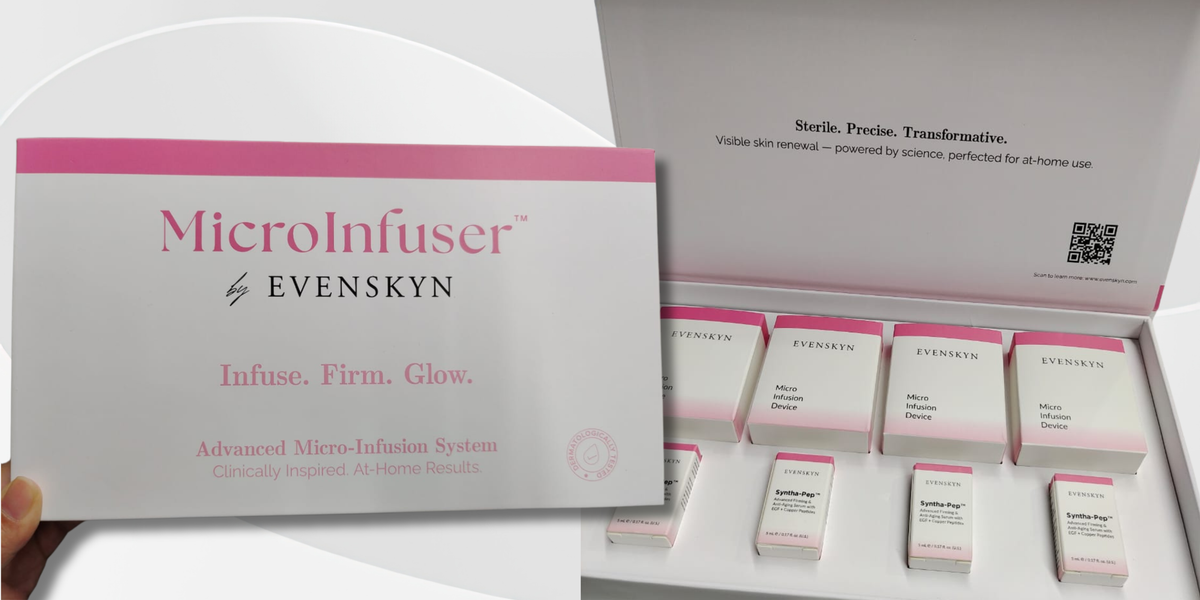
Still choosing a device? Compare the five at-home micro-infusion kits first; the cadence below assumes a fixed 0.5 mm depth and a sealed serum path.
What bi-weekly actually looks like in practice:
Pick a day. Same day every other week. I tell patients to treat it like a therapy appointment, the kind you show up for even when you don't feel like it. Evening sessions work best because the skin's absorption capacity stays elevated for about an hour post-treatment, and overnight recovery without environmental UV exposure produces the cleanest healing. Wednesday at 9 PM every other week is a perfectly reasonable rhythm. So is Sunday evening, every other Sunday.
Session itself takes 5 to 10 minutes including setup and the final pat-down of residual serum onto face and neck.
The first hour after the session is higher-value than people realize. Apply a hydrating sheet mask or a fragrance-free peptide cream within that window. Absorption is meaningfully elevated. Skipping this step is a missed opportunity.
For the first 24 hours, keep it minimal. No washing the face. No makeup. No gym, sauna, pool, or hot tub. Hands off. Sleep on a clean pillowcase: yes, this matters.
For hours 24 to 72, use a fragrance-free hydrating moisturizer twice daily. Broad-spectrum SPF every morning. Pause retinoids, vitamin C serums, AHAs, BHAs, and physical exfoliants until this window closes. Red and near-infrared LED can resume after 24 hours and actually supports recovery.
Days 4 through 13, resume your full routine on its normal schedule. Actives are fine. Retinol is fine. Your other at-home devices are fine.
By week 6 of this protocol, your fibroblasts have completed three proliferation cycles stacked on top of each other. By week 12, six cycles. That's where meaningful structural change starts being visible. At week 24, twelve cycles. That's where most patients tell me their skin looks fundamentally different from baseline.
📋 A Note From Dr. Hartford: Why Consistency Beats IntensityPatients ask me regularly whether they can "catch up" after missing a few weeks by doing more frequent sessions. The honest answer is no, and understanding why changes how you think about the whole protocol.Collagen induction isn't linear. It's cumulative. Six bi-weekly sessions produce more collagen than twelve weekly sessions, because the weekly sessions interrupt each proliferation cycle before it finishes. You're paying the inflammatory cost without collecting the tissue gain.The patients in my practice who get the best long-term results share one trait: they treat the schedule as non-negotiable. They don't skip. They don't double up. They do the session when they said they would, on the schedule they chose, and they let biology do what biology does.I have patients who've been on bi-weekly for 18 months. Their skin looks fundamentally different than it did at month 3. That is what consistency produces, and nothing else produces it.
The Advanced Pathway: Every 10 Days
After 4 to 6 sessions of confirmed good tolerance, meaning no redness persisting past 24 hours, no increased product sensitivity, no signs of barrier compromise: you can shorten the interval to once every 10 days.
This is the upper safe limit. Not a recommendation. An option.
The math: every 10 days is roughly three sessions a month instead of two. Over six months, that's 18 sessions rather than 12. At the dermal level, you compress about two months of standard protocol into six to eight weeks of the advanced version.
What the Advanced Pathway does not do: produce dramatically better results. The delta I see in clinic is modest, maybe 15 to 20% faster timeline. It doesn't make up for poor aftercare, skipped SPF, or inconsistent sessions. It doesn't rescue a protocol that's failing for other reasons.
What it does do: for users who are disciplined, past the adaptation window, and genuinely want the compression, it shortens time-to-visible-structural-change from about 12 weeks to about 9. That matters to some people. To others, it doesn't.
Hard ceiling: never below 10 days. At fixed 0.5 mm depth, more frequent stamping doesn't increase collagen synthesis and can compromise barrier integrity. If you find yourself wanting to do sessions weekly, resist the instinct. Weekly home needling is not a protocol that produces better outcomes. It's a protocol that produces worse ones.
Return to standard without apology. If any session on the Advanced Pathway produces redness that extends past 24 hours, or increased product sensitivity, or any of the signs I describe further down, return to bi-weekly and stay there. There's no penalty for de-escalating.
Protocol Comparison Table by Skin Type
Skin Type / Context Starting Interval Standard Interval Advanced Pathway Key Modifier Normal / oily / combination Bi-weekly Bi-weekly After 4 to 6 sessions: every 10 days None Sensitive Every 3 to 4 weeks Bi-weekly (after 4 to 6 sessions) Rarely advised Extended adaptation window Rosacea Every 4 weeks Every 3 weeks (after 6 sessions) Not advised 48-hour patch test required Fitzpatrick IV to VI Every 3 weeks Bi-weekly (after 4 to 6 sessions) After 8 sessions SPF 50+ every morning Mature (50+) Bi-weekly Bi-weekly indefinitely Rarely advised before 8 sessions Pair with RF 3 to 5x/week Perimenopausal Bi-weekly Bi-weekly indefinitely Not advised until confirmed Treat as maintenance Acne-scar correction Bi-weekly Bi-weekly After 6 sessions Extra sweeps within each session Notox-focused Bi-weekly Bi-weekly After 6 sessions Focus areas of dynamic movement Glass skin / Korean aesthetic Bi-weekly Every 10 days (after 4 to 6 sessions) Primary approach Hydration-forward aftercare
Two Patients, Same Goal, Different Protocols
Late 2024, within a week of each other, two patients came to me with roughly the same question and roughly the same profile. Both early-to-mid forties. Both Fitzpatrick IV. Both wanting structural improvement from at-home microinfusion. Both frustrated.
The first patient, I'll call her R, had been doing microinfusion weekly for three months. Frustrated that it wasn't working. Her skin had that low-grade persistent pinkness that isn't exactly inflamed but isn't exactly calm either. Products she'd used for years: a peptide eye cream, a basic vitamin C serum: had started stinging. No textural progress. If anything, her skin looked slightly thinner than in the baseline photos she'd taken when she started.
She'd convinced herself that weekly would produce faster results. I've seen this pattern maybe forty times. It's almost always the same outcome.
The second patient, I'll call her D, had been doing microinfusion every four weeks for three months. Her skin looked better than R's at the consultation, smoother, a bit softer. But her progress had plateaued around week eight. She wanted to know whether to keep going.
Two mistakes in opposite directions. Same root cause: neither had matched the interval to biology.
For R, I had her stop completely for three weeks. Barrier restoration with a niacinamide serum and a ceramide-heavy moisturizer, ruthless morning SPF, and nothing else. After the reset, we restarted at bi-weekly. By week eight post-restart, her skin was in better shape than at any previous point. By month four she'd passed D's earlier trajectory.
For D, we moved from monthly to bi-weekly. She'd been under-stimulating. Her fibroblasts were responding, then settling back to baseline before the next session arrived. Six weeks after the switch, visible improvement that her monthly protocol hadn't produced in the previous three months.
The lesson I take from cases like these: and I see them constantly, is that microinfusion isn't dangerous and it isn't gentle. It's biologically specific. The biology is the protocol. Deviate from it in either direction and the results degrade.
How Often by Age Bracket
Fibroblast responsiveness, baseline collagen turnover, and hormonal status all change with age. The protocol adjusts accordingly.
In your 20s. Endogenous collagen production is near peak. Fibroblasts respond vigorously. Bi-weekly works, but it's optional maintenance rather than necessary correction. Most 20-somethings without specific concerns do fine on monthly spacing combined with consistent topical peptides and good SPF. For 20s patients with active acne scarring or established textural issues, the bi-weekly protocol is appropriate and usually produces results faster than in older brackets.
In your 30s. This is the decade when most people first notice the skin-quality shifts that matter: fine lines around the eyes, loss of plumpness, slower recovery from environmental stress. Standard bi-weekly protocol. Advanced Pathway available after 4 to 6 sessions. Pair with at-home RF two or three times a week on non-microinfusion days.
In your 40s. Perimenopause begins for most women in their early-to-mid forties. Estrogen decline starts affecting dermal collagen synthesis and the baseline inflammatory response. The 14-day proliferation cycle sometimes extends to 16 to 18 days. Stick with bi-weekly for the first 4 to 6 sessions, monitor carefully for extended post-session sensitivity, and lengthen to every 18 days for 2 to 3 sessions if redness still appears at day 10 to 12. Avoid the Advanced Pathway until 6 sessions confirm good tolerance.
50s and beyond. This demographic benefits most from microinfusion, not because the protocol changes but because the baseline is more depleted and every session produces more relative gain. Estrogen-depleted skin responds more slowly per session but more visibly in aggregate. Bi-weekly. No Advanced Pathway for at least the first 6 months. Pair rigorously with RF. Expect initial visible improvement at week 8 rather than week 6, peak structural change at month 6 rather than month 3, and: this matters: plan for indefinite maintenance. This demographic loses the gains fastest if the protocol stops.
How Often by Skin Type and Skin Tone
Sensitive skin
Start at every 3 to 4 weeks rather than bi-weekly. After 4 to 6 well-tolerated sessions, advance to bi-weekly. Some sensitive-skin patients never advance past every 3 weeks. That's not failure. Forcing a schedule your skin resists doesn't produce more collagen. It produces more inflammation.
Rosacea
Extended caution. 48-hour patch test. Begin at every 4 weeks. Advance only after 6+ well-tolerated sessions, and only to every 3 weeks: not to bi-weekly. Some rosacea patients in my practice do well on a modified protocol. Others don't. The signal is usually clear within 2 to 3 sessions.
Fitzpatrick IV to VI
Standard bi-weekly is appropriate, with three specific modifications:
- 48-hour patch test before first full-face session, not 24 hours
- SPF 50+ every morning throughout the entire treatment cycle
- Start at every 3 weeks for the first 4 to 6 sessions, then advance
The elevated concern in darker skin tones isn't the treatment itself. The mechanical stimulus of microinfusion doesn't disproportionately injure melanin-rich skin. What does vary is the melanocyte response to any prolonged inflammation. Extended adaptation plus ruthless SPF compliance plus a sealed-ampoule device that eliminates contamination risk at the delivery point, together, those three factors make this protocol genuinely safe for Fitzpatrick IV to VI.
Mature skin (loose umbrella, roughly 45+)
Bi-weekly, standard. The 14-day proliferation cycle may slightly extend; adjust if post-session redness persists past day 10. Skip Advanced Pathway until at least 8 sessions confirm tolerance.
Oily / combination
Bi-weekly, standard. Some oily-skin users experience mild breakouts during the first 2 to 3 sessions as channels open sebaceous follicles. This is adaptation, not complication. If breakouts persist past session 3, extend to every 3 weeks temporarily.
How Often by Goal
Anti-aging maintenance (fine lines, tone, firmness). Bi-weekly, standard. Most users, most goals. The protocol was designed for this and delivers on it reliably over 3 to 6 months.
Atrophic acne scars. Bi-weekly, with extra sweeps over scarred areas during each session. Don't increase frequency: increase within-session coverage. Expect 4 to 6 months for meaningful atrophic scar improvement. Acne scars are genuinely one of the slower-responding indications.
Notox-adjacent (softening dynamic expression lines without injectables). Bi-weekly, with focus on dynamic-movement zones: forehead, between the brows, crow's feet. The Argireline (Acetyl Hexapeptide-8) component in well-formulated microinfusion serums is specifically relevant to this goal, and dermally delivered Argireline produces measurably better results than topical Argireline. Expect gradual softening over 8 to 12 weeks.
Hyperpigmentation and tone evenness. Bi-weekly with particularly strict post-session SPF discipline. Niacinamide and Ergothioneine in the serum, both dermally delivered, are strongly evidenced for melanocyte regulation. But UV exposure in the post-session window can trigger paradoxical darkening. The protocol for tone evenness is bi-weekly plus non-negotiable morning SPF.
Glass skin / Korean aesthetic. Every 10 days once the bi-weekly adaptation window is complete. Glass skin rewards frequency more than any other goal because the effect is primarily dermal hydration and surface luminosity, both of which peak immediately post-session and fade over 10 to 14 days.
Perimenopausal / menopausal structural support. Bi-weekly, indefinite maintenance. This is the only demographic where I tell patients explicitly that stopping the protocol is a setback rather than a neutral pause. The underlying biology continues eroding collagen whether the treatment continues or not.
Signs You're Overdoing It
Clinical picture of a compressed protocol producing compounding damage. If any of these show up, slow down.
Persistent low-grade redness that never resolves between sessions. Normal post-session redness fades in 1 to 4 hours. Redness that lingers into day 2, 3, or 4 and never fully settles before the next session is a clear signal that the proliferation phase is being interrupted.
Products that used to be fine now irritate. Barrier disruption. Retinol that used to work stings. Vitamin C that used to produce a glow burns. This is your skin telling you the stratum corneum is being opened faster than it can reform.
Breakouts 5 to 10 days post-session in an established protocol. Early breakouts in sessions 1 to 3 are adaptation. Breakouts appearing consistently 5 to 10 days after sessions in an established routine suggest either contamination, barrier compromise, or overstimulation.
Tight, uncomfortable skin in the interval between sessions. Healthy skin on a sustainable protocol feels comfortable. Tightness that wants a moisturizer even after you've just applied one is a signal of barrier thinning.
Visible texture plateau or regression after 10 to 12 weeks. Texture should improve gradually over 8 to 12 weeks. A visible plateau or (worse) backward drift at the three-month mark suggests the protocol is misaligned with your skin.
What to do if any appear: stop all microinfusion for three weeks. Return to gentle barrier-focused skincare only (niacinamide, ceramide moisturizer, ruthless SPF, no actives). Resume at every 3 to 4 weeks. Advance back to bi-weekly only after 4 to 6 sessions of confirmed good tolerance.
De-escalation isn't failure. Slower, well-tolerated protocols produce better long-term outcomes than compressed protocols your skin can't sustain.
Signs You're Not Doing It Often Enough
The opposite problem is less dramatic but equally real. Intervals longer than 3 weeks usually don't produce cumulative results the way bi-weekly does, because each session's effect fades before the next arrives.
Warning signs:
- No visible change after 12 weeks of consistent treatment. This is the clearest signal. At bi-weekly with appropriate aftercare, most users see meaningful changes by week 8 to 12. Nothing at week 12 means your interval may be too long.
- Each session feels like starting over. Healthy protocols feel cumulative. Sessions respond a little better. Recovery gets a little faster. Skin sits more settled between treatments. If every session feels like the first, the interval is probably too long.
- Plateau after initial improvement. Some users see progress in sessions 1 to 6 and stall. If you're on monthly or longer, plateau is usually a spacing problem.
What to do: shorten to bi-weekly if you were on every 3 to 4 weeks. Don't shorten further as a first correction. Most users don't need to. Give the new interval 6 sessions to produce visible change before reassessing.
Coordinating With RF, Ultrasound, EMS, and LED
Most at-home skincare enthusiasts are layering modalities. The interaction effects matter.
RF (radiofrequency). Before microinfusion, same day earlier: ideal. RF warms the dermis and primes circulation. After microinfusion: wait 24 hours minimum. Heat on freshly treated skin extends recovery. Between sessions: RF 3 to 5 times a week on non-microinfusion days is the layering protocol I recommend most often for mature skin. Combined effect is meaningfully larger than either alone.
Ultrasound. Same rhythm as RF. Before: same-day earlier, ideal. After: 24-hour wait. Between: normal schedule.
EMS / microcurrent. Before: same-day earlier. After: 24-hour wait. Between: 3 to 5 times a week. EMS targets facial muscle tone, which is a different anti-aging layer than microinfusion addresses, and they stack well when properly sequenced.
LED (red and near-infrared). LED is non-thermal and the most permissive companion. Wait 24 hours after microinfusion, then resume on normal schedule. Between sessions, red and near-infrared LED actively supports the proliferation phase. This is the one device I recommend daily during active microinfusion protocols.
Simple stacking schedule: microinfusion on day 1, LED daily throughout, RF or ultrasound or EMS from day 2 onward 3 to 5 times a week, next microinfusion on day 15.
Timing Around Botox, Fillers, Peels, and Lasers
If you combine at-home microinfusion with in-clinic procedures, scheduling matters. Defer to the practitioner who did the clinical work, they know the specifics. General guidelines:
- Botox / neurotoxin injections. 2 weeks before microinfusion. 2 weeks after. Longer is fine; shorter can displace the neurotoxin or increase bruising.
- Dermal fillers. 2 weeks before, 1 to 2 weeks after. Some injectors want longer: confirm.
- Light chemical peel. 3 days before, 5 to 7 days after.
- Medium-to-deep chemical peel. 4 weeks minimum in both directions.
- Laser resurfacing (ablative). 4 to 6 weeks in both directions. Confirm with your laser provider.
- IPL / photofacial. 1 week in both directions. Wait longer if redness persists.
- Microdermabrasion. 3 days before, 5 days after.
- Hydrafacial. 2 days before, 3 days after.
-
Professional microneedling. 7 days minimum, 14 is safer.
The Menstrual Cycle and Treatment Timing
Rarely discussed in consumer microinfusion content, and genuinely affects outcomes for cycling patients.
Follicular phase (roughly days 1 to 14 after menstruation starts). Rising estrogen. Elevated collagen synthesis rate. Lower baseline inflammation. Optimal window. If you can align bi-weekly sessions to fall during days 5 to 12 of your cycle, you'll get modestly better results per session.
Ovulation (roughly day 14). Peak estrogen. Skin at its most responsive. If choosing between two possible session dates, pick the one closer to ovulation.
Luteal phase (days 15 to 28). Progesterone dominant. Increased sebum, slightly elevated inflammatory response, slower healing in some women. Standard protocol still works, but avoid the Advanced Pathway during luteal-phase sessions. Post-session redness may linger a few hours longer than usual.
Menstrual phase (days 1 to 5). Lowest estrogen. More sensitive skin, sometimes with hormonal breakouts. If your skin is reactive during menstruation, push that week's session to the following week. If you're not particularly reactive, standard protocol is fine.
Hormonal birth control users: less cycle variation, less need for timing specificity. Most HBC users can schedule without particular cycle alignment.
Perimenopausal or menopausal users with irregular or absent cycles: this consideration is less relevant. Focus on consistency of interval rather than alignment with a cycle.
Perimenopause and Menopause Specifics
The standard "bi-weekly" answer applies least well to the demographic that benefits most from microinfusion, and it deserves its own treatment.
The biology: estrogen decline during perimenopause drives roughly 2.1% loss of dermal collagen per year, totaling about 30% within the first five post-menopausal years, well-documented in the Journal of the American Academy of Dermatology and in the journal Climacteric. Fibroblasts aren't dying. They're becoming less responsive to the hormonal signals that previously kept them active. This is exactly where mechanical stimulation produces its largest relative benefit.
The standard protocol still applies: bi-weekly, but the meaning changes. For younger users, bi-weekly is a maintenance tool. For perimenopausal and menopausal users, it's a structural countermeasure. Each session actively replaces collagen that the underlying biology is continuing to erode. The interval still matches the proliferation cycle, but the stakes of adherence are higher because the baseline is eroding while you work.
What I tell perimenopausal patients specifically:
- Bi-weekly, no deviation to the Advanced Pathway in the first 6 months
- Indefinite continuation: this isn't a course of treatment that ends
- Pair with at-home RF 3 to 5 times a week. The RF + microinfusion combination is the most clinically justified at-home anti-aging protocol for this demographic
- Add red/near-infrared LED daily if tolerated, supports the slightly extended proliferation phase common in perimenopausal skin
- Morning SPF non-negotiable, regardless of planned sun exposure
Expected timeline for this demographic:
- Week 4: subtle hydration and skin-quality improvement
- Week 8: visible softening of fine lines, improved tone
- Month 3: genuine structural change visible in photos
- Month 6: plateau of initial gains, where consistent protocol maintains rather than dramatically improves
- Month 12: most patients describe their skin as looking alive again: plumper, more responsive, the way it felt before the decline started
That last marker isn't clinical, but it's consistent. And it's the outcome structural countermeasures produce in this demographic.
Morning or Evening: Does It Matter?Evening. Specifically.
Three reasons. Your skin's absorption capacity stays elevated for roughly 60 minutes after a session. Evening means that window overlaps with your nighttime routine, when you're applying your most supportive products anyway. Overnight recovery happens without UV exposure, environmental pollution, makeup, or repeated face-touching: all of which are mildly counterproductive in the hours after a session. And the temporary post-session pinkness (1 to 4 hours) resolves while you sleep, not during your day.
If evening genuinely isn't possible: work constraints, childcare, whatever: morning works. You just need to be more disciplined about what follows. Full sunscreen coverage immediately after. Avoid makeup until at least noon if you can. Skip any outdoor exercise for the day. And budget for the pinkness to be visible for a few hours.
Midday sessions are the worst option. UV load is high. You'll likely have environmental exposure during the critical absorption window. Avoid if possible.
Preparing for a Specific Event (Wedding, Photos, Reunion)
Patients ask me this constantly. Here's the timing that actually works.
If your event is 3+ months away. Start the protocol now. Bi-weekly for the full lead-up. Your skin will peak somewhere in the 8 to 12 week window, which means timing your final session 2 weeks before the event gives you the best visible result on the day.
If your event is 6 to 12 weeks away. Start immediately. Run bi-weekly. Final session exactly 2 weeks before the event. Expect some improvement but not peak: textural and luminosity gains rather than structural.
If your event is 3 to 5 weeks away. You can still benefit. Do 1 to 2 sessions, with your final session 14 days before the event. Expect a noticeable glow and plumpness rather than dramatic change.
If your event is less than 14 days away. Do not schedule a session. The pinkness recovery window plus the temporary barrier permeability means the skin on the day may look less optimal than it would without a session. Skip the microinfusion. Do a hydrating sheet mask 3 to 5 days before. Lean on the skincare you already know works.
Day-of-event reminder: the glow you want on the day comes from sleep, hydration, a light hand with makeup, and skincare that's been working cumulatively. Last-minute intervention is almost always counterproductive.
Week-by-Week Results Timeline
What to expect at each stage of a consistent bi-weekly protocol, in a typical adult user without specific complications.
Day 1, first session. Pinkness for 1 to 4 hours post-session, slight tingling, faint glow.
Day 2. Visible hydration, brighter skin, plumper texture.
Days 3 to 13. Normal skincare. No further visible progress from session 1 expected at this stage.
Day 14, second session. Same immediate response. No cumulative change yet. The first session was stand-alone.
Week 4, after session 2. Skin feels subtly smoother. Makeup applies better. Very subtle glow improvement beyond the immediate post-session glow.
Week 6, after session 3. More consistent hydration between sessions. Fine lines around the eyes may begin to soften. Skin feels more settled overall.
Week 8, after session 4. Clear improvement in skin quality. Texture smoother. Tone more even. This is usually where patients say "I think this is working."
Week 10, after session 5. Continued improvement. Fine lines visibly softer. Baseline glow noticeable without product application.
Week 12, after session 6. Peak early-phase results. Structural improvement visible in photographs. Most clinical studies use this milestone as their primary evaluation point, and it's where the first meaningful assessment of your protocol's effect is appropriate.
Month 4 to 5, sessions 8 to 10. Deeper structural change. Texture refinement continues. Softening of some established lines, not just fine lines. Jawline firmness sometimes improves.
Month 6, sessions 12 to 13. Substantial cumulative results. Structural remodeling well underway. Skin visibly different from baseline. Most users decide here whether to continue indefinitely.
Month 6 onward. Continued slow improvement. Maintenance of gains. Most users settle into indefinite bi-weekly use.
Seasonal Adjustments
The bi-weekly interval doesn't change. Aftercare does.
Summer. Ruthless SPF. SPF 50+ throughout the treatment cycle, reapplied every two hours outdoors. UV exposure in the 48-hour post-session window is the single largest PIH trigger. If you're spending significant time outside, beach, hiking, yard work: schedule individual sessions for evenings when the next day is indoor.
Winter. Hydration focus. Dry indoor air compounds temporary post-session sensitivity. Heavier ceramide moisturizer. Running a humidifier in the bedroom overnight on session days actually helps.
Travel. Skip sessions during travel rather than attempting them in hotel environments. One missed session in a six-month protocol is functionally invisible. Stressed skincare in unfamiliar surroundings isn't worth the trade.
High-altitude or arid climate travel. Extend recovery skincare by 3 to 4 days versus your standard 1 to 2.
What to Do If You Miss a Session
Not a crisis. Clinical guidance:
- Missed by 3 to 5 days. Do the session when you can. Continue from that point on the new rhythm. No catch-up.
- Missed by a week or two. Still fine. Resume bi-weekly from the next session.
- Missed by a month or more. Resume at bi-weekly. The protocol still works. You've just extended the timeline to visible results by the length of the gap. Do not compress sessions to "catch up": that is the single most common mistake patients make and produces worse outcomes than simply resuming the normal rhythm.
-
Multi-month gap (travel, life events, illness). Resume at bi-weekly. Treat it as a protocol restart. Expect results to rebuild along the timeline I outlined. In mature skin, gaps longer than 3 months do reset a meaningful portion of cumulative benefit. In younger skin, gaps are more forgiving.
Questions to Ask Your Dermatologist Before Starting
If you have access to a dermatologist: and if you're starting any needle-based home protocol, you should: these are the questions worth asking in advance. Bring this list.
- Given my specific skin type (state it: Fitzpatrick I, II, III, IV, V, VI, and any conditions), what starting interval do you recommend?
- Are there any medications I'm currently on that would modify the safety profile? (Discuss blood thinners, isotretinoin history, immunosuppressants, any systemic steroids.)
- Do I have any history: personal or family, of keloid or hypertrophic scarring that would change your recommendation?
- Is there a specific concern you'd flag about my barrier function that should modify the protocol?
- If I develop persistent redness past 24 hours, at what point should I contact you?
- Do you have a preferred device or set of engineering standards you recommend?
- How does at-home microinfusion coordinate with any clinical work you already do for me (Botox, fillers, peels)?
A dermatologist who can answer these specifically is worth the consult fee. A dermatologist who waves off the questions isn't the right practitioner for this protocol.
Research Supporting These ProtocolsPeer-reviewed evidence underpinning the guidelines above.
Foppiani, J.A. et al. (2024). "Microneedling for Facial Rejuvenation: A Systematic Review and Meta-analysis." Aesthetic Plastic Surgery. 26 studies, 1,037 patients. Documents the 12 to 14 day proliferation phase and confirms statistically significant improvement in facial wrinkles, skin texture, and scarring across varied protocols.
El-Domyati, M. et al. (2015). "Multiple sessions of fractional microneedling in rejuvenation of skin." Journal of Cutaneous and Aesthetic Surgery. Histological evidence of collagen induction at 0.5 mm across multiple sessions.
Aust, M.C. et al. (2018). "Percutaneous collagen induction: minimally invasive skin rejuvenation without risk of hyperpigmentation." Plastic and Reconstructive Surgery. Safety profile across Fitzpatrick types including melanin-rich skin.
Brincat, M. et al. (1983, 2005). Foundational and updated research in British Medical Journal and Climacteric. Quantifies the 2.1% annual dermal collagen loss during perimenopause and the 30% cumulative loss in the first five post-menopausal years.
Palumbo, P. et al. (2023). "Copper Tripeptide-1 (GHK-Cu): Pharmacological Properties and Emerging Therapeutic Applications." Molecules. Mechanism evidence for GHK-Cu.
Bos, J.D. & Meinardi, M.M. (2000). "The 500 Dalton rule for the skin penetration of chemical compounds and drugs." Experimental Dermatology. Foundational paper establishing why dermal delivery is necessary for large peptides (EGF, Argireline) that don't penetrate intact skin effectively.
Frequently Asked Questions
How often should you do microinfusion? Once every 14 days for most adults. After 4 to 6 sessions of confirmed tolerance, optionally shorten to once every 10 days.
How often should you do at-home microinfusion specifically? Same answer as in-clinic. Bi-weekly. The biology is the same whether the setting is a clinic or your bathroom.
How often can you do microinfusion at home safely? Upper limit is every 10 days at fixed 0.5 mm depth. More frequent treatments produce more inflammation without more collagen.
Can I do microinfusion weekly? No. Weekly treatment interrupts the fibroblast proliferation phase and produces measurably worse outcomes than bi-weekly.
Can I do microinfusion every 10 days? Yes, after 4 to 6 well-tolerated bi-weekly sessions. Produces about 15 to 20% timeline compression.
How many microinfusion sessions will I need to see results? Visible changes typically start at sessions 3 to 4 (weeks 6 to 8). Meaningful structural change at session 6 (week 12). Peak early results at sessions 12 to 13 (month 6).
When will I see results from microinfusion? Hydration glow within 24 to 48 hours. Subtle texture improvement at weeks 4 to 6. Visible fine line softening at weeks 8 to 10. Structural change at week 12. Peak early-phase results at month 6.
Is microinfusion safe long-term? Yes. There is no evidence of cumulative harm from sustained bi-weekly use. Many of my patients have been on consistent bi-weekly protocols for 3 to 5 years without complications.
Is microinfusion worth it? For users willing to commit to 6 months of consistent bi-weekly protocol, yes. For users who anticipate inconsistent use, the cumulative benefit doesn't develop and the investment is harder to justify.
How often for acne scars? Bi-weekly, with extra sweeps over scarred areas within each session. Don't increase frequency; increase within-session coverage. Timeline is 4 to 6 months for meaningful atrophic scar improvement.
How often for fine lines and wrinkles? Bi-weekly. Peak visible softening at 8 to 12 weeks. Continued improvement through month 6.
How often for hyperpigmentation? Bi-weekly with non-negotiable post-session SPF. The protocol itself doesn't change; the aftercare discipline does.
Can I do microinfusion during my period? Yes if your skin isn't reactive. Push to the following week if your skin is reactive during menstruation. Cycle alignment is a modest variable. Consistency of interval matters more.
What happens if I do microinfusion too often? Persistent redness, product sensitivity, breakouts, tight skin, visible plateau or regression. Return to every 3 to 4 weeks until skin recovers.
What if my skin is still red 48 hours after a session? Extend the next interval to 3 weeks. If redness persists consistently past 48 hours, extend to every 4 weeks.
How long until I can stop doing microinfusion? Most users don't. For perimenopausal and menopausal users especially, stopping allows underlying biology to re-erode gains. Bi-weekly is maintenance.
Can I combine microinfusion with retinol? Yes, with timing. Pause retinoids 48 hours before a session and resume 72 hours after.
Can I combine microinfusion with RF? Yes. RF before microinfusion (same day, earlier) is ideal. RF after microinfusion requires a 24-hour wait. Between sessions, RF 3 to 5 times a week is ideal.
Can I combine microinfusion with Botox? Yes with 2-week spacing in both directions.
How often for perimenopausal skin? Bi-weekly, indefinite. Pair with at-home RF 3 to 5 times a week. Treat as maintenance rather than a finite treatment course.
How often for Fitzpatrick VI skin? Every 3 weeks for the first 4 to 6 sessions, then advance to bi-weekly. 48-hour patch test before first session. SPF 50+ every morning throughout.
Morning or evening microinfusion? Evening is substantially better. Aligns absorption window with nighttime routine. Overnight recovery without UV or environmental exposure. Post-session pinkness resolves while you sleep.
Can I do microinfusion on my neck? Yes. Same protocol, gentler pressure over thinner neck skin. Follow with the same aftercare as facial treatment.
Is microinfusion safe for men? Yes. Protocol is identical. Men with facial hair should shave the day of treatment and avoid stamping directly over beard follicles.
Should I pause microinfusion while pregnant or breastfeeding? Yes. Pause entirely until cleared by your obstetrician or dermatologist.
Can I do microinfusion postpartum? Once you've finished breastfeeding or your physician clears you, yes. Expect some adjustment in the first 2 to 3 sessions as hormones stabilize.
What about microinfusion before a wedding or photoshoot? Last session 2 weeks before the event. Don't treat within 14 days of the event. If the event is less than 14 days away, do not start.
Does alcohol affect microinfusion recovery? Mildly. Alcohol in the 24 hours after a session can extend pinkness and slightly impair barrier recovery. Not a firm contraindication, but worth minimizing on session nights.
Can I do microinfusion while sick with a cold or flu? Skip that week's session. The immune system is already engaged. Resume when you've recovered.
What's the single most common mistake people make? Compressing the schedule. Weekly treatment is the most reliably counterproductive mistake at-home. Bi-weekly is correct because biology says so.
What's the second most common mistake? Inconsistency. Bi-weekly for three months then nothing for two months then bi-weekly again produces meaningfully worse outcomes than sustained bi-weekly for six straight months.
How do I know which microinfusion device to choose? Three non-negotiable engineering features: mechanically fixed depth (cannot exceed regardless of pressure), single-use gamma-sterilized needle heads, and a sealed serum-to-needle delivery system with no air or hand exposure. Devices meeting all three are appropriate for unsupervised home use. Devices missing any one introduce compounding risks over time.
Glossary of Terms
Bi-weekly: Every 14 days. Sometimes expressed as "fortnightly." The standard microinfusion interval.
Advanced Pathway: The optional every-10-days interval, appropriate after 4 to 6 sessions of confirmed good tolerance at bi-weekly spacing.
Fibroblasts: Cells in the dermis responsible for manufacturing collagen and elastin.
Fibroblast proliferation phase: The 12 to 14 day window after dermal stimulus during which fibroblasts multiply and produce new collagen. The biological basis of the bi-weekly interval.
Papillary dermis: The upper dermal layer where fibroblasts are most densely concentrated. The target tissue for 0.5 mm microinfusion.
Collagen induction therapy (CIT): The clinical category of treatments: including microneedling and microinfusion, that stimulate collagen production through controlled micro-injury.
Post-inflammatory hyperpigmentation (PIH): Darkening of the skin following an inflammatory event, more common in Fitzpatrick types III to VI. Primary risk requiring SPF compliance during at-home microinfusion.
Fitzpatrick skin types: A scale from I (very fair, always burns) to VI (deeply pigmented, never burns). Microinfusion protocol modifications are primarily based on Fitzpatrick type IV to VI (melanin-rich skin).
Argireline (Acetyl Hexapeptide-8): A hexapeptide that shares a mechanism of action with botulinum toxin at a smaller scale. Relevant to the Notox approach.
EGF (Epidermal Growth Factor, sh-Oligopeptide-1): A 53-amino-acid signaling peptide that activates fibroblasts. Too large to penetrate intact skin in meaningful concentrations, which is why dermal delivery via microinfusion is meaningfully more effective than topical application.
Notox: A consumer movement seeking Botox-adjacent results without neurotoxin injections. Growing at 12% CAGR with 56% YoY increase in search volume.
50% Overlap Technique: The stamping pattern for microinfusion in which each new stamp covers half freshly-treated skin and half new skin, ensuring no untreated gaps.
How This Article Was Researched
This guide synthesizes (a) current peer-reviewed literature on collagen induction therapy, microneedling depth profiles, and microinfusion-specific outcomes, cited above with full bibliographic references; (b) Dr. Hartford's 18 years of clinical experience, drawn from approximately 4,800 consultations specifically focused on mature-skin cases including roughly 1,200 patients actively using at-home needle-based treatments; and (c) the specific protocol guidance adopted by the American Academy of Dermatology and the FDA regarding appropriate depth thresholds for unsupervised home-use devices.
The article was researched and written independently by Dr. Hartford. Dr. Hartford serves as Doctor-in-Residence for EvenSkyn and provides clinical oversight on protocols published by the brand. This relationship is disclosed transparently throughout and does not modify her clinical recommendations, which are based on the evidence base and her clinical practice rather than on promotional considerations.
The article does not recommend any specific product by brand name in its substantive guidance. Product mentions are confined to contextual references answering specific user questions in the FAQ section.
A Final Note From Dr. HartfordIf you take one thing from this article, make it this: your skin runs on a biological clock, and the collagen induction protocol works when it syncs with that clock. Not faster. Not slower. Bi-weekly matches the fibroblast proliferation cycle for the majority of adults, and every modification I described: skin type, skin tone, age, goal: is a refinement around that baseline. It isn't a departure from it.The patients in my practice who get the best results from at-home microinfusion don't do more of it. They do it consistently. They protect the aftercare window. They wear sunscreen. They give biology the time biology takes.Six months of bi-weekly sessions, respected faithfully, produces the kind of structural change no topical routine can match. Less than six, you're starting to see it. More than six, you're locking it in.Pick a day. Same day every other week. Treat it like an appointment with yourself. And let the rest work the way it's supposed to., Dr. Lisa Hartford, MD
Related Reading From EvenSkyn- At-Home Microinfusion Guide 2026: How the Device and Serum Work
- Microinfusion vs. Microneedling vs. Dermarolling
-
Is At-Home Microinfusion Safe? A Dermatologist's Clinical Answer
Editorial disclosure: This article is educational and does not constitute individual medical advice. Consult a board-certified dermatologist before starting any needle-based skincare treatment. The views expressed are Dr. Hartford's own clinical perspectives.
Conflict of interest disclosure: Dr. Lisa Hartford serves as Doctor-in-Residence for EvenSkyn. This relationship is ongoing and compensated. The clinical guidance in this article is based on peer-reviewed literature and her clinical practice rather than on promotional considerations for any specific product.Last fact-checked: April 2026. References: Foppiani et al. (2024), El-Domyati et al. (2015), Aust et al. (2018), Brincat et al. (1983/2005), Palumbo et al. (2023), Bos & Meinardi (2000).


Leave a comment
All comments are moderated before being published.
This site is protected by hCaptcha and the hCaptcha Privacy Policy and Terms of Service apply.