


Medically Reviewed by Dr. Lisa Hartford, MD
EvenSkyn Skin Science Desk · Doctor-Reviewed · First-Party Guide
What Is Syntha-Pep™? Inside EvenSkyn's Fermentation-Derived PDRN Micro-Infusion Serum
It is not a serum you pat on. It is a fermentation-derived PDRN serum built to be infused through micro-channels, which is the delivery PDRN was waiting for. Here is what is in it, why the sourcing matters, and where it is honestly limited.
The short answer
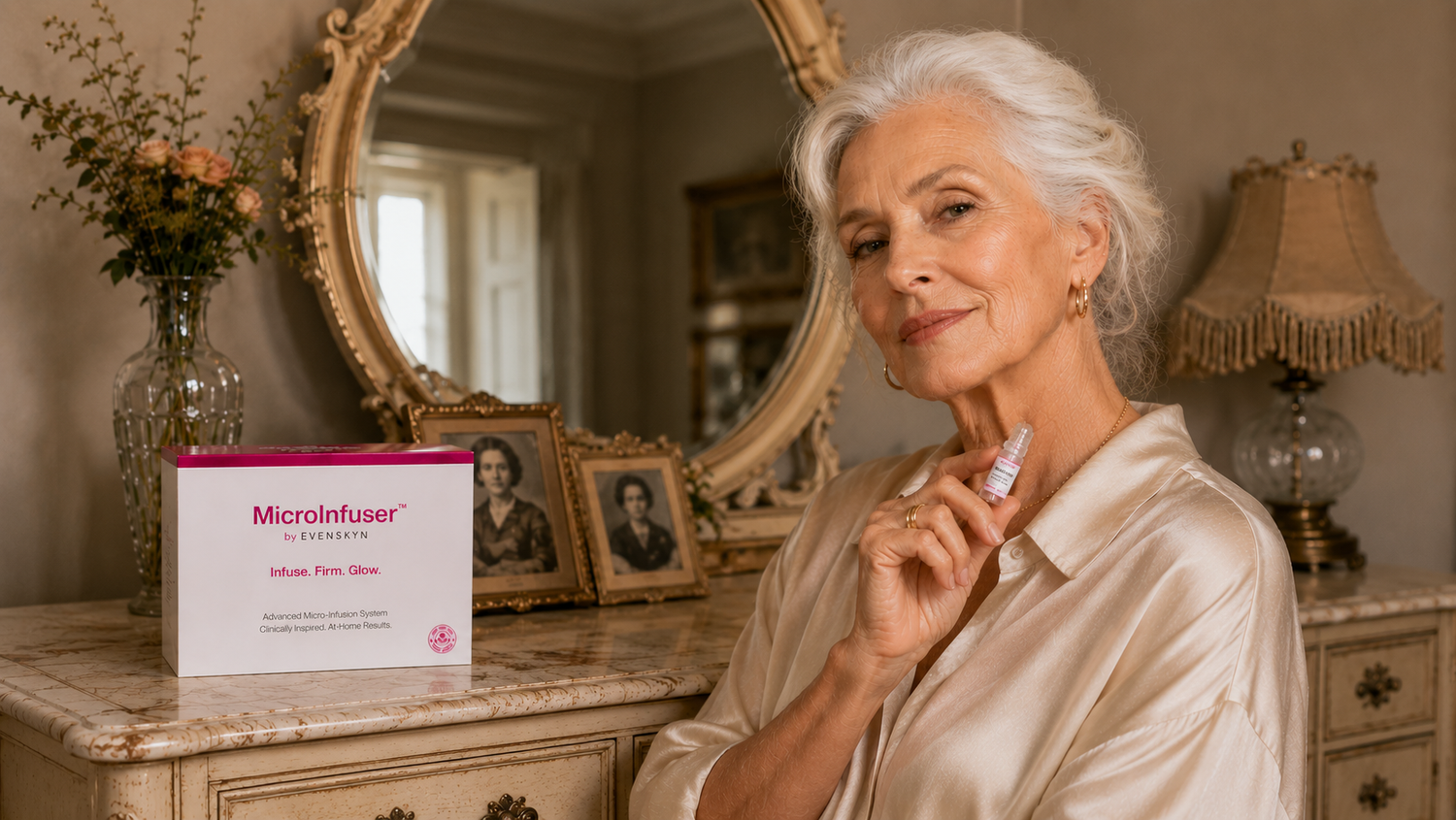
Syntha-Pep is the proprietary serum that powers the EvenSkyn MicroInfuser. It is built around a bioengineered PDRN made by controlled fermentation, so it carries no salmon-derived material, alongside an EGF-class peptide and copper peptide GHK-Cu. The thing to understand is that it was designed to be infused through the micro-channels the device creates, not patted onto the surface like an ordinary serum. That delivery is the point: PDRN does its work in the dermis, and reaching it is the part most topical PDRN serums leave to chance. Syntha-Pep is cruelty-free, but because it contains marine-derived collagen it is not vegan.
The takeaways, up front
Syntha-Pep is a consumable for the MicroInfuser system, not a standalone topical. Each sealed 5 mL ampoule connects directly to a fresh needle head for one session.
Its lead active is PDRN, bioengineered by fermentation rather than extracted from salmon, so it carries no salmon-derived material. The serum is cruelty-free but not vegan, because it contains marine-derived hydrolyzed collagen.
PDRN signals fibroblasts through the A2A adenosine receptor pathway and acts in the dermis. Getting a DNA-fragment molecule down there is the whole game, which is why infusing it matters more than the brand name on the bottle.
It pairs PDRN with EGF (sh-Oligopeptide-1) and GHK-Cu, plus a four-weight hyaluronic acid system and a barrier-repair complex. It is the only at-home micro-infusion serum built around all three regenerative molecules.
The differentiator versus a drugstore PDRN serum is not a louder claim, it is the delivery. Micro-channels bypass the barrier that blocks most of a topical PDRN serum.
Honest limits: it is not vegan, it is not meant to be patted on, the evidence for at-home PDRN is still maturing, and it depends on the device and on daily SPF to do its job.
What Syntha-Pep is, and what it is not
Most serums are made to sit on your skin and soak in. Syntha-Pep is not. It is the sealed consumable for the MicroInfuser, EvenSkyn's at-home micro-infusion device, and it is engineered to be delivered through the temporary micro-channels the device opens. Each ampoule holds 5 mL of a concentrated payload, and it connects directly to a single-use needle head so the serum never meets open air, your fingers, or a refillable chamber. One ampoule and one head make one session, then both are discarded.
That design has a consequence worth being upfront about: Syntha-Pep is not sold or intended as a pat-on topical you swap for a drugstore serum, and a drugstore PDRN serum is not a substitute for it either. They are different products doing the same job two different ways. If you want the device side of the story, the head-to-head of the leading at-home micro-infusion systems covers how the MicroInfuser compares on hardware, and the guide to choosing a micro-infusion kit covers the category. This guide is about the serum.
What is actually in it
EvenSkyn built Syntha-Pep from the first molecule outward to be infused, not adapted from a topical. Three hero actives anchor it.
1. A fermentation-derived PDRN (the lead)
PDRN, polydeoxyribonucleotide, is a DNA-fragment ingredient that signals skin cells to repair and rebuild. It works mainly by binding the A2A adenosine receptor, which prompts fibroblasts toward collagen synthesis, downregulates the collagen-degrading enzyme MMP-1, and calms inflammation, as summarized in a 2025 review in the International Journal of Molecular Sciences. Most PDRN on the market is purified from salmon DNA. Syntha-Pep's is different in a way that genuinely matters: it is bioengineered by controlled fermentation, so the PDRN itself contains no salmon-derived material. More on what that does and does not mean below.
2. An EGF-class peptide (sh-Oligopeptide-1)
sh-Oligopeptide-1 is a bioengineered signaling peptide whose sequence matches the human Epidermal Growth Factor your skin makes, grown by recombinant fermentation rather than taken from animals. EvenSkyn includes it to support the same fibroblast activity micro-infusion sets in motion. We treat the growth-factor category as supportive rather than a proven wrinkle eraser; for the deeper EGF story, see our EGF in skincare guide.
3. Copper peptide GHK-Cu
Copper Tripeptide-1, GHK-Cu, has been studied for over five decades. Foundational work showed the tripeptide-copper complex stimulates collagen synthesis in fibroblast cultures, and a 2018 review in the International Journal of Molecular Sciences documents its role in skin repair, elasticity, and the look of firmer skin. It anchors a wider peptide complex that also includes Acetyl Hexapeptide-8 and palmitoyl peptides.
Around those three sit a multi-molecular-weight hyaluronic acid system (four forms of hyaluronate, hydrating from the surface down), a barrier-repair pairing of Centella Asiatica and arginine, and a brightening base of niacinamide and ergothioneine. Niacinamide's tone-evening effect is well evidenced: in the Hakozaki study it inhibited melanosome transfer by 35 to 68 percent in a coculture model and reduced visible hyperpigmentation in clinical use. EvenSkyn positions these together for the look of firmer, more even, more rejuvenated skin. The cosmetic framing is ours; the ingredient science is cited.
The PDRN source, told straight
PDRN reaches skincare by three routes. The original and still most common is salmon-derived, purified from fish DNA. A second, newer route is plant or phyto PDRN, marketed as vegan and drawn from sources like rice, ginseng, or Centella. Syntha-Pep uses a third: a PDRN bioengineered by controlled fermentation, which means the PDRN molecule itself contains no salmon or other fish-derived material. We are not going to re-run the whole salmon-versus-vegan debate here, because our PDRN guide already covers it; the point for Syntha-Pep is simply that its PDRN is not salmon-derived.
Now the precise part, because this is where marketing usually gets sloppy. Not salmon-derived is not the same as vegan. Syntha-Pep still contains a small amount of marine-derived hydrolyzed collagen as a humectant, which is the one animal-derived component in the formula. So the serum is cruelty-free but not vegan, and anyone with a fish or shellfish allergy should treat the marine collagen, not the PDRN, as the reason to consult a doctor and patch test before first use. We would rather tell you that cleanly than let "not from salmon" do quiet work it has not earned.
The argument no one else in this category makes
Here is the case for Syntha-Pep that has nothing to do with a louder claim. PDRN acts in the dermis, through the A2A pathway, on the fibroblasts that build collagen. The hard part for any serum is getting a relatively large DNA-fragment molecule down through the stratum corneum, the barrier that exists precisely to keep things out. That is the well-known limitation of topical delivery, and it is why so much of PDRN's strongest evidence involves getting it past the barrier rather than relying on absorption from the surface. Micro-channels are an established way to bypass that barrier, documented across the microneedle-assisted delivery literature and the microneedling reviews. Syntha-Pep is formulated to be infused through exactly those channels. In other words, it pairs the active with the delivery the active actually needs, instead of asking a surface serum to do something the barrier makes hard. That is the honest differentiator, and it is one neither the topical PDRN serums nor the other device serums are built around.
A topical PDRN serum asks the molecule to cross a barrier built to keep it out. An infused one routes it through a door the device opens. Same active, very different odds of reaching where it works.
The full ingredient list, decoded
Here is the complete INCI, grouped by what each part is doing. Nothing hidden, including the trace fragrance and the one animal-derived ingredient.
INCI: Water, Glycerin, Butylene Glycol, Niacinamide, 1,2-Hexanediol, Hydroxyacetophenone, Mannitol, Pentylene Glycol, Polydeoxyribonucleotides (PDRN), Carbomer, Arginine, Sodium Hyaluronate, Centella Asiatica Extract, Ergothioneine, Acetylated Sodium Hyaluronate, Acetyl Hexapeptide-8, Sodium Hyaluronate Crosspolymer, PEG-40 Hydrogenated Castor Oil, Hydrolyzed Sodium Hyaluronate, Ethylhexylglycerin, Citrus Aurantium Amara (Bitter Orange) Flower Oil, Acetyl Tetrapeptide-11, Acetyl Tetrapeptide-9, Sodium Lactate, Polysorbate 20, Copper Tripeptide-1 (GHK-Cu), sh-Oligopeptide-1, Soluble Collagen, Palmitoyl Tripeptide-1, Collagen, Palmitoyl Tetrapeptide-7, Trehalose.
Reading it at a glance
The regenerative actives are Polydeoxyribonucleotides (the fermentation PDRN), Copper Tripeptide-1 (GHK-Cu), and sh-Oligopeptide-1 (the EGF-class peptide), supported by a peptide complex of Acetyl Hexapeptide-8, Palmitoyl Tripeptide-1, Palmitoyl Tetrapeptide-7, Acetyl Tetrapeptide-9, and Acetyl Tetrapeptide-11. Hydration runs deep through four forms of hyaluronate (Sodium Hyaluronate, Acetylated Sodium Hyaluronate, Sodium Hyaluronate Crosspolymer, and Hydrolyzed Sodium Hyaluronate) plus glycerin, mannitol, and trehalose. Centella Asiatica and arginine handle barrier and soothing, while niacinamide and ergothioneine handle tone and radiance. The two ingredients labeled Collagen and Soluble Collagen are the marine-derived hydrolyzed collagen, present at a low level as a humectant, and the Citrus Aurantium Amara (Bitter Orange) Flower Oil is a trace, kept below the cosmetic fragrance-allergen threshold and included for its aroma. [SPEC TO CONFIRM AT LAUNCH: published PDRN concentration of Syntha-Pep, in ppm.]
Syntha-Pep versus a typical topical PDRN serum
The fair comparison for Syntha-Pep is not another device, it is the PDRN serum you would otherwise pat on. Here is how they differ on the things that actually change the outcome.
| What differs | Syntha-Pep (infused) | A typical topical PDRN serum |
|---|---|---|
| How the PDRN reaches the dermis | Through micro-channels the device opens | Must cross the intact skin barrier on its own |
| PDRN source | Fermentation-derived, not salmon | Most often salmon-derived; some plant or phyto |
| Active stack | PDRN + EGF + GHK-Cu + peptides | Frequently PDRN-led with a lighter supporting cast |
| Format and hygiene | Sealed single-use ampoule, never exposed to air | Open multi-use bottle or dropper |
| What you need to use it | The MicroInfuser device | Nothing; apply with clean hands |
| Best understood as | A treatment serum for a delivery system | A daily-routine serum |
Brand and product names are the property of their respective owners. This compares formats, not specific competing products. For a device-versus-device comparison of the leading at-home micro-infusion systems, see the dedicated head-to-head linked above.
Neither approach is wrong. A topical PDRN serum is convenient and fits a daily routine. Syntha-Pep trades that convenience for delivery: it asks more of you (a device, a session every two weeks) and gives the PDRN a real route to where it acts. If the appeal of PDRN is the regeneration story, the delivery is the part worth paying attention to.
What serum belongs in a micro-infusion device
The moment people buy any micro-infusion or microneedling tool, they ask what to put in it. The short answer is not your everyday serum. The micro-channels are delivery routes, and a serum built for the surface, carrying fragrance, preservatives, or large molecules, can behave differently when it is driven below the barrier instead of sitting on top of it. That is a path to irritation rather than results, and aesthetic suppliers make the point repeatedly: infuse a serum formulated for infusion, not whatever is on your shelf.
That is what Syntha-Pep is, and it is also why the MicroInfuser does not let you fill your own chamber. The serum arrives sealed, pre-matched to the needle head, and formulated from the start to be delivered through channels rather than absorbed from the surface. It removes the most common at-home mistake in a single step, because there is no wrong serum to load when the serum and the delivery are designed together. For what to apply around a session, as opposed to what to infuse during one, our layering and compatibility guide covers the timing for hyaluronic acid, vitamin C, retinol, and the rest.
Where Syntha-Pep sits next to salmon DNA and Rejuran
If you have read about PDRN at all, you have met it under other names: salmon DNA, the salmon sperm facial, or the clinic injectable Rejuran. It helps to place Syntha-Pep on that map honestly. The deepest version of PDRN, and its longer-chain cousin PN (polynucleotides), is the injected one given in a clinic. In the United States those injectables, Rejuran among them, are currently not FDA-approved for that cosmetic use and are generally not available for injection, while topical and at-home PDRN is sold legally as a cosmetic. So at-home PDRN is the accessible, legal route, not a stand-in for a clinic injection.
Two honest distinctions follow. Syntha-Pep uses PDRN, the shorter DNA fragment, not the longer-chain PN behind Rejuran-style injectables, and it is delivered by infusion rather than injection, so it does not reach injection depth and is not equivalent to a clinic skin booster. What micro-infusion does is carry the PDRN meaningfully deeper than patting a salmon DNA serum on the surface, which is the honest middle ground between a cream and a needle. And Syntha-Pep's PDRN is not salmon-derived at all; it is made by fermentation. Research on microbial and fermentation-derived PDRN describes it as a sustainable alternative to salmon-based PDRN that works through the same A2A pathway, with smaller DNA fragments that may aid absorption (microbial-derived PDRN research). So if the salmon DNA story is what drew you in, Syntha-Pep offers the same class of regenerative signal without the salmon, delivered deeper than a cream, and with no claim to replace a clinic.
Using it, and keeping it
One sealed ampoule and one fresh needle head make a single session, used roughly once every two weeks in the evening. You break the seal, click on the head, rest the device so the serum reaches the needles, then stamp gently across the face, and pat any remainder into the skin afterward since absorption is heightened for the first hour. For the full step-by-step and the reasoning behind the cadence, see how often to do at-home micro-infusion. Store ampoules in a cool, dry place between 5 and 30 C, away from direct sun and out of the bathroom. The serum tolerates the warmth of normal shipping as long as the seal is intact and the liquid stays clear and uniform; if it has been held at sustained high heat or looks cloudy or separated, do not use it. To keep results, you reorder heads and ampoules, since both are single-use by design.
The verdict, scored honestly
A genuinely differentiated infusion serum, with one honest caveat on evidence
Our own editorial assessment of the formula and its design, scored against the criteria below. A first-party score, not an average of customer reviews, and it carries no star rating.
PDRN, EGF, and GHK-Cu together, with a four-weight HA system and barrier support. Few serums in any format combine all three regenerative actives.
Built to be infused, which targets the delivery step that limits topical PDRN. This is the strongest thing about it.
Fermentation-derived PDRN, not salmon-sourced, a fully published INCI, and a clear statement that the serum is not vegan. No hand-waving.
Four hyaluronate weights plus Centella, arginine, and trehalose make it well rounded beyond the headline actives.
PDRN's mechanism is well established, but the body of evidence for at-home, non-injected PDRN specifically is still building. Infusion is the rational delivery, not a proven shortcut to clinic results.
Single-use ampoules are the hygiene benefit and the running cost at once. You reorder to continue.
Best for
- People drawn to PDRN specifically, especially if avoiding salmon-derived sources
- MicroInfuser owners who want the serum matched to the device
- Anyone who wants a multi-active (PDRN, EGF, GHK-Cu) actually delivered, not just applied
- Mature skin focused on firmness, texture, and tone over months
Not the right fit for
- Anyone who needs a fully vegan formula (it contains marine collagen)
- People wanting a pat-on topical for a daily routine; this is an infusion serum
- A fish or shellfish allergy without medical clearance and a patch test
- Anyone expecting injectable-clinic results from an at-home serum
Who should hold off
Because Syntha-Pep is used by stamping it into the skin, the device's safety guidance applies to the serum too. Beyond the marine-collagen and fish-allergy caution already covered, hold off or check with a doctor first if you are pregnant or breastfeeding, have taken oral isotretinoin in the past six months, take prescribed blood thinners, have a history of keloid scarring, or have active acne, eczema, rosacea, or an infection in the area. Our micro-infusion safety guide covers the full list of medications, skin types, and contraindications.
The pick
Syntha-Pep, EvenSkyn's PDRN infusion serum
If PDRN is the active you actually want, and you care that it reaches the layer where it works, this is a serum built for that, with clear eyes about what it is.
What it does well
- Fermentation-derived PDRN, not from salmon
- Designed for infusion, the delivery PDRN benefits from most
- The only at-home micro-infusion serum on PDRN plus EGF plus GHK-Cu
- Deep, four-weight hydration and real barrier support
- Sealed single-use ampoule, never exposed to air or fingers
What it will not do
- Qualify as vegan (it contains marine collagen)
- Work as a pat-on topical; it needs the device
- Promise injectable-clinic results; at-home PDRN evidence is still maturing
- Replace daily SPF, which the routine depends on
- Come without an ongoing consumable cost
Want the full Syntha-Pep details?
Ingredients, pricing, and reorder options live on the product page.
View Syntha-Pep Link activates when Syntha-Pep goes live. Publish this guide just after launch so the product page and pricing are in place. [SET PDP URL AT LAUNCH]Frequently asked questions
What is Syntha-Pep?
Is Syntha-Pep vegan?
If the PDRN isn't from salmon, is it safe with a fish or shellfish allergy?
Is Syntha-Pep's PDRN derived from salmon?
Can I use Syntha-Pep as a regular topical serum, without the device?
Why would an infused PDRN beat a topical PDRN serum?
What are the main active ingredients?
How is it different from the popular Korean PDRN serums?
How often do I use it, and how should I store it?
My package was left in heat. Is the serum still usable?
Does it sting, and why does it feel slightly tacky?
Is Syntha-Pep worth it?
What is the best serum to use in a micro-infusion device?
Can I put my own serum in the MicroInfuser or another micro-infusion device?
Is Syntha-Pep a salmon DNA serum?
Is Syntha-Pep like Rejuran or a needleless Rejuran treatment?
What is the difference between PN and PDRN, and which does Syntha-Pep use?
How we put this together
This is a first-party guide. EvenSkyn makes Syntha-Pep, so we separated two kinds of claim throughout. Sourcing and formulation facts come straight from the product, including the full INCI. Ingredient mechanisms are grounded in peer-reviewed research, named in the text and listed below. Cosmetic outcomes are described in the language of appearance, and we stated plainly where the serum is limited, where the evidence is still maturing, and who it does not suit. We do not use star ratings or aggregate-review markup on our own product, and the score above is our own editorial assessment against stated criteria.
Medically reviewed by Dr. Lisa Hartford, MD
Board-certified dermatologist and EvenSkyn's Doctor-in-Residence, who reviews the protocols and safety guidance behind EvenSkyn's skin products. Read her full bio.
References
- Marques C, Pereira A, Lopes K, et al. From Polydeoxyribonucleotides (PDRNs) to Polynucleotides (PNs): Bridging the Gap Between Scientific Definitions, Molecular Insights, and Clinical Applications. Int J Mol Sci. 2025. PMID: 39858543.
- Tehrani L, Tashjian M, Mayrovitz HN. Physiological Mechanisms and Therapeutic Applications of Microneedling: A Narrative Review. Cureus. 2025;17(3):e80510. PMID: 40225445. PMC11993440.
- Microneedles in Action: Microneedling and Microneedles-Assisted Transdermal Delivery. PMC9024532.
- Pickart L, Margolina A. Regenerative and Protective Actions of the GHK-Cu Peptide in the Light of the New Gene Data. Int J Mol Sci. 2018;19(7):1987. PMC6073405.
- Maquart FX, Pickart L, Laurent M, Gillery P, Monboisse JC, Borel JP. Stimulation of collagen synthesis in fibroblast cultures by the tripeptide-copper complex glycyl-L-histidyl-L-lysine-Cu2+. FEBS Lett. 1988;238(2):343-346.
- Hakozaki T, Minwalla L, Zhuang J, et al. The effect of niacinamide on reducing cutaneous pigmentation and suppression of melanosome transfer. Br J Dermatol. 2002;147(1):20-31. PMID: 12100180.
- Microneedling for Dermatologic Conditions: A Systematic Review of Efficacy and Safety. 2025. PMC12456936.
- Fernandes D. Percutaneous Collagen Induction: An Alternative to Laser Resurfacing. Aesthet Surg J. 2002;22(3):307-309.
- Microbial-Derived Polydeoxyribonucleotide: A Sustainable and Enhanced Alternative to Salmon-Based Polydeoxyribonucleotide. 2025. PMC11763902.
Published [PUBLISH DATE: set at launch]. Last reviewed [REVIEW DATE]. Next review due [NEXT REVIEW DATE]. Syntha-Pep is a cosmetic skincare product for personal at-home use with the MicroInfuser device. It is not a medical product and is not intended to diagnose, treat, cure, or prevent any disease or condition. Individual results vary. Consult a qualified healthcare provider if you have a medical condition, are pregnant or breastfeeding, take prescription medication, or have a fish or shellfish allergy.




Leave a comment
All comments are moderated before being published.
This site is protected by hCaptcha and the hCaptcha Privacy Policy and Terms of Service apply.