At-Home Microinfusion 2026: The Complete Guide to Devices, Serums and Results
What at-home microinfusion is, what a 0.5 mm needle length does and does not mean, how kits compare, what the evidence supports, and a two-week routine with the safety rules that matter.
Published
23 min read
A complete guide, checked against the research and our own product pages, updated 15 November 2026
At-home microinfusion stamps a serum through very short needles in one motion. Here is what the 0.5 mm number does and does not mean, how kits differ, what the evidence supports, and a two-week routine you can follow safely.
EvenSkyn Skin Science Desk. We make the EvenSkyn MicroInfuser, which this guide recommends for some readers. No clinician reviewed this version.
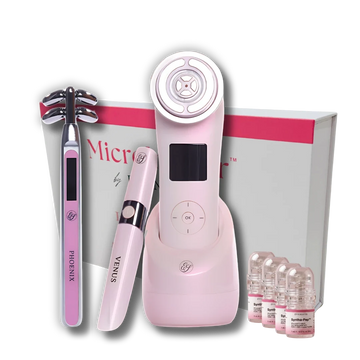
Illustrative still life, not our product.
The short answer
At a glance
Microinfusion pairs short needles with a serum in one step. A stamp opens temporary channels in the skin and the serum goes on in the same motion. With our kit, a sealed ampoule clicks onto a single-use needle head.1
0.5 mm is a needle length, not a delivery depth. Imaging in volunteers found channels markedly smaller than the needles that made them.2 Nobody, including us, has measured where a serum goes.
The evidence is early. Microneedle delivery is well studied in the lab, and one small study without a control group paired home microneedling with a growth factor serum.3,4 We found no published trial of a home microinfusion stamp, ours included.
The routine is every two weeks. One evening session of 5 to 10 minutes, never more often than every ten days.1,5
Some people should not use it at all. Recent isotretinoin, keloid scarring and active infection are on that list. Run through the five questions before you buy any kit.
Key takeaways
01Channels made by microneedles close within hours, up to 72 hours in the studies reviewed, while the repair underneath runs for about two weeks before remodeling takes over.3,6
02Needle length is not delivery depth. Skin compresses as needles go in, and needles pressed in by hand pierce less reliably than needles driven in by impact.2,7
03PDRN fragments run from 50 to 1,500 kilodaltons, at least 100 times the 500 dalton size that crosses intact skin, and a 2026 review judged topical PDRN likely to be less effective than injections.8,9,10
04The FDA has cleared certain microneedling devices for specific uses, but none for use with another product such as a serum.11 Our MicroInfuser is a cosmetic device, not a medical device and not FDA-cleared.1
05Clinics usually treat acne scars with 3 to 5 microneedling sessions, 2 to 4 weeks apart.12 A home kit is a gentler, longer routine for the look of skin, not a cheaper clinic.
The 0.5 mm needle: what the number means and what it does not
Our MicroInfuser’s head carries needles of 0.5 mm nominal length, fixed at the head, 24 karat gold-plated, single use and individually gamma-sterilised.1 Nominal means the length of the needle as made. It is not how far the needle travels into your skin, and it is not where the serum ends up.
The research shows why those are different numbers. When researchers imaged microneedle insertion in volunteers with optical coherence tomography, the skin compressed as the needles went in, the channels collapsed once the device came off, and for every device studied the channels were markedly smaller than the needles.2
How the needles go in matters too. In tests on skin donated after cosmetic surgery, arrays from 200 to 475 micrometres reached close to full penetration when driven in by impact, against about 80 percent when pressed in, and the shortest array needed more than 25 newtons to pierce the skin at half its needle sites.7 A home stamp is pressed, not fired.
What a fixed length does do. It takes one variable out of your hands. Our safety page explains that fixed-length needles narrow the technique risks of variable-depth devices, such as over-penetration, uneven channels and deep pigment injury, and that they do nothing for the medical reasons not to needle at all.5
So treat any delivery depth quoted in microns, by anyone, as unmeasured. Judge a kit by what can be checked: the needle length, whether it is fixed, and how the head is sterilised.
The category map: four kinds of at-home needling
Home needling products differ on two things: who controls the needles, and how the serum gets to the skin. Read the table as a map, not a ranking.
Kind
Needle control
How the serum arrives
Heads
Where it fits
Serum alone
No needles
On the surface
None
Daily care; large molecules mostly stay at the surface.9
Derma roller
Varies with pressure and angle
Applied before or after
Often reusable
Depth and hygiene depend on you.
Clinic microneedling pen
Adjustable, set by a practitioner
Applied by the clinic
Single-use cartridges
Acne scars and deeper concerns, usually 3 to 5 sessions.12
Microinfusion stamp
Fixed at the head
Delivered as you stamp
Single use
Home care for the look of skin, every two weeks.
The microinfusion stamp is the only home format that fixes the needle length and puts the serum on in the same motion. That is a design difference, not proof of better results; the evidence section below says what is and is not known.
Why microneedling rules don’t transfer to microinfusion
Frequency. Clinic schedules are built for clinic treatments. The American Academy of Dermatology says acne scar treatment with microneedling is usually 3 to 5 treatments, every 2 to 4 weeks.12 Our kit’s schedule, every two weeks and never more often than every ten days, is our instruction as the manufacturer, not a figure from a trial.1,5 No study we found compared different intervals for home microinfusion, ours included.
Reuse. A clinic cartridge and a home head have the same rule: one use. Home sterilising cannot match gamma sterilisation, and reusing a head raises the risk of infection and blunts the tips.5
Needle count. More needles on a head cover more skin per stamp. They do not go deeper. Our reading of the insertion research is that more points share the same hand pressure, which if anything makes each one less likely to pierce fully.7
Pressure. With a fixed head, pressing harder adds discomfort and redness, not length. Firm, even contact is the goal.
Under the skin: channels and the repair that follows
A stamp opens temporary channels through the outer barrier. In the microneedle studies reviewed by Nguyen and Nguyen, reported closure ranged from a few hours to 72 hours, and in one measured patch the pores were essentially closed by six hours.3 The channels close fast. The repair underneath takes longer.
A 2016 review of wound healing describes overlapping phases: inflammation in the first days, a proliferative phase that can run to about day 14, and remodeling that starts at two to three weeks and can go on for a year or more.6 A microinfusion session is a very small injury, but those phases are why we space sessions two weeks apart.
Fig. 1 | A two-week gap places the next session after the proliferative phase of the last. Phase timings are for skin wounds in general, and the phases overlap;6 channel closure comes from a review of microneedle studies, where the dark gold mark is one patch measured closed by about six hours and the light bar the reported range up to 72 hours.3 Session markers follow our kit’s instructions. Drawn by us; the alignment is our inference, not a measured result.
Age changes the pace, not the destination. A review of ageing and wound healing found that healing in older people is delayed, though the final result is similar to that in younger people.13 After menopause, lower estrogen is linked with thinner skin that has less collagen, reduced elasticity, more wrinkling and dryness.14
Why the needle step exists at all. A compound generally has to weigh under 500 daltons to be absorbed through intact skin.9 PDRN fragments run from 50 to 1,500 kilodaltons.8 The PDRN raw material in our serum averages 31 kilodaltons, as measured and published in our Transparency Lab, which is about 62 times that threshold by our arithmetic. Our serum declares PDRN at 2,000 ppm, which is 0.2 percent.1
The evidence, graded
Here is what this guide relies on, what each source shows, and how much weight we give it.
Study without a control group: 11 women aged 33 to 61, a growth factor serum twice daily and a 0.2 mm home microneedling device twice weekly, for 3 months
Texture, wrinkles, red areas and brown spots improved on imaging, wrinkles by 17.3%; no serious adverse effects
We do not quote results from it; what is on record is in our Transparency Lab
Not graded
Review: summarizes other studies. Mechanistic: shows how needles and skin behave, not what a kit does to the look of skin. Early: no control group, so change cannot be separated from time, routine or expectation.
The gap is plain: we found no published, controlled trial of any home microinfusion stamp with its serum. The closest human study used a different device on a different schedule, and the serum was applied separately rather than through the needles.4
What a session is like
A full-face session takes about 5 to 10 minutes. Each one uses a fresh needle head and a fresh sealed ampoule, and with our kit the serum never touches open air, fingers or a refillable chamber.1
During and after, expect mild warmth or a faint tingling, a slightly tacky feel as the serum settles, and a light pink or red flush that lasts one to four hours.5 Our safety page says most people see a hydrated glow by the next morning.
Where not to stamp. Avoid raised scars, moles and skin tags, and stay off the eyelids, the under-eye hollow and the lips. For the under-eye area, pat leftover serum along the orbital bone with clean fingertips instead.5
After the session. A used head is a sharp. Put it in a rigid container with a screw cap and take it to a sharps drop-off, not the household bin.5 Our step-by-step guide to using the MicroInfuser shows the stamping pattern.
The deciding factor: delivery, not depth
This section is our reasoning, labeled so you can see where the evidence stops.
Fact, from the cited sources. Needle length is not delivery depth.2 Large actives do not cross intact skin.8,9 Microneedle channels start closing within hours.3
Our inference. What a home user can actually control is threefold: that the serum is on the skin while the channels are open, that it reaches the needles uncontaminated, and what the serum contains. That is why we built our kit as a sealed ampoule on a single-use head that applies the serum as you stamp. The inference is ours, not the cited authors’.
Our hypothesis. A sealed, same-motion system leaves more of a large active in the skin than applying the same serum after stamping, because the channels begin closing at once. Nobody has tested that, including us. What would prove us wrong: a study measuring uptake of the same active, applied both ways, on matched skin.
Four reader profiles
Early thirties, thinking about prevention
Every two weeks if you use a kit. We found no evidence that starting young changes how skin ages, and daily sunscreen will do more for you than any device.
Forties, skin looking tired
Every two weeks. If redness or sensitivity starts to last longer than it used to, take a longer gap, not a shorter one.
Fifties and beyond
Every two weeks, and patience. Older skin repairs more slowly but reaches a similar result.13 Judge over at least one full kit, about two months.
Weighing a clinic instead
If your goal is deep acne scars, real laxity or a lift, start with the clinic section. A home kit is not built for those jobs.
How kits compare in 2026
Most home kits look alike on the box: short gold-plated needles, a serum and a four-session pack. Seven questions separate them, and the answers should all be on the product page. The checker below works on any kit, ours included. For a side-by-side of named kits, see our five-kit comparison.
Does this kit pass the basics?
Answer each question from the kit’s own product page. The check runs in your browser; nothing is stored or sent anywhere.
Answer the seven questions to see how a kit measures up.
Our own kit meets six of the seven. It has no published clinical study, and we say so on its product page.1 Price is the other honest difference between kits; work it out per session, not per box.
The numbers that matter
Number
What it is
Source
0.5 mm
Nominal needle length, fixed at the head; not a delivery depth
One session, then thirteen days of ordinary skincare with a few rules. Every timing below comes from our safety page and product page.1,5
When
What to do
Earlier the same day
If you use radiofrequency, ultrasound, EMS or microcurrent, do it before the session as a warm-up, never after.
Day 1, evening
One session of 5 to 10 minutes with a fresh head and ampoule. Do not wash your face for the rest of the evening.
Days 1 and 2
Skip makeup, sweat, pools, saunas and hot showers. A light pink flush for one to four hours is normal.
From hour 24
Red or near-infrared LED can resume. Radiofrequency, ultrasound, EMS and microcurrent wait at least 24 hours; our product page says never to run radiofrequency on freshly treated skin, so if in doubt, wait 48.
About 48 to 72 hours around the session
Pause retinoids, AHAs, BHAs and vitamin C.
Every morning
Broad-spectrum SPF 30 or higher while you are treating.
Days 4 to 13
Your usual routine.
Day 15
Next session, two weeks after the last; never sooner than ten days.
Stop and contact a healthcare provider if redness lasts more than 48 hours, swelling increases rather than decreases, or you notice warmth, pus or fever.5
Illustrative still life.
To put the dates in your calendar, use the session planner in our guide to how often to microinfuse. It exports every session as a calendar file.
The recommendation, in one paragraph
If your goal is the look of hydrated, smoother skin over months, and none of the reasons not to needle apply to you, a sealed, single-use microinfusion kit used every two weeks is a reasonable home routine. If your goal is a lift, deep scars or real laxity, see a clinic. We make the MicroInfuser, so weigh our recommendation with that in mind; the checker above works on any kit.
Our recommendation, and yes, it includes our own kit. The reasoning is above so you can disagree with it.
The look of hydration and fine lines, with patience: a sealed, single-use microinfusion kit, one session every two weeks.
Deep acne scars or real laxity: a clinic consultation.
Any of the reasons not to needle: no kit at all.
A kit that quotes a delivery depth or FDA clearance for its serum: leave it on the shelf.
Our pick for a two-week routine, and yes, we make it
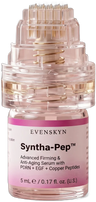
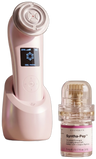
EvenSkyn MicroInfuser with Syntha-Pep PDRN serum
Four sealed sessions, one every two weeks.
How it deliversA sterile 0.5 mm head clicks onto a sealed 5 mL ampoule, and the serum goes on as you stamp. Needle length is not delivery depth, and we quote no depth.
What it carriesBiosynthetic PDRN at 0.2 percent with EGF, copper tripeptide-1, hyaluronic acid and niacinamide. The full ingredient list is published.
How oftenOne evening session every two weeks, never more often than every ten days.
StatusA cosmetic device for the look of skin, not a medical device and not FDA-cleared.
$179.98
Four treatments, about two months at one session every two weeks. 60-day money-back guarantee on unused treatments, for US and Canada residents.
What it will not do: deliver clinic microneedling results, treat scars or any skin condition, or work faster if you use it more often. It contains an essential oil, so read the full list if you have known allergies.
What to expect, week by week
These checkpoints are our suggestion, built from the biology above and our own product page, not from a trial of our kit.
The next morning. Our safety page says most people see a hydrated glow.5 That is early hydration, not the result to judge.
Weeks two and three. In wound research, remodeling begins around now and can continue for a year or more.6 Nothing dramatic should show yet.
After one kit, about two months. The first fair checkpoint. Compare photos taken in the same light, at the same distance, before session one and after session four.
Three months and beyond. The one home study that paired microneedling with a serum ran for three months.4 Change is gradual, so decide whether to continue at this point, not before.
Before you buy: five questions to ask yourself
1. Have you taken oral isotretinoin in the past six months? If yes, wait. Our kit sets a six-month rule for unsupervised home use.5
2. Do you, or does your family, have a history of keloid or raised scarring? If yes, do not use a microinfusion kit.1,5
3. Is the skin infected, broken or inflamed, or has it had a peel, laser treatment or sunburn in the past seven days? If yes, wait until it has fully settled. Never stamp over a cold sore or an active breakout.5
4. Are you pregnant or breastfeeding, on blood thinners or immunosuppressants, or managing uncontrolled diabetes or an autoimmune flare? Speak to your doctor first. Our product page says the system is not suitable during pregnancy or breastfeeding.1,5
5. Do you have rosacea, well-controlled eczema or psoriasis, melasma, or a history of dark marks after inflammation? Do an extended 24 to 48 hour patch test and stop at the first unusual reaction. With darker skin tones, wear daily SPF, watch for early pigment change and start conservatively.5
And read the ingredient list if you have known allergies, because the serum goes on while the skin is open. The PDRN in our serum is biosynthetic and not derived from salmon, and its soluble collagen is made by yeast fermentation, both per written supplier declarations.1 That is not a statement that the serum is safe for anyone with a fish or shellfish allergy: we hold no allergen testing on the finished formula.5
When to skip it entirely
Do not use a home microinfusion kit if any of these apply: oral isotretinoin now or within six months; a personal or family history of keloid or hypertrophic scarring; an active skin infection or cold sore in the area; open wounds or broken skin; or a peel, laser treatment or significant sunburn in the past seven days.5
Skip it too if what you want is something it cannot do. It is not intended to treat any skin condition,1 and it is not built to lift sagging skin or remodel deep scars. A fixed needle length makes technique safer; it does not make the reasons above go away.5
When a clinic is the better route
Acne scars. The American Academy of Dermatology describes clinic microneedling for acne scars as usually 3 to 5 treatments, every 2 to 4 weeks.12 That is a medical treatment with a clinician setting the device.
Devices cleared for a use. The FDA has cleared certain microneedling devices for specific uses, but none for use with another product such as a serum.11 A clinic can tell you which device it uses and for what.
Laxity and lift. For loosening skin, a clinician can assess options such as radiofrequency microneedling or focused ultrasound. Our guides to radiofrequency microneedling and home skin tightening explain what each can and cannot do.
Six months, planned
At one session every two weeks, six months is twelve sessions. With four sessions to a kit, that is three kits.1
At today’s list price, one kit is $179.98, so a session costs 45.00 USD and three kits come to 539.94 USD before any offer. Offers change, and the product page shows the price on the day.
Twelve sessions is also twelve evenings, each followed by a day or two of the aftercare rules above. If that rhythm does not fit your life, a good serum and daily sunscreen are the better plan.
Three mistakes, three myths
Mistake one: pressing harder to go deeper
The needle length is fixed, and pressed needles pierce less reliably than impact-driven ones anyway.7 Extra force adds discomfort and redness, not depth beyond the needle. Firm, even contact is enough.
Mistake two: skipping the aftercare window
Retinoids, acids, heat and sweat in the first day or two are the commonest ways to turn a light flush into lasting irritation. Follow the timings in the 14-day cycle.5
Mistake three: judging month one against glossy photos
The morning-after glow is hydration. Our product page describes results over a course of consistent sessions, not one evening.1 Compare your own photos, in the same light, at three months.
Myth one: more sessions mean faster results
Our safety page is direct: more frequent stamping does not improve results at 0.5 mm and can compromise the barrier.5 No study we found tested a faster schedule.
Myth two: a home kit replaces clinic treatment
It does a different job. Clinic microneedling for scars is a medical treatment on a clinician’s schedule.12
Myth three: the serum is injected into the skin
The needles make channels and the serum is on the skin while they are open. Where it goes from there has not been measured, and the channels are smaller than the needles.2
The case against our recommendation
The strongest case is simple. No published, controlled trial has tested a home microinfusion stamp with its serum, ours included. The evidence is lab work, imaging and one small uncontrolled study of a different routine.4 Our own study is unpublished, so it counts for nothing here. A good moisturizer and daily sunscreen cost less and help everyone. And a session from a kit costs far more than the same evening with a serum alone.
What would change this view
A controlled trial of a home microinfusion kit against the same serum applied without needles, measured over at least three months. Independent measurement of how far a serum travels from a stamp. Any study comparing two-week and longer intervals. If those come back against us, this guide will change.
Frequently asked questions
What is microinfusion, and how is it different from microneedling?
Microinfusion is a form of microneedling that applies a serum in the same motion as the needles. A stamp with very short needles opens temporary channels, and the serum goes on while they are open. Microneedling is the broader term, and in clinics it usually means an adjustable pen with the serum applied separately.
Is at-home microinfusion with a 0.5 mm needle safe?
Most healthy adults can use it when they follow the instructions, according to our safety page. It is not for anyone who has taken isotretinoin in the past six months, has a history of keloid scarring, or has an active infection or broken skin in the area. Expect a light pink flush for one to four hours. Redness that lasts more than 48 hours is a reason to stop and see a healthcare provider.
How often should I use a microinfusion device?
Our kit is used once every two weeks, in the evening, and never more often than every ten days. More frequent sessions do not improve results and can irritate the skin.
When will I see results from at-home microinfusion?
A hydrated glow often shows the next morning; that is hydration, not lasting change. Judge after one kit at the earliest, and ideally after three months of steady sessions.
Can I use microinfusion if I take blood thinners?
Speak to your prescribing doctor first. Blood thinners can increase bruising and pinpoint bleeding, even with a short fixed needle.
Can I use it while pregnant or breastfeeding?
Our product page says the system is not suitable during pregnancy or breastfeeding. Wait, and speak to your doctor before restarting.
Can I use microinfusion under my eyes?
Do not stamp the eyelids or the under-eye hollow. Pat leftover serum along the orbital bone with clean fingertips instead.
Can I combine microinfusion with radiofrequency or red light?
Yes, with timing. Use radiofrequency, ultrasound, EMS or microcurrent before a session as a warm-up, never on freshly treated skin, and wait at least 24 hours after a session before using them again. Red light can resume from 24 hours.
Can I reuse a needle head?
No. Heads are single use. Home cleaning cannot match factory sterilisation, and reuse raises the risk of infection and blunts the needles.
Is the MicroInfuser FDA-cleared?
No. It is a cosmetic device, not a medical device and not FDA-cleared. The FDA has cleared certain microneedling devices for specific uses, but none for use with a serum, so be wary of any kit that claims otherwise.
How we built this guide
On 15 November 2026 we checked each study against its Crossref, Semantic Scholar or Europe PMC record, and read our own MicroInfuser product page and safety page for every product fact and timing. Where a source did not state something, we say so rather than fill it in. The figure is drawn by us from the cited papers, and the photographs are illustrations, not product photographs. This version replaces an earlier one at the same address. It drops a reviewer attribution, competitor comparisons and references we could not verify today.
Conflicts: we make the EvenSkyn MicroInfuser and the Syntha-Pep serum recommended here. No clinician reviewed this version. General information, not medical advice: speak to a doctor before needling if you are pregnant, take blood thinners or have a skin condition.
Further reading from the EvenSkyn Skin Science Desk
EvenSkyn. EvenSkyn MicroInfuser with Syntha-Pep PDRN serum, product page: specifications, schedule, regulatory status and source declarations. Read 15 November 2026. evenskyn.com
Coulman SA, Birchall JC, Alex A, Pearton M, Hofer B, O’Mahony C, Drexler W, Považay B. In vivo, in situ imaging of microneedle insertion into the skin of human volunteers using optical coherence tomography. Pharmaceutical Research. 2011;28(1):66-81. doi:10.1007/s11095-010-0167-x
Quinlan DJ, Ghanem AM, Hassan H. Topical growth factors and home-based microneedling for facial skin rejuvenation. Journal of Cosmetic Dermatology. 2022;21(8):3469-3478. doi:10.1111/jocd.14650
EvenSkyn. Micro-infusion contraindications and safety: who should not use an at-home device. Last updated 4 September 2026; read 15 November 2026. evenskyn.com
Gonzalez ACO, Costa TF, Andrade ZA, Medrado ARAP. Wound healing - A literature review. Anais Brasileiros de Dermatologia. 2016;91:614-620. doi:10.1590/abd1806-4841.20164741
Leone M, Van Oorschot BH, Nejadnik MR, Bocchino A, Rosato M, Kersten G, O’Mahony C, Bouwstra J, Van der Maaden K. Universal applicator for digitally-controlled pressing force and impact velocity insertion of microneedles into skin. Pharmaceutics. 2018;10(4):211. doi:10.3390/pharmaceutics10040211
Squadrito F, Bitto A, Irrera N, Pizzino G, Pallio G, Minutoli L, Altavilla D. Pharmacological activity and clinical use of PDRN. Frontiers in Pharmacology. 2017;8:224. doi:10.3389/fphar.2017.00224
Bos JD, Meinardi MMHM. The 500 Dalton rule for the skin penetration of chemical compounds and drugs. Experimental Dermatology. 2000;9(3):165-169. doi:10.1034/j.1600-0625.2000.009003165.x
Arora G. Polynucleotides and polydeoxyribonucleotides in dermatology: a narrative review. Journal of Cutaneous and Aesthetic Surgery. 2026;19(1):17-28. doi:10.25259/JCAS_65_2025
US Food and Drug Administration. Microneedling devices: getting to the point on benefits, risks and safety. Consumer update, content current as of 15 October 2025. fda.gov
American Academy of Dermatology Association. Microneedling can fade scars, uneven skin tone, and more. aad.org
Gosain A, DiPietro LA. Aging and wound healing. World Journal of Surgery. 2004;28:321-326. doi:10.1007/s00268-003-7397-6
Thornton MJ. Estrogens and aging skin. Dermato-Endocrinology. 2013;5(2):264-270. doi:10.4161/derm.23872
*No purchase necessary. Void where prohibited. Ages 18+. Open worldwide, with a few exceptions. Three prizes, total approximate value US$2,309.91. Closes December 25, 2026 at 3:00 PM ET. Odds depend on the number of eligible entries. Canadian winners must answer a skill-testing question. Official rules
Nine brands, one shared depth ceiling, and a set of differences that sit in the hygiene design rather than the marketing. We compare Seranova, Qure, Glov and the EvenSkyn MicroInfuser on single-use...
No radiofrequency microneedling device is meant for home use, and the FDA says so in writing. What you can do at home instead, twelve products ranked on what each one publishes, and...
How to use PDRN at home, step by step: as a daily serum on intact skin, or through a sealed micro-infusion kit every two weeks, with the two-week schedule, what can go...
Leave a comment
All comments are moderated before being published.






Leave a comment
All comments are moderated before being published.
This site is protected by hCaptcha and the hCaptcha Privacy Policy and Terms of Service apply.