

PDRN Microneedling: What It Costs at Home and in Clinic
Cost and depth, compared
Clinic sessions were listed between $225.00 and $295.55 on 23 August 2026, with a course of three at $1,308.15. An at-home micro-infusion kit is $119.99. That gap is mostly a depth gap and a supervision gap, not a discount, and this page shows the working.
What you are choosing between
PDRN microneedling means pairing a needle-based device with a PDRN serum so the serum travels through the channels the needles make. It is the same basic idea whether a clinic does it or you do it yourself, and it exists because of a delivery problem. PDRN is far larger than the rough 500 Dalton ceiling for passive skin penetration[1], and the tissue it acts on sits in the dermis[2]. Rubbing it on the surface is not obviously enough. The channel is the delivery route.
Where the clinic route and the at-home route separate is depth, who holds the device, and price. A practitioner sets depth to the face in front of them on a professional device. An at-home stamp like ours has a fixed 0.5 mm mechanical stop and cannot be set deeper. Those are different treatments and we are not going to pretend otherwise.
What each route costs
| Route | Listed price | What the price covers |
|---|---|---|
| Clinic session, single | $225.00 to $295.55 | One appointment. $225.00 listed by regainmedspa.com, $295.55 by Olympus Cirugia Plastica. |
| Clinic course of three | $1,308.15 | Full face and neck, package of three, listed by Euro Laser Services. A course is what practitioners generally recommend. |
| PDRN ampoule alone | $99.00 to $129.00 | Serum only, sold for use with a pen you already own. No device. |
| Microneedling pen alone | $269.10 | Device only. No PDRN serum. |
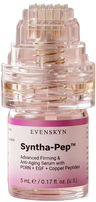
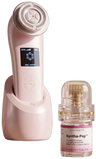
| EvenSkyn MicroInfuser kit | $119.99 | Device and Syntha-Pep PDRN serum together, 0.5 mm fixed stop, sealed single-use ampoules. |
Competitor prices read from Google Shopping listings for the United States on 23 August 2026. Ours is our published price. Listings change and promotions come and go, so check them yourself before relying on any figure here.
What the price difference is actually buying
It is tempting to line up $119.99 against $1,308.15 and call the at-home route an eleven to one saving. That is the wrong reading. The gap is mostly a depth gap and a supervision gap.
A practitioner works deeper than a fixed 0.5 mm stop allows, adjusts to the skin in front of them, and carries the training to decide when not to treat at all. None of that is in a box. What the at-home kit buys instead is frequency and privacy at a price that does not require a course commitment, with a depth ceiling that is set for you and cannot be exceeded. For some people that fixed ceiling is the feature rather than the limitation.
The claim we will not make. Nobody has published a measurement of PDRN delivery through a microchannel at any depth, in clinic or at home, and nobody has run a controlled trial of PDRN microneedling against microneedling alone. An outcome comparison between the two routes would be invention. What this page compares is cost, depth and supervision, which are things that can actually be checked.
Which route fits which situation
| If this is you | Route | Why |
|---|---|---|
| Treating scarring, deep textural damage, or anything you would call a medical concern | Clinic | Depth and clinical judgement are the whole point. An at-home device is the wrong instrument and we would rather say so than sell past it. |
| You want the deepest result available and the budget is there | Clinic | A course of three at $1,308.15 buys practitioner-set depth that a fixed stop cannot reach. |
| You want a maintained routine rather than a course, at a fixed depth you cannot exceed | At home | $119.99 once, used on your own schedule, with the depth ceiling decided by the hardware rather than by you. |
| You already own a pen and only want the serum | Ampoule only | $99.00 to $129.00 buys the serum alone. Check what your pen is actually rated for first. |
| You are pregnant, breastfeeding, on isotretinoin, or have active skin infection | Neither | These are standard contraindications for needle-based treatment. Ask a clinician, not a product page. |
Where our kit sits, stated plainly
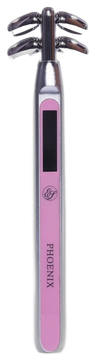
We make the EvenSkyn MicroInfuser, an at-home micro-infusion system with a 0.5 mm stamp, a fixed mechanical stop, and a Syntha-Pep PDRN serum delivered from a sealed single-use ampoule through the channels in the same motion that creates them.
The honest case for it is a chain of published evidence, not an outcome claim: PDRN's targets are in the dermis[2], PDRN is far too large to be expected to cross intact stratum corneum[1], and polynucleotides are in active clinical use by injection for exactly the tissue effects people want[3]. A delivery route is needed. Ours is one.
The honest limits are equally clear. Nobody has measured PDRN delivery through a microchannel, including us. This is a cosmetic device, not a medical one. And it does not reach the depth a practitioner works at, which is the thing the clinic price is buying. The full evidence review, including the studies that cut against us, is on our PDRN absorption page. If you are comparing kits rather than routes, that is the micro-infusion buyer's guide.
One sourcing fact belongs here because almost every kit in this category leaves it out: supplier documentation reviewed in August 2026 records the PDRN in Syntha-Pep as biosynthetic and not derived from salmon. Every competitor kit we have found that discloses a source uses salmon-derived PDRN. On current evidence the molecule behaves the same either way, so read this as a known, controlled origin, not as a performance claim. The same documentation records the Soluble Collagen as produced by yeast fermentation rather than extracted from animal sources. Those declarations cover those two ingredients only, and EvenSkyn makes no vegan claim because no formula-level attestation is on file. Correction, 4 September 2026: earlier versions of this page described the collagen as marine-derived and advised against use with a fish or shellfish allergy on that basis. That premise is not what the documents say. This is not a statement that the serum is safe for anyone with a fish or shellfish allergy: we hold no allergen testing on the finished formula, and the full ingredient declaration is published so you can read it and speak to a doctor before a first session. The source table for the whole category is on the PDRN absorption page linked above.
Questions people ask
How much is PDRN microneedling?
In a clinic it is priced per session. Listings on Google Shopping for the United States on 23 August 2026 showed a single Vamp/PDRN microneedling session at $225.00 from regainmedspa.com, microneedling with PDRN at $295.55 from Olympus Cirugia Plastica, and a package of three full face and neck sessions at $1,308.15 from Euro Laser Services. Practitioners usually recommend a course rather than one visit, so the realistic figure is the course price. Professional PDRN ampoules sold for use with a pen you already own were listed at $99.00 and $129.00, and a microneedling pen on its own at $269.10.
Is PDRN microneedling better than PDRN injections?
They are not the same treatment and nobody has run the head to head study that would settle it. Injection places PDRN directly at depth and is the route almost all of the published clinical work used. Microneedling creates temporary channels and relies on the serum travelling through them, which is a less direct route. The published outcomes people cite for PDRN come from injected PDRN in medical settings, and those results do not transfer to a topical product applied through channels, whether that happens in a clinic or at home.
Can you do PDRN microneedling at home?
You can use an at-home micro-infusion device with a PDRN serum. It is not the same procedure a clinic performs. A clinic uses a practitioner-set depth on a professional device. An at-home stamp like ours has a fixed 0.5 mm mechanical stop that cannot be adjusted. Published measurement puts a needle of roughly half a millimetre at a channel around 160 micrometres deep, which clears the stratum corneum and the viable epidermis. That is a real delivery route and it is a shallower one than a clinic works at.
Does PDRN microneedling actually work?
The mechanism is reasonable and the outcome evidence for this specific combination does not exist. PDRN is far larger than the rough 500 Dalton limit for passive skin penetration and its targets sit in the dermis, so a delivery route is needed. Microchannels do measurably increase delivery of large molecules. What nobody has published, including us, is a measurement of PDRN delivery through a microchannel, or a controlled trial of PDRN microneedling against microneedling alone. Anyone telling you the combination is proven is going beyond the evidence.
What is the difference between PDRN microneedling and micro-infusion?
Microneedling makes channels and the serum is applied to the surface before or after, so it has to find its way in. Micro-infusion delivers the serum through the needles in the same motion that creates the channels, from a sealed ampoule. The practical difference is that micro-infusion does not leave an open channel sitting exposed while you apply something to it, and the dose is contained rather than spread on the skin. Both are needle-based delivery. The distinction is when the serum arrives.
How often can you do PDRN microneedling?
Clinic courses are typically spaced by weeks because the depth worked at needs recovery time. At-home 0.5 mm stamping is shallower and is generally used more often, but frequency should still be set by how your skin actually responds rather than by a schedule. Channels close after use, and treating again before the skin has settled gives you irritation rather than a better result. If you are unsure, less often is the safer error.
References
- Bos JD, Meinardi MM. The 500 Dalton rule for the skin penetration of chemical compounds and drugs. Exp Dermatol. 2000;9(3):165-9. PubMed
- Squadrito F, Bitto A, Irrera N, Pizzino G, Pallio G, Minutoli L, Altavilla D. Pharmacological Activity and Clinical Use of PDRN. Front Pharmacol. 2017;8:224. PubMed
- Lee KWA, Chan LKW, Hung LC, et al. Polynucleotides in Aesthetic Medicine: A Review of Current Practices. J Cosmet Dermatol. 2024. PubMed
This page is maintained by the EvenSkyn research team. It carries no clinician byline because no clinician has reviewed it. Prices were read on 23 August 2026. Last updated 18 September 2026.